Are Olympic Medals Real Gold?

Olympic medals are real gold in the sense that they contain genuine gold, but they are not made entirely of solid gold. Modern Olympic gold medals are primarily composed of silver and are plated with a thin layer of pure gold.
Key Takeaways
- Gold Medal Composition: Modern Olympic gold medals are made of at least 92.5% silver and plated with approximately 6 grams of pure gold.
- Historical Context: The last Olympic gold medals made entirely of solid gold were awarded in 1912.
- Silver and Bronze Medals: Silver medals are made of pure silver, while bronze medals are composed of a copper alloy.
- 2024 Paris Olympics Design: The Paris 2024 medals incorporate iron from the original Eiffel Tower, embedded in the centre as a hexagon, symbolising France.
- Medal Value: The material value of an Olympic gold medal is approximately £715, based on current market prices for gold and silver.
If you’ve ever watched Olympic champions bite down on their medals, you might wonder – are Olympic medals real gold? It’s a fascinating question that gets to the heart of what these coveted prizes are really made of. In this article, we’ll explore the true composition of Olympic gold medals, dispel common myths, and answer all the burning questions: What are Olympic gold medals made of? How much are they worth? How much gold do they actually contain? How heavy are they? Let’s dive in.
Are Olympic Medals Real Gold?
Are Olympic medals real gold? The short answer is both yes and no. Olympic “gold” medals do contain real gold, but they are not made of solid gold. In fact, modern Olympic gold medals are mostly made of silver with a thin layer of gold on the outside. The gold coating is genuine – typically about 6 grams of pure gold – but beneath that shiny exterior is sterling silver (at least 92.5% pure silver). So while Olympic medals aren’t solid gold, they are certainly real gold-plated medals.
This might surprise some people. Historically, there was a time when Olympic gold medals were actually solid gold. The last Olympic gold medals made entirely of gold were awarded in 1912 at the Stockholm Games. Those 1912 medals were smaller – only about 33 mm across and weighing 24 grams – but they were 100% pure gold. After 1912, the increasing cost of gold and the onset of global wars led the International Olympic Committee (IOC) to switch to gilded silver medals. Since then, every Olympic gold medal has been a silver medal plated with real gold. The iconic tradition of athletes biting their medals is a fun photo op, but if the medals were pure gold (a very soft metal), they would actually dent easily! Today’s winners can rest assured their medal won’t bend between their teeth – it’s mostly silver underneath that gold plating.
Fun fact: The idea of gold, silver, and bronze medals for 1st, 2nd, and 3rd place began in 1904. In the 1896 Athens Olympics (the first modern Games), winners got silver and runners-up bronze. By 1904, gold medals were introduced – and for a few Olympics (1904, 1908, 1912) those were true solid gold medals. But for over a century now, Olympic gold medals have been real gold-plated silver, not pure gold. So when someone asks “Are Olympic medals real gold?”, you can explain that the gold part is real, but the medal as a whole isn’t 100% gold.
What Are Olympic Gold Medals Made Of?
So, what are Olympic gold medals made of? Let’s break down the materials and composition of these famous awards. According to IOC specifications, each Olympic gold medal must contain a minimum of 92.5% silver (essentially sterling silver) and at least 6 grams of pure gold plating. In practical terms, an Olympic gold medal is a large silver medal coated with a layer of gold. Here’s the typical composition of Olympic medals:
- Gold Medal (1st place): Mostly silver (92.5% purity) with about 6 grams of pure gold plated on the surface. The gold is enough to give the medal its golden shine but is only a tiny percentage of the total weight.
- Silver Medal (2nd place): Entirely silver (92.5% purity sterling silver) with no gold plating.
- Bronze Medal (3rd place): Bronze alloy, usually mostly copper mixed with tin and sometimes zinc. (For example, recent bronze medals are about 95% copper with tin and zinc making up the rest.)
In other words, Olympic “gold” medals are really silver-gilt medals – silver covered in gold. The silver content gives the medal heft and durability, while the gold layer gives it the prestigious appearance of a gold medal. Many people are shocked to learn the truth of what Olympic gold medals are made of. It’s a common myth that they are pure gold, but in reality the gold medal’s core is silver. Only about 1.2% of an Olympic gold medal’s weight is gold, the remaining ~98% is silver (and a bit of copper).
Why not make them solid gold? One reason is practicality and cost. A solid gold medal would be extremely expensive – hosts would spend millions just on the medals, and athletes might be tempted to melt them down for cash. By using silver gilt, the IOC ensures the medals have a manageable cost while still containing real gold for symbolism. In fact, the IOC has stuck with this composition to deter scrappers and preserve the medal’s symbolic value. The value of an Olympic medal is meant to be more symbolic than material – it represents the athlete’s triumph, not just precious metal.
Another interesting point is tradition. The Olympic ideals, as stated by Pierre de Coubertin (founder of the modern Games), emphasise that “the importance lies not in the triumph but in the struggle.” The gold medal’s worth comes from the achievement it symbolises, not the gold itself. By keeping gold medals as gold-plated silver, the Olympics subtly reinforce that message: it’s the honour that’s golden, even if the medal is mostly silver.
How Much Is An Olympic Gold Medal Worth?
From a fan’s perspective, an Olympic gold medal is priceless – it represents years of training and a moment of glory. But if you’re curious about the monetary value, you might ask: How much is an Olympic gold medal worth? The answer can be looked at in two ways: the intrinsic metal value (melt value) and the collector’s value.
-
Intrinsic Metal Value: Given the composition (around 6 g of gold and 500+ g of silver), the raw metals in a gold medal are worth far less than you might expect. Let’s do the math based on today’s prices. As of now, gold is roughly in the range of $70–$75 per gram and silver around $0.70–$1 per gram. That means 6 g of gold (6 × $75) is about $450, and 525 g of silver (about 16.9 troy ounces) might be around $400 (depending on silver’s price). In total, the melt value comes out to roughly $800–$900 USD (approximately £650–£750) for the metals in an Olympic gold medal. Indeed, one analysis during the Paris 2024 Olympics valued the gold medal’s metal content at about $831 (≈£654). Another estimate from Oxford Economics put it slightly higher, around $1,000 in value for the gold and silver combined. Fluctuations in gold and silver prices will cause these estimates to rise or fall over time. But generally, an Olympic gold medal is worth under $1,000 in raw metal.
Fun fact: If Olympic gold medals were solid gold, their melt value would be astronomical. At ~529 g weight, a pure gold medal would contain about 17 troy ounces of gold. At current prices, that would be on the order of $30,000–$40,000 (over £25,000) just in gold value! Clearly, it wouldn’t be practical to award dozens of those at each Olympics.
-
Collector’s Value: The true value of an Olympic gold medal often far exceeds the metal content because of its collectible and historic value. Olympic medals are rare and treasured trophies. Athletes nearly always keep them, but on the occasions when an Olympic gold medal is sold, it can fetch a high price. For example, medals auctioned for charity or from famous athletes have reached tens of thousands of dollars. Collectors are willing to pay a premium for the prestige – it’s not about the gold and silver, but the story behind it. According to reports, Olympic gold medals from past games have been auctioned for $20,000, $50,000, even over $100,000 depending on their history and the athlete. A Stockholm 1912 solid gold medal (being one of the last pure gold ones) is extraordinarily rare – one such medal was sold at auction for around $35,000.
In short, the medal’s melt value (~$800) is only a fraction of its worth to an athlete or collector. Most Olympians would say their gold medal is worth more than gold because of what it represents. And indeed, many winners would never sell their medal at any price. The value is in the victory, not the metals. (As a gold buyer at GoldSell, we know precious metals have value – but even we’d agree that an Olympic champion’s joy is priceless!)
How Much Gold Is In An Olympic Gold Medal?
Let’s get specific: How much gold is in an Olympic gold medal? Despite the name, there’s only a small amount of actual gold in a “gold” medal. Each modern Olympic gold medal contains approximately 6 grams of gold. This gold is used as a plating over the surface. Six grams might sound small (it’s about the weight of two pennies), but it’s enough to cover the large medal in a thin layer of pure gold. The rest of the medal – about 500 to 525 grams – is made up of silver (and a bit of copper to strengthen the silver).
To put it in perspective, 6 grams of gold is roughly 1.34% of the medal’s weight. The other 98+% is silver alloy. That’s why we say Olympic gold medals are mostly silver. The gold layer is just thick enough to meet the requirement and give the medal its golden appearance.
The International Olympic Committee mandates at least 6g of gold, but some host cities have added a tiny bit more for design reasons. Generally, it’s right around that amount. For example, the Tokyo 2020 and Paris 2024 gold medals each had about 6 grams of gold plating, adhering to the standard. No modern gold medal has significantly more than that, because it would be wasteful and expensive to add extra gold beyond what’s required.
Historically, when Olympic gold medals were solid gold (like in 1912 and earlier), they contained a lot more gold by definition – those were 24 grams of gold (100% of the medal). But those medals were much smaller in size. Today’s medals are larger but mostly silver, with just that smaller amount of real gold applied on the outside. So when you hold an Olympic gold medal, remember: only a thin coating – about the same weight as a few wedding rings – is pure gold.
What Are Olympic Gold Medals Made Of? (Myths vs. Reality)
At this point, it’s clear what Olympic gold medals are made of: high-purity silver with a gold overlay. However, it’s worth exploring a bit more and addressing some myths and variations. The phrase “gold medal” makes many assume it’s made entirely of gold, which is a persistent misconception. In reality, as we’ve confirmed, Olympic gold medals are made of silver and gold – not pure gold.
The composition of Olympic medals has actually been remarkably consistent for over a century. Since 1912, every host city has struck gold medals to the same basic standard: sterling silver base, plated with at least 6 grams of gold. The IOC requirements ensure this, and hosts typically follow them closely. There have been some creative touches over the years, but they don’t change the core metals:
- For example, at the 2016 Rio Olympics, the gold medals were 500g of silver with 6g of gold, and were lauded for being produced with sustainable methods (the gold was extracted without mercury, and some silver was recycled).
- The Tokyo 2020 Olympics took sustainability even further – all the gold, silver, and bronze for the medals were sourced from recycled electronic waste. Japan’s medal project collected old phones and gadgets, extracting around 70 pounds of gold, 7,700 pounds of silver, and 4,850 pounds of bronze from e-waste to make the 5,000+ Olympic and Paralympic medals. Importantly, even those “green” medals still contained 6g of gold plating on a silver core – only the source of the metals was different.
- Some Olympics incorporate local flavour: Beijing 2008 added a ring of white jade into each medal, Sochi 2014 included fragments of a meteorite in the medals, and Paris 2024 has pieces of the Eiffel Tower embedded in the medals. These design flourishes make the medals unique, but the primary materials (gold plating, silver, bronze) remain the same. For Paris 2024, the gold medal still has ~6 g of gold plating over silver, plus an 18 g piece of iron (from the Eiffel Tower) set in the middle.
Myth vs. Reality: A common myth is that Olympic committees might skimp on gold and use cheap metals. In reality, the IOC’s rules ensure a high standard of metal quality. The silver used is typically sterling silver (which is 92.5% pure silver), and the gold is 24-karat pure gold for plating. There’s nothing fake about the metals – they just aren’t all gold. In fact, a modern Olympic gold medal actually contains more silver than a silver medal (because it’s larger and heavier), plus the gold layer on top. The silver medal is a bit lighter but fully silver, and the bronze medal – while it might look “golden-bronze” in colour – contains no gold at all, just base metals.
So, what are Olympic gold medals made of? Simply put: silver, gold, and a lot of pride. They are gold-plated silver, a blend of precious metals that balance value and tradition. Knowing this reality doesn’t make them any less special – if anything, it adds to the appreciation of the craftsmanship. Each host city carefully mints these medals to be robust souvenirs of victory. They have to last generations without tarnishing (hence using high-purity metals). Next time you see that glint of an Olympic gold medal, you’ll know it’s genuine gold on the outside and very real silver inside – a worthy prize for a world-class achievement.
How Much Do Olympic Gold Medals Weigh?
Olympic medals have gotten larger and heavier over time, which leads to another question: How much do Olympic gold medals weigh? Modern Olympic gold medals are quite hefty – about 500 to 600 grams on average – which is well over a pound. The exact weight varies by each Olympic Games since the host country designs the medals. For recent Summer Olympics:
- Paris 2024: The gold medal weighs about 529 grams (18.7 ounces). All medals in Paris are 85 mm in diameter and 9.2 mm thick, making them among the largest ever. This weight includes the silver core, gold plating, and even an 18 g piece of Eiffel Tower iron in the medal’s centre.
- Tokyo 2020: Similar to Paris, the Tokyo gold medals weighed in the neighbourhood of 556 grams each (Tokyo’s were slightly thicker). They were also around 85 mm across. Tokyo’s medals were a touch heavier due to design, but roughly in the same half-kilo range.
- Rio 2016: The Rio gold medals were about 500 grams (17.6 ounces) each. In fact, Rio 2016 set a record at the time for the heaviest Summer Olympic medals ever, at half a kilogram. They were 85 mm diameter and about 10 mm thick in the centre.
- London 2012: The London gold medals weighed around 400 grams (14 ounces). London’s medals (85 mm diameter, ~7 mm thick) were notable for being the heaviest in Olympic history up to that point – significantly more massive than previous games. Each London gold medal was 412 g of metal, of which only 6 g was gold (1.34%).
- Beijing 2008: By contrast, Beijing’s gold medals were about 200 grams (6.6 ounces), much lighter than the later editions. They had a 70 mm diameter plus the jade ring.
- Earlier 20th Century: Gold medals used to be smaller and lighter. For example, the 1912 Stockholm gold medal weighed just 24 grams as mentioned (because it was solid gold and only 33 mm in size). As the decades went on, medal sizes increased. Mid-century Olympic gold medals might have weighed on the order of 50–150 grams, depending on the games.
From these examples, you can see a clear trend: Olympic gold medals have grown in size and weight, especially in the last few decades. The IOC stipulates a minimum diameter of about 60 mm and a minimum thickness (usually at least 3 mm), but host cities often exceed those minimums to make the medals feel substantial and impressive in hand. The result: today’s gold medal is a big, heavy disk – roughly the weight of a can of beans, as one reporter quipped.
To sum up, an Olympic gold medal typically weighs around 500 grams (about 1.1 pounds) in recent games. This weight comes mostly from the dense silver inside. Athletes often remark on how surprisingly heavy the medal feels when they put it around their neck! That weight is a tangible reminder of all the metal (and metaphorical weight of achievement) they’ve earned.
Historically, the weight can vary: some Winter Olympics medals have been even heavier or oddly shaped (Vancouver 2010 had large irregular medals ~576 g each), while some early Olympics were very light. But if you’re talking about current standards, expect a gold medal to be roughly half a kilo. That makes the Olympic gold medal one of the heaviest sports medals out there – far heavier than, say, a marathon finisher’s medal or a typical sports trophy medal.
Interesting note: Despite the heavy weight, athletes almost never complain – they’ve literally shouldered much harder burdens in pursuit of gold! The weight of an Olympic medal is a point of pride. In fact, design teams often test that the ribbon and clasp can handle the medal’s weight comfortably around an athlete’s neck. So when you see Olympians grinning on the podium, know that the hefty medal hanging from their neck is both a physical and symbolic weight of victory.
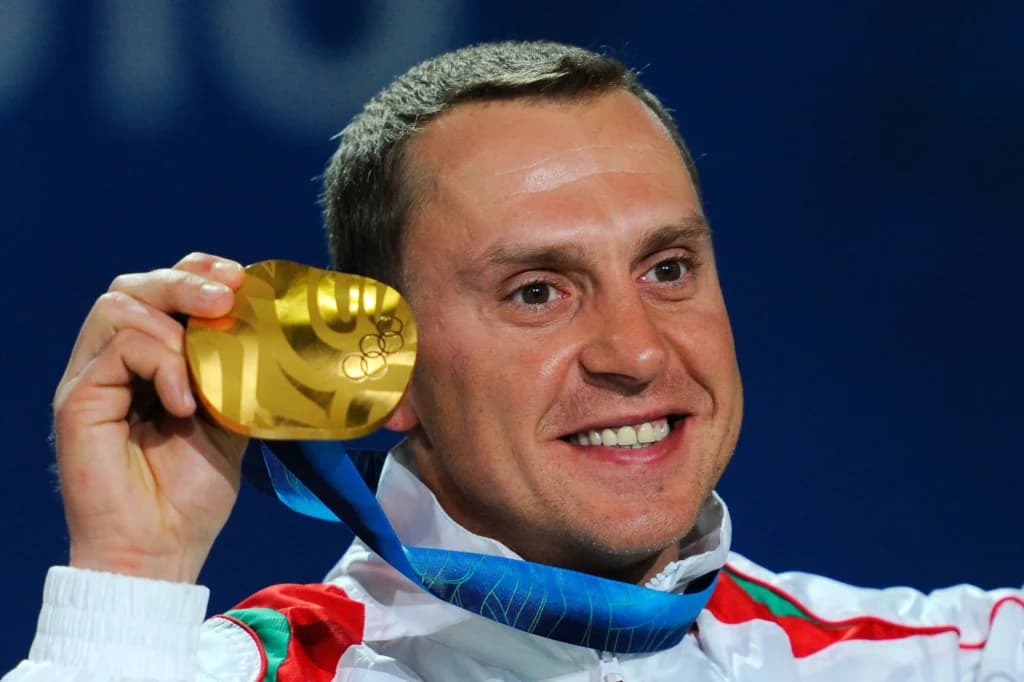
(Athlete holding a Vancouver 2010 gold medal, showcasing its unique curved design and golden finish)
Frequently Asked Questions
How much is an Olympic gold medal worth?
An Olympic gold medal is worth roughly $800–$1,000 USD in scrap metal value based on its content (about 6g of gold and 500g of silver). However, its true value is far greater to athletes and collectors. Olympic gold medals often sell for tens of thousands of dollars at auction due to their rarity and significance. The sentimental value to the winner is priceless.
What are Olympic gold medals made of?
Olympic gold medals are made mostly of silver, plated with a layer of gold. Specifically, they contain at least 92.5% silver (sterling silver) and are coated with about 6 grams of pure gold. This gives them the appearance of a gold medal while keeping the cost and weight manageable. Silver medals are all silver, and bronze medals are copper alloys.
Are Olympic medals real gold?
Modern Olympic gold medals are real gold-plated medals – the gold is real, but it’s only on the surface. The core of the medal is sterling silver. So, Olympic gold medals aren’t solid gold (and haven’t been since 1912), but they do contain real 24k gold in their plating. In short, yes, there is real gold, but no, they are not pure gold through-and-through.
How much do Olympic gold medals weigh?
A modern Olympic gold medal weighs around 500 grams (about 1.1 pounds). For example, the Paris 2024 gold medal is about 529g, and the Rio 2016 medal was 500g. Earlier medals were smaller – the 1912 gold medal weighed only 24g – but today’s medals are large (around 85 mm in diameter) and hefty. The weight comes mostly from the silver content.
Are Olympic medals solid gold?
No, Olympic gold medals are not solid gold. They are silver medals with gold plating. The last time solid gold medals were awarded was in 1912. Today’s gold medal contains only about 1.2% gold by weight (about 6 grams), with the rest being silver. They look gold on the outside, but inside they’re primarily silver.
How much gold is in an Olympic gold medal?
Approximately 6 grams of pure gold is in a modern Olympic gold medal. That’s the thickness of the gold plating. The 6g of gold is only a small fraction of the medal’s ~500g weight. The remainder (about 494g in some cases) is silver. So despite its golden shine, only a tiny amount of an Olympic “gold” medal is actually gold.
How many gold medals are given out at the Olympics?
Typically, around 300 gold medals are awarded at the Summer Olympics, one per event (339 at Tokyo 2020). Winter Olympics award fewer, usually 80–100 gold medals. The exact count varies by event number at each Games, plus additional medals are produced as spares.
How much is a 1912 Olympic gold medal worth today?
A 1912 Olympic gold medal, one of the last solid gold medals issued, contains about 24 grams of gold worth roughly $1,500 (£1,200). However, due to its rarity and historical significance, it could sell for around $35,000 or more to collectors.
Which country has the most Olympic gold medals?
The United States holds the record with over 1,000 Olympic gold medals, approximately 1,179 as of recent counts. The next closest is the former Soviet Union with about 473 gold medals, making the U.S. the all-time Olympic gold medal leader by a significant margin.
Interested in selling gold with the UK’s highest paying gold buyer? Visit our Sell Gold page to get a competitive valuation – we provide fully insured postage and fast payment.
For more insights and the latest gold price today, keep an eye on our live charts and blog updates.