Live 21ct Gold Price Per Gram
£86.82
Based on the live gold price in the UK. Updates every 60 seconds.
Sell gold with the UK’s highest paying online gold buyer in just 3 simple steps – trusted by thousands who get the best price for their gold every day.

Order Free Pack
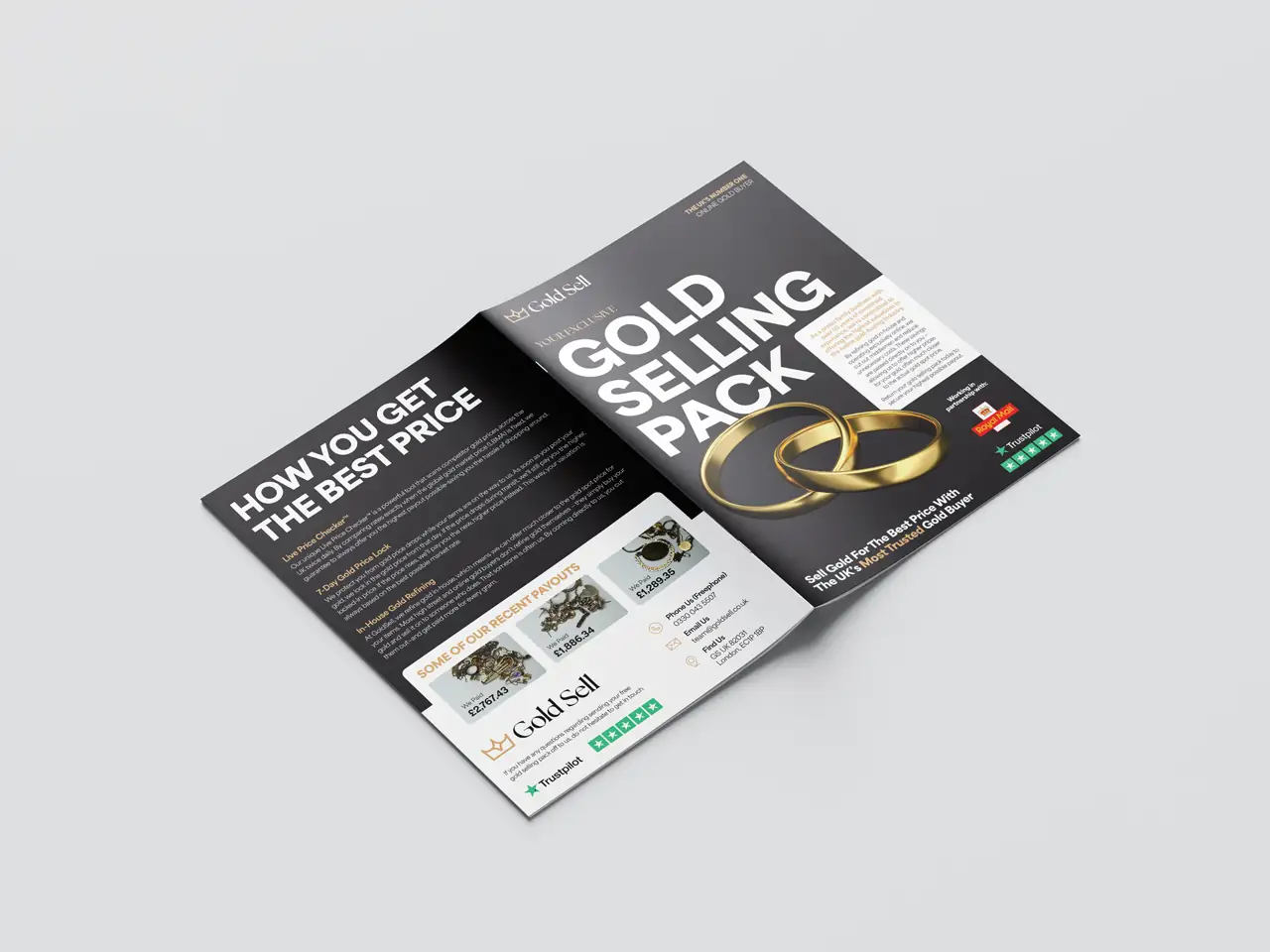
Order your free gold selling pack which contains your pre-paid, tracked and insured Royal Mail envelope as well as information on how we work.
Send Your Gold
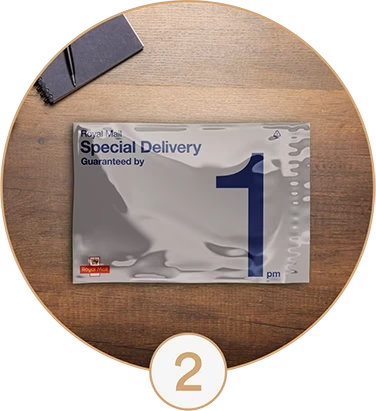
Securely place your gold items inside the provided prepaid envelope, then drop it at your nearest post office. Your items are insured up to £2,500*, and the process is completely discreet from start to finish.

Get Paid
Once we've received your gold you'll be contacted with a competitive valuation on the same day. Upon accepting, we'll pay you within 20 minutes.
How our gold buying process works in more detail
For a more detailed step-by-step overview of how our service works – from ordering your Gold Selling Pack to receiving payment – check out our how it works page.
The 21-carat gold price per gram today is £86.82. This high value reflects 21ct gold’s purity (87.5% gold content), meaning it trades at roughly 87.5% of the price of pure 24ct gold. For context, 24ct gold price per gram is currently £99.23, and one troy ounce of 24ct gold is £3,086.25 in the market – making a troy ounce of 21ct gold worth around 87.5% of that (£2,700.47).
Key Takeaways
- 21ct gold price today: £86.82 per gram, reflecting its high pure gold content (87.5% of 24ct’s value). It’s valued just below 24ct gold (£99.23/gram) and roughly corresponds to £2,700.47 per troy ounce (87.5% of the £3,086.25 per troy ounce pure gold price).
- Purity and hallmark: 21-carat gold is 87.5% pure gold by weight (21 parts gold out of 24). In the UK it carries the “875” hallmark, stamped on jewellery to certify it as 21ct gold.
- Value vs. 24ct: By definition, 21ct gold’s intrinsic worth is 87.5% that of 24ct gold of the same weight. However, sellers will receive a bit less than this spot value (dealers deduct refining costs and profit), and buyers of 21ct jewellery pay more than the raw gold price (for craftsmanship, branding, etc.).
- Durability & appearance: With its higher gold content, 21ct gold has a rich yellow hue and resists tarnish better than lower carats. It is slightly softer than 18ct gold, so pieces can scratch or bend if worn daily. Many cultures prize 21ct for wedding and heirloom jewellery due to its deep colour and value.
- Composition: 21ct gold is real gold alloyed with other metals (about 12.5%) like copper, silver or nickel. These alloys strengthen the gold and can subtly influence its colour (e.g. a hint of red with copper, or a paler yellow with silver), while still maintaining the classic gold look and high value.
21ct Gold Price Today
The 21ct gold price per gram is £86.82 based on the live gold price today. This reflects 21-carat gold’s purity of 87.5%, meaning it tracks closely to 87.5% of the 24ct spot price. The live 24ct gold price per gram is £99.23, and the troy ounce price of gold is £3,086.25. Because gold prices fluctuate daily, this live rate ensures an accurate valuation when buying or selling 21ct gold by weight.
Today's Live Gold Prices
Wondering what 21ct gold is worth right now? Our live gold price table below shows the live 21ct gold price per gram, updated in real time alongside other popular gold purities. These figures are based on the current global spot price of gold, a market-driven rate influenced by factors such as supply and demand, central bank reserves, economic uncertainty, and currency strength.
Live Gold Price Per Gram
Gold price last updated:
The LBMA (London Bullion Market Association) spot price changes daily.
The prices displayed are based on the global market rate for gold, known as the gold spot price. Like all gold buyers, GoldSell pays a percentage of this rate to account for assaying, refining, secure logistics, market volatility, and handling costs. We consistently offer among the highest payout rates in the UK, with the exact percentage increasing based on the weight and purity of the gold you sell.
The table below shows how the live price per gram of gold increases in line with its purity. Because gold is priced based on its fine gold content, higher carat values (like 18ct or 24ct) contain a greater proportion of pure gold — and therefore hold more intrinsic value. This comparison helps you understand exactly how the value of 21ct gold sits in relation to other common gold finenesses.
| Gold Fineness | Live Price per Gram |
|---|---|
| 9 carat (37.5 % pure) | £37.21 |
| 14 carat (58.5 % pure) | £57.88 |
| 18 carat (75 % pure) | £74.42 |
| 21 carat (87.5 % pure) | £86.82 |
| 22 carat (91.6 % pure) | £90.96 |
| 24 carat / Fine gold (99.9 % pure) | £99.23 |
How Much Is 21ct Gold Worth?
21ct gold is 87.5% pure, so its intrinsic worth is about 87.5% of the value of pure 24ct gold of the same weight. In simple terms, 21 carat gold’s metal value is calculated by taking the current pure gold (24k) price and multiplying by 0.875. For example, pure gold is £99.23 per gram, so a gram of 21ct gold contains 0.875g of pure gold and is worth roughly £99.23 x 0.875 = £86.82 in gold content.
However, the price you actually get or pay for 21ct gold can differ from this raw value. If you are selling 21ct gold (e.g. old jewellery or scrap), you typically won’t receive the full £86.82/g market value. Gold dealers will deduct a margin for refining, handling, and market risk. In fact, you will never receive the full live metal price for scrap gold from any dealer – they need to cover business costs and turn a profit. A reputable UK gold buyer might pay close to the intrinsic value (often a high percentage of the spot price), but always a bit less. Less scrupulous buyers might offer far less (sometimes only 40–60% of the metal’s true worth), so it pays to use established gold buyers. Unlike many high street buyers or other online services that pay significantly less, we’re able to offer higher prices for your gold. That’s because we don’t operate costly physical stores and, more importantly, we refine gold ourselves. This means there are no middlemen in our process, allowing us to pass those savings directly to you. In fact, many other gold buyers ultimately sell their gold through us because we pay more. So while some companies offer reduced rates to cover overheads and earn a hefty profit, we offer you the best price for gold upfront.
On the other hand, if you’re buying 21ct gold jewellery at retail, you will usually pay above the gold’s raw value. Jewellers add premiums for craftsmanship, design, branding, and VAT (in some cases). The market price of the gold is just one component; labour and overhead can significantly increase the price tag. It’s not unusual for finished gold jewellery to cost well above its weight in gold. In fact, experts note that any time you buy gold in smaller volumes or as jewellery, “you will have to pay a premium” over the base metal price. This premium covers the middleman’s costs, the jeweller’s skill and profit, and any additional materials (gemstones, etc.). In some cases, fine gold jewellery pieces (especially designer or intricate ones) might retail at 2-3 times the value of their gold content due to the added workmanship.
Bottom line: 21ct gold’s worth by weight is straightforward – about 87.5% of pure gold’s value. But sellers should expect slightly less than that figure when cashing in (due to buyers’ fees), and buyers should expect to pay more than that figure when purchasing jewellery (due to added costs for making and selling the piece). Knowing this helps set realistic expectations whether you are investing in 21ct gold or selling it.
What Is The Gold Spot Price?
The gold spot price is simply the live market price for gold for immediate delivery (usually quoted per troy ounce). In practice it’s the baseline “raw” value of gold, set by international bullion markets (London Bullion Market, COMEX, etc.). It does not include any retailer premiums or manufacturing costs. In effect, the spot price is the intrinsic value of pure gold at any moment.
Key factors that drive the gold spot price include:
- Inflation and currency: When inflation is high, investors flock to gold as a hedge, pushing the spot price higher. Likewise, a weaker US dollar makes gold cheaper for holders of other currencies, often boosting demand. Conversely, a strong dollar can pressure gold prices down.
- Interest rates: Gold is non-interest-bearing. When real interest rates fall (or are negative), gold becomes more attractive than bonds, lifting its price. Lower rates tend to correlate with higher gold demand.
- Central bank and institutional demand: Central banks (especially in recent years) have purchased large amounts of gold to diversify reserves. These big buyers can drive prices up when they add to their holdings. Industrial uses and jewellery demand (from tech and emerging markets) also add steady baseline demand.
- Geopolitical events: Gold is famously a “crisis commodity.” Wars, political unrest or financial turmoil prompt safe-haven buying. For example, conflicts in Europe or the Middle East, or major election uncertainties, have recently triggered gold price spikes.
21ct Gold Hallmark
In the UK, 21ct gold is hallmarked with the number “875”. This 875 hallmark is the official stamp indicating that the item is 87.5% pure gold (21 parts gold out of 24). If you inspect a 21ct gold jewellery piece, you should find a tiny “875” mark inscribed on it – often alongside other assay symbols. UK hallmarking standards require gold items above a certain weight to be tested and marked by an Assay Office. The 875 mark is how you can confirm a piece is indeed 21 carat gold under these regulations.
Typically, a full UK hallmark will include a few elements: a maker’s (sponsor’s) mark, the millesimal fineness number (in this case 875), and the Assay Office symbol (like a leopard’s head for London, an anchor for Birmingham, etc.). The “875” fineness stamp is the numeric representation of 21ct purity in the millesimal system. So, when you see “875” on a gold ring, necklace or bangle, it’s a clear assurance you’re dealing with 21-carat gold. This helps buyers and sellers quickly identify the gold quality. Keep in mind that outside the UK you might simply see “21K” or “21kt” engraved, but the UK (and much of Europe) use the number system. An 875 hallmark on your jewellery means you can be confident it’s 21ct gold – nearly 90% pure gold by content.
One thing to note is that 21ct gold items are relatively uncommon in Britain. You’re more likely to encounter 9ct, 14ct, 18ct or 22ct hallmarked pieces. So if you do find “875” on a piece, it might be an import or a special-order item. Thanks to global trading and online marketplaces, 21ct jewellery is becoming more available in the UK, but it’s still a bit of a rarity. Always look for the hallmark (and if in doubt, have the piece tested) to ensure you know the exact carat of gold you have.
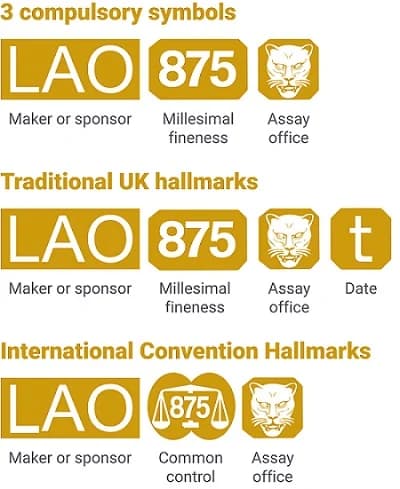
Examples of official 21k gold hallmarks: This image illustrates how 21ct (21k) gold is legally hallmarked in the UK and internationally. The ‘875’ stamp confirms the gold purity as 87.5%, while accompanying symbols identify the maker, assay office, and additional certification marks. Recognising these ensures you’re buying or selling genuine 21ct gold.
What Is 21ct Gold?
21-carat gold is a high-purity gold alloy – it consists of 21 parts pure gold out of 24, which is 87.5% gold content by mass. In the millesimal fineness scale, 21ct is denoted as 875, meaning 875 ‰ (parts per thousand) of the metal is gold. The remaining 12.5% is made up of other metals (alloys) added to the gold. This composition gives 21ct gold some characteristics distinct from both pure gold and lower-carat gold:
- Purity & Value: With 87.5% gold, 21ct is among the purest forms of gold used in jewellery. Only 22ct (91.6%) and 24ct (99.9%) are higher in purity. This means 21ct gold items have a high intrinsic value – more gold per gram than 18ct or 14ct pieces. They are often considered investment-grade jewellery in some cultures, as the high gold content means the piece retains significant value.
- Appearance: 21ct gold has a rich, lustrous yellow colour that is closer to pure gold than 18ct gold is. Because of the high gold content, the colour only varies slightly based on the alloy mix. In its typical form (21ct yellow gold), it exhibits a deep yellow hue that many find attractive for traditional jewellery. It’s a touch less orangey than 22ct (since there’s slightly more alloy), but much richer in colour than 14ct or 9ct gold. If the alloy has more copper, the tone of 21ct gold can lean warmer (a faint reddish tint); if there is more silver or palladium, it might appear a bit lighter or “paler” yellow. However, overall 21ct remains very much golden – the alloys don’t drastically change its colour since gold dominates the mix.
- Durability: Pure 24ct gold is extremely soft, so adding alloy metals makes gold harder. At 21ct, the gold is still quite soft and malleable compared to lower carats. It’s softer than 18ct gold (which has more alloy). This means 21ct jewellery can get scratched or bent more easily if knocked around. It’s often said that 21ct gold is not ideal for everyday wear on hands (like a daily ring) because it may wear down or deform over time. That said, it’s a bit more durable than pure 24ct gold – the 12.5% alloy does impart some strength. Many 21ct pieces are intended for occasional or ceremonial use (for example, wedding jewellery that isn’t worn 24/7). If you do wear 21ct gold regularly, you’d want to treat it with care to avoid scuffs. In contrast, 18ct or 14ct gold (with more alloy metal) can better withstand daily wear and tear, but they sacrifice some purity for that hardness.
- Tarnishing & Corrosion: One advantage of 21ct’s high gold content is that it resists tarnish and corrosion very well. Pure gold does not tarnish or rust at all; it’s the other metals (like copper, silver, zinc) that can oxidise. Since 21ct has only a small fraction of base metals, it rarely dulls or discolours. Lower carat gold (like 9ct, which is only 37.5% gold) can tarnish over time because of the high percentage of copper/silver in the alloy. By contrast, 21ct gold jewellery tends to maintain its shine with minimal tarnish, requiring just the occasional gentle polish to gleam like new. It’s also largely resistant to sweat or water causing any significant corrosion (though it’s always wise to rinse chemicals or chlorine off any karat of gold).
- Value & Use: Given its purity, 21ct gold commands a high price per gram (as detailed above). It straddles a middle ground between common jewellery gold and pure gold. In the UK and much of the West, 21ct is not very common – most jewellery here is 9ct, 14ct, 18ct, or in higher-end traditional pieces, 22ct. However, 21ct is popular in other parts of the world. It is notably used in Middle Eastern and South Asian jewellery. Many Arabic countries have 21k jewellery as a standard; you’ll find elaborate bridal sets and heirloom pieces in 21ct gold in those markets. In India, 22ct is more prevalent, but 21ct is also used for certain fine jewellery that balances purity with a bit more strength. Essentially, 21ct offers a lot of the prestige of very pure gold (deep colour, high value) while being slightly more practical for making wearable items than 24ct. It’s often chosen for investment-grade jewellery or special occasion gifts – pieces that are cherished for their gold value yet still meant to be worn for display on important days.
In summary, 21ct gold is a high-purity gold alloy (87.5% gold) that boasts a gorgeous colour and high value. It’s somewhat softer and more expensive than 18ct, but more durable than pure 24ct. 21ct gold jewellery tends to be coveted for its purity in cultures where gold is both adornment and savings. If you own a 21ct item, you have something quite special – it’s almost pure gold, with just enough alloy to shape it into a lasting piece of jewellery.
What Is 21ct Gold Made Of?
21ct gold is made of 21 parts gold and 3 parts other metals. In percentage terms, it’s about 87.5% gold and 12.5% alloy. The alloying metals can vary, but commonly include copper, silver, and sometimes nickel or zinc. These metals are mixed with pure gold to create a 21-carat alloy that is harder (and often a bit less expensive) than 24ct gold, while still retaining the vast majority of gold in the mix.
- Gold (87.5%): This is the primary component, giving 21ct gold its high value and yellow colour.
- Other Metals (12.5%): Jewellers add one or more metals such as copper, silver, zinc, nickel, or palladium to make up the remaining portion. The choice of alloy affects the gold’s hue and hardness. For yellow 21ct gold, usually a combination of copper and silver is used (for example, an alloy mix might be around 8% silver and 4.5% copper, approximately, to total 12.5%). Copper tends to impart a warmer, reddish tint, while silver gives a lighter yellow tint. The balance is chosen to keep the colour a rich yellow while improving hardness slightly.
In practice, 21ct yellow gold alloys are formulated to preserve that classic gold appearance. Because the gold percentage is so high, a 21ct yellow gold piece will always look yellow – the 12.5% of additives can only slightly tweak the shade. If more copper is in the mix, the gold might have a subtle rose or orange cast; if more silver (or palladium) is used, the gold might be a tad paler. But unlike lower carats, you won’t see dramatic colour differences – 21ct remains unmistakably gold in look.
It’s also possible to have 21ct white gold or 21ct rose gold, though these are less common. White gold at 21k fineness would be created by alloying gold with white metals (like palladium or nickel) in that 12.5% portion, plus usually a rhodium plating to enhance whiteness. However, due to the high gold content, 21ct white gold may still show a faint yellow hue through the plating over time. Similarly, a 21ct rose gold could be made with a larger copper proportion for a stronger pink tone, but 21ct rose gold is rare because the market that uses 21ct (Middle East/Asia) typically prefers yellow gold.
To sum up, 21ct gold is made of pure gold mixed with a small percentage of other metals to form an alloy that is 87.5% gold. The exact recipe can vary, but it’s usually gold + copper + silver in some ratio for yellow gold. This alloying is what makes the gold sturdy enough for jewellery, since 24ct on its own would be too soft. Importantly, the “875” stamp on 21ct jewellery assures you that no matter the alloy mix, the gold content is the same – 87.5% pure gold in that piece.
Looking To Sell 21ct Gold?: Here's What You Need To Know
If you’re considering selling 21ct gold, GoldSell makes the process easy, secure, and highly rewarding. Thanks to our proprietary Live Price Checker™, we consistently track UK gold prices to ensure you receive the highest payout available. Our in-house gold refining cuts out middlemen and extra fees, ensuring more money directly in your pocket.
With our exclusive 7-Day Gold Price Lock, your valuation is protected from market drops. As soon as you drop your items at the Post Office, our system automatically locks in the highest gold price from that moment until your gold arrives with us. Additionally, our Best Price Guarantee ensures that if you find a better offer elsewhere, we promise to match or beat it. And with same-day payment upon accepting your valuation, your money reaches you within minutes of accepting our valuation.
Ready to sell your 21ct gold? It couldn’t be simpler:
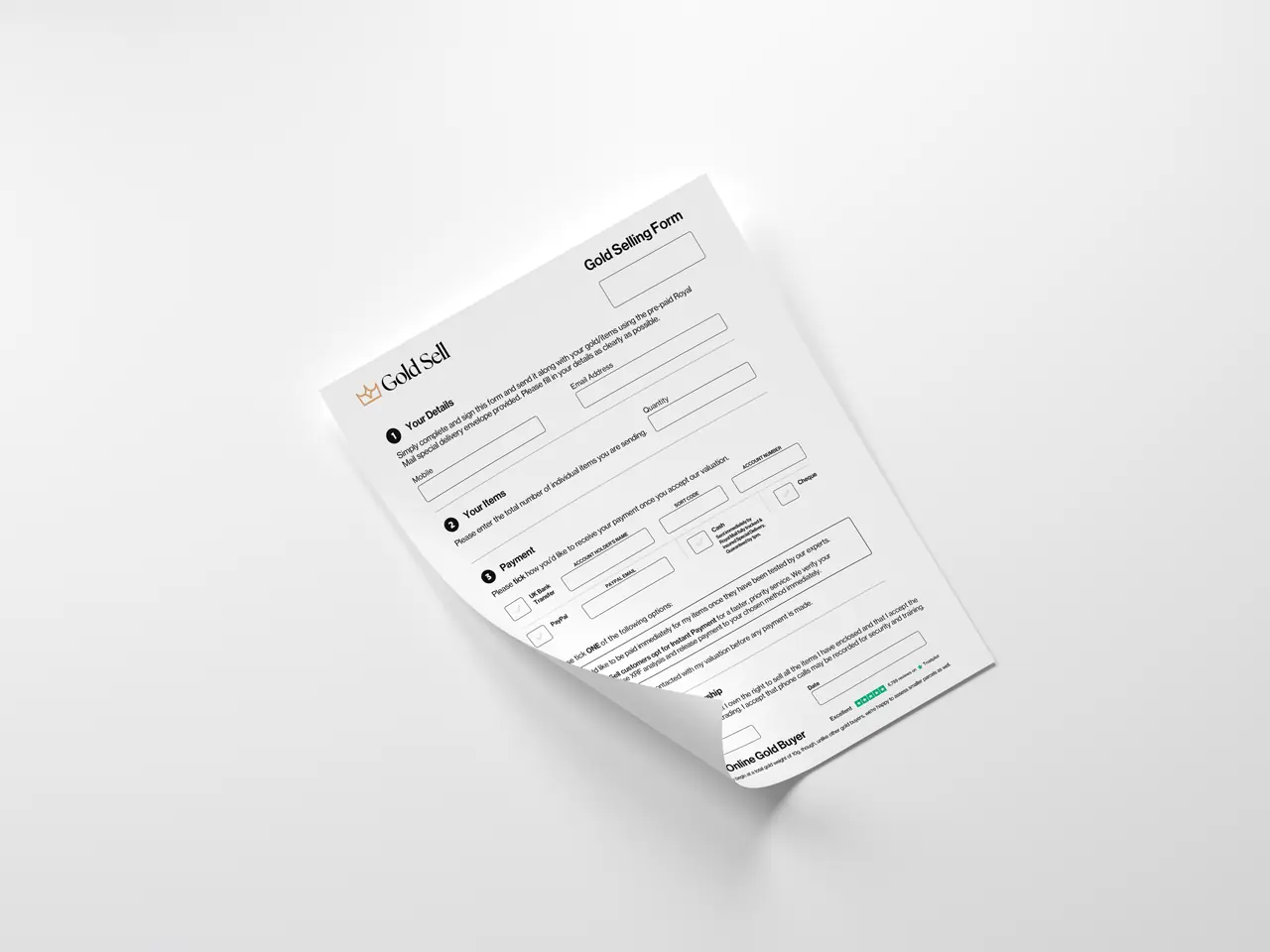
- Order Your Free Gold Selling Pack: Receive everything you need, including clear instructions and a short valuation form to select your preferred payment method. We’ve partnered with Royal Mail for pre-paid, discreet, fully insured Special Delivery, ensuring your items travel safely. Simply drop your pack at the Post Office and keep your proof of postage.
- Professional Gold Valuation & Secure Storage: Upon arrival, your gold undergoes precise XRF testing to accurately measure its true gold content. Every item is meticulously valued regardless of hallmark, size, or condition, ensuring you receive an accurate offer. Whether you’re sending a few small rings or a mixed selection of jewellery, we use XRF analysis to test each item individually—so you’re paid for every single gram of gold you send. Unlike some local jewellers or gold buyers who offer rough estimates or visual checks, we treat each piece with the same expert care to maximise your payout. Your gold remains secure in our CCTV-monitored vault throughout.
- Immediate Payment Within 20 Minutes: A friendly member of our team will contact you with your valuation the same day your gold arrives. Once you accept, we process your payment within just 20 minutes—no admin delays, no waiting. As the UK’s fastest paying gold buyer, we make sure your money gets to you quickly and securely, because it’s yours, and you shouldn’t have to wait for it.
Frequently Asked Questions
What is the 21ct gold price per gram today?
As of 21 Oct 2026, the live 21ct gold price per gram is £86.82 based on the live gold price as of today in the UK.
Is 21 karat gold pure?
No – 21 karat gold is not fully pure gold, but it’s very close. 24 karat is considered 99.9% pure gold. By contrast, 21k gold is 87.5% pure. The remaining 12.5% is composed of other metals alloyed with the gold. So 21ct is a high-purity gold alloy, but not 100% pure. It offers a good balance between purity and strength, whereas pure 24k gold is softer and rarely used for most jewellery.
What purity is 21ct gold?
21ct gold has a purity of 87.5%. In other words, it’s 875 parts gold per 1000 parts of material. The term “21 carat” means 21/24ths of the alloy is gold. This purity is officially stamped as “875” on UK hallmarked gold items. So if you have a 21ct piece, 87.5% of its weight is pure gold, with 12.5% made up of strengthening metals.
What is the hallmark for 21ct gold?
The UK hallmark for 21-carat gold is the number “875”. If you see “875” engraved on a gold item, that indicates it’s 21ct (87.5% pure gold). This millesimal fineness mark is often accompanied by a maker’s mark and an Assay Office symbol as part of the full hallmark. Some foreign-made 21k gold jewellery might simply be stamped “21K”, but any item assayed in the UK will bear the 875 hallmark to certify its carat.
Is 21ct gold real?
Yes – 21ct gold is real gold. In fact, it’s considered high-grade real gold. It contains 87.5% genuine gold, blended with 12.5% other metals. While it isn’t “pure” gold (which is 24ct), 21ct is certainly authentic gold valued for its purity. Jewellery marked 21k or 875 is legally and commercially recognised as real gold. In short, 21ct gold is definitely real, just alloyed slightly to make it practical for use in crafting durable jewellery.
What is the gold spot price?
The gold spot price refers to the current trading price for one troy ounce of pure 24ct gold, settled "on the spot" for immediate delivery in global markets. It represents the baseline value of raw gold before refining or fabrication and is used to price all gold items, regardless of purity. Today’s live gold spot price is £3,086.25 per troy ounce, which equals £99.23 per gram. This price fluctuates daily with global economic conditions.
What is a troy ounce?
A troy ounce is a unit of measurement used for precious metals like gold. One troy ounce equals 31.1035 grams and is heavier than a standard (avoirdupois) ounce, which equals 28.35 grams. All international gold pricing is quoted in troy ounces, including spot prices.
What's the difference between troy ounce and regular ounce?
The troy ounce (used for precious metals) weighs 31.1g, whereas a standard ounce (used in everyday weight) weighs 28.35g. This difference matters when valuing gold, as even small discrepancies affect price. Always ensure gold weights are quoted in troy ounces or grams for accuracy.
Is gold tax free in the UK?
Yes, certain types of gold are tax-free in the UK. Investment-grade gold bullion (bars or coins) is exempt from VAT and certain UK gold coins (like Sovereigns and Britannias) are CGT-exempt. However, jewellery is not CGT-exempt and VAT may be charged on new jewellery sales. Selling your gold privately typically doesn’t incur tax unless total annual gains exceed the CGT allowance.
What is 9ct gold?
9ct gold is an alloy containing 37.5% pure gold and 62.5% base metals such as copper and silver. It is the most common gold purity in UK jewellery due to its strength, affordability and practicality. Though less pure than higher-carat gold, it’s still real and widely hallmarked as “375”.
What is 14ct gold?
14ct gold is made of 58.5% pure gold and 41.5% alloy metals. It's hallmarked as “585” and offers a good balance between purity, durability and colour. Popular in the US and Europe, 14ct gold has a brighter finish than 9ct and holds more intrinsic value, while still being harder than 18ct or 24ct.
What is 18ct gold?
18ct gold is 75% pure gold, hallmarked as “750”. The remaining 25% is made up of other metals to improve durability. It has a rich, warm yellow tone and is often used in engagement rings and fine jewellery. It’s softer than 9ct or 14ct, but higher in value and purity.
What is 21ct gold?
21ct gold is 87.5% pure gold, hallmarked as “875”. It’s used in traditional jewellery in Asia and the Middle East but less common in the UK. It’s softer than 18ct gold but has a deeper yellow tone and higher intrinsic value, making it desirable for cultural and investment purposes.
What is 22ct gold?
22ct gold is 91.6% pure gold, hallmarked as “916”. It has a rich golden appearance and is typically used in high-value jewellery and some bullion coins. Because of its softness, it’s less suited for items like rings which undergo daily wear but remains popular for its purity and beauty.
What is 24ct gold?
24ct gold is 99.9% pure gold, hallmarked as “999”. It’s the highest possible gold purity and is used primarily in bullion bars and investment coins. Due to its softness, it’s not ideal for everyday jewellery, but it holds the most value by weight and is considered the purest form of gold.
What does 375 mean on gold?
“375” is a gold hallmark that indicates 9ct gold, or 37.5% pure gold content. It confirms that the jewellery meets the legal UK standard for 9ct and that it contains real, measurable gold content. It’s a common stamp found on British gold jewellery.
What does 585 mean on gold?
“585” is the hallmark for 14ct gold, meaning the piece contains 58.5% pure gold. It’s commonly used in jewellery across Europe and the US, striking a good balance between durability, affordability and gold value.
What does 750 mean on gold?
“750” refers to 18ct gold, which contains 75% pure gold and 25% alloy metals. This hallmark assures a high level of purity and makes it a popular choice for high-end jewellery, offering excellent colour and value.
What does 875 mean on gold?
“875” is the hallmark for 21ct gold, meaning the item contains 87.5% pure gold. This purity level is less common in the UK but frequently seen in Asian and Middle Eastern jewellery. It offers excellent intrinsic value and a vibrant yellow colour.
What does 916 mean on gold?
“916” marks 22ct gold, indicating the piece contains 91.6% pure gold. This high-purity gold is popular in traditional jewellery, especially in Indian, Chinese and Middle Eastern markets, and provides excellent resale value due to its high gold content.
What does 999 mean on gold?
“999” is the hallmark for 24ct gold, meaning it’s 99.9% pure with virtually no alloy metals. This is the standard used for investment-grade bullion and high-purity coins, offering maximum value per gram but low durability for everyday wear.
Interested in selling gold with the UK’s highest paying gold buyer? Visit our Sell Gold page to get a competitive valuation – we provide fully insured postage and fast payment.
For more insights and the latest gold price today, keep an eye on our live charts and blog updates.