
Live 22ct Gold Price Per Gram
£91.03
Based on the live gold price in the UK. Updates every 60 seconds.
Sell gold with the UK’s highest paying online gold buyer in just 3 simple steps – trusted by thousands who get the best price for their gold every day.

Order Free Pack
Order your free gold selling pack which contains your pre-paid, tracked and insured Royal Mail envelope as well as information on how we work.
Send Your Gold
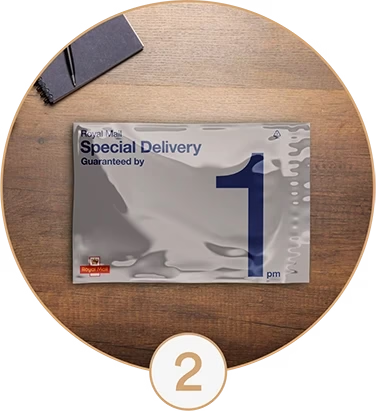
Securely place your gold items inside the provided prepaid envelope, then drop it at your nearest post office. Your items are insured up to £2,500*, and the process is completely discreet from start to finish.

Get Paid
Once we've received your gold you'll be contacted with a competitive valuation on the same day. Upon accepting, we'll pay you within 20 minutes.
How our gold buying process works in more detail
For a more detailed step-by-step overview of how our service works – from ordering your Gold Selling Pack to receiving payment – check out our how it works page.
The Live 22-carat gold (22ct) is currently**£91.03 per gram** in the UK. This reflects the high purity of 22ct gold (91.7% pure gold), which closely tracks the market price of pure 24ct gold (£99.31 per gram, or £3,088.73 per troy ounce right now).
Key Takeaways
- 22ct Gold Price (UK): The 22ct gold price today is £91.03 per gram, roughly 91.67% of the pure 24ct gold price per gram. This means 22ct gold’s value moves in line with the gold spot price.
- Purity: 22-carat gold is 91.67% pure gold (22 parts gold out of 24). It’s also known as “916” gold, and UK hallmarks stamp 916 on 22ct items to certify this purity.
- Value for Sellers/Buyers: 22ct gold is worth about 91.6% of the pure gold spot price per gram. In practice, gold dealers pay slightly less than this (to cover costs) when selling 22ct gold, and retail buyers will pay slightly more than the spot price as a premium for craftsmanship, branding, design, stones etc.
- Hallmark Identification: In the UK, 22ct gold jewellery is hallmarked with a 916 stamp and an Assay Office symbol (e.g. a leopard’s head for London or an anchor for Birmingham). Older British pieces might simply be marked “22”. These stamps ensure you’re getting genuine 22ct gold.
- Uses and Durability: 22ct gold value is high due to its purity, making it a premium choice for high-end jewellery and bullion coins. It has a rich yellow colour and strong resale value. While softer than lower carats (like 18ct), it’s more durable than 24ct and can be worn daily with proper care.
- Coins: Many famous gold coins are 22ct. British Gold Sovereigns (and pre-2013 Gold Britannias) are minted in 22ct gold, as are coins like the South African Krugerrand and US Eagle. This alloy (often called “crown gold”) balances near-pure gold content with added strength for handling.
22ct Gold Price Today
As of today, the 22ct gold price per gram in the UK is £91.03. 22ct gold’ value is derived from the live 24ct gold spot price – since 22ct is 91.67% pure gold, its price is about 91.67% of the 24ct price per unit weight. For context, 24ct gold is currently £99.31 per gram, which equals £3,088.73 per troy ounce of pure gold. So 22ct gold’s value closely tracks the market: if the pure gold price moves, 22ct moves with it.
Keep in mind that £91.03 per gram is the market (spot-based) value. In a real transaction, if you sell 22ct gold jewellery or scrap gold, a buyer might offer a bit less per gram (e.g. 80–90% of that figure) depending on the dealer’s margins. Likewise, if you’re buying a 22ct gold item (like a coin or jewellery piece), you might pay slightly above £91.03/g due to fabrication costs and dealer premiums. In other words, £91.03 is the intrinsic metal value per gram at 22 carats; actual buy/sell prices will vary around this benchmark.
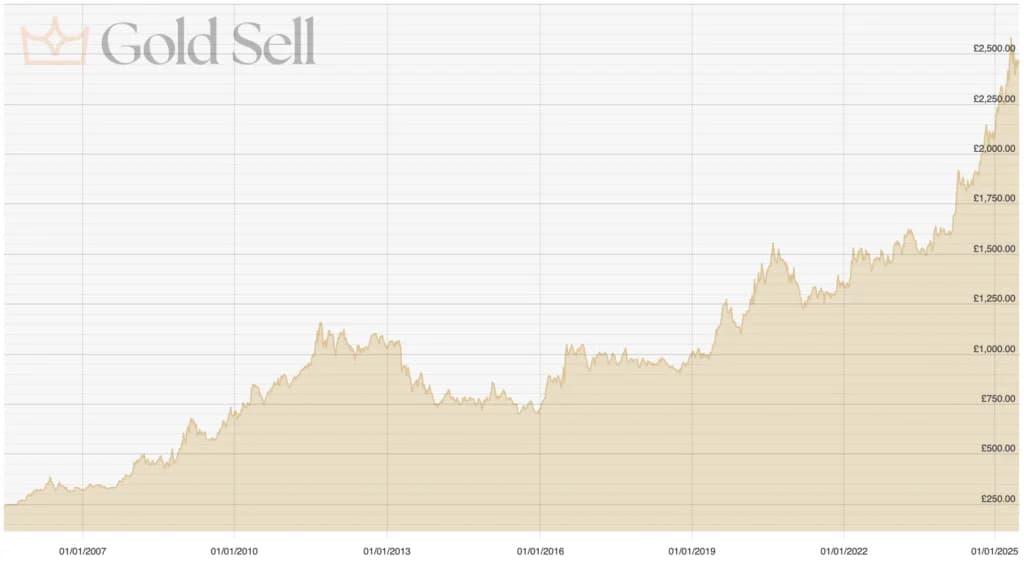
As the chart illustrates, gold prices have followed a strong long-term upward trend. From levels below £250 per troy ounce in 2007, the gold price has surged to over £2,500 per ounce by mid‑2025 — a tenfold increase over less than two decades. The most dramatic growth has occurred since 2020, with particularly sharp gains from late 2022 onwards. This sustained rise reflects global economic uncertainty, inflation pressures, and increased investor demand for safe-haven assets like gold. While short-term fluctuations are visible, the overall trajectory clearly shows gold’s enduring appeal as a reliable store of value.
Today's Live Gold Prices
Wondering what 22ct gold is worth right now? Our live gold price table below shows the live 22ct gold price per gram, updated in real time alongside other popular gold purities. These figures are based on the current global spot price of gold, a market-driven rate influenced by factors such as supply and demand, central bank reserves, economic uncertainty, and currency strength.
Live Gold Price Per Gram
Gold price last updated:
The LBMA (London Bullion Market Association) spot price changes daily.
The prices displayed are based on the global market rate for gold, known as the gold spot price. Like all gold buyers, GoldSell pays a percentage of this rate to account for assaying, refining, secure logistics, market volatility, and handling costs. We consistently offer among the highest payout rates in the UK, with the exact percentage increasing based on the weight and purity of the gold you sell.
The table below shows how the live price per gram of gold increases in line with its purity. Because gold is priced based on its fine gold content, higher carat values (like 18ct or 24ct) contain a greater proportion of pure gold — and therefore hold more intrinsic value. This comparison helps you understand exactly how the value of 22ct gold sits in relation to other common gold finenesses.
| Gold Fineness | Live Price per Gram |
|---|---|
| 9 carat (37.5 % pure) | £37.24 |
| 14 carat (58.5 % pure) | £57.93 |
| 18 carat (75 % pure) | £74.48 |
| 21 carat (87.5 % pure) | £86.89 |
| 22 carat (91.6 % pure) | £91.03 |
| 24 carat / Fine gold (99.9 % pure) | £99.31 |
How Much Is 22ct Gold Worth?
22ct gold is worth 91.6% of the pure gold spot price of the same weight. The purity of 22 carat gold is 91.67%, so its value is essentially prorated from 24 carat gold. For example, if pure 24ct gold is £99.31 per gram, then 22ct gold’s spot value is £99.31 x 0.9167 = £91.03 per gram. This simple calculation makes it very easy to work out the 22ct gold price per gram if you only have the pure gold spot price to go by. In essence, 22ct contains nearly 92% gold content, so it’s extremely valuable – each gram has 0.9167 grams of pure gold in it.
However, it’s important to distinguish between spot value and actual transaction price. The spot price is a market rate for pure gold. In reality:
- If you’re selling 22ct gold to a gold buyer, you usually get a bit less than spot value per gram. Gold buyers need a margin for refining, profit, testing fees, storage and insurance, so they might pay, say, 80%–90% of the spot-derived price. Less scrupulous buyers might offer far less (sometimes only 40–60% of the metal’s true worth), so it pays to use established gold buyers. Unlike many high street buyers or other online services that pay significantly less, we’re able to offer higher prices for your gold. That’s because we don’t operate costly physical stores and, more importantly, we refine gold ourselves. This means there are no middlemen in our process, allowing us to pass those savings directly to you. In fact, many other gold buyers ultimately sell their gold through us because we pay more. So while some companies offer reduced rates to cover overheads and earn a hefty profit, we offer you the best price for gold upfront.
- Buyers (retail) of 22ct gold jewellery or coins will typically pay above the metal or spot value, because finished products include manufacturing costs, design, and dealer markup. It’s nearly impossible to buy physical gold exactly at spot price. Premiums are added to cover refining, minting of coins or crafting jewellery, business overhead, and often a small profit for the seller. For example, a newly minted 22ct gold Sovereign coin might cost a few percent above its gold content value. The spread between buy and sell ensures gold traders stay in business.
In summary, 22ct gold’s intrinsic worth is ~91.7% of pure gold’s price. But the price you actually get or pay will be a bit different: sellers should aim for close to that intrinsic value, and buyers should expect to pay a premium above it. This clarity helps manage expectations whether you’re selling old 22ct jewellery or buying 22ct gold items.
What Is The Gold Spot Price?
Gold spot price is simply the live market price for gold for immediate delivery (usually quoted per troy ounce). In practice, it’s the baseline “raw” value of gold, set by international bullion markets (London Bullion Market, COMEX, etc.). It does not include any retailer premiums or manufacturing costs. In effect, the spot price is the intrinsic value of pure gold at any moment.
Key factors that drive the gold spot price include:
- Inflation and currency: When inflation is high, investors flock to gold as a hedge, pushing the spot price higher. Likewise, a weaker US dollar makes gold cheaper for holders of other currencies, often boosting demand. Conversely, a strong dollar can pressure gold prices down.
- Interest rates: Gold is non-interest-bearing. When real interest rates fall (or are negative), gold becomes more attractive than bonds, lifting its price. Lower rates tend to correlate with higher gold demand.
- Central bank and institutional demand: Central banks (especially in recent years) have purchased large amounts of gold to diversify reserves. These big buyers can drive prices up when they add to their holdings. Industrial uses and jewellery demand (from tech and emerging markets) also add steady baseline demand.
- Geopolitical events: Gold is famously a “crisis commodity.” Wars, political unrest or financial turmoil prompt safe-haven buying. For example, conflicts in Europe or the Middle East, or major election uncertainties, have recently triggered gold price spikes.
22ct Gold Hallmarks
When dealing with 22-carat gold in the UK, hallmarks are the key to identification and trust. A hallmark is a small stamped marking on gold items that tells you the piece’s purity (and the Assay Office that verified it). For 22ct gold, the standard hallmark is the number “916” – because 22ct gold is 916 parts per thousand fine gold.
UK law requires any gold item described as 22 carat (made after 1950) to carry a 916 hallmark stamp, plus the symbol of a UK Assay Office, to certify its purity. The four Assay Offices in the UK each have a unique symbol: for example, a leopard’s head for London, an anchor for Birmingham, a rose for Sheffield, and a castle for Edinburgh. So a typical 22ct gold British hallmark might look like “916” followed by a leopard head, indicating 91.6% gold assayed in London.
In older British jewellery (especially pre-1950 pieces), you might see a simple “22” mark stamped on the gold instead of the three-digit 916. This “22” or sometimes “22ct” mark was the traditional way to denote 22-carat gold. It indicates the item is 22/24 parts gold. Many antique 22ct gold rings, for instance, have “22” inside the band.
If a gold item has no hallmark, it could be for a few reasons: it might be very old (and worn off), very lightweight (certain small gold items under a weight threshold need not be hallmarked), not made in a country with strict hallmarking, or it might not actually be 22ct gold. In such cases, you’d want to get the item tested. Professional gold buyers use tools like XRF analysers to verify gold purity non-destructively. But for most UK jewellery, the hallmark is your quick assurance of gold content. Always look for a 916 (or “22”) stamp on any 22-carat gold piece – it’s proof you’re dealing with genuine 22ct gold under the UK’s stringent hallmarking system.
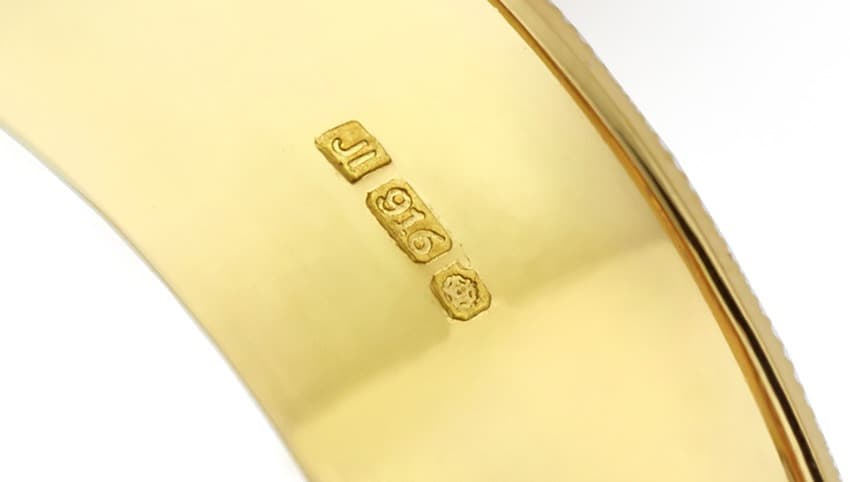
A 22ct gold hallmark featuring the 916 stamp confirms the item’s gold purity at 91.6%. The surrounding symbols represent the registered maker’s mark and the Assay Office responsible for testing and hallmarking. These marks are essential for verifying the authenticity and quality of 22-carat gold jewellery in the UK.
In older British jewellery (especially pre-1950 pieces), you might see a simple “22” mark stamped on the gold instead of the three-digit 916. This “22” or sometimes “22ct” mark was the traditional way to denote 22-carat gold. It indicates the item is 22/24 parts gold. Many antique 22ct gold rings, for instance, have “22” inside the band.
If a gold item has no hallmark, it could be for a few reasons: it might be very old (and worn off), very lightweight (certain small gold items under a weight threshold need not be hallmarked), or not made in a country with strict hallmarking, or it might not actually be 22ct gold. In such cases, you’d want to get the item tested. Professional gold buyers use tools like XRF analysers to verify gold purity non-destructively. But for most UK jewellery, the hallmark is your quick assurance of gold content. Always look for a 916 (or “22”) stamp on any 22-carat gold piece – it’s proof you’re dealing with genuine 22ct gold under the UK’s stringent hallmarking system. For a simple overview of how to identify gold hallmarks, check out our expert blog post which covers UK gold hallmarks and foreign gold hallmarks all in one place.
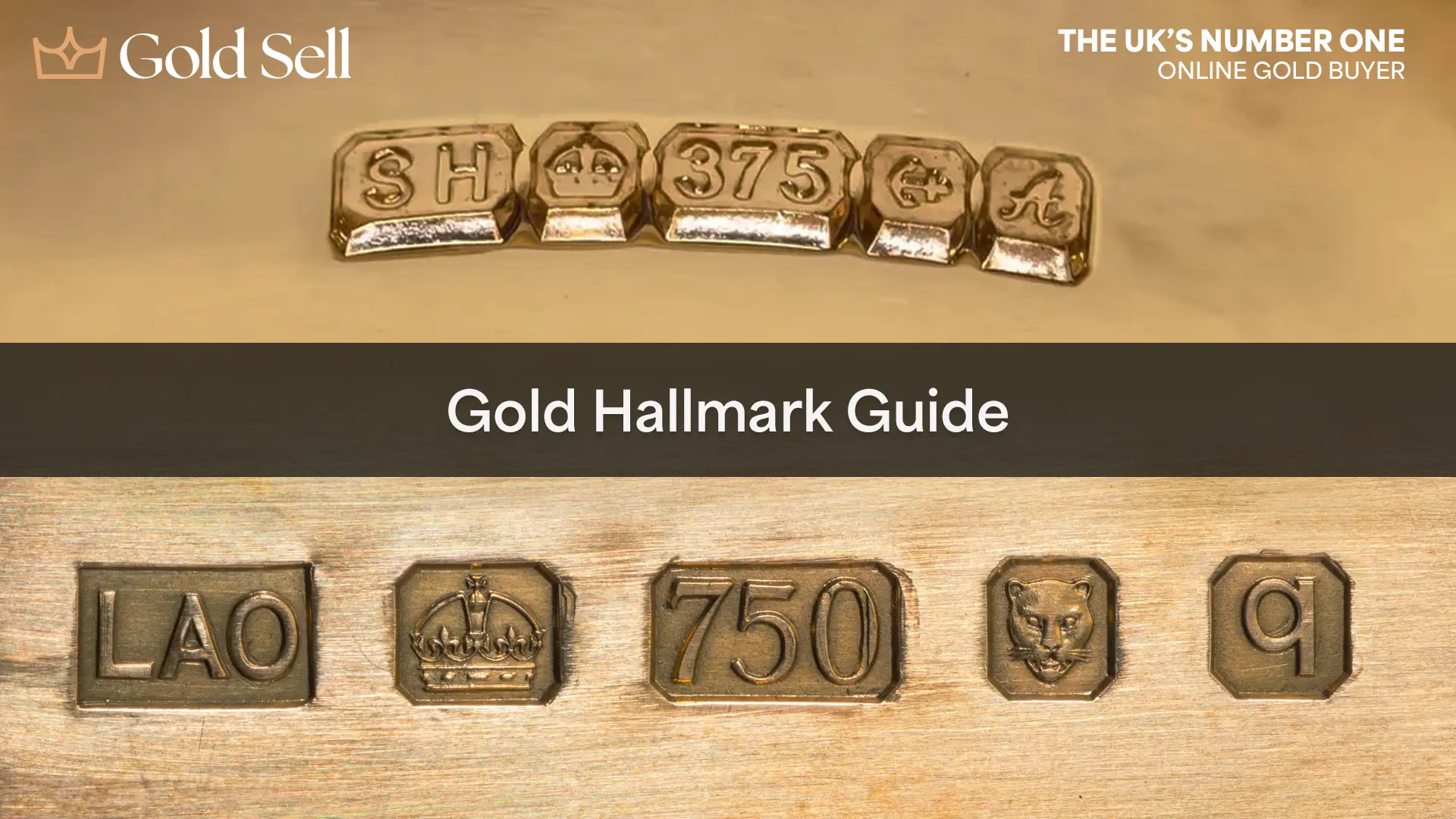
Gold Hallmarks Explained – Identify Gold Hallmarks
Learn how to identify gold hallmarks with our complete hallmark identification guide. Understand assay marks for gold on rings, coins, necklaces, and more.
What Is 22ct Gold?
22ct gold means gold of 91.67% purity. In practical terms, 22-carat gold is an alloy consisting of 22 parts pure gold and 2 parts other metal. Pure 24ct gold is very soft, so mixing in those 2 parts of alloy metal (around 8.33%) makes the gold harder and more durable for use in jewellery and coins. Despite the small addition, 22ct remains a very high purity gold – one of the highest used in jewellery.
Here are the defining characteristics of 22ct gold:
- Purity: 22ct is 91.67% gold by weight. It’s often expressed as “916 fineness” (out of 1000) in millesimal fineness terms. You might also see “.916” or “916/1000” used. This high gold content gives 22ct gold its rich yellow appearance and high intrinsic value.
- Durability: By adding roughly 8% alloy metals, 22ct gold becomes harder than 24ct. Pure 24ct (99.9% gold) is quite soft – it can scratch or bend with daily wear. 22ct gold, with a bit of copper, silver, or other metals mixed in, is slightly more robust while still retaining most of gold’s desirable qualities. It’s not as hard as 18ct or 14ct gold (which have more alloy), but it strikes a good balance for certain types of jewellery that won’t be subjected to very rough wear.
- Colour: 22ct gold has a classic warm yellow hue. The colour is often described as a deep, lustrous gold – more vibrant than 14ct or 18ct gold jewellery, because those contain more alloy that can pale the colour. In 22ct, the gold dominates, so you get that rich yellow glow that many find especially attractive. Depending on the exact alloy mix, 22ct gold can have subtle tone differences (a bit more reddish if more copper, or a tad lighter if more silver, etc.). But generally, 22ct yellow gold is unmistakably rich in colour.
- Usage: 22-carat gold is used in both jewellery and bullion. In the UK and Europe, 22ct isn’t as common in modern mass-market jewellery (18ct is often preferred for a balance of hardness and purity). However, 22ct is popular for high-end and traditional jewellery, especially in Asian communities and for wedding jewellery in many cultures where maximum gold purity is valued. It’s also the standard for many gold coins – historically and presently. Because of its high purity, 22ct commands a premium and is seen as a sign of wealth and quality in jewellery.
- Value: Items made of 22ct gold carry significant intrinsic value. If you have a 22ct gold necklace, most of its weight is pure gold, so its scrap value is very high compared to, say, a 9ct or 14ct piece of the same weight. This means 22ct gold jewellery can be considered a form of investment or savings to an extent – it holds value remarkably well over time, tracking the price of gold. In some cultures, people prefer keeping savings in 22ct jewellery because it’s both ornamental and a store of value.
In summary, 22ct gold is an alloy that’s almost pure gold, with a touch of other metals to make it usable. It’s prized for its lustrous colour and gold content. While slightly softer than lower carat golds, it remains a top choice for those who want the highest gold purity practical in wearable form, and it underpins some of the world’s most famous gold coins.
What Is 22ct Gold Made Of?
22ct gold is made of 22 parts pure gold and 2 parts other metals. Those “other metals” are usually alloying elements like copper, silver, zinc, or occasionally others, added to strengthen the gold and sometimes to tweak its colour. In percentage terms, 22ct is ~91.7% gold and ~8.3% alloy.
The exact composition of that 8.3% alloy can vary depending on the desired properties:
- For traditional 22ct yellow gold: The alloy mix often includes silver and copper. A typical formula, for example, could be about 5% silver, 2% copper, 1.3% zinc (approximately). This yields a classic yellow gold with perhaps a slight brightness from the silver and a touch of warmth from the copper. The zinc can help with hardness a bit. The World Gold Council notes such alloying not only hardens the gold but can also subtly influence hue.
- If a deeper reddish 22ct gold is wanted: Sometimes in antique jewellery, a higher copper proportion is used and little to no silver. For instance, one could have roughly 8% copper, which gives a richer red-yellow tone (this is akin to a 22ct rose gold – though rose gold is more common in 18ct, it can exist in 22ct as well, with high copper).
- Conversely, adding more silver: And maybe a pinch of palladium can produce a paler 22ct white-ish gold, but 22ct white gold isn’t common because you’d need significant alloy for a true white hue, which would drop the carat. Generally, you won’t see 22ct white gold; high-carat white gold is usually 18ct at most, due to the need for enough white metals.
The reason why 22ct gold is made with these alloy metals comes down to durability and handling. Pure 24ct gold, while beautiful, is very soft – it can deform just from firm hand pressure and scratches easily. By introducing a small percentage of other metals, the gold’s structure is strengthened. 22ct gold can better withstand everyday wear than 24ct gold, yet it remains far purer than 18ct or 14ct gold. It’s a sweet spot for certain uses.
Coins are a prime example of why 22ct alloys are used. Many famous bullion coins historically were minted in 22ct gold, a formulation often called “crown gold” in the UK. The British Gold Sovereign, for instance, has been 22ct (91.67% gold, with copper/silver alloy) since 1817. The slight alloy content makes the coins harder and less prone to wear, which was crucial when gold coins circulated as money. Similarly, the Krugerrand (South Africa) and the American Gold Eagle (USA) are 22ct gold coins – they contain one troy ounce of pure gold plus additional alloy metal to make the total weight a bit heavier than one ounce. These coins still give you a full ounce of gold, but the coin is tougher than it would be if it were .999 pure.
Britain’s Gold Britannia coin was also traditionally 22ct gold (from its launch in 1987 up through 2012). It contained one ounce of gold and some silver alloy. In 2013, the Royal Mint switched Britannias to 24ct (99.99% gold), aligning with other mints’ pure gold coins – but pre-2013 Britannias are 22ct. So when we say coins like Sovereigns and Britannias are made of 22ct gold, we’re referring to that long tradition of using 22ct crown gold for durability in circulation and bullion.
In summary, 22ct gold is made of gold plus a touch of other metals – usually copper, silver, and similar – to create an alloy that’s hard-wearing yet extremely high in gold content. This composition is ideal for applications where pure 24ct gold would be too soft. Whether in a gleaming 22ct wedding bangle or a historic gold Sovereign coin, the 22ct alloy offers a near-pure gold experience with improved strength.
Is 22ct Gold Good?
When people ask if 22ct gold is “good,” they usually mean in terms of quality, value, and suitability. The answer is yes – 22ct gold is excellent in quality and value, but with a couple of caveats regarding durability. Let’s break it down:
- High Gold Content (Value): 22ct gold value is very high because it’s 91.7% pure. In terms of material value, you’re getting a lot of gold for the weight. This makes 22ct jewellery intrinsically more precious than 18ct or 14ct pieces. For investors or anyone concerned with resale, 22ct items will fetch a high price relative to their weight. For example, a 22ct chain will have significantly more gold value than a 9ct chain of identical weight – roughly over twice as much gold content. So if by “good” we mean a wise store of value, 22ct is among the best for gold jewellery.
- Appearance: 22ct gold has a beautiful rich yellow appearance that many consider the quintessential “golden” look. It often looks more luxurious than lower carats. High-carat gold like this has a distinct glow – one could say it looks expensive (because it is). Many high-end jewellers and traditional goldsmiths love working in 22ct for the deep colour. So from an aesthetic standpoint, it’s very good if you love classic yellow gold.
- Use in Jewellery: 22ct is a premium choice for jewellery, especially pieces that are more ornamental (necklaces, pendants, earrings, bangles) rather than ones that take a lot of abuse (like rings worn daily). In the UK, 22ct gold is often used for special pieces and in certain cultural communities for bridal jewellery, etc., because of its purity and beauty. It is slightly softer than 18ct gold, so very thin or intricate designs in 22ct need careful handling. But generally, with a good design and thickness, 22ct jewellery is durable enough for occasional or even daily wear if treated well. You can absolutely wear 22ct gold every day, as many do, but you’d want to avoid heavy manual work or scratching while wearing it.
- Use in Bullion/Coins: 22ct is historically considered very good for coins. The British Sovereign, one of the world’s most famous coins, is 22ct and has proven its merit over two centuries. 22ct coins resist wear and tear, yet are accepted globally for their gold content. They also have the advantage (for coins like Sovereigns) of being tax-exempt in the UK for capital gains, etc., since they’re legal tender – making 22ct Sovereigns a popular investment vehicle. Investors find 22ct coins like Sovereigns or Krugerrands a good balance: you get full gold value and a coin that isn’t easily damaged.
- Comparison to 24ct: Some ask, if 24ct is pure, is 22ct “good” or somehow inferior? It’s different: 24ct is the absolute purest but also the softest. 22ct is slightly less pure but much more practical for most uses. Think of 22ct as premium gold that is actually usable in the real world. It’s sort of the gold standard for high-quality jewellery that still has some resilience. So yes, it’s “good” – in fact, it’s about as good as gold jewellery gets in terms of purity.
The only real “downside” of 22ct (versus lower carats) is the softness. If you need a ring that will take a beating (say a daily-wear ring that you’ll never take off and do lots of manual work with), 22ct might scratch up more quickly. For such cases, many opt for 18ct or 14ct which are harder. But if you’re mindful with your jewellery, 22ct will last generations and retain its value.
In summary, 22ct gold is considered very good – it’s high in value, admired for its beauty, and respected for its use in coins and fine jewellery. It carries a prestige due to that high purity. Just treat 22ct jewellery with a little care (avoid knocks and harsh chemicals), and it will indeed prove to be an excellent choice both for adornment and investment value.
Are All Sovereigns 22ct Gold?
Yes – all standard British gold Sovereign coins are 22-carat gold. The Gold Sovereign, first issued in 1817, has always been made of 22ct gold (also known as “crown gold”, an alloy of 91.67% gold and 8.33% copper or other metals). This has held true for all sovereigns from historical circulating coins to modern bullion sovereigns produced by the Royal Mint.
Each Sovereign contains approximately 0.2354 troy ounces of pure gold (7.322 grams of gold content) in a total coin weight of about 7.98 grams. The rest of the weight is the alloy metal (roughly 0.66g of copper, traditionally), making it exactly 22/24 pure. This composition has not changed over the centuries: any genuine Sovereign will be 22ct.
The reason is partly tradition and partly practicality. Sovereigns were meant to be used as currency in the past, so the coins needed to be durable. 22ct gold provided that durability while still being of high purity. Even today, the Royal Mint sticks with 22ct for Sovereigns to maintain consistency with older coins (which is important for collectors) and because it’s a proven standard.
So whether you have a Victorian-era Sovereign from the 1800s or a newly minted 2025 Sovereign, rest assured it’s 22-carat gold. The hallmark or description will often confirm this (modern bullion sovereigns usually come with documentation noting “916.7” gold fineness, and often you can see the colour difference – 22ct coins have that rich gold tone). It’s one of the defining features of the Sovereign coin series. In short, every Royal Mint Sovereign is 22ct – there are no 24ct (pure gold) sovereigns in regular issue.
One caveat: Be aware that we’re talking about official British sovereigns. If you encounter something like a “sovereign pendant” or imitation coin jewellery, always verify – but if it’s an official sovereign coin (any year, any monarch), it’s 22ct gold. Also, some countries have issued commemorative coins named “sovereign” (like an Isle of Man sovereign) – the vast majority still adhere to 22ct, but always check specifics for those.
By and large, the answer holds: all sovereigns are 22-carat gold coins, making them a consistent and trusted unit for gold investors and collectors.
Are All Half Sovereigns 22ct Gold?
Yes. Half Sovereigns, like their full Sovereign counterparts, are also made from 22-carat gold (91.67% pure). A half sovereign is essentially exactly half of a sovereign in weight and gold content, and it shares the same gold purity. This has been true since the modern half sovereign was introduced (alongside the full sovereign) in 1817, and it continues with modern issues.
A Half Sovereign contains half the pure gold of a Sovereign – about 0.1177 troy ounces of gold (which is approximately 3.66 grams of pure gold) in a total coin weight of ~3.99 grams. The rest of its weight (~0.33g) is the alloy metal (again traditionally copper, making the coin slightly more reddish). Because it’s precisely the same 22ct alloy, the gold purity of half sovereigns is identical to sovereigns: both are 22/24 parts gold.
No matter the year or the monarch depicted, if it’s a British Half Sovereign coin, you can be confident it’s 22ct gold. For example, a half sovereign from Queen Victoria’s time, an Edwardian half sovereign, or a modern Elizabeth II half sovereign for a commemorative set – all will be 22-carat gold. The Royal Mint has kept that standard consistent.
The half sovereign was historically a circulating coin too (value of 10 shillings back in the pre-decimal currency days), so durability was a factor – hence the 22ct choice for the same reasons as the full sovereign. Modern half sovereigns are mainly produced for collectors or jewellery (they’re popular to mount in rings or pendants), and they maintain the 22ct composition, which is great because it means they hold significant intrinsic gold value.
In summary, every official British half sovereign is also 22ct gold. If you see a half sovereign coin, you’re looking at 91.7% pure gold in that piece. They are the smaller siblings of the sovereign, equal in purity and only different in size and gold weight.
Difference Between 22ct and 24ct Gold
The difference between 22ct and 24ct gold lies in their purity — 24ct gold is 99.9% pure, while 22ct gold is 91.6% pure. This difference affects not only the gold’s value, but also its hardness, colour, and how it’s used. Below is a clear side-by-side comparison of 22-carat vs 24-carat gold across the key factors that matter:
- Purity: 24ct gold is pure gold, or as close as practically possible (99.9% or 99.99% pure). In 24ct, all 24 parts are gold with virtually no other metals. 22ct gold is 91.7% pure – meaning 22 parts gold, 2 parts other metals. So 22ct has slightly less gold per gram than 24ct. Another way to say it: 24ct gold is .999 fine, whereas 22ct gold is .9167 fine in terms of purity.
- Value: Because 24ct has more gold content per gram, it is more expensive per gram. For example, 24ct is £99.31 per gram, 22ct is £91.03 per gram. In terms of investment, both are valuable; 24ct will have the edge in pure gold content, while 22ct has 91.7% of that value. When selling, you’ll get paid for the actual gold in either. One practical aspect: 24ct is often traded as bullion (bars or coins) with very low premiums, whereas 22ct may come as jewellery or certain coins where a small premium might apply. But intrinsically, 24ct is 100% gold value, 22ct is 91.7% gold value.
- Hardness & Durability: This is one of the biggest differences. 24ct gold is extremely soft and malleable. You can bend a 24ct gold coin or bar with relatively little force (in fact pure gold is so soft it can be cut with a knife). It scratches very easily; rings made of 24k would quickly get scuffed out-of-round if worn daily. 22ct gold, while still soft compared to most metals, is notably harder than 24ct. The small amount of alloy metal gives it more strength. You can still scratch 22ct with a pin, but it holds up better than pure gold. This is why 22ct is used for coins that need to circulate or jewellery that needs some resilience, whereas 24ct items are usually kept as mint-condition bullion or for occasional wear if jewellery. Simply put, 24ct is too soft for most jewellery, so 22ct offers a compromise – nearly pure but just enough harder to be wearable.
- Colour: Both 22ct and 24ct are yellow, but their hues can differ slightly. 24ct gold has the most intense deep yellow hue – often described as almost orange-yellow because of its richness. It’s the colour people imagine for pure gold. 22ct gold is also richly yellow, and to most eyes it’s very similar, but the specific tone can depend on the alloy mix. Classic 22ct (with some copper) might appear a hair warmer or slightly less vivid than 24ct, but many would be hard-pressed to tell the difference in colour without comparing side by side. Some 22ct coins that use silver as alloy (like old Britannias which had silver) appear a bit paler yellow than 24ct. In summary, both are luscious yellow; 24ct is the pinnacle of gold colour, 22ct is nearly identical with potentially very minor hue differences.
- Usage: 24ct gold is used mainly for investment bullion (bars, coins like the Canadian Maple Leaf, Chinese Panda, etc., which are .999 or .9999 pure). It’s also used in electronics and medical devices in thin forms due to its purity. Jewellery in 24ct is uncommon in Western countries because of the softness, but in some Asian cultures 24k jewellery is made (it’s sold as pure gold jewellery, often for investment-gifting, though it must be worn carefully). 22ct gold is used for coins (bullion and some circulating commemoratives) and for high-purity jewellery. In countries like India, much of the traditional jewellery is 22ct because they value the purity and the jewellery is both adornment and investment. In the UK, you’ll find 22ct more in special pieces or coins, whereas 24ct you’ll mostly encounter as gold bars or certain modern bullion coins (Britannias post-2013, Canadian Maple, etc.).
- Price Premiums: When buying, 24ct bullion (like a bar or a 24ct Britannia coin) often has a lower relative premium than a 22ct coin like a Sovereign. That’s because 24ct bars/coins are marketed purely for gold content. A Sovereign (22ct) might have a slightly higher premium as it has historical/collectible appeal. However, the difference is small for common bullion coins – both 22ct and 24ct bullion coins are quite efficient for investment. For jewellery, 22ct will cost more than 18ct per gram (since more gold), and 24ct jewellery if found will cost even more per gram but again is rare.
In summary, 24ct gold is pure and very soft, 22ct gold is 91.7% pure and a bit harder. If you want absolute purity (for investment or symbolic reasons) and don’t need the item to withstand wear, 24ct is the choice. If you want something to wear or use that still has very high purity, 22ct is better. Both are high-end; it’s not that one is “better” universally – they serve different needs. Many investors actually like 22ct coins (like Krugerrands, Sovereigns) because they’re durable and hard to damage, which is practical, whereas a 24ct coin can nick easily if dropped. On the other hand, if melting down or alloying, 24ct is simpler since it’s pure. Ultimately, 24ct is gold in its purest form, and 22ct is gold optimised for real-world use.
Looking To Sell 22ct Gold?: Here's What You Need To Know
If you’re considering selling 22ct gold, GoldSell makes the process easy, secure, and highly rewarding. Thanks to our proprietary Live Price Checker™, we consistently track UK gold prices to ensure you receive the highest payout available. Our in-house gold refining cuts out middlemen and extra fees, ensuring more money directly in your pocket.
With our exclusive 7-Day Gold Price Lock, your valuation is protected from market drops. As soon as you drop your items at the Post Office, our system automatically locks in the highest gold price from that moment until your gold arrives with us. Additionally, our Best Price Guarantee ensures that if you find a better offer elsewhere, we promise to match or beat it. And with same-day payment upon accepting your valuation, your money reaches you within minutes of accepting our valuation.
Ready to sell your 22ct gold? It couldn’t be simpler:
- Order Your Free Gold Selling Pack: Receive everything you need, including clear instructions and a short valuation form to select your preferred payment method. We’ve partnered with Royal Mail for pre-paid, discreet, fully insured Special Delivery, ensuring your items travel safely. Simply drop your pack at the Post Office and keep your proof of postage.
- Professional Gold Valuation & Secure Storage: Upon arrival, your gold undergoes precise XRF testing to accurately measure its true gold content. Every item is meticulously valued regardless of hallmark, size, or condition, ensuring you receive an accurate offer. Whether you’re sending a few small rings or a mixed selection of jewellery, we use XRF analysis to test each item individually—so you’re paid for every single gram of gold you send. Unlike some local jewellers or gold buyers who offer rough estimates or visual checks, we treat each piece with the same expert care to maximise your payout. Your gold remains secure in our CCTV-monitored vault throughout.
- Immediate Payment Within 20 Minutes: A friendly member of our team will contact you with your valuation the same day your gold arrives. Once you accept, we process your payment within just 20 minutes—no admin delays, no waiting. As the UK’s fastest paying gold buyer, we make sure your money gets to you quickly and securely, because it’s yours, and you shouldn’t have to wait for it.
Frequently Asked Questions
What is the 22ct gold price per gram today?
As of 21 Oct 2026, the live 22ct gold price per gram is £91.03 based on the live gold price as of today in the UK.
What is 22ct gold made of?
22ct gold is made of 91.67% pure gold and 8.33% alloyed metals such as copper, silver, or zinc. These alloy metals are added to improve the strength and durability of the gold, which is naturally very soft in its pure form. The specific metal mix may vary slightly depending on the colour or use, but the gold content remains consistently high, making 22ct an ideal balance of purity and practicality.
Is 22ct gold pure gold?
No, 22ct gold is not fully pure — it is 91.67% pure gold, with the remaining 8.33% made up of other metals. While not as pure as 24ct gold, 22ct is still considered high purity and is widely used for jewellery and coins due to its improved durability. It is often referred to as “916 gold” and is one of the purest forms of gold practical for wearable items.
Is 22ct gold good?
Yes, 22ct gold is very good, especially for jewellery and bullion. It offers a high gold content at 91.67% purity, making it valuable and visually striking, while being more durable than 24ct gold. It is widely used in investment-grade coins like Sovereigns and in high-quality jewellery, particularly in cultures that value gold as a store of wealth. Its rich colour and strong resale value make it a premium choice.
Are all Sovereigns 22ct gold?
Yes, all official British Sovereign coins are made from 22ct gold. Since their modern reintroduction in 1817, Sovereigns have been struck in “crown gold,” a 22-carat alloy of 91.67% gold with a small amount of copper or silver. This composition ensures durability while maintaining high intrinsic value. Whether circulated or newly minted by The Royal Mint, all Sovereigns maintain the 22ct gold standard, with a fine gold content of 7.322 grams per coin.
Are all half Sovereigns 22ct gold?
Yes, all British Half Sovereigns are minted in 22ct gold. Like full Sovereigns, they contain 91.67% pure gold alloyed with a small amount of copper or silver to increase durability. The total weight of a Half Sovereign is approximately 3.99 grams, with around 3.66 grams of pure gold. This consistent standard makes Half Sovereigns a trusted form of fractional gold investment and a popular choice for collectors.
Can you wear 22k gold everyday?
Yes, you can wear 22k gold every day, but with care. While it is more durable than 24ct gold, 22ct gold is still relatively soft compared to lower carats like 18ct or 14ct. It’s suitable for jewellery such as bangles, chains, or earrings, but may scratch or bend if subjected to heavy wear. For rings or daily-use items, ensure they are well-crafted and avoid exposure to harsh chemicals or hard surfaces.
How to calculate 22ct gold price?
To calculate the 22ct gold price, multiply the current 24ct gold spot price per gram by 0.9167 (91.67%). For example, the live 24ct gold price per gram is currently £99.31, so 22ct gold is £99.31 x 0.9167 = £91.03 per gram. Multiply this by the weight of your gold item in grams.
How to find 22 carat gold?
To find 22 carat gold, look for the hallmark “916” on jewellery, which confirms it contains 91.67% pure gold. UK-hallmarked items will also show an Assay Office symbol verifying authenticity. You can buy 22ct gold at reputable jewellers, bullion dealers, or online from trusted retailers. For investment, look for coins like the British Sovereign or older Britannias. Always request certification and check weight and purity before purchasing.
How much gold is in 22 carat?
22 carat gold contains 91.67% pure gold, which means 22 out of 24 parts are gold, and the rest are alloy metals. In every 1 gram of 22ct gold, there are approximately 0.9167 grams of actual gold content. This high purity makes 22ct ideal for valuable jewellery and bullion items while maintaining better wear resistance than 24ct gold. The term “916 gold” is commonly used to reflect this percentage.
What is the gold spot price?
The gold spot price refers to the current trading price for one troy ounce of pure 24ct gold, settled "on the spot" for immediate delivery in global markets. It represents the baseline value of raw gold before refining or fabrication and is used to price all gold items, regardless of purity. Today’s live gold spot price is £3,088.73 per troy ounce, which equals £99.31 per gram. This price fluctuates daily with global economic conditions.
What is a troy ounce?
A troy ounce is a unit of measurement used for precious metals like gold. One troy ounce equals 31.1035 grams and is heavier than a standard (avoirdupois) ounce, which equals 28.35 grams. All international gold pricing is quoted in troy ounces, including spot prices.
What's the difference between troy ounce and regular ounce?
The troy ounce (used for precious metals) weighs 31.1g, whereas a standard ounce (used in everyday weight) weighs 28.35g. This difference matters when valuing gold, as even small discrepancies affect price. Always ensure gold weights are quoted in troy ounces or grams for accuracy.
Is gold tax free in the UK?
Yes, certain types of gold are tax-free in the UK. Investment-grade gold bullion (bars or coins) is exempt from VAT and certain UK gold coins (like Sovereigns and Britannias) are CGT-exempt. However, jewellery is not CGT-exempt and VAT may be charged on new jewellery sales. Selling your gold privately typically doesn’t incur tax unless total annual gains exceed the CGT allowance.
What is 9ct gold?
9ct gold is an alloy containing 37.5% pure gold and 62.5% base metals such as copper and silver. It is the most common gold purity in UK jewellery due to its strength, affordability and practicality. Though less pure than higher-carat gold, it’s still real and widely hallmarked as “375”.
What is 14ct gold?
14ct gold is made of 58.5% pure gold and 41.5% alloy metals. It's hallmarked as “585” and offers a good balance between purity, durability and colour. Popular in the US and Europe, 14ct gold has a brighter finish than 9ct and holds more intrinsic value, while still being harder than 18ct or 24ct.
What is 18ct gold?
18ct gold is 75% pure gold, hallmarked as “750”. The remaining 25% is made up of other metals to improve durability. It has a rich, warm yellow tone and is often used in engagement rings and fine jewellery. It’s softer than 9ct or 14ct, but higher in value and purity.
What is 21ct gold?
21ct gold is 87.5% pure gold, hallmarked as “875”. It’s used in traditional jewellery in Asia and the Middle East but less common in the UK. It’s softer than 18ct gold but has a deeper yellow tone and higher intrinsic value, making it desirable for cultural and investment purposes.
What is 22ct gold?
22ct gold is 91.6% pure gold, hallmarked as “916”. It has a rich golden appearance and is typically used in high-value jewellery and some bullion coins. Because of its softness, it’s less suited for items like rings which undergo daily wear but remains popular for its purity and beauty.
What is 24ct gold?
24ct gold is 99.9% pure gold, hallmarked as “999”. It’s the highest possible gold purity and is used primarily in bullion bars and investment coins. Due to its softness, it’s not ideal for everyday jewellery, but it holds the most value by weight and is considered the purest form of gold.
What does 375 mean on gold?
“375” is a gold hallmark that indicates 9ct gold, or 37.5% pure gold content. It confirms that the jewellery meets the legal UK standard for 9ct and that it contains real, measurable gold content. It’s a common stamp found on British gold jewellery.
What does 585 mean on gold?
“585” is the hallmark for 14ct gold, meaning the piece contains 58.5% pure gold. It’s commonly used in jewellery across Europe and the US, striking a good balance between durability, affordability and gold value.
What does 750 mean on gold?
“750” refers to 18ct gold, which contains 75% pure gold and 25% alloy metals. This hallmark assures a high level of purity and makes it a popular choice for high-end jewellery, offering excellent colour and value.
What does 875 mean on gold?
“875” is the hallmark for 21ct gold, meaning the item contains 87.5% pure gold. This purity level is less common in the UK but frequently seen in Asian and Middle Eastern jewellery. It offers excellent intrinsic value and a vibrant yellow colour.
What does 916 mean on gold?
“916” marks 22ct gold, indicating the piece contains 91.6% pure gold. This high-purity gold is popular in traditional jewellery, especially in Indian, Chinese and Middle Eastern markets, and provides excellent resale value due to its high gold content.
What does 999 mean on gold?
“999” is the hallmark for 24ct gold, meaning it’s 99.9% pure with virtually no alloy metals. This is the standard used for investment-grade bullion and high-purity coins, offering maximum value per gram but low durability for everyday wear.
Interested in selling gold with the UK’s highest paying gold buyer? Visit our Sell Gold page to get a competitive valuation – we provide fully insured postage and fast payment.
For more insights and the latest gold price today, keep an eye on our live charts and blog updates.





