Can You Be Allergic To Gold?
Yes, it is possible to be allergic to gold, although true gold allergy is quite rare. Most often, people who think they’re allergic to gold are actually reacting to other metals mixed in gold jewellery, such as nickel or copper, which are common triggers of skin allergies.
Key Takeaways
- Pure gold is rarely the culprit: Allergic reactions to gold are usually caused by alloy metals (especially nickel) mixed with gold, since 24-karat pure gold is largely inert and hypoallergenic.
- Typical symptoms: A gold allergy appears as contact dermatitis, red, itchy, possibly swollen skin where your gold ring, necklace or earrings touch. Severe cases can blister or become crusty if the irritation continues.
- White gold vs yellow gold: Yes, you can be allergic to white gold. White gold often contains nickel (to achieve its silvery colour), making reactions more likely for sensitive skin. Higher-karat yellow gold (18K–24K) has less nickel and is less likely to cause allergy than 9K or 14K gold.
- Testing and prevention: If you suspect a gold allergy, a dermatologist can perform a patch test with gold salts to confirm it. The best solution is avoiding the offending metal, opt for hypoallergenic jewellery like platinum, titanium, or high-purity gold, and use topical creams to soothe any rash.
Can You Be Allergic To Gold?
You can indeed be allergic to gold, though genuine allergy to pure gold itself is extremely rare. In fact, dermatologists have noted that gold is a surprisingly common sensitiser in allergy patch testing, one review found about 10–14% of people tested showed sensitivity to gold. However, the real-world cause of these reactions is usually not the gold alone. Gold jewellery is almost never 100% gold; it’s alloyed with harder metals for strength. These added metals are often the real culprits behind “gold” allergies.
Nickel is the number one suspect. It’s a cheap, strong metal frequently blended with gold (especially in white gold or lower-karat gold) and is a well-known cause of contact allergies. When someone thinks they’re allergic to gold, it’s usually nickel in the gold alloy causing the itchy rash. Other alloy metals can play a role too, for example, copper and zinc are often used in gold alloys. Copper can even leave a greenish stain on skin (think of the green tint from some rings or cheap jewellery), but that green mark is a chemical reaction, not usually an immune-system allergy. It’s often harmless and fades once the jewellery is removed. True allergic reactions to copper or zinc in gold are far less common than nickel allergies. Meanwhile, some people are also sensitive to metals like cobalt or palladium, occasionally used in jewellery alloys or plating. If you have a gold allergy, there’s a good chance you might also react to nickel or even cobalt, given their presence in many metal items.
Another reason gold allergies are uncommon is that pure gold (like 24K gold) is very unreactive. High-purity gold rarely irritates skin. 18K gold (75% gold) or 22K gold (91.6% gold) usually causes fewer problems as well, since there’s less alloy metal present. In contrast, 9K or 10K gold contains a higher percentage of base metals (over 50% other metals in 9K gold), so it’s more likely to trigger a reaction if you’re metal-sensitive. Many people who can wear 18K or 22K gold without issue might break out from a 9K gold ring, purely because of the larger nickel/copper content.
It’s worth noting that women report gold allergies far more often than men. Approximately 90% of people allergic to gold are women. This isn’t because women are biologically more sensitive to gold, but simply because women tend to wear more jewellery (and have more ear or body piercings) than men, so they have greater exposure to gold alloys. In other words, the more you come into contact with allergenic metals, the higher the chance your immune system may become sensitised. So yes, you can be allergic to gold, but usually it’s the other metals in your gold jewellery to blame.
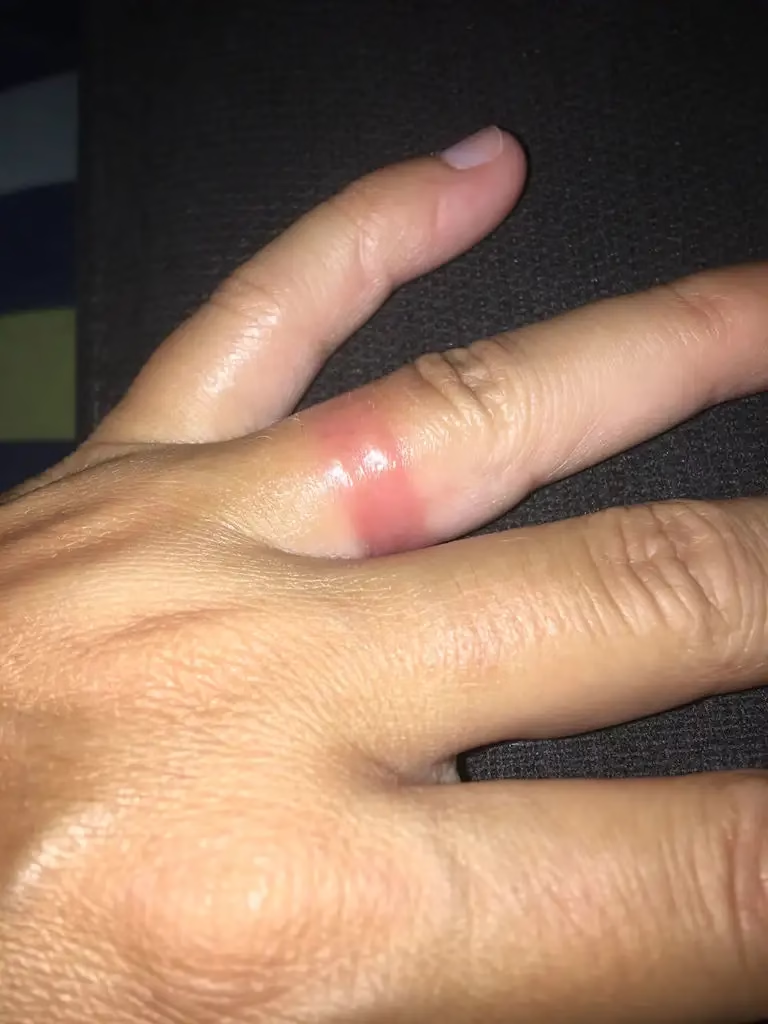
A visible example of a mild gold allergy reaction, where the skin becomes red, itchy, and inflamed beneath a ring. Such gold allergy symptoms often occur when the skin comes into contact with alloy metals like nickel or copper found in lower-karat gold, rather than pure gold itself.
Gold Allergy Symptoms
If you develop an allergic reaction to gold (or more precisely, to metal in a gold alloy), it will show up mainly on your skin. The hallmark of a gold allergy is a form of allergic contact dermatitis, essentially a rash that occurs where your skin touches the gold item. Gold allergy symptoms typically include: redness, an itchy rash, and mild swelling at the contact site. The skin may feel irritated or burning, and you might see it become dry, flaky or scaly with continued exposure. Oftentimes the rash is confined to the exact area the jewellery was worn, for example, a band of redness under a ring, or itchy earlobes where earrings were inserted.
In mild cases, the reaction might just be a bit of itching or slight redness that appears after wearing a gold necklace or ring for several hours. You might notice your ring finger becomes pink and itchy by the end of the day, then improves once you take the ring off. In more pronounced cases, the skin can develop blisters or hives and become very uncomfortable. The rash can also darken or leave discoloured spots as it heals (a result of inflammation), especially if you’ve been scratching it. If the exposure continues (say you keep wearing the offending jewellery), the rash can spread or turn into chronically thick, dry patches of skin.
Notably, a gold-induced contact dermatitis is a localised skin reaction. You won’t get systemic symptoms like sneezing or breathing trouble from a gold allergy, it’s not like a food allergy or hay fever. Instead, you’ll see skin changes: a rash, itchiness, and maybe minor swelling right where the gold touched you. The timing can vary: some people get a reaction within a day or two of wearing the item, while others might only notice a problem after repeated wear over weeks or months. But once your immune system is sensitised, the pattern tends to repeat consistently, each time you wear that gold piece (or any metal containing the allergen), the same rash flares up in that area.
If you suspect a gold jewellery allergy, pay attention to where symptoms appear. Common sites are earlobes (from gold earrings), fingers (rings), wrists (bracelets or watch bands), and neck (necklaces). Sometimes a rash from a gold ring can also show up as dryness or cracking under the ring, which people might mistake for eczema or just irritation from soap. But if it consistently happens with certain jewellery, allergy is likely. One clue is if switching to higher-purity gold or hypoallergenic metal makes the problem go away – that suggests it was the alloy (nickel, etc.) causing the reaction, not the gold itself.
Gold Allergy Reaction
A gold allergy reaction usually looks like a typical contact dermatitis, but its severity can range from very mild to quite irritating. If it’s your first time experiencing a reaction to gold, you might only see a slight rash or some itchiness after wearing the piece for a while, and it may clear up quickly once you remove the jewellery. Early or mild reactions can be easily overlooked, perhaps just a bit of dryness under a ring or minor itching that you dismiss. However, with repeated exposure or higher sensitivity, the reactions can become more intense.
In a more severe allergic reaction to gold, the skin under the jewellery can become intensely red, inflamed, and swollen. You might develop blistering or weeping sores in the area if the contact continues and the irritation is significant. The itching can be severe, and the urge to scratch may actually worsen the rash. Some people even develop a persistent eczema-like rash that lasts for days or weeks, especially if they keep exposing the skin to the allergen.
Allergic reactions to metals like gold can also build up over time. Often there is a delay between exposure and reaction onset, because allergic contact dermatitis is a delayed hypersensitivity response. You might wear a gold chain for several days before noticing a rash on your neck, or you could suddenly react to a ring that you’ve worn for years without trouble. Allergies can “switch on” unpredictably, your immune system may have tolerated the metal before, but after enough exposure, it recognised it as a threat and now responds with inflammation. So it’s not unusual to hear someone say, “I wore this wedding ring for a decade, and all of a sudden it’s causing a rash.”
The extent of a gold allergy reaction can vary. Typically, it stays localised to where the metal touched the skin. In rare cases, if the allergy is strong, the rash can spread beyond the contact area or cause a more general flare of dermatitis on the body. For example, someone allergic to gold might primarily get a rash under a necklace, but could also see smaller patches of eczema on the torso or limbs due to immune system activation. This is uncommon but does happen in very sensitive individuals. Additionally, touching the area of contact and then touching other parts of your body can transfer tiny particles of the allergen. People have reported reactions like eyelid dermatitis or face rash from gold, not because gold directly touched their face, but because they handled a gold item (or had residue on their fingers) and then touched their face or eyes. The thin skin of the eyelids is especially prone to show allergic rashes. So if you ever notice an unexplained rash on your eyelids and you wear rings, it could be from inadvertently transferring gold/nickel particles when rubbing your eyes.
It’s also worth mentioning that not all skin irritation from jewellery is an allergy. Irritant dermatitis can occur if a ring is too tight or if soap and moisture get trapped under it, causing redness. This isn’t an immune allergic reaction but can look similar. A key difference is that a true gold allergy will tend to occur every time you wear the offending piece, and often gets a bit worse each time, whereas a one-off irritation might not consistently reappear with the jewellery. A dermatologist can help distinguish the two if in doubt.
In summary, a gold allergy reaction can range from a nuisance rash that appears only after prolonged contact, to an acute dermatitis that flares up quickly and can become quite uncomfortable. The good news is that once you pinpoint the cause (and remove that metal from contact with your skin), the rash should gradually settle down. Skin allergies are manageable as long as you avoid or minimise exposure to the trigger.
How To Test For Gold Allergy?
If you suspect you’re allergic to gold (or the metals in your gold jewellery), the definitive way to know is through an allergy test, specifically, a patch test performed by a dermatologist. Testing for gold allergy isn’t something you can do with a quick blood test or scratch test like some other allergies; instead, doctors use a patch testing method to check for contact allergens. In a patch test, small amounts of common allergens are applied to patches (usually little discs or squares on adhesive tape) which are then placed on your skin (often on your back) for around 48 hours. To test for gold allergy, the doctor will use a tiny sample of a gold compound, typically gold sodium thiosulfate, which is a salt that contains gold and is standard for patch testing. Don’t worry, these test patches won’t make you systemically ill; they just sit on the surface of your skin to see if a local reaction occurs.
After about two days, the patches are removed and the doctor checks your skin for any reaction under each patch. Sometimes an initial reading is done at 48 hours and then another at 72 or 96 hours, because reactions to metals like gold can be delayed. If you have a gold allergy, the skin under the gold patch will typically show redness, possibly a small eczema-like rash or even a few tiny blisters, indicating your immune system responded to that substance. The doctor will interpret the results, a positive patch test to gold confirms that your body has been sensitised to gold (or more likely, to gold in the form it was tested, which again could indicate alloy issues).
It’s important to note that patch tests might reveal an allergy even if you haven’t had obvious symptoms before. Some people test positive to gold but never recall a rash from jewellery, this can happen because gold allergy can sometimes be subclinical (not manifesting clearly) or because it was causing subtle issues they didn’t connect to their jewellery. Conversely, you might have a negative gold patch test but still react to a piece of jewellery; in such cases, the allergen could be something else in the metal (like nickel, which would be tested separately, or even the metal plating). Therefore, doctors often include a panel of metal allergens (gold, nickel, cobalt, etc.) in the patch test to cover all bases.
Besides formal patch testing, another “test” is simply observing your reactions. If you swap your gold ring for a high-purity 24K gold or platinum ring and the rash disappears, that’s a strong clue that something in the lower-karat gold was causing your allergy. Similarly, testing jewellery with a nickel spot-test kit (available in pharmacies) can tell you if nickel is present, if it is, and you react to that piece, nickel is likely the offender. However, these DIY approaches only go so far. For a clear answer, seeing a dermatologist for patch testing is the gold standard (no pun intended) for diagnosing a gold allergy.
Remember that if you do have a confirmed gold allergy, it’s wise to also test for other metals. Often, people allergic to gold are also allergic to nickel, and sometimes to cobalt or other metals used in jewellery. Knowing all your triggers helps you avoid future rashes. The good news is that once you’ve identified the cause, you can choose jewellery and other products that are free of that allergen, and your skin will stay much happier.
Frequently Asked Questions
Can you be allergic to gold?
Yes, you can be allergic to gold, although it is uncommon. Most people who experience reactions are allergic to other metals mixed with gold, such as nickel or copper. Pure gold (24 karat) is generally hypoallergenic, but lower karat gold contains more alloy metals that can cause rashes, itching, and irritation. People with metal sensitivities should choose high-purity gold, platinum, or titanium jewellery to avoid allergic skin reactions.
What is a gold allergic reaction?
A gold allergic reaction is a type of allergic contact dermatitis that occurs when the skin reacts to gold or metals mixed with it. Symptoms include redness, itching, swelling, and sometimes blistering at the site where the jewellery touches the skin. The rash can appear within hours or days of exposure and may last for several days. Removing the jewellery and using soothing creams can help reduce inflammation and discomfort.
Why am I suddenly allergic to gold?
You may suddenly become allergic to gold if your immune system has developed sensitivity after repeated exposure to gold or the metals alloyed with it. Nickel, commonly used in white or low-karat gold, is a frequent cause. Allergies can appear later in life, even after years of wearing jewellery without issues. Hormonal changes, skin barrier damage, or increased exposure can also trigger a delayed allergic response to metal components in gold.
Can you be allergic to white gold?
Yes, you can be allergic to white gold because it often contains nickel, a common allergen. Nickel is used to give white gold its silvery colour and hardness, but it can cause skin irritation and rashes in sensitive individuals. Even if white gold is rhodium-plated, the coating can wear off over time, exposing nickel beneath. Nickel-free white gold or palladium-based alloys are safer options for those with metal allergies.
How to test for gold allergy?
A dermatologist can confirm a gold allergy through a patch test, where small amounts of gold salts are applied to your skin and monitored for a reaction over several days. This identifies whether your immune system reacts to gold or to other metals in the alloy. If you suspect an allergy, avoid wearing gold temporarily before testing. Nickel and cobalt testing are also recommended, as these metals often coexist with gold in jewellery.
Can you be allergic to fake gold?
Yes, allergic reactions are more common with fake or gold-plated jewellery than with real gold. Fake gold often contains base metals like nickel, brass, or copper, which can irritate the skin and cause itching or rashes. When gold plating wears away, these metals come into direct contact with the skin, triggering allergic dermatitis. People prone to skin allergies should choose nickel-free or hypoallergenic jewellery to prevent such reactions.
Can you be allergic to gold earrings?
Yes, some people are allergic to gold earrings, especially those made from lower-karat gold that includes nickel or copper. Symptoms usually appear on the earlobes as redness, itching, swelling, or small blisters after wearing the earrings. Because pierced skin is sensitive, reactions can be stronger in the ears. Choosing high-purity gold, surgical-grade titanium, or platinum earrings helps avoid irritation and keeps newly pierced ears healthy and free from allergic flare-ups.
Can you become allergic to gold?
Yes, you can develop an allergy to gold even if you have worn it for years without problems. Allergic contact dermatitis can appear after long-term exposure as your immune system gradually becomes sensitised to metals within the alloy, often nickel. Once an allergy forms, reactions can happen more quickly each time you wear gold. Switching to higher-purity gold or hypoallergenic alternatives usually prevents further irritation and reduces allergic symptoms.
Why am I allergic to gold?
If you are allergic to gold, your skin is likely reacting to metals used to strengthen it, such as nickel, copper, or zinc. These alloy metals can trigger your immune system to release inflammatory chemicals that cause itching and redness. True allergy to pure gold is very rare, but lower-karat gold often contains these reactive metals. Opting for 18- to 24-karat gold, platinum, or nickel-free jewellery can prevent allergic flare-ups.
Interested in selling gold with the UK’s highest paying gold buyer? Visit our Sell Gold page to get a competitive valuation – we provide fully insured postage and fast payment.
For more insights and the latest gold price today, keep an eye on our live charts and blog updates.