How Much Gold Does The UK Have?
The United Kingdom currently holds around 310 metric tonnes of gold in its official reserves. This makes the UK one of the world’s largest holders of gold, though far below the top few countries. All of Britain’s gold is stored by the Bank of England (in its underground vaults), and at current prices (~$3,300 per ounce) this stockpile is worth on the order of $30–36 billion (roughly £25–30 billion). In global ranking, the UK’s gold reserve sits around 17th–18th place (with the largest holders being the USA, Germany, Italy, etc.)
Key Takeaways
- UK Gold Holdings: Approximately 310 tonnes of gold are held as official UK reserves (valued at £25-30 million).
- Location: Almost all UK gold is stored in the Bank of England’s vault at Threadneedle Street, London.
- History: British gold reserves were once much higher – over 2,500 t in 1950 – but were sharply reduced by government sales in the 1970s and early 2000s.
- Global Rank: The UK ranks about 18th in the world by gold reserves. The top holders are the United States (~8,133 t), Germany (~3,352 t) and Italy (~2,452 t).
- Bank of England’s Role: As the UK’s central bank, the Bank of England secures the gold (along with other reserves) and even holds gold for other countries. It maintains roughly 400,000 gold bars (worth over £100 bn) in its vaults.
- Gold in Britain: There are small gold deposits in the UK (in Scotland, Wales, Cornwall, etc.), but the country has no major commercial gold mining – only a few minor and historic mines, and a very low annual production.
How Much Gold Does The UK Have?
Britain’s official gold reserves stand at about 310 tonnes. This figure has been stable for the past decade (around 310–314 t since 2010) and is all held by the UK government in the Bank of England vault. In value terms, 310 t equals roughly 11 million troy ounces. At current gold prices (~$3,300/oz as of April 2025), that is on the order of $30–36 billion (approximately £25–30 billion). In percentage of foreign reserves, gold makes up a significant portion of the UK’s assets, but the UK’s gold stockpile is modest compared to its economy.
By global standards, the UK ranks in the top twenty for national gold reserves. The United States leads with about 8,133 t, followed by Germany (3,352 t), Italy (2,452 t), France (2,437 t), and so on. The UK’s ~310 t is well below these leaders, placing it roughly 17th–18th in the world. (By contrast, its larger reserve competitors store their gold mostly outside their borders, while the UK’s is primarily on-site at the Bank of England.)
The UK’s entire gold reserve is held at the Bank of England vaults, under Threadneedle Street in London. In fact, the Bank of England’s vault contains an estimated 400,000 gold bars (some for the Bank itself, but mostly for the UK government and foreign custodial accounts). Only the New York Federal Reserve (holding much of the U.S. gold) stores more bars. This means that Britain’s gold is secure in one location, though it could be used by the government as needed (e.g. for loans or swaps) if policy required. No recent sales or purchases by the UK have changed this 310 t figure; the level has been essentially unchanged since the early 2000s.
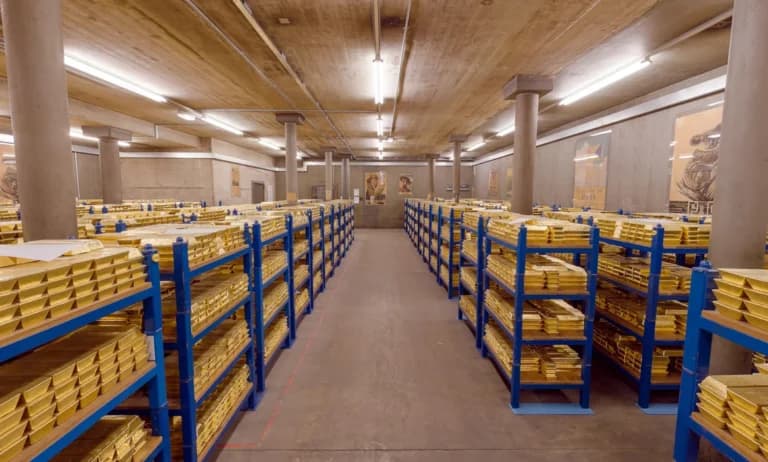
(This photo shows part of the Bank of England’s underground vaults, where the UK gold reserves are stored. These vaults hold over 310 tonnes of gold for the UK government, along with additional gold for other central banks and institutions)
UK Gold Reserve History
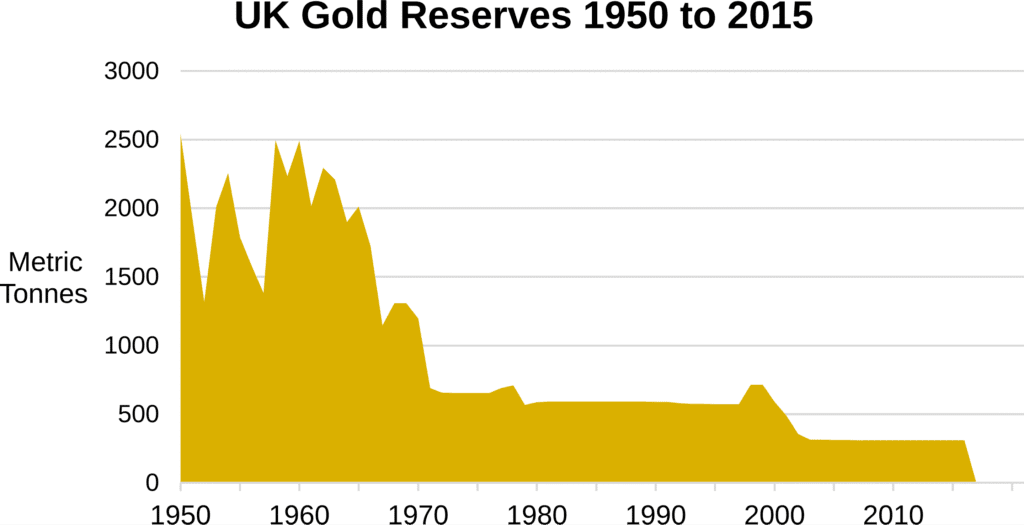
(Historical UK gold reserves (in tonnes) from 1950 to 2018. Large sales around 1970 and 2000 led to steep declines)
Britain’s gold reserves history shows that holdings were once much higher. In 1950 the UK had about 2,543 tonnes of gold. During the 1950s and 60s those reserves gradually declined. A major policy change occurred in 1970 when the government sold nearly half of the remaining gold (around 650 t) to support the pound and meet IMF obligations. After 1970, reserves hovered around 600–650 t for several decades.
The next big reduction came in 1999–2002 under Chancellor Gordon Brown. He famously sold about 415 t (roughly half of Britain’s gold) at then-historic lows to diversify UK foreign assets. (That move later became controversial when gold prices rose sharply.) By 2002 UK reserves had fallen to ~310 t. Since then, the reserve level has remained roughly constant (fluctuating slightly around 310–314 t). In summary, the gold reserves in UK – once in the thousands of tonnes – were whittled down by two large sales (around 1970 and 2000–2002) to the current ~310 t.
The long-term trend of British gold reserves is therefore sharply downward. The chart above illustrates this: after 1950 the line drops through 1970 and again in 2000. These declines reflect policy decisions, not physical loss of gold (the metal simply changed ownership). Today’s modest reserve (~5% of its 1950 peak) is a legacy of that history.
Gold Reserves By Country
The UK’s ~310 t is relatively modest compared to the world leaders. The top holders of gold reserves (as of 2025) are, in order:
- United States – 8,133 t
- Germany – 3,352 t
- Italy – 2,452 t
- France – 2,437 t
- Russia – 2,336 t
- China – 2,264 t
- Switzerland – 1,040 t
- India – 854 t
- Japan – 846 t
- Netherlands – 612 t
Beyond the top 10, other major holders include Turkey (~595 t), Taiwan (~423 t), Poland (420 t), Portugal (383 t), Uzbekistan (374 t), Saudi Arabia (323 t), and then the United Kingdom (~310 t) at about rank 17. The remaining top-30 list (descending) includes countries like Kazakhstan (296 t), Lebanon (287 t), Spain (282 t), Austria (280 t), Thailand (235 t), Singapore (228 t), Belgium (227 t), Algeria (174 t), Venezuela (161 t), Iraq (152 t), Libya (147 t), Brazil (130 t), and the Philippines (128 t). Together, these figures cover the largest national gold reserves.
The question “which country has the most gold?” is answered by the United States (8,133 t), followed by Germany and Italy. The UK, with its ~310 t, is far down the list by comparison. (For context, the UK’s economy is much larger relative to its gold holding, whereas some smaller countries like Belgium or Lebanon still appear on the list at ~150–280 t.) All of these figures come from official data (primarily IMF reporting compiled by the World Gold Council.)
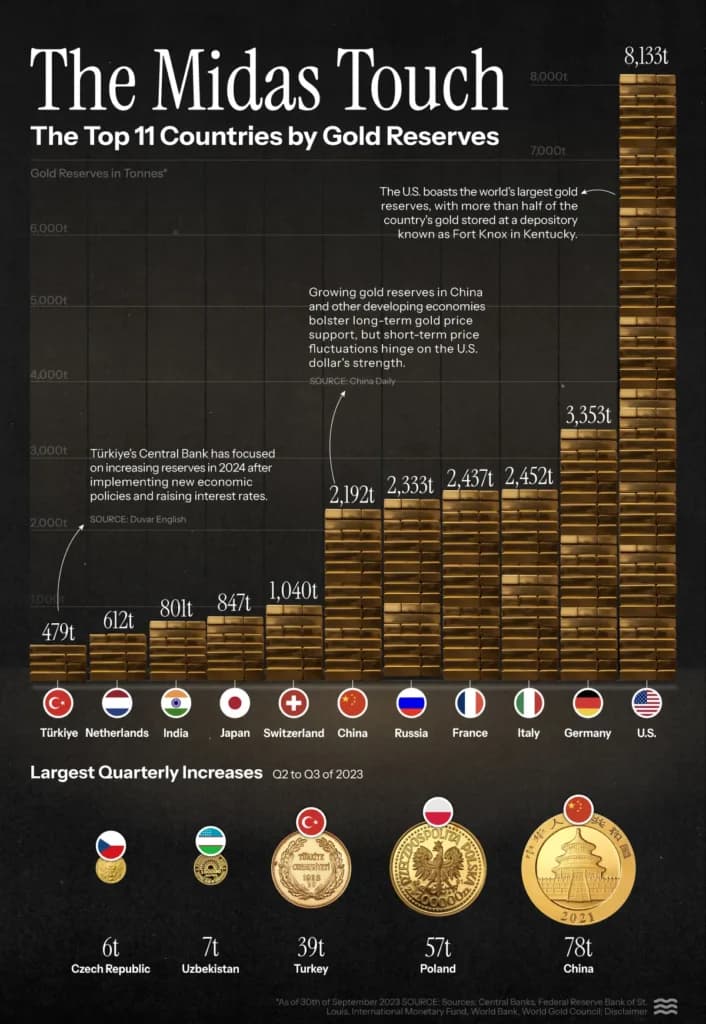
(Infographic illustrating gold reserves by country, showing the United States as the country with the most gold)
What Is The Bank Of England?
The Bank of England is the United Kingdom’s central bank (founded in 1694), responsible for monetary policy, issuing currency, and managing the nation’s official reserves. In terms of gold, the Bank of England acts as custodian. It holds all of the UK government’s gold and also provides vaulting services for other central banks and institutions. In fact, the Bank’s vault contains about 400,000 gold bars (worth over £100 billion), making it the second largest depository of gold in the world after the U.S. Federal Reserve. Most of the UK’s gold reserve is physically inside the Bank of England (underground vaults beneath Threadneedle Street in the City of London). Only a small portion of gold stored there is actually owned by the Bank itself; the rest belongs to the UK government and to foreign entities that use London as a safe storage location.
Where Is The Bank Of England?
The Bank of England’s headquarters is located at Threadneedle Street in the City of London (often called “The Old Lady of Threadneedle Street”). Its famous gold vaults are deep underground at this site. During World War II, Britain even moved gold to Canada for safekeeping, but today all of the remaining UK gold reserves are back under Threadneedle Street. (This London location means the UK’s gold is highly secure and centralised.)
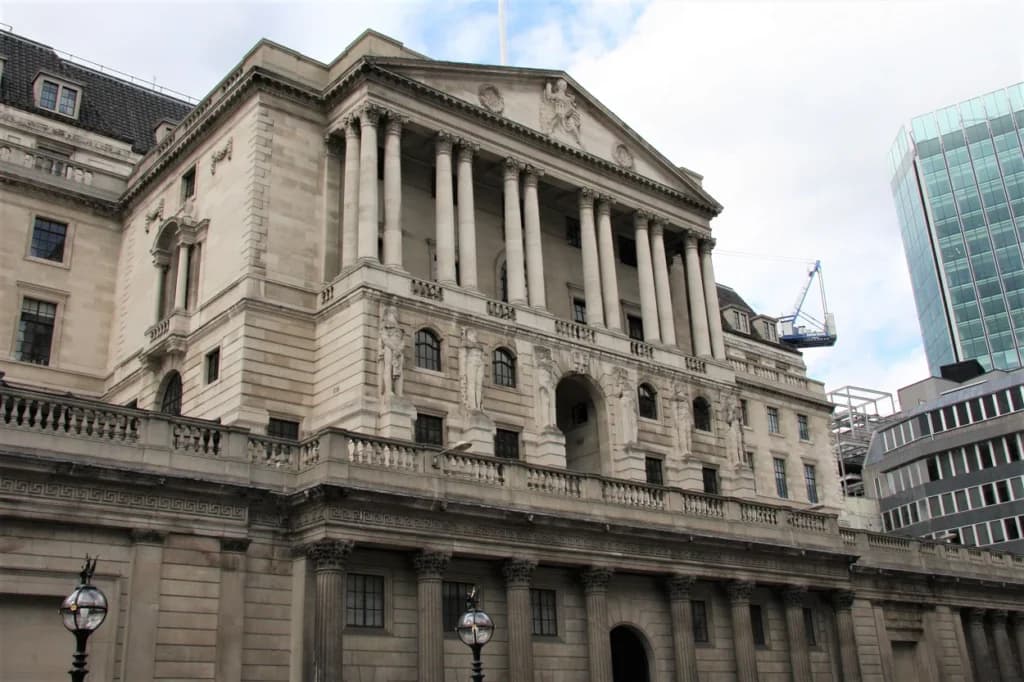
(This is the Bank of England’s headquarters on Threadneedle Street in central London. Known as the UK’s central bank, it also houses the country’s gold reserves in vaults deep beneath the building)
Is There Gold In The UK?
Yes – though only in very limited quantities. The UK has natural gold occurrences, primarily in Wales and Scotland (and a few in England). For example, the Dolaucothi Gold Mines in Wales were worked by the Romans and intermittently in modern times, and the Clogau mine in North Wales produced famed “Welsh gold” for royal wedding rings. In Scotland, a mine at Cononish (Tyndrum) was reopened in 2016 and produces a few hundred kilograms per year. There are also small gold veins in Cornwall (Southwest England) and in the Lake District, and placer gold can be panned from streams in some areas. However, gold in the UK is very scarce. These deposits have never been large enough to make the UK a significant gold producer; current production is measured in mere tonnes or kilograms. In short, gold can be found in the UK, but only modest amounts in certain regions.
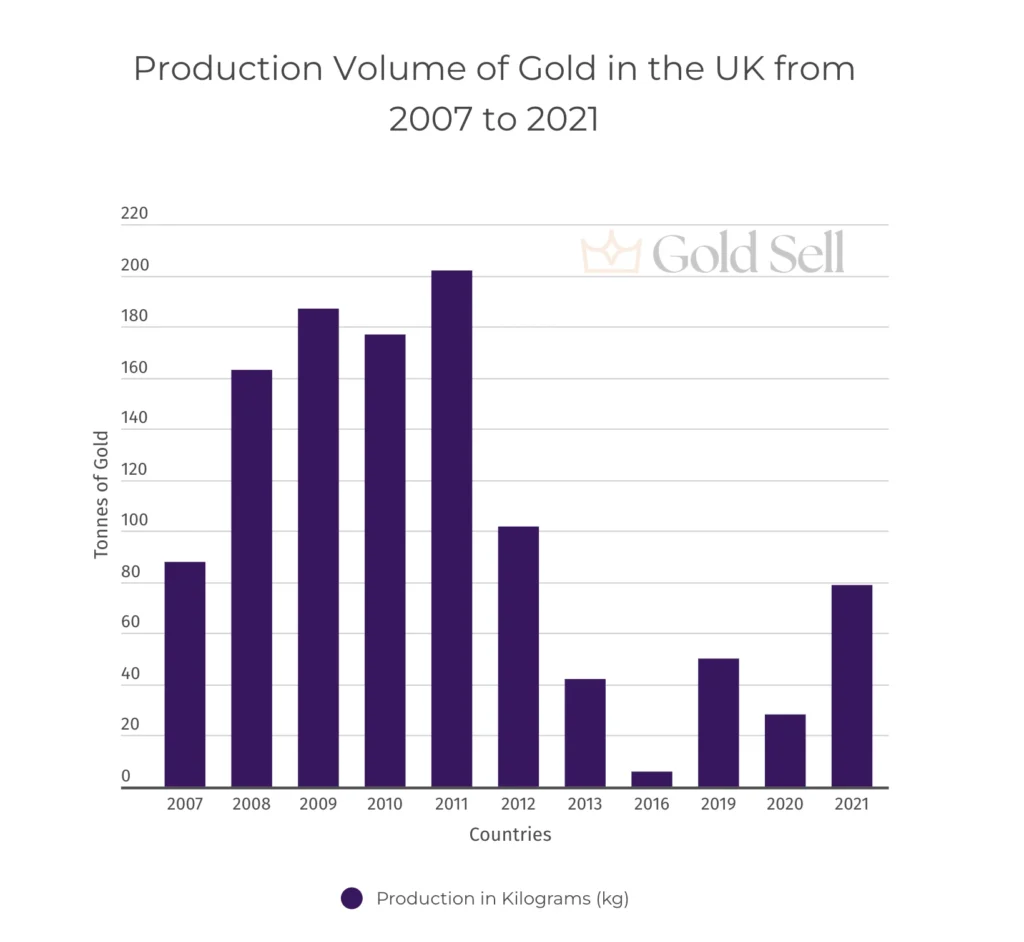
(This chart shows UK gold production from 2007 to 2021, highlighting a peak in 2011 at around 200 tonnes before a sharp decline. The data illustrates how limited and inconsistent domestic gold output has been, supporting the fact that while gold can be found in the UK, it is not a major gold-producing country)
UK Gold Deposits Map
The limited UK gold deposits are scattered in a few regions. In Wales, geological faults in the Armorican arc yielded the Dolaucothi and Clogau goldfields (south and north Wales, respectively). In Scotland, the Southern Uplands (Leadhills, Cononish) contain small quartz-gold veins. Cornwall has gold in veins and old mine tailings, but nothing exploited on a large scale. Apart from these known sites, Britain has no major gold mining districts. (A map of UK gold occurrences would show only these isolated pockets rather than extensive belts.) There is no new large deposit known, and prospecting yields few new finds. In practice, all gold in the UK comes from these historic mines or is imported and held in reserve; the country relies on foreign sources for any significant gold usage.
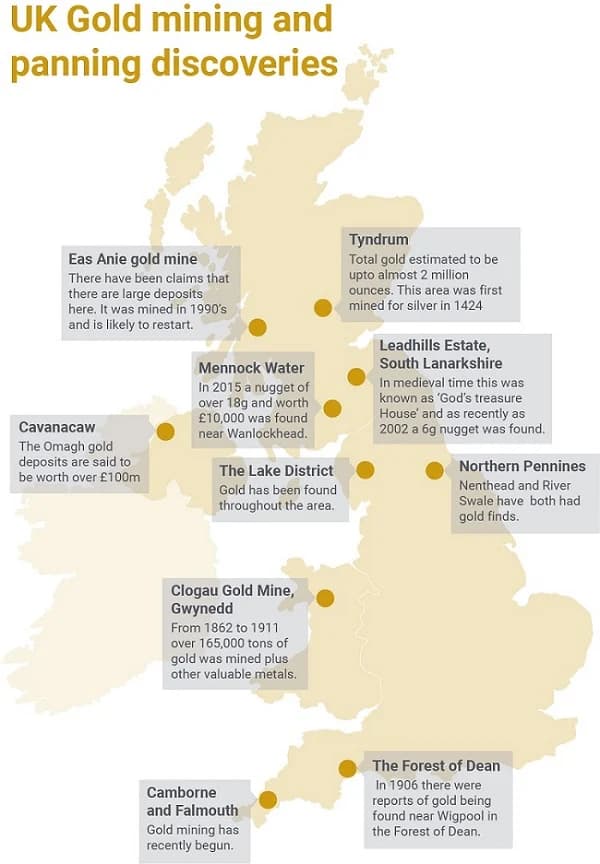
(This UK gold deposits map shows key locations where gold has historically been mined or discovered in the UK. While gold can be found across the UK, these deposits are generally small and have not supported large-scale commercial mining)
Frequently Asked Questions
How much gold reserves does the UK have?
As of 21 Oct 2026, the UK holds about 310 metric tonnes of gold in official reserves, equivalent to around 310,000 kilograms.
What is the value of the UK’s gold reserve?
As of 21 Oct 2026, the UK gold reserve is worth approximately $30–36 billion (or £25–30 billion), based on today's live gold price of £3,088.73 per troy ounce.
Why does the UK have low gold reserves?
The UK’s gold reserves are low due to major government sales, especially in 1970 and between 1999–2002, which reduced the total from over 2,500 tonnes to around 310 tonnes today.
Which country has the most gold reserves?
The United States holds the largest gold reserves in the world, with approximately 8,133 tonnes. Germany and Italy are next, with ~3,352 and ~2,452 tonnes respectively.
Why did the UK government sell its gold?
The UK sold much of its gold between 1999 and 2002 to diversify its assets. The Treasury believed gold was volatile and chose to shift reserves into foreign currencies instead.
Can gold be found in the UK?
Yes, gold can be found in the UK, but only in small quantities. Gold-bearing rocks and historical mine sites exist in Wales, Scotland, and parts of England, but commercial-scale deposits are rare.
Are there gold mines currently operating in the UK?
There are only a few small gold mines in the UK today. The most notable is the Cononish mine in Scotland, which produces limited amounts. No large-scale commercial gold mines are active.
Interested in selling gold with the UK’s highest paying gold buyer? Visit our Sell Gold page to get a competitive valuation – we provide fully insured postage and fast payment.
For more insights and the latest gold price today, keep an eye on our live charts and blog updates.