How Much Gold Is In A Gold Bar?
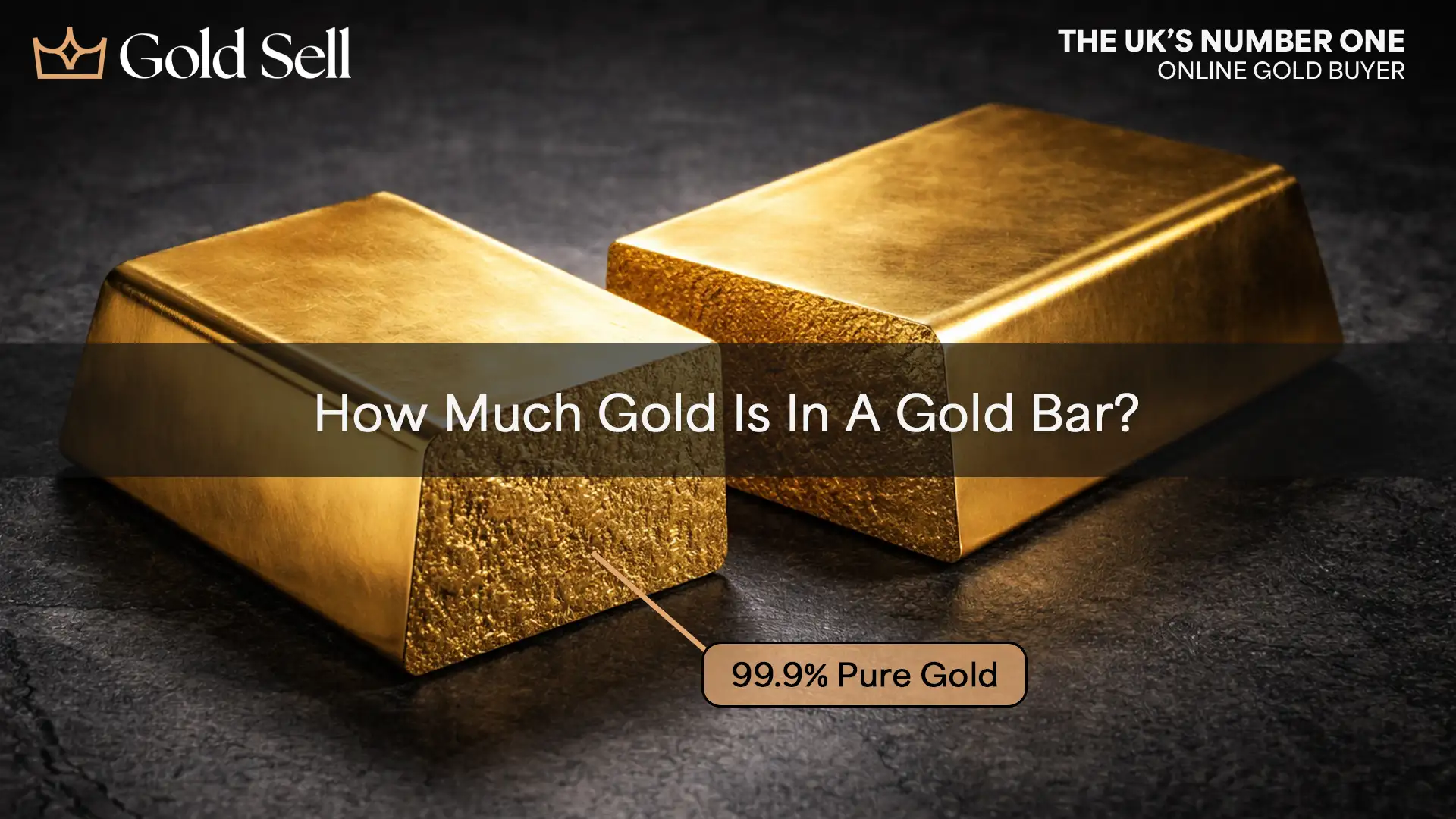
A gold bar is almost entirely gold, most investment bars are 99.9% pure (or higher). At GoldSell, it’s one of the most common questions we hear, especially when you start comparing sizes like 1g, 1oz, 100g and 1kg.
Key Takeaways
- Most gold bars contain: 99.9% gold (marked “.999”) or 99.99% gold (marked “.9999”), so almost all of the bar’s weight is gold.
- Gold bars come in many sizes: from 1g right up to 1kg for everyday investors, plus wholesale bars like the ‘Good Delivery’ bar used in the London bullion market.
- Gold is extremely dense: so even a small bar can feel surprisingly heavy in your hand.
- In the UK: qualifying investment gold is VAT-free, but gold bars are not CGT free, which is why many investors also consider UK legal-tender bullion coins.
- Buy from reputable UK dealers: with insured delivery, transparent pricing and clear buy-back policies.
How Much Gold Is In A Gold Bar?
Most gold bars are made from near-pure gold, typically 99.9% (marked “.999”) or even 99.99% (marked “.9999”). In plain English, that fineness number tells you how many parts per thousand are gold: 999 = 999 parts gold, 1 part other metals (usually tiny trace elements). That’s why “24ct” bullion bars are widely described as “pure gold” in everyday investing language.
It’s also worth knowing that the global wholesale benchmark, the London Bullion Market Association ‘Good Delivery’ standard used for major market settlement, sets a minimum acceptable fineness of 995.0 parts per thousand (99.5%), alongside specific requirements for markings like serial number, refiner stamp, fineness and year of manufacture. In other words: retail bars are usually “three nines” or “four nines”, but the professional benchmark is “at least 995” for large-market deliverable bars.
A common point of confusion is the word “hallmark”. In bullion, people often use “hallmark” to mean the fineness stamp (e.g., 999 / 999.9) and the refiner’s mark. Strictly speaking, UK hallmarking is an assay-office process used for many precious-metal items sold as such, but there are exemptions (including coins) and a different practical reality for bullion, which is normally stamped by a mint/refiner for trade rather than sold as crafted jewellery.
A quick way to calculate the actual gold content
If you want to be super precise, you can estimate the “fine gold” inside a bar like this:
Fine gold weight = bar weight × fineness
Examples (to make it real):
- 100g bar stamped 999.9: 100g x 0.9999 = 99.99g of gold (0.01g is other trace metals)
- 1kg bar stamped 999: 1,000g x 0.999 = 999g of gold (1g is other trace metals)
In practice, at .999 or .9999 fineness, the “non-gold” part is tiny—and for most investors, the market value is driven almost entirely by the gold weight.
Gold bar sizes, and what each is typically used for
Gold bars come in a huge range of denominations, but UK buyers most often see sizes from 1g up to 1kg.
Below is a practical guide to what each size is typically used for (and why people choose it):
This pattern isn’t just a UK phenomenon, either: research into physical gold buying behaviour consistently shows that very small bars are often chosen for gifting, while larger bars resonate with higher-value buyers who are prioritising gold accumulation and long-term holding.
Finally, you’ll often hear investors talk about “minted” versus “cast” bars. In general, smaller bars are commonly minted and packaged (often in tamper-evident assay cards), while larger bars are frequently cast “ingot-style” for cost efficiency.
How Heavy Is A Gold Bar?
A gold bar can weigh anything from 1 gram to over 12 kilograms, and even the small ones feel surprisingly heavy because gold is extremely dense. Gold’s density is about 19.32 g/cm³ at room temperature, which is why a “not that big” piece of gold can still feel like a proper lump in your hand.
To put that density into perspective, a 1kg bar of gold has a volume of only about 52 cm³ (that’s roughly the volume of a small box), because gold packs a lot of mass into a small space.
Common gold bar weights you’ll see (UK investor view)
Gold is commonly measured in troy ounces in the bullion trade. One troy ounce is defined as 31.1034768 grams (exactly), and the industry conversion commonly used is 1 kg = 32.1507 troy ounces.
Common investment sizes include:
- 1 oz: (a very common global “standard” size)
- 10 oz: (chunkier, often better value per oz than 1 oz)
- 100g: (popular for building a meaningful holding without going straight to kilo territory)
- 1 kg: (often chosen for efficiency per gram)
At the other end of the spectrum is the wholesale market standard: the ‘Good Delivery’ gold bar used for settlement in the London bullion market. These bars are permitted within a weight range of 350 to 430 fine troy ounces (roughly 10.9 to 13.4 kg) and sit around the widely referenced “400 oz” size.
What’s the biggest gold bar in the world?
Gold bars can vary dramatically in weight, from as little as 1 gram to several hundred kilograms, and their density often surprises first-time buyers. The current world record for the largest gold bar is 300.12 kg, achieved by Emirates Minting Factory LLC in Dubai on 10 November 2024, and is estimated to be worth around $24–$25 million at current gold prices. Before this, a widely recognised record-holder was the 250 kg gold bar displayed at the Toi Gold Museum in Izu, Japan, which remains one of the most famous large-scale gold bullion examples ever produced.

The biggest gold bar in the world weighs an astonishing 300.12 kilograms, highlighting just how dense and heavy gold is compared to its size. While most investors buy much smaller bars such as 1oz or 1kg, this record-breaking example demonstrates the scalability of gold bullion and why even modest-sized bars can feel surprisingly heavy in hand.
Where Can You Buy Gold Bars?
In the UK, you can buy gold bars securely online from established bullion dealers and mints, provided you stick to reputable names and insured delivery. A smart first filter is to ensure the product qualifies as investment gold, which (for bars) means at least 995 thousandths purity and a weight accepted by bullion markets, this is the definition used in UK VAT guidance for VAT-exempt investment gold.
For UK buyers, reputable online options commonly include:
- BullionByPost: (wide range from small bars up to wholesale sizes, with insured delivery)
- The Royal Mint: (minted Britannia bars and larger cast bars; UK delivery options)
- GOLD.co.uk: (24ct investment bar range, certificate, insured delivery and vaulting options)
- Hatton Garden Metals: (bars from 1g to 1kg, insured delivery and certificates)
- Atkinsons Bullion: (bars from 1g to 1kg, with fully insured UK delivery)
A quick “buyer’s checklist” (worth doing once)
If you’re buying gold bars online for the first time, these checks dramatically reduce risk:
- Look for clear fineness: (e.g., 999 / 999.9) and weight stated up-front
- Prefer bars from recognised refiners/mints: and reputable UK dealers with a trading history
- Check delivery is fully insured and tracked: not just “signed for”
- Keep invoices/receipts: for your records (especially helpful for future resale and tax)
- Don’t be swayed by deals that look “too good to be true”:
One additional UK-specific point: many sellers clearly state that bullion products are not FCA regulated, meaning you don’t get the same protections that apply to regulated investment products.
And as a general safety habit, it’s sensible to check the Financial Conduct Authority warning list if you’re unsure about a firm’s legitimacy.
Is It Worth Buying Gold Bars?
Gold bars can be worth buying if your goal is long-term, low-premium exposure to physical gold as a store of value, but they’re not perfect for every UK investor. The World Gold Council summarises the investment case well: gold is globally liquid, carries no credit risk, and has historically preserved value over time, attributes that can support diversification and liquidity in a portfolio
Why many investors like gold bars
Gold bars are often chosen because they’re a highly “direct” form of ownership: you’re paying for bullion metal, not collectability.
In pure cost terms, bars (especially larger bars) are frequently attractive because manufacturing can be simpler than with coins, particularly for cast bars, helping to keep premiums down. Even the The Royal Mint explicitly positions cast bars as a cost-effective option, noting that their manufacturer premium is often lower.
Gold is also widely discussed as an inflation hedge over the long run (with the important caveat that short-term performance can be less consistent), and that’s one reason some investors hold it as part of long-term financial resilience planning.
The main downsides to consider (UK-specific)
There are two big practical trade-offs:
First, qualifying investment gold is VAT exempt in the UK (good news), but that doesn’t automatically make it “tax free” overall.
Second, while bullion bars can be VAT-free, they are generally subject to Capital Gains Tax (CGT) when you sell at a profit, so tax can still matter in a big way. In the 2025/26 tax year, CGT rates for “other chargeable assets” are shown at 18% and 24%, depending on your income band.
That’s also why many UK investors weigh bars against UK legal-tender bullion coins (like Sovereigns and Britannias), which HMRC treats as sterling currency and therefore exempt under the relevant CGT rules.
Gold Bar vs Gold Coins For Investment
For investment, gold bars usually win on value per gram, while gold coins often win on flexibility and UK tax advantages. In fact, UK demand patterns have recently shown that some buyers actively favour coins because of the tax angle, reporting has highlighted rising interest in CGT-exempt bullion coins as CGT rules tightened.
Here’s a clear, UK-relevant comparison:
On premiums specifically, it’s helpful to remember there’s no single universal premium, and different products can be priced differently even at the same gold weight; premiums reflect manufacturing, distribution and dealer costs.
On the CGT point, HMRC’s guidance is unusually clear for bullion: post-1837 Sovereigns and Britannia gold coins are treated as sterling currency and are exempt, while non-sterling bullion coins (and bars) don’t get that carve-out.
A sensible “real world” approach many long-term investors take is blending both: a core holding in cost-efficient bars, plus some CGT-exempt coins for flexibility.
Are Gold Bars CGT Free?
No, gold bars are not Capital Gains Tax free in the UK. Capital Gains Tax is a tax on the profit you make when you sell (or otherwise “dispose of”) an asset that has increased in value; it’s the gain that’s taxed, not the amount you receive.
How Capital Gains Tax works in practice
A few rules matter most to everyday investors:
- You have an annual CGT-free allowance: (annual exempt amount). For the 2025 to 2026 tax year, that allowance is £3,000 for most individuals.
- For gains from 6 April 2025 onwards: CGT rates for “other chargeable assets” are shown at 18% (basic rate) and 24% (higher/additional rate), depending on your taxable income and the size of the gain.
Why bars aren’t exempt (but certain coins can be)
The key difference is legal tender status. HMRC treats certain UK legal tender bullion coins (including post-1837 Sovereigns and Britannias) as sterling currency, and sterling currency is exempt from CGT under the relevant rules. Gold bars don’t have that status, so they don’t get the exemption.
Also note: CGT can apply to “personal possessions” (chattels) when disposal proceeds are above certain limits, which can be relevant for high-value bullion.
If you do have CGT to report on bullion gains, UK guidance explains reporting deadlines (for non-property gains, it’s typically reported and paid via Self Assessment timelines).
Frequently Asked Questions
How much gold is in a gold bar?
A gold bar typically contains 99.9% pure gold, often stamped as .999 fine gold, which is considered 24 carat. The exact amount of gold depends on the bar’s size, ranging from 1 gram to 1 kilogram or more. For example, a 100g bar contains 100 grams of nearly pure gold. Most investment-grade gold bars meet standards set by the London Bullion Market Association, ensuring consistent purity and authenticity.
How heavy is a gold bar?
A gold bar can weigh anywhere from 1 gram to over 12 kilograms depending on its type and purpose. Small investment bars such as 1g, 10g, or 1oz are common for private buyers. Larger bars include 1kg bars and the standard 400 troy ounce Good Delivery bar used by central banks, which weighs about 12.4 kilograms. Gold’s high density makes even small bars feel surprisingly heavy for their size.
Where can you buy gold bars?
You can buy gold bars securely from reputable bullion dealers in the UK, both online and in person. Trusted providers include BullionByPost, The Royal Mint, GOLD.co.uk, Hatton Garden Metals, and Atkinsons Bullion. These dealers offer LBMA-approved gold bars in sizes from 1g to 1kg, with insured delivery and transparent pricing. Always choose established sellers to ensure authenticity, proper certification, and secure storage or delivery options.
What are gold bars called?
Gold bars are commonly called bullion bars, gold bullion, or simply gold bars. Larger bars used by financial institutions are known as Good Delivery bars, which meet strict standards set by the London Bullion Market Association. Smaller bars for investors are often referred to as minted bars or cast bars depending on how they are produced. The term bullion generally refers to gold valued by weight and purity rather than face value.
Is it worth buying gold bars?
Buying gold bars is worth it for long-term investors seeking to preserve wealth and hedge against inflation. Gold bars typically have lower premiums than coins, making them more cost-effective for larger investments. They are widely recognised and easy to store securely. However, they are subject to Capital Gains Tax in the UK, which may reduce returns compared to CGT-free gold coins such as Britannias or Sovereigns.
What are the best gold bars to buy for investment?
The best gold bars for investment are typically LBMA-approved bars from recognised refiners such as PAMP, Valcambi, Heraeus, and The Royal Mint. Popular sizes include 1oz, 100g, and 1kg depending on budget and investment goals. Larger bars offer lower premiums per gram, while smaller bars provide greater flexibility when selling. Choosing bars with certification and serial numbers helps ensure authenticity and resale value.
Are gold bars CGT free?
Gold bars are not CGT free in the UK because they are not considered legal tender. Capital Gains Tax may apply when you sell gold bars at a profit above the annual allowance set by HMRC. In contrast, certain gold coins such as Britannias and Sovereigns are exempt because they are legal tender in the UK. Investors often consider this when deciding between gold bars and coins.
What are the best gold bar brands?
The best gold bar brands are those accredited by the London Bullion Market Association, ensuring high standards of purity and quality. Leading brands include PAMP Suisse, Valcambi, Heraeus, Metalor, and The Royal Mint. These refiners produce 24-carat gold bars with .999 or higher purity. Choosing well-known brands improves trust, liquidity, and resale potential, as buyers recognise and value established refiners.
Can I carry a gold bar from UK to India?
Yes, you can carry a gold bar from the UK to India, but strict customs rules apply. Indian authorities allow limited quantities of gold to be imported by passengers, subject to duty charges and declaration requirements. The allowance depends on residency status and length of stay abroad. Failing to declare gold can result in penalties or confiscation, so it is important to check current Indian customs regulations before travelling.
Interested in selling gold with the UK’s highest paying gold buyer? Visit our Sell Gold page to get a competitive valuation – we provide fully insured postage and fast payment.
For more insights and the latest gold price today, keep an eye on our live charts and blog updates.