What Does Karat Mean For Gold?
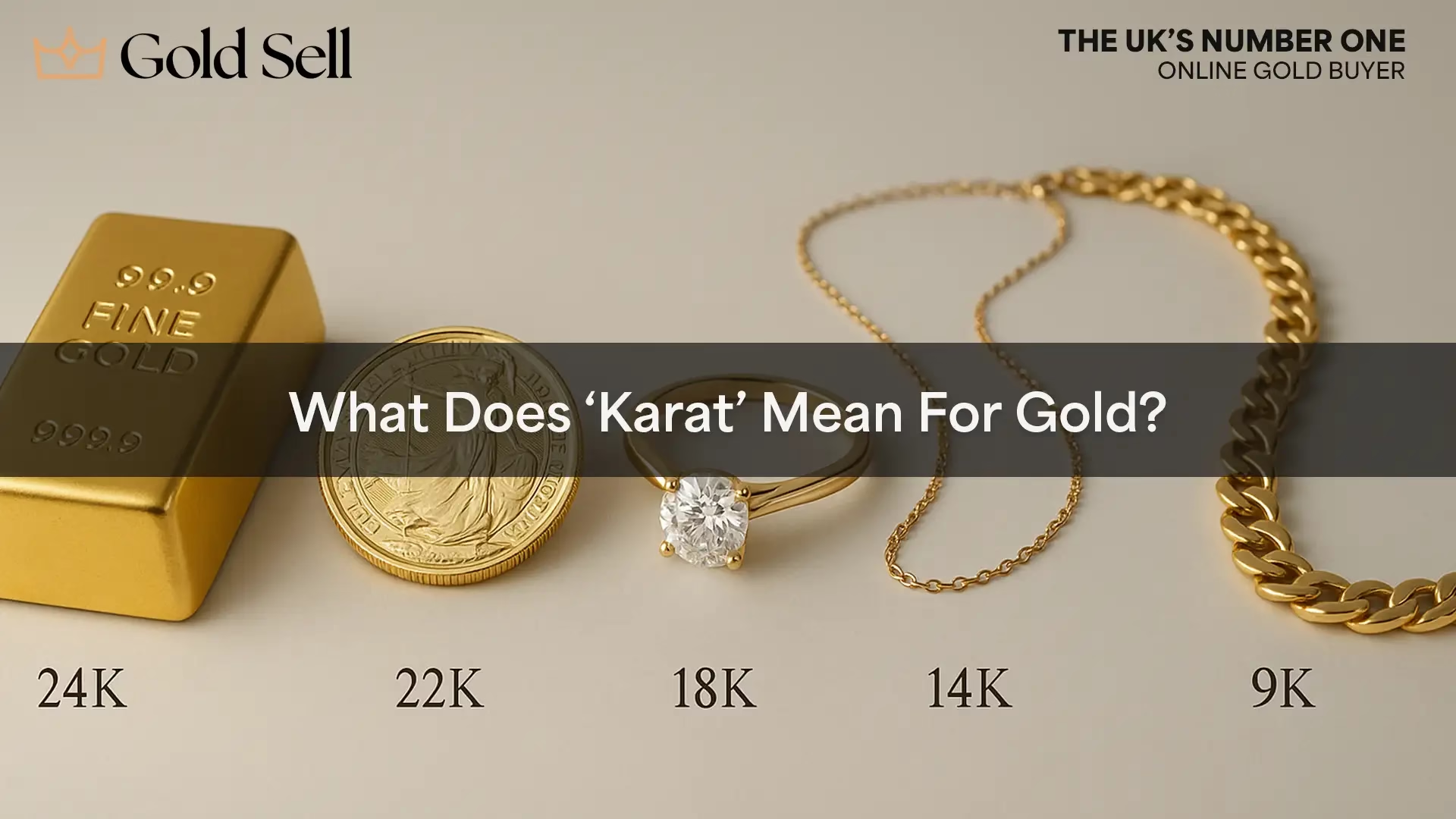
When it comes to gold, karat is the measure of gold’s purity out of 24 parts. In other words, 24-karat gold is pure gold, while any lower karat number indicates that the gold is mixed with other metals in a gold alloy. This article will explain gold karats in detail and answer common questions about the best karat for different uses.
Key Takeaways
- Karat denotes gold purity on a 24-point scale: 24 karat gold is 99.9% pure gold, whereas 18 karat gold is 75% gold, 14 karat is about 58%, and 9 karat only 37.5% gold. The higher the karat, the greater the gold content.
- Higher karat vs lower karat gold: Pure 24K gold is very soft and malleable, so it’s often alloyed with harder metals for durability. Lower karat gold (like 14K or 9K) is harder and more durable, making it ideal for jewellery that will be worn daily, while higher-karat gold (18K, 22K, 24K) has a richer yellow colour and higher value but is softer and more prone to scratches.
- “Best” gold karat depends on usage: For investment or bullion, 24K (99.99% pure) is often preferred to maximise gold value, though some classic bullion coins are 22K for hardness. For jewellery, mid-range purities like 14K or 18K tend to be best, offering a balance of beauty, high gold content, and durability for everyday wear.
- Hallmarks indicate gold purity: Gold items are usually stamped with a hallmark number (parts per thousand) to show purity. For example, “999” means 24 karat pure gold, “750” means 18 karat (75% gold), and “375” means 9 karat gold. In many countries (including the UK), 9K is the minimum caratage legally called “gold”, whereas in the US the minimum is 10K.
What Does Carat Mean For Gold?
Karat, when referring to gold, means the purity of the gold alloy, essentially how many parts of 24 are gold. One gold karat equals 1/24th (4.167%) of the whole, so the karat number tells you the proportion of pure gold in the metal. Pure gold is defined as 24 karat (24/24 parts gold), whereas 12 karat would be 12 parts gold and 12 parts other metals (50% purity), 18 karat is 18 parts gold and 6 parts other metals (75% purity), and so on. Outside the United States the spelling “karat” is commonly used to refer to gold purity, while “carat” (typically used for gemstones) may still be seen in some regions, but both terms refer to gold content.
Gold in jewellery and bullion is rarely 100% pure, it’s typically mixed with small amounts of other metals like silver, copper, zinc, nickel, or palladium to create an alloy. The karat rating tells you the ratio of gold to other metals in that alloy. For example, 18 karat gold is 75% gold and 25% other metals, giving it a fineness mark of “750” (meaning 750 parts gold per 1000 parts alloy). Likewise, 9 karat gold, common in British jewellery, is only 37.5% gold, hallmarked “375”. These hallmarks are a quick way to identify purity: 375 = 9kt, 585 = 14kt, 750 = 18kt, 916 = 22kt, 999 = 24kt, etc.
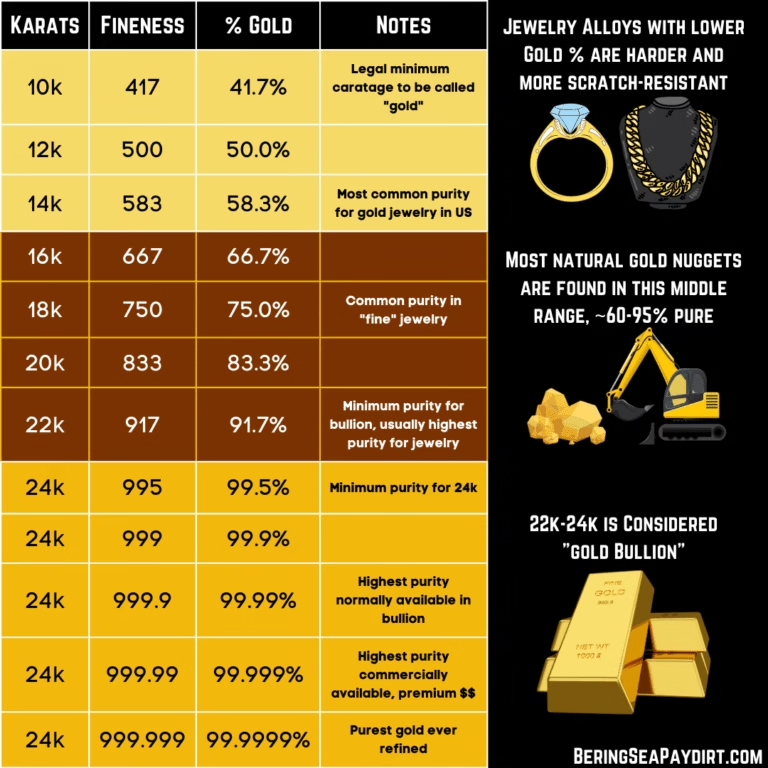
This chart breaks down the purity levels of gold by karat, fineness, and percentage of gold content. It highlights how lower karat gold alloys are harder and more durable, while higher karats like 22K–24K are used for bullion and premium jewellery due to their higher gold content. Use this as a reference when comparing gold purity for investment, durability, or daily wear.
Where did the 24-karat system come from? The use of a 24 part scale for gold purity dates back to medieval times. Historically, a gold coin called a “mark” weighed 24 karats, with “karat” originally being a unit of weight equal to the mass of a carob seed. Pure gold was too soft to be used alone for coins, so other metals like copper were mixed in for hardness. The purity of the coin was then expressed by how many of those 24 karats were actual gold. A coin that was half gold by weight would be 12 karats, and a completely pure gold coin would be 24 karats. This old tradition is why we still use 24 as the basis for measuring gold’s fineness today.
What Karat Gold Is The Best?
There is no single “best” karat of gold for all purposes, the ideal gold karat depends on what you need it for. In general, higher karat gold is more valuable by gold content and has a richer yellow colour, while lower karat gold is more durable and resistant to wear. The “best” gold karat will vary if you’re talking about investment bullion versus everyday jewellery.
For pure value and investment, 24K gold is best. If your goal is to maximise the gold content, for example gold bullion bars or coins to hold value, 24 karat gold (99.99% pure) is typically preferred. 24K contains the most gold by weight, making it the most valuable per gram. It’s the form of gold used in many bullion coins, high value gold bars, and ceremonial pieces. However, 24K gold is very soft, it can bend or scratch easily, so it’s usually not considered the best for jewellery that will be worn regularly.
For jewellery durability, lower karats like 14K or 18K are often best. Gold is alloyed with other metals to make it harder and more suitable for wear. 18K gold (75% gold) is a popular choice for fine jewellery because it strikes a lovely balance, it has a high precious metal content and rich colour, but also enough alloy metals to be harder than pure gold. Many view 18K gold as the ideal mix of luxury and practicality for rings, watches, and other items. 14K gold (58% gold) is even more robust, in fact 14K is the most common choice for engagement rings and everyday jewellery in some countries because its higher percentage of alloy metals makes it tougher and more scratch-resistant. A 14K gold ring will withstand daily wear better than an 18K one, though the 18K will have a slightly yellower hue due to the higher gold content.
Why not always use the highest karat? The reason we don’t use 24K for most jewellery is that pure gold is too soft and bends or wears down quickly. By mixing gold with harder metals like copper, silver, zinc or nickel, the alloy becomes stronger. For example, 14K and 9K gold can endure more rough handling than 22K or 24K. So if by “best” we mean most durable, 10K or even 9K gold would technically be the best because they are hardest. 9K (37.5% gold) contains so much alloy that it can be very sturdy for chains and rings. However, low karat gold has a paler colour and lower intrinsic value, which is why it’s considered a budget option. In the UK and some parts of Europe, 9K and 14K gold are common for affordable, everyday jewellery, precisely because they offer good durability at a lower price point. In contrast, in many Asian and Middle Eastern cultures, people prefer higher karats like 22K for the beauty and value, even though that gold is softer.
In short, the “best” karat depends on context. If you want maximum gold purity for investment or cultural reasons, 22K to 24K is best. If you want jewellery that won’t easily scratch or deform, 14K or 18K gold is better. A good rule of thumb some jewellers give is “buy the highest karat your budget allows for the intended use, but don’t go so high that the piece becomes impractical.” For something like a daily-wear ring or bracelet, that often means 14K or 18K for a balance of beauty and strength. For a collectible coin or gold bar meant to hold value, 24K is king.
Also note that “best” can depend on the colour of gold you want. For example, white gold and rose gold are created by alloying gold with specific metals, white gold with palladium or nickel, rose gold with copper. These are typically seen in 14K or 18K forms. An 18K white gold ring (75% gold, 25% white metals) will have a very slight yellow tinge since it’s still mostly gold and is usually rhodium-plated to appear bright white. A 14K white gold ring (58% gold, 42% white metals) will be naturally a bit whiter due to less gold and is also usually rhodium plated. In this case, the lower karat can sometimes achieve the colour more easily, but both will look similar once plated. Again, it comes down to balancing purity with practical properties.
What Karat Is Gold Bullion?
Most gold bullion is very high purity, typically between 22 karat and 24 karat gold. Bullion refers to gold bars or coins held for investment or value storage, rather than for wearing. To maximise the intrinsic value, bullion usually contains as much gold as possible. Modern gold bullion bars are generally 24K pure gold, often .999 or .9999 fine (99.9% or 99.99% gold). Many popular bullion coins are also 24K, for example, Canadian Gold Maple Leafs, Australian Kangaroo/Nugget coins, and British Britannia coins minted since 2013 are all 24-karat, 99.99% pure gold.
However, some well-known bullion coins are made of 22K gold (91.67% pure). Why would a bullion coin not be pure? The classic reason is durability. A 22K coin includes a small amount of alloy, often copper or silver, to harden it, making it more resistant to scratches and wear if it’s handled or circulated. The South African Krugerrand, introduced in 1967 as the first modern bullion coin, is 22 karats. It contains one troy ounce of pure gold, alloyed with about 0.09 ounces of copper to make the coin harder, bringing the total weight to around 1.09 troy ounces. The American Gold Eagle coins and British Gold Sovereigns are also 22K gold, adhering to the old “crown gold” standard that has been used for gold coins for centuries. Despite being 22K, these coins still contain exactly one ounce, or a fixed fraction of an ounce, of pure gold, with the extra weight made up by the alloy metal.
Examples: The UK’s Gold Britannia coin was traditionally 22K (91.7% gold) up until 2012. From 2013 onward, the Royal Mint upgraded the Britannia to 24K fine gold (0.9999 purity) to compete with other 24K bullion coins. Meanwhile, the Krugerrand (South Africa) remains 22K (91.67% gold), as does the American Eagle. The Canadian Gold Maple Leaf has always been 24K (99.99% pure). In India and much of Asia, 24K small bars and coins called “biscuits” are common for investment, whereas in Western markets 22K coins have also been historically popular. Both 22K and 24K bullion coins are globally traded, the main difference is that 22K coins might be a tiny bit more robust to handle, whereas 24K coins are slightly softer and purer.
Whether 22K or 24K, gold bullion items are typically marked with their purity so buyers know what they’re getting. Gold bars from reputable mints, like a 1 oz bar from Pamp Suisse or Perth Mint, will usually be stamped with a fineness like “999.9” along with the weight and serial number. This indicates essentially 24K pure gold. Bullion coins often have text or symbols indicating purity. For instance, a Canadian Maple Leaf says “9999” (for 99.99% pure) on the coin, and Britannia coins now say “1 oz 999.9 Fine Gold”. A Krugerrand doesn’t stamp “22K” on the coin, but it does say “FYNGOUD 1 OZ FINE GOLD” in Afrikaans and English, signalling it contains one ounce of fine gold, with the rest being alloy. If you see a hallmark like “917” on a coin or bar, that’s another way of expressing 91.7% purity (i.e., 22 karat). Likewise, “999” means 99.9% (24K), and “999.9” means 99.99% pure. These standardised hallmarks are a quick and reliable guide to a bullion item’s karat purity.
In summary, gold bullion is almost always high-karat gold. 24K (pure) is the norm for bars and many coins, while some famous coins use 22K for added hardness. The key is that in either case, you’re getting a very high percentage of gold, at least 91.6% and up to 99.99%. If you are buying bullion as an investment, you will typically look for 22K or 24K gold products, and the item’s purity will be clearly indicated by the mint or dealer for trust and verification.
Frequently Asked Questions
What does karat mean for gold?
Karat is a measure of gold purity on a 24 point scale. 24 karat means pure gold, while lower karats indicate the gold is mixed with other metals. For example, 18K gold is 75% pure gold and 25% alloy. The karat system helps consumers understand how much actual gold is present in a piece of jewellery or bullion. In the UK, common karats include 9K, 14K, 18K, 22K and 24K.
What karat is pure gold?
Pure gold is 24 karat. This means it contains 99.9% or more gold with no significant alloying metals. It has a rich yellow colour and is very soft, making it ideal for investment bars and coins but less suitable for everyday jewellery. Most gold bullion bars and high-purity investment coins are made from 24K gold. Jewellery in 24K is available but can be prone to scratching and bending with regular wear.
What karat gold is the best?
The best karat gold depends on its use. For investment, 24K is best due to its maximum purity and value. For jewellery, 18K balances beauty and durability, while 14K is more robust for daily wear. 9K is affordable but contains less gold. There is no universal “best” karat. Each has trade-offs between purity, price, colour and strength, so the ideal karat varies depending on whether it’s for investment, gifting or daily use.
What karat is dental gold?
Dental gold is typically 16K to 18K, which contains between 66.7% and 75% pure gold. These alloys are selected for their strength, corrosion resistance and biocompatibility. Pure gold is too soft for use in fillings or crowns, so other metals like palladium, platinum or silver are added to improve durability. Dental gold alloys vary in composition depending on their application, but 18K remains one of the most commonly used standards in restorative dentistry.
What karat gold is best for rings?
The best karat gold for rings is usually 14K or 18K. 14K gold contains 58.3% gold and is highly durable, making it ideal for engagement rings or wedding bands worn daily. 18K gold, at 75% purity, offers a richer yellow colour with a balance of luxury and strength. Higher karats like 22K or 24K are softer and more prone to wear, so they are less suited to everyday ring use without extra care.
What karat is gold bullion?
Gold bullion is most often 24 karat, meaning it contains 99.9% or 99.99% pure gold. Bars and modern investment coins like the Britannia and Maple Leaf are typically 24K. Some bullion coins, such as the Krugerrand or American Eagle, are 22K, containing one troy ounce of pure gold plus alloy for durability. The karat is usually marked with a hallmark like 999 or 917 to confirm the purity level of the bullion item.
What karat is Indian gold?
Indian gold is typically 22 karat, which contains 91.6% pure gold. It is favoured for traditional jewellery due to its rich yellow colour and high value. 22K strikes a balance between purity and strength, although it is still relatively soft for intricate designs. In India, 24K gold is commonly used for investment in coins and bars, while 22K is the standard for ornaments, especially during weddings and religious festivals.
What karat gold is 375?
Gold marked “375” is 9 karat gold. This means it contains 37.5% pure gold and 62.5% alloy metals. It is commonly used in British and European jewellery as an affordable, durable option. The hallmark 375 refers to 375 parts per thousand of gold content. Though it has a lower intrinsic gold value, 9K gold is harder and more resistant to scratches than higher karats, making it suitable for daily-wear jewellery on a budget.
What karat is white gold?
White gold can be any karat, but it is most commonly 14K or 18K. It is made by alloying yellow gold with white metals such as palladium, silver or nickel to achieve a paler appearance. The karat indicates gold content, not colour. For example, 18K white gold contains 75% gold, while 14K contains 58.3%. Most white gold jewellery is rhodium-plated to enhance its bright finish and protect the underlying alloy from wear.
Which karat gold is most durable?
9 karat gold is the most durable among commonly used gold types. It contains just 37.5% pure gold, with the remainder made up of harder metals like copper and zinc, which improve its strength and resistance to wear. This makes 9K ideal for items subject to daily friction, such as chains and rings. Although less valuable and paler in colour than higher karats, its durability and affordability make it popular in the UK.
Which karat gold is best for jewellery?
18 karat gold is often considered the best for fine jewellery. It contains 75% gold and 25% alloy metals, offering a luxurious appearance while maintaining enough strength for regular use. It is ideal for high-end rings, necklaces and earrings. For more rugged wear, 14K or even 9K gold may be preferable due to their higher durability. The best karat for jewellery depends on the balance of purity, colour, durability and budget.
Which karat gold is best for investment?
24 karat gold is best for investment as it offers the highest purity and resale value. It is typically found in bullion bars and coins like the Britannia or Maple Leaf, marked with “999” or “999.9”. Investors prefer 24K gold because it holds intrinsic value and is globally recognised. Some coins use 22K for added hardness, but they still contain one troy ounce of pure gold. For maximum gold content, 24K is ideal.
Which karat gold is best for daily use?
14 karat gold is best for daily use. It contains 58.3% gold and a high proportion of alloy metals, giving it strength and resistance to wear. This makes it ideal for engagement rings, bracelets and other jewellery worn regularly. 18K gold is also suitable for daily wear but may scratch more easily due to its higher gold content. 9K gold is more durable but has less gold and a paler appearance.
Interested in selling gold with the UK’s highest paying gold buyer? Visit our Sell Gold page to get a competitive valuation – we provide fully insured postage and fast payment.
For more insights and the latest gold price today, keep an eye on our live charts and blog updates.