
What Is The Gold Standard?
The gold standard was a monetary system where a country’s currency value was directly linked to a fixed quantity of gold. This system aimed to provide long-term price stability but was eventually abandoned due to its limitations in addressing economic fluctuations.
Key Takeaways
- Definition: The gold standard was a monetary system where a country’s currency had a value directly linked to gold. Under this system, paper money could be exchanged for a fixed amount of gold, ensuring a stable exchange value.
- Historical Adoption: The gold standard became the basis for the international monetary system from the 1870s to the early 1920s, and again from the late 1920s to 1932. It was also part of the Bretton Woods system from 1944 until 1971.
- Abandonment Reasons: The system was largely abandoned during the Great Depression due to its rigidity and inability to allow governments to engage in expansionary policies during economic downturns.
- Final Termination: In 1971, the United States unilaterally ended the convertibility of the US dollar to gold, effectively terminating the Bretton Woods system and the gold standard.
- Modern Context: Today, no country operates under the gold standard; instead, most use fiat money systems where currency value is not based on physical commodities but is established by government decree.
The gold standard is one of the most iconic monetary systems in history. It evokes images of paper money freely exchangeable for gold and currencies that hold their value over time. In this article, we will explore what the gold standard means, how the gold standard works, and its historical role in economies like the UK and USA. We’ll also compare the gold standard system versus today’s fiat money system, weighing the pros and cons of each. By the end, you’ll understand why the gold standard was once dominant, why it was abandoned, and whether it could ever return.
What Does Gold Standard Mean?
What does gold standard mean? In simple terms, the gold standard is a monetary system where a country’s currency is directly linked to gold. Under this system, a unit of currency (like a dollar or pound) is defined as equal to a fixed weight of gold investopedia.com. For example, if the law defines £1 as 0.25 grams of gold, then £100 could be exchanged for 25 grams of gold from the central bank. In essence, the money is “as good as gold.”
In a gold standard system, people can convert paper money into gold at the guaranteed rate. The currency is backed by gold reserves, meaning the government holds a stockpile of physical gold to redeem notes upon request investopedia.com. This convertibility is key to what the gold standard means – it assures the public that paper money has real value tied to a precious metal. The phrase “gold standard” has also entered common language to mean the best or most reliable benchmark (since gold-backed money was seen as extremely trustworthy). However, in economics what the gold standard means is specifically this linkage of currency to gold.
According to Encyclopaedia Britannica, the gold standard is a system in which the standard unit of currency is a fixed quantity of gold, and currency is freely convertible into that amount of gold britannica.com. In an international gold standard, countries fix their exchange rates based on gold parity; gold (or gold-convertible currency) is used to settle trade balances, keeping exchange rates stable within narrow limits britannica.com. This provided certainty in global trade for many decades. In summary, what the gold standard means is that money literally equals a certain amount of gold, creating a stable link between currency and a tangible asset.
How Does The Gold Standard Work?
Now that we know the definition, let’s address how does the gold standard work in practice. The mechanism is straightforward on the surface: governments set a fixed gold price and agree to buy or sell gold at that price to anyone who wishes to exchange currency for gold investopedia.com. By fixing a price of gold, they effectively fix the value of the currency. For instance, if the U.S. Treasury pegs gold at $35 per ounce, then $1 is worth 1/35th of an ounce of gold. This was exactly how the system worked in the early 20th century, when the U.S. defined $20.67 to equal one ounce of gold investopedia.com.
So, how does the gold standard work behind the scenes? There are a few key principles:
- Fixed Convertibility: Paper money and coins can be converted into a set amount of gold. If you walked into a bank during the gold standard era with a £5 note, the bank was obliged to give you a fixed amount of gold (in coin or bullion) in exchange. This convertibility anchors trust in the currency lordslibrary.parliament.uk.
- Gold Reserves: The central bank or treasury maintains gold reserves to back the money supply. They hold enough gold so that, theoretically, every paper note in circulation could be redeemed for the promised gold amount. The money supply, therefore, is limited by the amount of gold the country owns investopedia.com. If the government wants to issue more money, it generally needs to acquire more gold.
- Balance of Payments Adjustment: Under a classical gold standard, if a country imports more than it exports (trade deficit), gold flows out to creditor nations as payment. This loss of gold forces a contraction of the money supply, which can reduce spending and lower prices (deflation), eventually making the country’s exports more competitive. Conversely, countries with trade surpluses gain gold, expanding their money supply and experiencing inflation, which makes imports cheaper investopedia.com. These automatic adjustments (known as the price-specie flow mechanism) help balance trade between gold-standard countries without direct government intervention.
- Central Bank Role: Central banks under the gold standard often adjusted interest rates to maintain the gold peg. For example, the Bank of England would raise rates to attract gold inflows if gold reserves were falling, or lower rates if gold was accumulating too rapidly lordslibrary.parliament.uk. Maintaining gold convertibility was the primary monetary policy goal, even if that meant higher interest rates and short-term pain in the domestic economy.
In essence, how the gold standard works is by enforcing discipline: a government can’t simply print money at will, since every pound or dollar in circulation represents a claim on a fixed amount of gold. If they print too much, people would redeem paper money for gold until the reserves are depleted, forcing authorities to contract the money supply. This discipline often led to long-term price stability and confidence in the currency’s value. However, it also meant painful adjustments during economic shocks – a topic we’ll explore later.
Gold Standard UK
When it comes to the Gold Standard, UK history is especially noteworthy because Britain was a pioneer of the system. Great Britain effectively adopted a de facto gold standard as early as 1717, when Sir Isaac Newton (master of the Royal Mint) set the silver-to-gold rate in a way that undervalued silver. Silver coins then disappeared from circulation, leaving gold as the primary standard en.wikipedia.org. Later, in 1821, the UK formally put the gold standard into operation britannica.com, making the British pound officially redeemable for a fixed amount of gold. This made the pound sterling as good as gold and helped London become the financial centre of the 19th century.
For most of the period from 1717 to 1931, Britain operated on a formal or informal gold standard lordslibrary.parliament.uk. The Bank of England issued banknotes that were convertible into gold bullion on demand at a fixed rate (the British gold mint price was about £4.25 per ounce of gold in the 19th century) lordslibrary.parliament.uk. The Gold Standard UK system constrained inflation and lent tremendous credibility to the pound. It also locked Britain (and the many countries pegged to the pound) into fixed exchange rates, which facilitated stable international trade lordslibrary.parliament.uk. British leadership in the gold standard encouraged other economies to follow suit; by the late 1800s, major nations like Germany, France, and the United States had shifted to gold-based currencies britannica.com, often to participate in the thriving trade network centered on Britain.
However, the Gold Standard UK story also had its challenges. During World War I (1914–1918), Britain – like many nations – suspended gold convertibility to finance wartime expenditures lordslibrary.parliament.uk. You could no longer redeem pound notes for gold, as the government needed to print money and borrow heavily for the war effort. After the war, in 1925, Chancellor of the Exchequer Winston Churchill led Britain back onto the gold standard, restoring the pound’s convertibility to gold at the pre-war parity. This decision is debated by historians and economists; while it was meant to restore Britain’s preeminence, it arguably overvalued the pound and made British exports expensive, contributing to economic pain in the late 1920s.
The Gold Standard UK era ultimately came to an end due to the Great Depression. In September 1931, facing high unemployment, budget deficits, and a draining of gold reserves, Britain abandoned the gold standard investopedia.com. The pound was devalued (it was no longer fixed to gold), which immediately helped boost British exports and economic relief. In fact, Britain’s departure from gold in 1931 was a pivotal moment: it “forced the final departure” and many other countries also left gold around that time. Economists note that countries like the UK that left the gold standard early recovered from the Depression more quickly than those that clung to gold longer en.wikipedia.org. After 1931, the UK did not return to a full gold standard. Today, Britain’s currency (and all major currencies) are fiat money, not tied to gold. Yet the legacy of the Gold Standard UK era is still felt – the Bank of England’s credibility and the pound’s status were built on that golden promise of stable value.
Key historical milestones for the UK gold standard:
- 1717: Britain (under Newton’s oversight) sets a gold-centric valuation, unintentionally creating a de facto gold standard en.wikipedia.org.
- 1821: United Kingdom officially adopts the gold standard, making Bank of England notes convertible to gold on demand britannica.com.
- 1914: Gold standard suspended with the outbreak of WWI (to allow more flexible money supply during war).
- 1925: Britain returns to the gold standard at the pre-WWI rate (₤1 = 113 grains of pure gold, about £4.25/oz).
- 1931: Under global economic strain, Britain permanently leaves the gold standard, allowing the pound to float investopedia.com.
Throughout the Gold Standard UK period, the system had advantages like low inflation but also drawbacks, especially when economic conditions changed. We’ll discuss these trade-offs more when comparing to fiat systems.
American Gold Standard
The American gold standard journey both parallels and diverges from Britain’s experience. In the United States, the early monetary system was bimetallic – meaning both gold and silver were used as legal money. The US Constitution in 1788 gave Congress the power to coin money and regulate its value, and the Coinage Act of 1792 defined the dollar in terms of both gold and silver. However, over time, market forces and legislation led the U.S. toward gold. By the 1870s, influenced by global trends and large gold discoveries, the United States moved to a monometallic gold standard (demonetizing silver in 1873, often called “the Crime of 1873” by silver proponents) britannica.com.
America’s commitment to gold was formalised at the turn of the 20th century. In 1900, Congress passed the Gold Standard Act, officially designating gold as the sole basis for U.S. currency value. This act confirmed what was already practice: the U.S. dollar was defined as about 1.5046 grams of gold (roughly $20.67 per troy ounce of gold) investopedia.com. Thus, the American gold standard meant anyone holding a $20 gold certificate could go to the U.S. Treasury and redeem it for one ounce of gold. The U.S. held large gold reserves (in places like Fort Knox later on) to support this system. By linking the dollar to gold, the United States gained the same benefits as Britain had – long-term price stability and fixed exchange rates (e.g., the dollar was pegged to the British pound and other gold-linked currencies at stable rates).
However, the American gold standard came under severe strain during the Great Depression. As the economy collapsed in the early 1930s, people and foreign governments began converting dollars to gold aggressively, fearing devaluation. U.S. gold reserves started draining. In 1933, President Franklin D. Roosevelt took dramatic action: he suspended gold convertibility for Americans and even forbade private hoarding of gold investopedia.com. By Executive Order 6102, Americans were required to turn in their gold coins and certificates to the government (with some exceptions). The dollar was devalued in 1934 (from $20.67/oz to $35/oz of gold) to inflate prices and ease the depression. Effectively, the U.S. went off the classical gold standard domestically – you could no longer go to a bank and demand gold for your dollars.
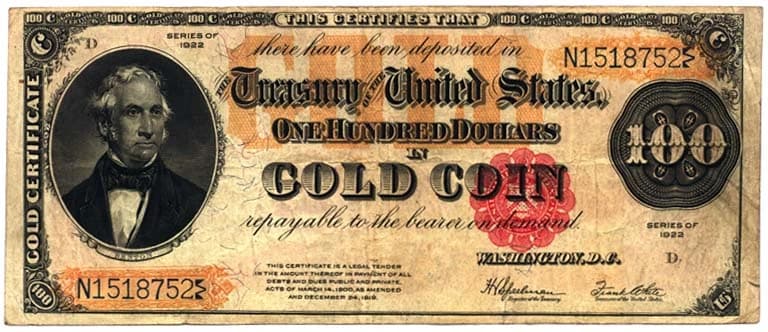
(A US $100 gold certificate (Series 1922), which was paper currency redeemable in gold. Such certificates circulated when the American gold standard was in effect, ensuring paper money could be exchanged for gold coin)
After World War II, the American gold standard re-emerged in a new form. The Bretton Woods Agreement of 1944 created an international monetary system where the U.S. dollar was fixed to gold at $35/oz, and other allied currencies were fixed to the U.S. dollar investopedia.com. In practice, only foreign governments and central banks could convert their U.S. dollars into gold (ordinary citizens could not). The U.S. amassed huge gold reserves (peaking in the 1950s) to support this system, and the dollar became the world’s reserve currency – essentially the American gold standard underpinned the global economy in the 1950s and 60s.
By the late 1960s, however, the strains were showing again. The U.S. was printing dollars faster than it could back them with gold (partly due to spending on the Vietnam War and domestic programs), and other countries began to doubt the dollar’s value. A “run” on U.S. gold started as nations like France demanded gold for their dollars. This led to the pivotal moment: in August 1971, President Richard Nixon ended the American gold standard by announcing that the U.S. would no longer convert dollars to gold for foreign governments. This move, known as the Nixon Shock, closed the “gold window” and effectively ended the Bretton Woods system. By 1973, major currencies were floating freely against each other, and gold’s official role in the international monetary system was over. The U.S. dollar became a pure fiat currency (backed only by faith in the government and economy), as did other currencies.
Summary of the American gold standard timeline:
- 1873: The U.S. effectively switches to a gold standard (stops coining silver for circulation).
- 1900: Gold Standard Act signed by President McKinley establishes gold as the only standard for redeeming paper money (officially pegging the dollar to gold).
- 1914–1918: Gold convertibility suspended during WWI (international gold flows disrupted).
- 1933: President F.D. Roosevelt ends the domestic gold standard – no more redeeming dollars for gold; private gold ownership (for monetary use) is halted.
- 1944: Bretton Woods system pegs global currencies to the U.S. dollar, and the dollar to gold at $35/oz (a limited gold standard for international settlements).
- 1971: President Nixon shuts the gold window, ending dollar-to-gold convertibility for good. This marks the final end of the American gold standard and the start of the purely fiat USD era.
The American gold standard left a strong legacy: the phrase “the dollar is as good as gold” was once literal. Today, the U.S. dollar is not backed by gold, yet the United States still holds the largest gold reserves in the world (over 8,000 tonnes) as a remnant of the bygone gold era. The next section will compare this past gold-based system to the present-day fiat money system.
Gold Standard System vs. Fiat System
With the gold standard’s history covered, it’s important to compare it to what we use now: fiat currency. Let’s examine the Gold Standard System vs. Fiat System to understand their differences, advantages, and disadvantages.
Definition and Backing: The gold standard system is commodity-backed money – currency is backed by a tangible asset (gold) and can be exchanged for it investopedia.com. In contrast, a fiat system is not backed by any physical commodity. Fiat money’s value comes from government decree and public confidence, not because you can trade it in for gold or silver investopedia.com. (“Fiat” is Latin for “let it be done,” meaning the value is asserted by law investopedia.com.) Modern paper notes and coins are fiat money – they have value because everyone believes others will accept them as payment, and because governments require them for taxes.
How Value is Maintained: In a gold standard, the value of money is maintained by the fixed gold peg. If £1 is 0.25g gold, the Bank of England must defend that rate by trading gold for pounds at that ratio. In a fiat system, value is maintained by economic policy and the issuing authority’s credibility. Central banks (like the Bank of England or U.S. Federal Reserve) manage money supply and interest rates to keep the value of money relatively stable (often targeting a low, steady inflation rate rather than a fixed gold price).
Money Supply & Inflation: One of the biggest differences in Gold Standard System vs. Fiat System is how the money supply is controlled. Under gold standard rules, the money supply is constrained by gold reserves – it can only expand as fast as the supply of gold (through mining or bullion imports) allows investopedia.com. This can indeed restrain inflation; historically, gold-standard countries experienced long-term price stability and low inflation on average. Hyperinflation was virtually impossible because you can’t arbitrarily increase gold stocks. Fiat systems, on the other hand, allow elastic money supply. Central banks can print more money or withdraw money from circulation according to economic needs. The downside is the risk of inflation if too much money is created. Indeed, without the discipline of gold, some governments have printed excessive money leading to inflation. However, responsible central banks aim to keep inflation low (around 2% annually in many countries). The fiat system gives flexibility to respond to economic crises, but it relies on good policy to avoid eroding the currency’s value.
Monetary Policy Flexibility: In a fiat system, central banks have powerful tools to manage the economy: adjusting interest rates, open market operations (buying/selling government bonds to affect money supply), and unconventional tools like quantitative easing. In a gold standard system, such interventions are limited. If a central bank prints a lot of money or lowers interest rates too much under gold standard, gold outflows would occur until confidence is restored, so there is a built-in check. This means the gold standard can prevent over-expansion of money but also “hinders the ability of a government to increase its money supply,” even when stimulus is needed in a recession investopedia.com. During the Great Depression, for example, sticking to the gold standard forced central banks to keep interest rates high and budgets tight to maintain gold parity, exacerbating the downturn en.wikipedia.org. Fiat money systems did away with that constraint, allowing aggressive actions (like massive stimulus in 2008 or 2020) to fight recessions.
Exchange Rates: Under a gold standard, exchange rates between participating countries are fixed based on their gold parities. For instance, if the UK defined £1 = 0.25g gold and the US defined $1 = 1/35oz (~0.89g) gold, one could derive a fixed £ to $ exchange rate from those gold equivalences. This fixed rate regime provided stability for international trade – businesses didn’t worry about currency fluctuations day to day investopedia.com. In a fiat system, most exchange rates float. The pound, dollar, euro, etc., trade in foreign exchange markets and their values change continuously based on supply and demand. Floating rates can move a lot, introducing uncertainty for traders and investors, but they also act as a shock absorber (a country in trouble might see its currency weaken, which can help rebalance trade).
Pros and Cons Summary: Both systems have upsides and downsides, which we can summarise:
Advantages of the Gold Standard System:
- Long-Term Price Stability: Over decades, the gold standard kept inflation very low on average. Money could even gain purchasing power during periods of strong economic growth with limited gold supply.
- Fiscal & Monetary Discipline: Governments and banks are restrained from reckless money creation, which can prevent high inflation and currency debasement. The gold backing acts as a self-imposed financial discipline.
- Fixed Exchange Rates: For countries on the gold standard, exchange rates were stable, boosting international trade and investment by removing currency risk.
- Confidence in Currency: People trust that paper money won’t lose value because it’s redeemable for something real and scarce. This can enhance confidence in the financial system (at least until that confidence is shaken by crisis).
Disadvantages of the Gold Standard:
- Lack of Flexibility: The money supply can’t be easily expanded to respond to crises or to grow with the economy’s needs. For example, if the economy grows faster than the gold supply, you can get deflation (falling prices) which can lead to high unemployment.
- Economic Pain During Adjustments: Because exchange rates can’t move, countries must adjust to trade imbalances via slow and painful changes in wages, prices, and employment. Historical records show that adhering to gold often meant higher interest rates and unemployment in times of stress (Keynes famously called Britain’s return to gold in the 1920s “deflation at any cost”).
- Dependency on Gold Supply: A gold discovery (like a gold rush) could inject inflation, whereas a shortage could strangle growth. The system’s health can hinge on mining output or geopolitical factors affecting gold.
- Financial Crises: Bank runs and credit contractions were common under the gold standard during downturns. With limited lender-of-last-resort capability (since money couldn’t be freely created), banking panics could spiral. The Great Depression’s depth is often attributed partly to the gold standard’s constraints on central banks.
Advantages of the Fiat System:
- Monetary Policy Flexibility: Central banks can act decisively as needed – lowering interest rates, printing money, or stimulating the economy in a downturn. This flexibility helped prevent the 2008 financial crisis and COVID-19 shock from turning into depressions, by flooding economies with liquidity (something not possible under gold without vast new gold supplies).
- Seigniorage and Convenience: Governments don’t need to amass gold to increase money supply; they can issue currency according to economic conditions. This can fund productive investments (if used wisely) and adapt to a growing economy’s demand for money.
- Isolation from Commodity Swings: The currency’s value isn’t subject to gold market fluctuations. For instance, a new gold mine discovery or a technological change in gold demand won’t directly deflate or inflate a fiat currency.
- Support for Full Employment: Policymakers can prioritise objectives like full employment or moderate inflation without being shackled by a fixed gold peg. If unemployment is high, they can stimulate the economy (which under gold standard might have been impossible due to fear of losing gold reserves).
Disadvantages of Fiat System:
- Inflation and Hyperinflation Risk: Without the anchor of gold, a country that prints too much money can destroy its currency’s value. Extreme cases like Zimbabwe or Venezuela show how fiat money can fail if mismanaged, leading to hyperinflation – something a gold standard would have mechanically prevented.
- Discipline Depends on Policymakers: The fiat system places a lot of trust in central bankers and governments to maintain stability. Poor decisions (like keeping interest rates too low for too long, or financing large deficits by money-printing) can cause boom-bust cycles or inflation.
- No Intrinsic Value: Fiat money is sometimes criticised for having no intrinsic worth – if people lose faith, it can become worthless paper. (In practice, established fiat currencies derive value from the productive economies and stable governance behind them, not just blind faith.)
- Trade and Budget Deficits: Countries can run large trade deficits or government deficits by borrowing or printing money, which under a gold standard would be checked by gold outflows. While this is also an advantage in the short run (more freedom), it can lead to buildup of debt and imbalances in the long run.
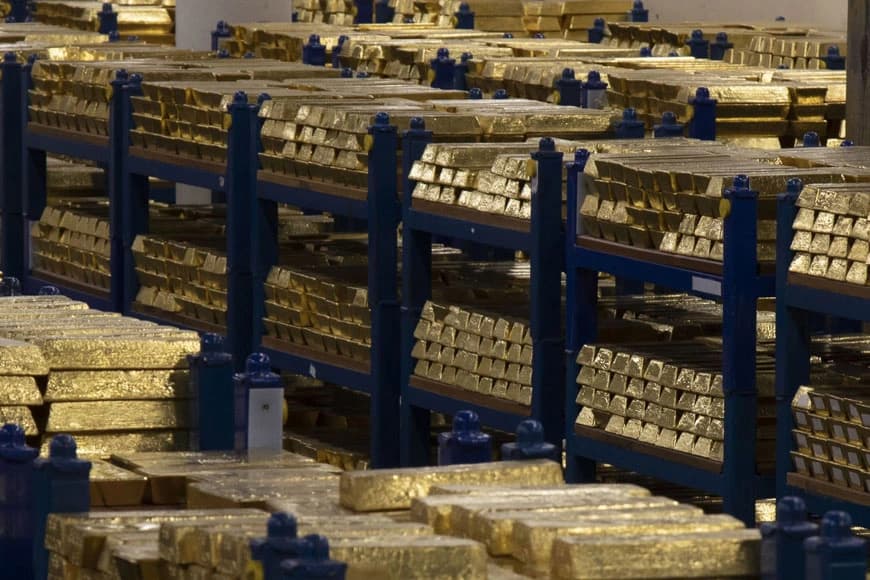
(Stacks of gold bars in the Bank of England’s vault. Under a gold standard, central banks hold gold reserves like this to back the currency’s value. In modern fiat systems, gold is no longer redeemable for cash, but central banks still keep gold as part of their reserves)
In Gold Standard System vs. Fiat System, which is generally preferred today? The clear winner in practice is the fiat system – since the 1970s, virtually all countries have operated with fiat money. Modern economies prefer the fiat system because it provides greater control over economic fluctuations and financial crises en.wikipedia.org. The gold standard, while stable in theory, proved too rigid during times of widespread stress, such as the 1930s. As one economic analysis notes, the gold standard was abandoned because it “hamstrung” governments from taking action to reduce unemployment during recessions en.wikipedia.org. Most economists argue that the fiat system’s flexibility, if managed prudently, outweighs the gold standard’s rigidity. That said, gold continues to play a role as a reserve asset and hedge. And the idea of a gold standard still has its champions who argue it would curb inflation and government overspending.
The debate of gold standard vs fiat often boils down to a trade-off between stability and flexibility. The gold standard offers a stable, rules-based monetary anchor (but at the cost of economic agility), whereas fiat money offers agility and policy power (but requires wise management to maintain stability). Understanding both systems helps inform why the global economy operates the way it does today. Next, let’s address some frequently asked questions about the gold standard.
Frequently Asked Questions
How did the gold standard work?
Under the gold standard, currency value was fixed to a set amount of gold. For example, $35 equalled one ounce of gold, and you could exchange paper money directly for gold. Governments held gold reserves matching their money supply, ensuring the currency remained stable and trusted.
How did the gold standard promote stability?
The gold standard promoted stability by linking currency directly to gold, limiting inflation. Governments couldn't print unlimited money, ensuring price stability. Fixed exchange rates also made international trade predictable and secure, reducing economic uncertainty.
How did the gold standard affect the Great Depression?
The gold standard worsened the Great Depression by restricting monetary flexibility. Central banks had to keep interest rates high to protect gold reserves, deepening economic decline. Countries abandoning gold, like Britain in 1931, recovered faster because they could lower interest rates and stimulate growth.
Is the gold standard good?
The gold standard provides long-term price stability and prevents hyperinflation. However, its inflexibility can worsen recessions and lead to unemployment. Modern economies generally favour flexible fiat systems, as the disadvantages of rigidity under gold typically outweigh stability benefits.
Why don't we use the gold standard?
We don't use the gold standard because it lacks flexibility in economic crises. It limits governments' ability to manage money supply during recessions or wars, potentially prolonging downturns. Fiat currency allows central banks greater flexibility to stabilise economies effectively.
Will the gold standard return?
A return to the gold standard is unlikely. Modern economies have outgrown available gold reserves, making it impractical. While some advocate gold backing to enforce financial discipline, economists agree fiat currency offers necessary flexibility, making a full return improbable.
Where is UK gold stored?
Most UK gold reserves are stored in secure vaults beneath the Bank of England in London. These vaults hold around 400,000 gold bars, worth hundreds of billions of pounds, including gold reserves belonging to other nations as well.
Who ended the gold standard?
The global gold standard ended primarily in 1971, when President Richard Nixon ended US dollar convertibility into gold, effectively collapsing the international Bretton Woods system. However, Britain had already abandoned gold in 1931 under Prime Minister Ramsay MacDonald.
What replaced the gold standard?
The gold standard was replaced by the fiat currency system. Fiat money isn't backed by commodities like gold but by government decree and economic confidence. Central banks control money supply and stability through policies rather than gold convertibility.
What is the new gold standard?
There is no official new gold standard today. Occasionally, the term is used metaphorically or when proposing currency systems backed by commodities or cryptocurrencies. Currently, central banks manage fiat money systems with no direct gold backing.
Why gold standard failed?
The gold standard failed due to its rigidity and inability to manage economic crises effectively. By restricting money supply, it prolonged downturns like the Great Depression. Modern economies abandoned it for more flexible fiat currency systems, allowing better crisis management and economic growth.
Interested in selling gold with the UK’s highest paying gold buyer? Visit our Sell Gold page to get a competitive valuation – we provide fully insured postage and fast payment.
For more insights and the latest gold price today, keep an eye on our live charts and blog updates.





