Where Is Platinum Found?
Platinum is a rare precious metal found mostly in a few specific regions of the Earth. The largest platinum reserves and mines are in South Africa, with other notable sources in Russia and Zimbabwe. Platinum forms deep underground through unique geological processes and even owes part of its origin to ancient meteorite impacts, making it one of the most extraordinary metals on (and beyond) Earth.
Key Takeaways
- Scarce and Localised: Platinum is an extremely rare element (around 30 times rarer than gold) found in only a few places worldwide. South Africa alone accounts for nearly three-quarters of the world’s platinum supply, making it the answer to where you can find platinum in abundance.
- Geological Origins: This metal forms in the Earth’s crust through intense geological activity and was also delivered by meteorites long ago. Platinum often occurs alongside nickel and copper ores in mineral-rich layers formed billions of years ago.
- Industrial & Luxury Uses: Platinum’s value comes from its versatile uses – it’s crucial in catalytic converters for cars, high-end jewellery, electronics, and even medical treatments. Its durability, high melting point, and corrosion resistance make it indispensable in many fields.
- Value vs. Gold: Despite being rarer than gold, platinum is currently less expensive. As of 2025, gold’s price per ounce is roughly triple that of platinum. Gold’s strong investment demand and market factors have made it pricier in recent years, although historically platinum traded higher at times.
- Physical Properties: Platinum is a heavy, dense metal with a silvery-white appearance. It is not magnetic and does not tarnish or oxidise in air, which is why platinum jewellery stays bright and lustrous over time. Its hardness means it wears well, but it can scratch and develop a patina that can be polished away.
Where Is Platinum Found
Platinum is found in Earth’s crust but very unevenly – where can you find platinum? Predominantly in Southern Africa. In fact, South Africa’s Bushveld Complex is by far the richest platinum-bearing area in the world, containing massive layered igneous formations loaded with platinum group metals. Other countries with notable platinum resources include Russia (for example, the Norilsk region in Siberia and the Ural Mountains historically) and Zimbabwe (the Great Dyke region). Smaller deposits are mined in Canada and the United States (particularly the Stillwater complex in Montana), as well as minor outputs in countries like Australia or Finland. In summary, platinum comes from just a handful of geologically unique areas on the planet.
How Is Platinum Formed?
Platinum’s story begins long before human discovery – it was forged in the heart of dying stars. Heavier elements like platinum are created by cosmic events such as supernova explosions or neutron star collisions. Fragments from these stellar events, rich in heavy metals, eventually coalesced into Earth. During Earth’s formation, much of the native platinum would have sunk into the core due to its density. However, scientists believe that meteorite bombardment after the Earth’s core formed re-enriched the upper crust with platinum and other precious metals. That means a significant portion of the platinum we mine near the surface today literally came from outer space. Geologically, platinum is typically found in magmatic ore deposits – these are igneous rocks that cooled slowly and allowed heavy minerals to concentrate. Platinum often occurs in association with other platinum-group metals (like palladium, iridium, osmium, rhodium, and ruthenium) and with sulfide minerals of nickel and copper. Over millions of years, natural erosion can also release platinum into alluvial deposits (river gravels), where it can be found as native nuggets or grains. This is how platinum was first encountered by humans – as small, heavy nuggets in stream beds.
Where Did Platinum Come From?
Platinum’s ultimate origin is extraterrestrial. As mentioned, the element came from cataclysmic star events billions of years ago, making it a truly cosmic metal. Meteorites delivered platinum to the young Earth’s crust, so in a sense, platinum “came from the sky.” In terms of human history, platinum first came to the attention of Western science in the 18th century. Spanish explorers in South America encountered an unusual white metal in placer deposits (alongside gold) in what is now Colombia. They dubbed it “platina” (meaning “little silver”) because it looked like a lesser form of silver. Unaware of its value, they even discarded it, thinking it was an unripe form of gold. We now know platinum is far more rare than gold and extremely stable. So while early prospectors wondered where did platinum come from, we understand today that it’s both a gift from violent cosmic events and a native element in Earth’s geology – essentially stardust that became embedded in our planet.
How Is Platinum Mined?
Mining platinum is a challenging process that reflects its rarity and the depth at which it is found. Platinum is typically mined from deep underground, often in narrow seams of ore. In South Africa’s platinum mines, for example, miners follow seams (reefs) such as the Merensky Reef or the UG2 Reef that can be over a mile below the surface. Extracting platinum ore involves drilling and blasting hard rock, then hauling it to the surface. Once the ore is brought up, it undergoes a series of processes: it is crushed and milled to a fine powder, and then flotation is used to separate platinum-bearing minerals. The concentrated ore is then smelted at extremely high temperatures, and further refined chemically to isolate platinum metal. Since platinum usually occurs with other metals, refineries also recover palladium, rhodium, and other valuable by-products during this process. In some cases, platinum is not mined as the primary product but as a byproduct of mining other metals. For instance, in Russia and Canada, platinum (and palladium) often come from nickel and copper mining operations – the platinum-group metals are extracted from the sulfide ores of those base metals. There are also small-scale platinum operations in river deposits (alluvial mining) where miners sift platinum nuggets from sands and gravels, but the bulk of today’s platinum comes from large industrial mines.
Where Is Platinum Mined?
If you’re wondering what country has the most platinum, the answer is unequivocally South Africa. South Africa is home to the vast majority of known platinum reserves and remains the top producer by far. Each year, South African mines produce roughly 70–75% of the world’s newly mined platinum, a dominance driven by the enormous Bushveld Complex geological formation. The Russian Federation is typically the second-largest platinum producer, contributing around 10% of annual production (mostly from the Norilsk-Talnakh nickel mining region in Siberia). Zimbabwe comes next with significant output (the Great Dyke is a major geological source of platinum there). These three countries form the top tier of platinum sources. Beyond them, Canada (with mines in Ontario’s Sudbury Basin and Quebec) and the United States (the Stillwater and East Boulder mines in Montana) produce smaller but noteworthy quantities of platinum each year. Other nations, such as Botswana or Russia’s smaller operations in the Urals, have minor production. In total, the top 5 countries account for nearly all of the platinum mining in the world. In summary, platinum is mined in only a handful of countries – with South Africa richly endowed with this metal, and a few others trailing behind – reflecting just how rare and geographically concentrated this resource is.
What Is Platinum Used For?
Platinum may be scarce, but it punches above its weight in terms of usefulness. Its unique physical and chemical properties lend themselves to a wide array of applications, from heavy industry to luxury goods. Here are the primary uses of platinum:
- Automotive Catalysts: Perhaps the most important use of platinum is in catalytic converters, the devices that help clean exhaust gases in cars and trucks. Platinum (along with related metals like palladium and rhodium) serves as a catalyst to convert harmful pollutants (carbon monoxide, unburnt hydrocarbons, nitrogen oxides) into less harmful carbon dioxide, water, and nitrogen. In particular, platinum is heavily used in diesel engine catalytic converters and is also used in gasoline vehicle catalysts (often in combination or substitution with palladium). This sector traditionally consumes a large share of the platinum mined each year (historically around 40–45% of annual platinum demand). Stricter global emissions standards have required more catalytic material, underpinning platinum’s importance – and now platinum is also a key component in emerging hydrogen fuel cell vehicles (which use platinum catalysts to generate electricity from hydrogen).
- Jewellery: Platinum’s beautiful silvery-white shine and its resistance to tarnish make it a prized jewellery metal. It’s considered more exclusive than gold in many circles because of its rarity and high purity. Most platinum jewellery is about 95% pure platinum, usually alloyed slightly for strength. It’s popular for engagement rings and wedding bands, especially since it’s hypoallergenic and doesn’t corrode. In jewellery use, platinum holds gemstones very securely (platinum’s density and strength ensure prongs and settings are durable). About one-quarter to one-third of yearly platinum demand is for jewellery, with strong markets in countries like China, Japan, the US, and India for platinum pieces. An interesting fact: Platinum is so rare that all the platinum ever mined would barely fill an average living room, and an ounce of platinum can be drawn into a wire miles long – a testament to its ductility and value for fine work.

This elegant platinum ring set with a single diamond highlights the metal’s popularity in fine jewellery thanks to its durability, shine, and rarity.
- Industrial Applications: Beyond cars and jewellery, platinum is critical in various industries due to its chemical stability. In the chemical industry, platinum catalysts are used to produce nitric acid (important for fertilizers) and in oil refining processes (such as catalytic reforming to produce high-octane gasoline). Platinum’s excellent conductivity and durability also make it useful in electronics – for example, it’s found in computer hard disks and thermocouples, and some high-end spark plugs and oxygen sensors contain platinum. The glass industry uses platinum equipment (like crucibles or mesh) for making high-purity glass and fiberglass, because platinum can withstand very high temperatures without contaminating the glass. In medicine, platinum compounds (like cisplatin and related drugs) are powerful chemotherapy agents used to treat cancers. Platinum is also used in medical devices: it’s biocompatible, so it appears in pacemakers, cochlear implants, and dental alloys. Fuel cells and electrolyzers for green hydrogen rely on platinum as well, which is a growing segment of use. All these industrial uses account for roughly another 20-30% of platinum demand in a given year.
- Investment: Like gold and silver, platinum is also bought by investors in the form of coins, bars, or exchange-traded products. There are platinum bullion coins (for example, the American Platinum Eagle or the Canadian Platinum Maple Leaf) and bars of various weights. Investors view platinum as a precious metal investment, though it’s a smaller market than gold. At times when platinum prices are low relative to its scarcity, some see it as an attractive investment opportunity. Investment demand for platinum can fluctuate greatly year to year, sometimes even going negative (when investors as a whole are net selling off holdings). But overall, platinum holds value and is recognized as a store of wealth, albeit with more industrial underpinning to its price than gold has.
In summary, platinum is valued for being highly unreactive, dense, and stable. It doesn’t corrode or tarnish, can catalyse critical chemical reactions, and has a superb finish in jewellery. These traits mean platinum is simultaneously an industrial workhorse and a luxury status symbol. For these reasons, even though it’s less visible to the public than gold, platinum is an essential metal in modern life – from the catalytic converter in your car to the ring on a bride’s finger and the electrodes in life-saving medical devices.
Is Platinum Worth More Than Gold?
Historically, platinum was often more expensive than gold. Its extreme rarity and broad industrial use led to prices that usually surpassed gold during the late 20th century and early 2000s. However, the situation has changed in recent years. As of today, gold actually outvalues platinum by a significant margin. If we compare their market prices: one ounce of gold is currently around three times the price of an ounce of platinum. For example, in mid-2025 gold is trading in the ballpark of $3,300 per troy ounce, whereas platinum is about $1,100 per ounce. This means if you held equal weights of gold and platinum right now, the gold would be worth substantially more in money terms.
Several factors explain why gold is pricier at the moment. Gold enjoys a unique role as a financial safe haven and investment asset. During times of economic uncertainty, currency inflation, or geopolitical tensions, investors worldwide flock to gold, driving its price up. We’ve seen gold hit record highs recently due to such safe-haven demand. Platinum, on the other hand, is influenced more by industrial supply and demand. Its price suffered in the mid-2010s when demand for diesel car catalysts fell and when some platinum was substituted by cheaper palladium in gasoline cars. Meanwhile, gold’s investment demand kept rising. Additionally, the platinum market is smaller and can be more volatile. There have been periods (like around 2008) when platinum spiked far above gold, only to crash down. From 2015 onward, gold steadily climbed while platinum remained relatively flat or lagged.
In summary, gold is currently more expensive than platinum. But this can change over time. Platinum’s value could increase if industrial demand surges (for instance, through growth in hydrogen fuel cell technology or supply constraints in mining). For now, though, an ounce of gold costs much more than an ounce of platinum, reversing the old historical relationship.
Platinum Price Today
To put concrete numbers on it, let’s look at the platinum price today. As of the latest data in 2025, platinum trades around $1,050–$1,100 per troy ounce (approximately £800 per ounce for UK readers, given exchange rates). The price isn’t static – it moves daily with global market trading. In the past year, platinum’s price has shown an upward trend, rising about 15–20% since the start of 2025 as industrial demand remains solid and supply has some constraints. By comparison, gold prices today are hovering around $3,300+ per ounce, reflecting gold’s strong run.
It’s interesting to note that platinum prices have been relatively stable in the ~$900–$1,200 range in recent years, whereas gold has climbed dramatically. For instance, between 2022 and 2024, gold jumped from roughly $1,500 to $2,500+ per ounce, while platinum stayed near the $1,000 mark. This divergence is why platinum is seen by some investors as potentially undervalued – it is incredibly rare and useful, yet cheaper than gold at the moment. If you check live market data today, you’ll likely see platinum quoted around the low thousands of dollars per ounce, with day-to-day fluctuations based on economic news, mining output, auto industry demand, and investor sentiment.
For anyone considering buying or selling platinum, it’s wise to monitor current prices through a reliable source (such as metals exchanges or financial news). As of now, platinum’s price is lower than gold’s, but it’s a dynamic situation. Keep an eye on how the auto industry (e.g., the shift to electric vehicles) and emerging technologies (like green hydrogen) might affect platinum’s market in the near future.
(Note: Precious metal prices can change rapidly. The figures above are indicative of mid-2025 and should be checked against the latest data for accuracy.)
Is Platinum Magnetic?
No, platinum is not magnetic. If you hold a magnet up to a pure platinum coin or bar, you won’t feel it pull – the platinum will not stick to the magnet. The reason is that platinum is classified as a paramagnetic substance, which means it only exhibits a very weak attraction to a magnetic field, barely detectable except with sensitive instruments. This is in contrast to ferromagnetic metals like iron or nickel, which are strongly attracted to magnets.
In everyday terms, pure platinum and typical platinum alloys used in jewellery will not be drawn to a magnet. This property is actually sometimes used as a quick test – for example, if a ring purported to be platinum is strongly magnetic, it’s likely not genuine platinum (it could be another metal). One caveat: some platinum jewellery is alloyed with a small percentage of other metals to improve hardness, and if one of those metals is magnetic (like cobalt or nickel in certain alloy formulas), a faint magnetism might be detectable. But the platinum itself remains non-magnetic.
Platinum’s non-magnetic nature ties into its position on the periodic table; it has a completely filled electron d-subshell in its atomic structure, which doesn’t give rise to the unpaired electrons needed for ferromagnetism. For most people, the key point is simply that platinum will not behave like a magnet and won’t be attracted to one.
What Does Platinum Look Like?
In appearance, platinum is often described as a silvery-white metal with a brilliant lustre. To the untrained eye, a piece of platinum might look similar to silver or white gold, but there are subtle differences. Platinum has a steely-white colour that doesn’t tarnish or fade. It’s also denser and heavier than gold or silver – if you hold a platinum item in one hand and a similar-sized silver item in the other, the platinum will feel notably heavier (platinum is about 60% heavier than an equal volume of 14k gold, for example).
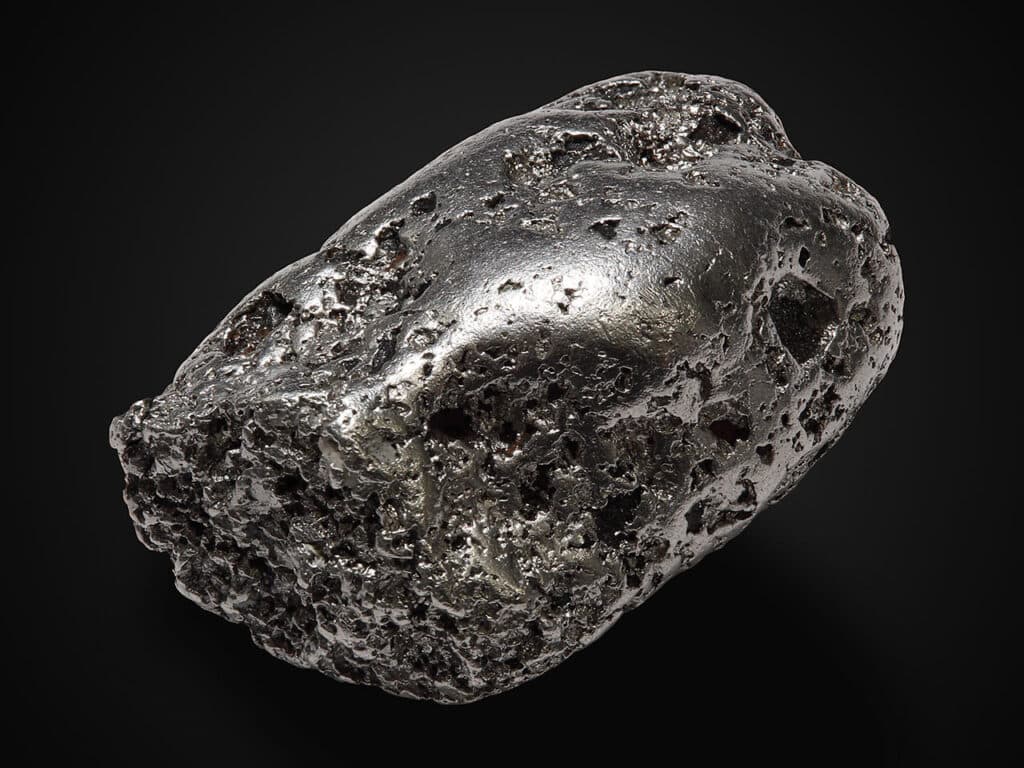
This unrefined platinum nugget displays the metal’s natural silvery-grey surface and rough texture, as it appears before smelting and industrial processing.
In its raw form, platinum is usually found as small nuggets or grains with a dull metallic gray or silver color. Raw platinum can have a somewhat rough, irregular texture (often with other minerals attached) and doesn’t shine as much until it’s been refined. Early prospectors often mistook platinum nuggets for silver or unrefined ore because of its greyish-white look. One of platinum’s nicknames is “white gold” due to its colour, although it’s actually a different element altogether.
When refined and polished, platinum is stunningly bright and reflective. Platinum jewellery has a white sheen that remains over time. Unlike sterling silver, which can tarnish and blacken when exposed to air and moisture, platinum doesn’t corrode or form an oxide layer at ordinary temperatures. This means platinum jewellery keeps its colour and shine without needing frequent polishing or plating. White gold, by contrast, is usually rhodium-plated to appear as white – but platinum is naturally white and lustrous. Over years of wear, platinum develops a slight patina (a soft matte sheen) as microscopic scratches accumulate. Some people love this patina as it gives the piece character; others prefer to have their platinum periodically polished back to a high-gloss finish. The good news is polishing platinum doesn’t remove as much material as polishing gold does (platinum’s scratches mostly displace metal rather than shaving it off).
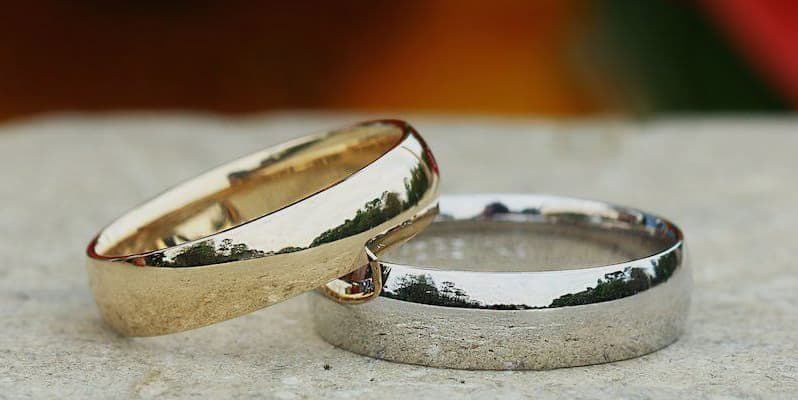
A side-by-side comparison of gold vs platinum rings, clearly highlighting gold’s warm yellow tone against platinum’s bright, cool-white finish and reflective shine
In the image above, you can see the contrast between platinum and traditional yellow gold in jewellery. Platinum’s colour is a cool white that pairs beautifully with diamonds and coloured gemstones (platinum’s neutrality won’t reflect colour into the gem, which is one reason it’s popular for setting diamonds). Also, note the polished smoothness – platinum when buffed has a mirror-like surface.
Beyond jewellery, if you were to see platinum in other forms, you might encounter it as shiny little industrial pellets, laboratory crucibles (which appear as solid silver-coloured bowls), or platinum wire which looks like any other shiny metal wire. There are also platinum bullion coins and bars; a freshly minted platinum coin resembles a silver coin but with a slightly different hue and heft (many first-time holders of platinum are surprised by how weighty it feels for its size).
In summary, platinum looks like a bright, white metal that stays white. It doesn’t have the warm colour of gold or the tarnish of silver. It’s often the metal of choice when one wants something elegant and enduring, which is why it’s so beloved in fine jewellery and high-end watches. Whether in a raw nugget or a polished ring, platinum’s appearance exudes purity and strength.
Frequently Asked Questions
Where is platinum found?
Platinum is found in limited regions of the world, with South Africa hosting over 70% of global reserves. It’s also found in Russia’s Norilsk region, Zimbabwe’s Great Dyke, and to a lesser extent in Canada and the United States. Geologically, platinum occurs in deep magmatic rock formations and can also appear in riverbed alluvial deposits. These deposits are rich in platinum-group metals, making mining concentrated in just a few areas globally.
What is platinum used for?
Platinum is used in catalytic converters for reducing vehicle emissions, platinum jewellery for its shine and durability, and industrial processes like refining and electronics. It's also used in cancer treatments, medical implants, thermocouples, fuel cells, and as a precious metal investment. Its high melting point, corrosion resistance, and conductivity make it invaluable across technology, automotive, and luxury sectors. Platinum’s versatility is a key reason it remains one of the most in-demand rare metals.
What is platinum made of?
Platinum is a pure chemical element with the symbol Pt and atomic number 78. It consists solely of platinum atoms in its elemental form. In practical use—especially in jewellery—it’s often alloyed with other metals like iridium or ruthenium to enhance strength. Unlike gold or silver alloys, platinum jewellery is typically 95% pure. Industrial platinum may also be mixed with other platinum-group metals depending on the application, but fundamentally, platinum is a naturally occurring pure metal.
Where did platinum come from?
Platinum originally came from massive cosmic events such as supernovae and neutron star collisions. These stellar explosions created heavy elements like platinum, which were delivered to Earth via meteorites billions of years ago. On Earth, platinum became concentrated in deep geological formations through volcanic and magmatic activity. This means platinum has both cosmic and geological origins, making it one of the rarest and most extraordinary elements used in modern technology and fine jewellery today.
How is platinum mined?
Platinum is mined using deep underground methods in countries like South Africa and Russia. Miners blast through hard rock to access platinum-rich seams, then crush and mill the ore. The extracted ore undergoes flotation, smelting, and chemical refining to isolate platinum. It’s also recovered as a byproduct of nickel and copper mining. The process is labour-intensive and costly due to the metal’s scarcity and the complexity of separating it from other minerals and metals.
Is platinum worth more than gold?
No, platinum is not currently worth more than gold. Although historically platinum often traded at a premium due to its rarity and industrial use, gold now commands a higher price. As of 2025, gold is about three times more expensive per ounce than platinum. This shift is driven by gold’s role as a safe-haven investment and rising investor demand, while platinum prices are more influenced by industrial trends and automotive sector developments.
Where can you find platinum?
You can find platinum in South Africa, which leads global production, and in countries like Russia, Zimbabwe, Canada, and the USA. It’s typically located in geological formations like the Bushveld Complex or Norilsk-Talnakh region. Platinum also occurs in secondary alluvial deposits from river erosion. However, the metal is extremely rare, and mining operations are limited to a few key areas worldwide, making platinum far less accessible than gold or silver.
Is platinum magnetic?
No, platinum is not magnetic. It’s a paramagnetic material, meaning it shows only weak magnetic behaviour in strong magnetic fields—not detectable by ordinary magnets. Pure platinum and most platinum alloys used in jewellery or industry will not stick to magnets. However, if platinum is alloyed with small amounts of magnetic metals like cobalt, it might show minimal magnetic response. This non-magnetic property is one way to identify real platinum versus other metals.
Can platinum be polished?
Yes, platinum can be polished to restore its original shine. Over time, it may develop a patina—fine scratches that create a soft, matte appearance—which some wearers appreciate for its character. A professional jeweller can easily buff and polish platinum jewellery to a mirror-like finish without significantly removing metal. Unlike white gold, platinum does not require rhodium plating to maintain its colour, and its lustre lasts much longer with basic care and occasional polishing.
Where is platinum mined?
Platinum is mined in a small number of countries, with South Africa dominating global production. Major mines are located in the Bushveld Complex. Russia, Zimbabwe, Canada, and the United States also mine platinum, often as a byproduct of nickel and copper extraction. Most platinum mining is deep underground and resource-intensive due to the narrow ore seams and high melting point of the metal. Global production is highly concentrated, making supply sensitive to geopolitical shifts.
What country has the most platinum?
South Africa has the most platinum reserves and produces the majority of the world’s supply—around 70–75% annually. The Bushveld Complex in South Africa is the world’s richest source of platinum-group metals. Russia and Zimbabwe also have significant reserves, but none rival South Africa’s scale or output. This concentration of supply gives South Africa a crucial role in the global platinum market and impacts prices and availability worldwide.
What metal is 30 times rarer than gold?
Platinum is roughly 30 times rarer than gold in Earth’s crust. Its extreme scarcity makes it one of the most precious metals used today. Despite being rarer, platinum is currently cheaper than gold, due to shifting industrial demand. The difficulty in mining and limited natural deposits contribute to platinum’s rarity. This makes platinum highly valued for specialised uses in automotive, medical, and high-end jewellery sectors where both purity and performance matter.
Can platinum be melted down and reused?
Yes, platinum can be melted and reused without losing quality. It has a high melting point of around 1,768°C and can be reformed into new jewellery, catalysts, or industrial components. The metal retains its purity and properties through recycling, which is why it’s widely reclaimed from old jewellery, medical tools, and spent catalytic converters. This recyclability makes platinum a sustainable option for both industry and investment, supporting its long-term value and demand.
Interested in selling gold with the UK’s highest paying gold buyer? Visit our Sell Gold page to get a competitive valuation – we provide fully insured postage and fast payment.
For more insights and the latest gold price today, keep an eye on our live charts and blog updates.