Gold Sovereign Prices
As of 30 Oct 2026, a gold Sovereign is worth £683.67 based on the live gold price as of today in the UK. A half gold Sovereign is worth £341.84. These prices are based on the live market price in the UK and update every 60 seconds.
Key Takeaways
- Live Market Value: The value of gold Sovereigns is directly tied to the current gold price, with full Sovereigns currently valued at £683.67 and Half Sovereigns at £683.67.
- Gold Content: A full Sovereign contains 7.32 grams of pure gold, while a Half Sovereign contains 3.66 grams, both minted in 22-carat gold.
- Investment Appeal: Gold Sovereigns are exempt from Capital Gains Tax in the UK, making them a tax-efficient investment option.
- Market Demand: Prices can vary based on demand, coin condition, and rarity, with certain years or mint marks commanding higher premiums.
- Buying and Selling: Reputable dealers offer live pricing and secure transactions, ensuring fair market value for both buyers and sellers.
Full Gold Sovereign Prices
A full gold Sovereign is a British gold coin with a nominal face value of £1. It contains 7.98 grams of 22-carat gold, which equals about 0.2354 troy ounces of pure gold. In other words, each full Sovereign has approximately 7.32 grams of fine gold. This standard has held since modern Sovereigns were introduced in 1817, featuring Benedetto Pistrucci’s iconic St. George and the Dragon design.
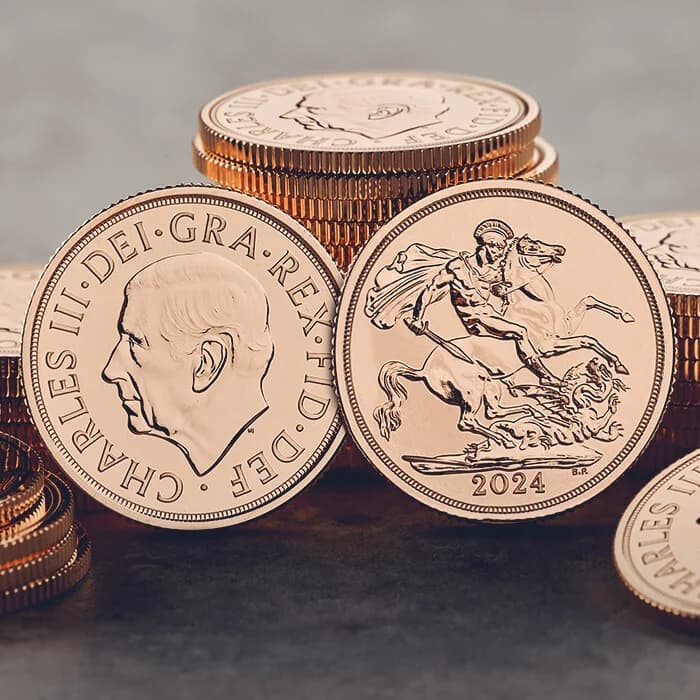
(Full gold Sovereign coin (reverse design with St. George and the dragon)
Modern bullion Sovereigns (post-1957): For coins minted from 1957 onward, the gold Sovereign price closely tracks the spot price of gold. Each coin’s intrinsic value is essentially its gold content times the current gold price per gram. On top of that, dealers charge a small premium (about 3–10%) over the gold melt value to cover manufacturing and distribution costs. In practice, modern bullion Sovereigns often trade at ~5% above their gold content value in the retail market. For example, if the gold value in a Sovereign is £550, a typical market price might be around £575–£600. This premium can vary with demand – in strong markets the premium may approach 10%, while in stable times it may be as low as 3–5%.
Older collectible Sovereigns (1817–1952): In contrast, Sovereigns minted between 1817 and 1952 can carry significant numismatic (collector) value beyond just gold content. Their pricing factors include rarity, mintage year, mint mark, and condition. The gold Sovereign price for these coins can far exceed the bullion value if the coin is a key date or in excellent preservation. For instance, an 1819 Sovereign (George III era, with only ~3,500 minted) is extremely scarce – only about 10 are believed to survive – and such a coin can be worth [£10000+] or even into six figures at auction. Similarly, certain Victorian issues like the 1859 “Ansell” Sovereign (a special issue using experimental alloy) are known in tiny quantities (fewer than 25 exist) and have sold for over £10,000 in top condition. In these cases, collectors pay for historical significance and rarity, not just the gold.
Full gold Sovereign value: A full gold Sovereign contains 0.2354 troy oz of gold. At today’s rates, a bullion Sovereign is worth £683.67 in gold content. By contrast, rare older Sovereigns can fetch far more – for example, an average-condition 1817 Sovereign (common date) might trade for £2,650+ at the time of writing, while the ultra-rare 1819 can exceed £100k in top grade.
In summary, bullion Sovereigns vs. collectible Sovereigns have very different pricing dynamics. A modern 2021 or 2022 Sovereign’s value will mainly reflect the gold Sovereign price based on weight, with a small markup. An antique Sovereign’s value might have only a loose connection to gold weight, being driven by its collector market. Always identify what type of Sovereign you have. If it’s a common date from recent decades, expect a price near the gold melt value. If it’s a pre-1950s coin with a low mintage or special story, its price could be much higher due to numismatic demand. In either case, the full Sovereign remains a 0.9167 fine gold coin with significant intrinsic value.
Half Gold Sovereign Prices
A half gold Sovereign is exactly what it sounds like – half the size and gold content of a full Sovereign. Half Sovereigns were first issued in 1817 alongside the full Sovereign and have the same 22-carat (91.67% pure) gold fineness. A half Sovereign weighs 3.99 grams and contains about 0.1177 troy ounces of pure gold. In diameter, it’s ~19.3 mm (versus 22.05 mm for a full Sovereign). Half Sovereign coins bear similar designs to full Sovereigns (typically the monarch’s head on the obverse, and St. George or shield on the reverse), just scaled down.
Half gold Sovereign price: The value of half Sovereigns is roughly half that of full Sovereigns, since they contain 50% of the gold. The half gold Sovereign coins therefore have about 3.66g of fine gold in them. Their market price equals the gold melt value plus a small premium. For modern half Sovereign bullion coins, the premium is usually in the same percentage range (5–10%) as full Sovereigns. For example, if a full Sovereign’s gold content is worth £683.67 today, a half Sovereign’s gold is worth £341.84. They are an affordable entry point for gold investors, often costing around half the full gold Sovereign price as expected.
Collectible half Sovereigns: Half Sovereigns were not minted in every year, and pre-1950 halves can also have numismatic value if rare. Key dates (like certain low-mintage Victorian half Sovereigns) or historically significant issues can command premiums from collectors. However, in general, half gold Sovereign coins are a bit less sought-after by collectors than full Sovereigns, simply because more people focus on the full £1 coin. That said, condition and rarity still matter – an old half Sovereign in uncirculated grade or from a rare year/mint (say a Sydney Mint half Sovereign from the 1850s) can fetch well above its gold content value.
Investment appeal: Half Sovereigns offer flexibility. They are small fractional gold coins, making them easier to sell in small quantities or to use for barter/trade. Investors often like half Sovereigns because you can liquidate smaller amounts of gold when needed (as opposed to a full Sovereign or larger coin). Like full Sovereigns, half Sovereigns from the UK are exempt from Capital Gains Tax and VAT, which is a big plus (more on that later). They also share the Sovereign’s reputation as “the chief coin of the world” in terms of recognition – any dealer globally will know a half Sovereign. In summary, half Sovereigns carry all the same advantages of Sovereigns, just in a smaller package. If you’re starting out, half gold Sovereign coins provide a low-cost way to accumulate gold with the added bonus of collector interest potential over time.
Full Gold Sovereign vs Half Gold Sovereign
Wondering about the differences between a full gold Sovereign and a half gold Sovereign? The table below breaks down the key features of each coin — including weight, size, face value, and gold content — to help you easily compare the two.
Gold Sovereign Price Today
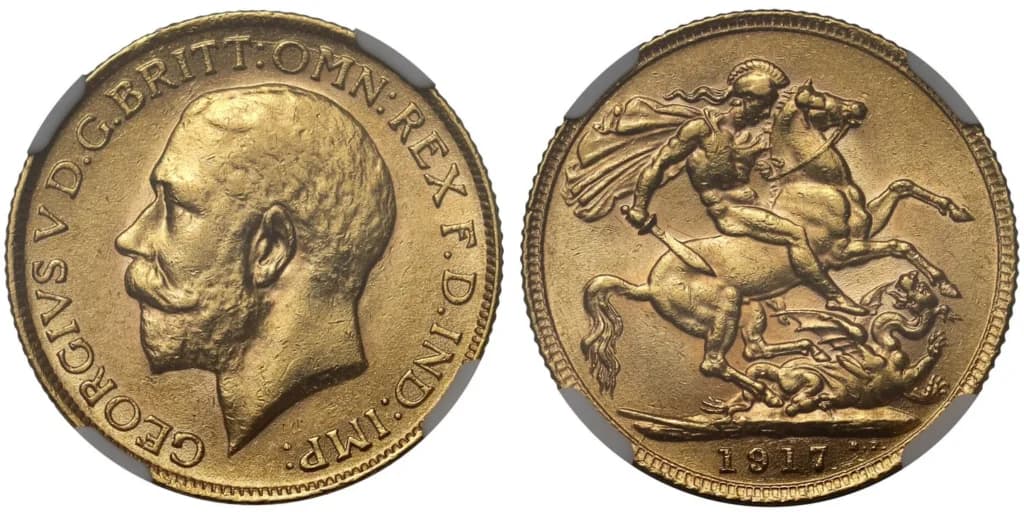
(Rare 1917 George V full gold Sovereign coin from London Mint – highly sought after by collectors and investors)
What is the gold Sovereign price today, and how can you estimate the value of your coins? The good news is that Sovereign prices are relatively straightforward for bullion-grade coins. They are tied to the live gold price which we use to guide our valuations. Here’s how it works:
- Gold content: A full Sovereign has ~7.32g of pure gold, and a half Sovereign ~3.66g. Multiply that by the gold price per gram to get the intrinsic value. Gold is currently £93.46 per gram, a full Sovereign’s melt value is therefore 7.32 x £93.46 = £683.67, and a half Sovereign’s is roughly half of that (≈ £341.84).
- Premium: Add a typical premium of, say, 5%. Using the above example, if melt is £683.67, the full gold Sovereign price in the retail market might be around £717.86 (melt plus premium). A half Sovereign price similarly would be about £358.93 with the average small premium included. These figures fluctuate daily with the changing price of gold.
For a concrete snapshot, today’s gold Sovereign prices are: Full Sovereign ~£683.67–£717.86, Half Sovereign ~£341.84–£358.93. The lower end represents the intrinsic gold value (what you might roughly get if selling to a gold dealer at melt value), and the higher end represents the typical price to buy the coin retail with a premium. Keep in mind that different dealers have different premiums – some efficient bullion dealers might offer Sovereigns at just 3% over spot, while a high-street shop might tag on 8–10%. It pays to shop around for the best gold coin prices if you’re investing.
Whether you search for full gold Sovereign price or half Sovereign price, remember they are driven by the same core factor – the gold market. The live gold price per gram is £93.46, which underpins all Sovereign valuations. If gold prices rise, Sovereign prices rise accordingly; if gold falls, so do Sovereigns. Always use up-to-date sources (like our gold price today or the LBMA gold price) for accuracy. On our site you’ll see live updates because we know transparency is key.
Today's Gold Price Per Gram
Gold price last updated:
The LBMA (London Bullion Market Association) spot price changes daily.
The prices displayed are based on the global market rate for gold, known as the gold spot price. Like all gold buyers, GoldSell pays a percentage of this rate to account for assaying, refining, secure logistics, market volatility, and handling costs. We consistently offer among the highest payout rates in the UK, with the exact percentage increasing based on the weight and purity of the gold you sell.
Are Gold Coins A Good Investment?
Gold coins – particularly UK gold Sovereigns – are often touted as a good investment, and there are solid reasons for this. Let’s focus on Sovereigns and their unique benefits:
- Intrinsic Value & Stability: Gold Sovereigns derive value from physical gold, which has historically maintained purchasing power. In times of economic uncertainty or inflation, gold often rises or at least holds value. Sovereigns benefit from this stability, making them a conservative investment choice. Unlike paper assets, a gold coin in your hand is a tangible store of wealth that isn’t someone else’s liability.
- Capital Gains Tax (CGT) Advantage: One big perk for UK investors – British gold Sovereigns are exempt from Capital Gains Tax because they are legal tender coins. This means if you buy some Sovereigns and their value increases over the years, you won’t owe any CGT on profits when you sell (for UK residents). In contrast, if you held a gold ETF or foreign gold coin, large profits could trigger taxes. With Sovereigns (and other UK legal tender coins like Britannias), any amount of profit is tax-free. This makes Sovereigns especially attractive for long-term investment or for higher net-worth buyers who might exceed CGT allowances with other assets. (It’s worth noting investment gold is also VAT-free in the UK, including Sovereigns – so you don’t pay 20% tax when buying, whereas you would on something like silver or platinum coins.)
- Britannia Reference: Similar to Sovereigns, Gold Britannia coins (which are one-ounce gold coins) are also CGT-free and VAT-free. Britannias contain 1 troy oz of gold (pure 24-carat in recent issues). They often appeal to investors aiming for larger gold allocations. The choice between Sovereigns and Britannias usually comes down to divisibility and preference. Sovereigns (0.2354 oz) are smaller units, so they can be easier to sell incrementally or to gift, etc. Britannias (1 oz) can be more efficient (lower premium per ounce typically). Both are excellent investment coins backed by the Royal Mint. Many UK investors hold a mix of Sovereigns and Britannias to balance flexibility and volume. The key point is that Sovereigns and Britannias share the same tax advantages, which give them an edge over foreign coins like Krugerrands or bars which could incur taxes on gains.
- Liquidity and Recognition: Gold Sovereigns are among the most recognised gold coins worldwide. They have been minted for over 200 years and circulated across the British Empire. Today, any bullion dealer globally will be familiar with Sovereigns and willing to buy them. This high liquidity means you can easily sell when needed. Sovereigns often fetch very close to melt value when sold because of this strong secondary market demand (and sometimes more if you find a collector who needs a specific year). In the UK especially, Sovereigns are arguably the best-known gold coin – even jewellers and pawnshops readily trade them. This ubiquity provides peace of mind that your investment is easily convertible to cash at any time.
- Portability and Divisibility: Sovereigns pack a lot of value in a small size. With a few coins, you can carry thousands of pounds worth of wealth in your pocket. This could be useful in extreme scenarios (economic crises, moving countries, etc.). They are also “divisible” – meaning you can sell one coin at a time as needed, unlike a large 1kg gold bar where you’d have to liquidate the whole thing. This makes managing your investment easier.
- Collectible Upside: While we mostly discuss bullion value, there’s an added kicker that some Sovereigns might gain collector premium over time. For example, special year designs (like the 2002 or 2012 Jubilee Sovereigns, or a 2017 bicentenary Sovereign) might become sought-after. If you buy new Sovereigns each year, you not only get gold exposure but potentially a set that numismatists would pay extra for in the future. This shouldn’t be counted on as a guarantee, but it’s a nice bonus possibility – essentially free upside beyond gold’s price.
In conclusion, gold Sovereigns tick many boxes for investment: tangible asset, globally recognised, tax-free on gains, no VAT, historically stable, and easy to sell. They can form part of a balanced portfolio, acting as a hedge against inflation and economic downturns. Of course, like any investment, they should be considered in the context of your goals and done through reputable sources. If you’d like a deeper discussion on gold investing strategy, check out our guide on investing in gold for more insights. Overall, for UK investors, it’s hard to beat Sovereigns as a convenient way to hold physical gold with maximum tax efficiency.
Gold Sovereign Value By Year
Not all Sovereigns are equal – some years are far more valuable than others. Below is a Gold Sovereign Value by Year table highlighting a mix of modern bullion coins and older rare issues. This gives an idea of typical gold Sovereign price ranges by date and context:
Table Notes: Values in brackets are approximate ranges for typical grades (for older coins, this assumes a circulated but decent example, not a pristine museum piece). Modern Sovereigns (late 20th century to present) mostly hover around their gold spot price value. For example, the gold Sovereign price chart for 1980–2020 would essentially mirror the gold price trend – as gold went up, so did common Sovereign values, and vice versa. In contrast, collectible Sovereigns (particularly pre-1957 issues in rare years) behave more like fine wine or art at auction – their value can jump irrespective of gold’s spot price, based on collector demand. For instance, the price of an 1819 Sovereign has skyrocketed over the decades due to its rarity, not because of gold (its gold content is the same as any Sovereign, but its collector value has appreciated dramatically).
Modern vs. Rare value dynamics: Think of a modern bullion Sovereign as liquid gold – easy to buy/sell at published market rates. An older rare Sovereign is more like an antique – its price is set by what a collector is willing to pay. The year-by-year values above highlight this split. Years like 1817, 1887, 1957, 1968, etc., are basically bullion coins – plenty available, so their value = gold content (maybe a small add-on for age or condition). Years like 1819, 1841, 1917 (London) are numismatic coins – limited supply, so they draw high bids from collectors, often far above the gold melt value.
If you have a pre-1957 Sovereign, it’s wise to consult with a reputable coin dealer or numismatist for an accurate valuation. Don’t just sell an old Sovereign for scrap gold without checking if the date/mint is special. You might unknowingly hand over a £5,000 coin for £400 of gold if you’re not careful! A specialist can tell you if your coin warrants a collector premium. For those interested, numerous resources and catalogs (Spink, Marsh, online databases) track gold Sovereign value by year, and you can view auction results for rare dates to gauge their market price.
In summary, modern Sovereign prices = gold, while historic Sovereign prices = gold + rarity factor. The table above provides a glimpse, but a full gold Sovereign price chart would show a flat line for most dates (at melt value) and spikes for the famous rarities. Always do your homework or get expert advice when dealing with pre-decimal Sovereigns.
Where To Buy Gold Sovereigns?
When you’re ready to purchase gold Sovereigns, it’s important to buy from reputable sources to ensure authenticity and fair pricing. Here are some trusted places in the UK for acquiring bullion-grade Sovereigns:
- The Royal Mint – The original issuer. You can buy new Sovereigns directly from the Royal Mint (either as bullion or proof coins). Assurance of authenticity is 100%. Prices may be a bit higher than dealers for bullion, but you get brand new coins and confidence of origin.
- Chards Coin and Bullion – An established UK coin dealer (since 1964) known for competitive prices. Chards offers both historic and new Sovereigns, often at low premiums. They have physical store in Blackpool and online ordering.
- BullionByPost – One of the UK’s largest online gold retailers. They offer gold Sovereign coins from various years with free insured delivery. Their prices are transparent and they’re a well-reviewed company.
- ATS Bullion – A specialist bullion dealer based in London (Strand). ATS is a family-run firm focused on gold/silver coins. They are a good option if you prefer buying in person in London or want a professional dealer experience.
- Bleyer Bullion – A Southwest England-based bullion broker. Bleyer offers Sovereigns (and other coins) online. They sometimes have fractional/smaller orders available and provide personalised service.
- Local Coin Shops and Auctions – Aside from the big names, you might find Sovereigns at local coin shops, jewellery stores, or coin shows/auctions. Just ensure the seller is reputable. If buying privately or from auction, verify the coin’s authenticity (most Sovereigns are 22mm in diameter, 7.98g – if significantly off, it could be fake). Reputable auction houses will have done authenticity checks.
When buying, compare premiums over the gold price. A reasonable premium for a single bullion Sovereign might be ~5–6% in normal market conditions. Anything drastically above 10% for common modern coins should prompt you to ask why (it could be a special proof or rarity – or it might be overpriced). Stick to known dealers to avoid counterfeit coins – fortunately, Sovereigns are widely faked, but with a bit of due diligence (buying from trusted sources, checking weight/dimensions), it’s easy to avoid problems.
Lastly, if you plan to invest regularly, consider using the same dealer for possible loyalty perks or better buyback rates. All the sources above also buy gold Sovereigns if you ever want to sell. In fact, Sovereigns are so liquid that you can usually sell them back to any major dealer close to the spot price.
Frequently Asked Questions
What are gold Sovereigns worth?
As of 30 Oct 2026, the full Sovereign price is £683.67 based on the live gold price as of today in the UK.
What are half Sovereigns worth?
As of 30 Oct 2026, the half Sovereign price is £341.84 based on the live gold price as of today in the UK.
What is a gold Sovereign?
A gold Sovereign is a British gold coin with a face value of £1. It contains 7.98 grams of 22-carat gold (0.2354 troy ounces of pure gold). Originally minted in 1817, it's known for its iconic design featuring the monarch's portrait and St. George and the dragon on the reverse.
Are gold Sovereigns a good investment?
Yes, gold Sovereigns are often seen as an excellent investment because they're exempt from Capital Gains Tax (CGT) in the UK, VAT-free, highly liquid, and internationally recognised. They can protect wealth from inflation and economic uncertainty.
Where to buy gold Sovereigns?
Buy gold Sovereigns from reputable UK dealers like The Royal Mint, BullionByPost, Chards, ATS Bullion, or Bleyer Bullion. These dealers ensure authenticity, transparent pricing, and secure transactions.
Where to sell gold Sovereigns?
You can sell gold Sovereigns to reputable gold buyers like GoldSell, the UK's highest-paying online gold buyer. With GoldSell, you can easily sell Sovereigns from home for the best prices and receive fast, secure payment.
Are gold Sovereigns exempt from inheritance tax?
No, gold Sovereigns are not exempt from inheritance tax (IHT). They count as part of your estate’s value, so normal IHT rules apply, unless held within a tax-efficient structure like certain trusts or pensions.
Are gold Sovereigns exempt from capital gains tax?
Yes, UK gold Sovereigns are exempt from Capital Gains Tax (CGT) for UK residents because they’re legal tender. Any profit made from selling Sovereigns is completely tax-free, making them attractive for investors.
What is the best gold Sovereign to buy?
Modern bullion Sovereigns (post-1957) are best for investors due to low premiums. Collectors should look for rare dates (like 1819, 1841, 1917 London Mint) or special editions (2002 Jubilee, 2017 Bicentenary) for greater potential value appreciation.
Are gold Sovereigns legal tender?
Yes, gold Sovereigns are legal tender in the UK with a nominal face value of £1. However, their actual value far exceeds this amount due to their gold content and collectible appeal.
Which gold coin is best to buy?
UK gold Sovereigns and Britannias are generally the best choices because they're CGT-exempt, VAT-free, and highly liquid. Sovereigns offer flexibility with smaller sizes, while Britannias provide slightly lower premiums per ounce of gold.
When did Sovereigns stop being used as currency?
Gold Sovereigns ceased regular circulation as currency in 1914, though they continued being minted periodically afterwards. Today, they're primarily investment and collectible items rather than everyday money.
Which gold Sovereign is the most valuable?
The most valuable Sovereign is typically the 1819 Sovereign of King George III, with only around 10 surviving examples. It's exceptionally rare, with prices often exceeding £100,000 at auction depending on condition.
Are all gold Sovereigns 22 carat?
Yes, all modern gold Sovereigns (since 1817) are made of 22-carat gold, which is 91.67% pure gold. This standard has been consistent, ensuring the Sovereign's global reputation and recognition.
Interested in selling gold with the UK’s highest paying gold buyer? Visit our Sell Gold page to get a competitive valuation – we provide fully insured postage and fast payment.
For more insights and the latest gold price today, keep an eye on our live charts and blog updates.