Investing In Gold: Is Gold A Good Investment?

Investing in gold has delivered modest long‑term growth—doubling in value from 2010 to 2024 while outpacing UK inflation—and serves as a stable hedge and portfolio diversifier.
Key Takeaways
- Strong historical returns: Gold’s price in GBP roughly doubled between 2010 and 2024, versus around 40% cumulative UK inflation over the same period.
- Inflation hedge & diversifier: Gold protects purchasing power during economic uncertainty and tends to move independently of stocks and bonds.
- Multiple investment routes: You can invest via physical bullion (coins/bars), gold ETFs, mining stocks, or digital savings platforms—each suiting different goals.
- Consider the downsides: Gold offers no passive income, incurs storage/insurance costs, can be volatile in the short term, and may lag equities during strong bull markets.
- Recommended allocation: Financial advisors often suggest a 5–10% portfolio allocation to gold for balance without overexposure.
Investing in gold has long been popular for those seeking a hedge against inflation and a safe-haven asset. Gold’s appeal comes from its reputation as a store of value that holds up when paper currencies fall in value. Unlike stocks or bonds, gold is a tangible asset with intrinsic worth, which gives investors confidence during turbulent times. With inflation fears and economic uncertainty on the rise, many are asking “is gold a good investment?” This comprehensive guide will examine gold’s historical performance, current market outlook, and the pros and cons to help you decide if and how you should invest in gold.
TL;DR: Gold can play a valuable role in a diversified portfolio, especially as protection against inflation or crises. Over decades, it has generally increased in value – often outperforming inflation – but it’s not without risks. We’ll cover gold’s price history, whether now is a good time to buy, ways to invest (coins, bars, ETFs, stocks, etc.), and important considerations like taxes and volatility. Let’s dive in.
Is Gold A Good Investment?
Gold is often seen as a long-term store of wealth. Historically, it has preserved (and even grown) purchasing power over the very long run. For example, back in the mid-1970s, gold was priced around £60–£70 per troy ounce in the UK. Today the gold price is £3,088.06 – an increase of more than 20-fold, outpacing the rise in consumer prices over that period. In other words, gold has beaten inflation in the long run, helping investors preserve real value. Notably, a World Gold Council study found that during periods of high inflation (over 3%), gold returned about 15% per year on average, versus about 6% when inflation was low, illustrating its strength as an inflation hedge in tough times.
That said, gold’s journey has not been straight up. Its price history is marked by cycles of sharp rises and corrections. To understand gold’s investment merit, let’s look at some historical data:
- Long-Term Performance: Taking a 50+ year view, gold’s price in the global market has risen dramatically. In the 1970s, as high inflation and currency turmoil set in, gold surged from its fixed $35/oz level (pre-1971) to an all-time high in 1980. That 1980 peak, driven by double-digit inflation and geopolitical tensions, saw gold reach around $850/oz (about £400+ in sterling). However, after this spike, gold entered a long downturn. By 1999, it fell to about $253/oz – losing nearly 80% of its value in real (inflation-adjusted) terms from 1980 to 1999. Investors who bought at the 1980 peak suffered a prolonged decline.
- 2000s Bull Market: Gold’s fortunes reversed in the 2000s. The early 21st century brought new catalysts: tech bubble burst, 9/11, and a weakening US dollar. From 2001 onward, gold started climbing. During the 2008–2009 Great Recession, gold proved its safe-haven status – rising from around $730 in late 2008 to about $1,300 by late 2010 . The European debt crisis in 2011 pushed it even higher, hitting a then-record of ~$1,825/oz in August 2011. Many investors flocked to gold to protect their wealth amid stock market turmoil.
- Recent Years: After 2011, gold cooled off for a few years, dipping in the mid-2010s as the economy recovered. But it didn’t stay down. In the late 2010s and early 2020s, new uncertainties (trade wars, pandemic, inflation surge) fuelled gold’s rise again. In 2020, amid the COVID-19 crisis, gold jumped ~27% from about $1,575 in January to over $2,000/oz by August 2020 . Governments printing money and cutting rates to support economies led investors to seek refuge in gold. By April 2024, gold reached a new all-time high of around $2,265/oz in USD terms (about £1,820 in GBP), surpassing the 2011 peak. (For context, that 1980 peak would equal over $3,300 in today’s money, so the 2024 price is the highest ever in nominal terms, though still below the 1980 high after inflation.)
Clearly, gold has delivered solid gains over the decades, especially during recessions or crises when other assets faltered. Investors who held gold through various downturns often saw it shine when stocks sank, which is why it’s considered a defensive asset.
Expert projections: Looking ahead, many analysts remain optimistic about gold’s prospects. For instance, Goldman Sachs recently projected that gold will hit fresh record highs, forecasting a rise to around $2,700/oz by early 2025. Their reasoning: cooling inflation and potential interest rate cuts could weaken major currencies, while central banks and investors continue to buy gold as a hedge. Some bullish forecasters even see the potential for gold to approach $3,000 or higher later in the decade if conditions remain supportive. Of course, these are predictions – not guarantees. But the consensus among many market strategists is that gold remains a relevant and potentially rewarding investment, especially as part of a diversified strategy.
Bottom line: Yes, gold can be a good investment if used correctly. It has proven able to preserve wealth over the long haul and provide protection in economic downturns. However, it’s not a get-rich-quick asset – its long-term average returns (historically ~6-7% annually in GBP terms) are modest, and there have been long stretches of poor performance. Treat gold mainly as a store of value and insurance policy in your portfolio, rather than a high-growth investment. Next, we’ll look at where prices stand today and whether it’s a good time to buy.
Today's Gold Price Per Gram
Gold price last updated:
Wednesday, 21 October 2026, 12:32.
The LBMA (London Bullion Market Association) spot price changes daily.
The prices displayed are based on the global market rate for pure 24ct gold, known as the spot price. Like all gold dealers, GoldSell pays a percentage of this rate to account for assaying, refining, secure logistics, market volatility, and handling costs. We consistently offer among the highest payout rates in the UK, with the exact percentage increasing based on the weight and purity of the gold you sell.
As of today, the gold price is near historic highs in many currencies, including British Pounds. After strong gains in recent years, gold is trading around the £3,088.06 per troy ounce level in the UK market. To put this in perspective, five years ago (2019) gold was about £1,000/oz – so it’s over 50% higher now. This rise has been driven by inflationary pressures, geopolitical tensions, and robust demand from both investors and central banks ().
Gold price in GBP per ounce (2019–2024). The line chart shows the price starting around £1,000 in 2019 and climbing to over £1,900 in early 2024, with a dip in 2021 and sharp gains in 2020 and 2022–2023.
At the moment, gold’s price momentum is strong. It hit an all-time high in GBP of ~£1,635/oz in April 2023 and remains close to that peak in 2024. Investors are understandably cautious about buying at record levels, yet the supportive factors (inflation, uncertainty, etc.) are also still present.
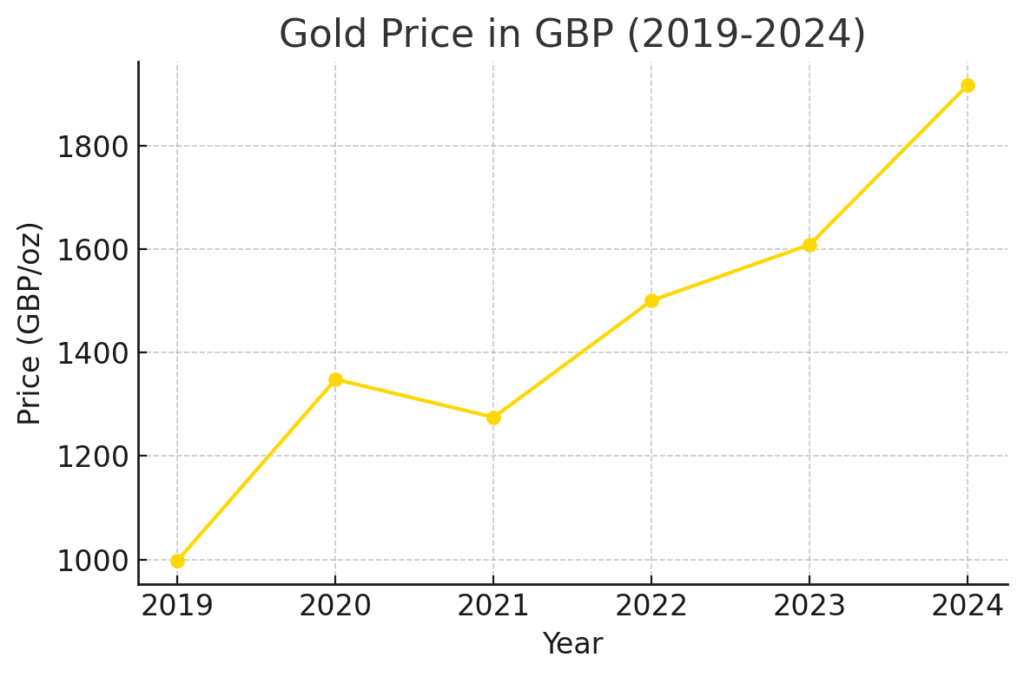
(Graph showing the gold price per ounce in GBP from 2019-2024)
For up-to-the-minute rates, you can check our gold price today page, which provides live gold prices per gram. Keeping an eye on the live gold price is useful if you’re looking to time a purchase or sale. Gold prices do fluctuate day to day based on market news, currency movements (a weaker pound tends to raise GBP gold prices), and supply/demand.
When viewing today’s price, remember that gold is typically quoted in troy ounces (1 troy oz ≈ 31.1035 grams). Also, the market price (spot price) is what you’d pay for unfabricated gold – buying coins or bars will include a small premium over spot. In the next section, we’ll discuss whether current conditions make it a smart time to buy, or if patience is warranted.
Is It A Good Time To Buy Gold?
With gold prices at elevated levels, is now a good time to buy gold? The answer depends on your outlook and reason for investing:
- Current Economic Indicators: Inflation has been running high recently (UK CPI hit 40-year highs in 2022), which generally bodes well for gold. Although central banks are now tightening monetary policy (raising interest rates) to fight inflation, real interest rates (after inflation) remain low or negative, preserving gold’s appeal. If inflation stays above interest rates, holding gold can be attractive as it helps preserve purchasing power. On the other hand, if inflation subsides and interest rates remain high, that could create headwinds for gold (since investors might prefer interest-bearing assets again). Keep an eye on central bank policies – talk of pausing or cutting rates in major economies is typically bullish for gold, whereas unexpectedly high rate hikes could be bearish.
- Market Sentiment: Investor sentiment toward gold is currently positive but cautious. The metal’s rapid rise to record highs has some analysts predicting a pullback or consolidation in the near term. It’s not uncommon for gold to correct after hitting new peaks. However, there are strong underpinnings supporting prices: central banks globally have been buying gold at the fastest pace in decades, providing a floor under the market. Geopolitical tensions (war, trade disputes) and financial system worries also continue to create safe-haven demand. In 2022, central banks bought over 1,000 tonnes of gold – the highest in modern records – as countries like China, India, and Turkey increased reserves. This central bank demand, alongside investment demand, suggests any dips could be met with buyers.
- Analysts’ Views: Many trusted analysts see room for further upside. As mentioned, Goldman Sachs expects gold to “climb to record highs” and forecasts ~$2,700/oz in the next year, citing factors like potential U.S. rate cuts and ongoing emerging market central bank purchases as drivers. They even call gold their “preferred hedge” against financial and geopolitical risks at present. Similarly, other investment banks and gold research firms point out that if the economy weakens or if any surprise crisis hits (for example, a flare-up in geopolitical conflict or debt worries), gold could rapidly gain. On the flip side, some contrarians note that if inflation suddenly falls back to target and economies avoid recession, gold might stagnate or dip in the short term as risk appetite shifts back to stocks.
In sum, it can be a good time to buy gold, but with a few cautions. If you are under allocated in safe-haven assets or are worried about the economic outlook, initiating or adding to a gold position now makes sense – perhaps using a dollar-cost averaging approach (buying in portions over time) to mitigate the risk of near-term volatility. Gold’s fundamentals (inflation hedge, uncertainty hedge) remain strong in the current climate. Just be mindful that after a big run-up, short-term price swings are possible. A prudent strategy is to take a long-term view: buy some gold as insurance and wealth preservation, and be prepared to hold through any short-term dips. As one famous adage goes, “the best time to buy gold was 20 years ago; the second best time is now” – this speaks to gold’s enduring value across cycles.
Finally, consider your personal situation. It’s usually not wise to throw your entire budget into gold at once, especially at record prices. But gradually accumulating on dips and holding for the long term has historically paid off. If you’re unsure, you can consult a financial advisor, but generally keeping 5-10% of your portfolio in gold (whether physical or via ETFs) is a commonly cited rule of thumb for diversification. Next, let’s explore how to invest in gold, as the method you choose can also affect timing and returns.
How To Invest In Gold
Once you decide to invest in gold, the next question is how to do it. There are several ways to invest in gold, each with its pros and cons. Here are the most popular methods:
- Physical Gold – Coins and Bars: Buying physical gold bullion (such as gold coins or gold bars) is the most direct way to invest. You own the actual metal, which can be reassuring. Popular choices for UK investors include gold coins like Britannias or Sovereigns, and gold bars of various weights (1g, 1oz, 100g, 1kg, etc.). If you invest in gold coins or small bars, they are portable and easy to sell back to dealers. Larger gold bars offer a lower premium per ounce (cheaper per unit weight), making them cost-effective for big investors, but they are less divisible for future sale. One key benefit in the UK: certain British coins (Britannias, Sovereigns, etc.) are Capital Gains Tax free. As they are legal tender, any profits on these coins are exempt from CGT. (By contrast, gold bars or foreign coins can incur CGT on gains above your annual allowance.) This tax perk makes coins particularly attractive for UK gold investors – you could realise unlimited profits on Sovereigns/Britannias with no tax due. On the downside, physical gold needs secure storage (at home in a safe, or in a vault service) and insurance. Also, when you buy physical gold, you’ll pay a small premium over the market (spot) price to cover manufacturing and distribution. When selling, you might face a small discount to spot. These transaction costs mean physical gold is best for long-term holding, not frequent trading.
- Gold ETFs (Exchange-Traded Funds) and ETCs: If you prefer not to handle physical metal, you can invest in gold via ETFs. These are funds traded on the stock exchange that track the gold price. For example, popular gold ETFs like iShares Physical Gold (SGLN) or Invesco Physical Gold ETC hold bullion in vaults and issue shares that represent a fractional claim on that gold. When you buy an ETF share, you effectively own a slice of a gold bar held in a London vault. ETFs closely follow the spot price (minus a small annual management fee, usually <0.25%). They offer high liquidity – you can buy or sell during market hours instantly – and no hassle with storage on your part. ETFs are great for investors who want exposure in their brokerage or retirement accounts. Note: you won’t physically see or use the gold, and you rely on the fund’s custodian to actually have the metal. But for most, established gold ETFs are a convenient and low-cost way to invest in gold. (Tax-wise, profits on gold ETFs are subject to CGT as with stocks, unless held in an ISA or SIPP.)
- Gold Mining Stocks and Funds: Another route is to invest in gold stocks – i.e. shares of gold mining companies. Examples include large miners like Newmont, Barrick Gold, or Fresnillo. When you buy a gold mining stock, your investment’s value is influenced by the company’s performance and profits, not just the gold price. Gold stocks often have a leveraged effect to gold’s moves: in a gold bull market, mining companies’ profits can surge (their costs are relatively fixed, so higher gold prices = higher margins), potentially making the stock climb faster than gold itself. On the flip side, if gold prices drop or the company faces operational issues, the stock can underperform. Gold stocks also carry company-specific risks (management, geopolitical risks where mines are located, etc.). However, they do offer dividends in some cases (many large miners pay dividends to shareholders), which physical gold does not. You can also invest via gold mining funds or ETFs (like GDX or ESPO) to own a basket of miners and reduce single-company risk. The main thing to remember is that gold mining stocks ≠ gold; they’re correlated, but not perfectly. As one strategist said, “Gold mining stocks are ultimately equities … They don’t provide that extra layer of protection I’m looking for” compared to physical gold. So, gold stocks can be part of an equity portfolio for those seeking higher return potential, but they won’t offer the same safe-haven qualities in a market crisis (miners’ stock prices can fall with the stock market even if gold itself holds value).
- Gold ETFs vs Gold Stocks: It’s worth highlighting this difference: a gold ETF (like GLD, etc.) gives you direct exposure to bullion, whereas gold stock funds give you exposure to mining businesses. In terms of volatility, gold stocks tend to be more volatile. For example, if gold rises 10%, a mining stock might rise 15-20% (or more), and similarly could fall more on the downside. Over the long run, well-managed mining companies could outperform the metal (due to expanding production or new discoveries), but they could also underperform if they hit a dry spell or mismanage costs. Many investors choose to hold some miners for growth and some physical/ETF gold for stability.
- Digital Gold and Online Platforms: In the digital age, there are fintech platforms that let you buy fractions of physical gold online, often termed “digital gold.” Services like bullion vault accounts or fintech apps allow you to purchase, say, £50 or £500 worth of gold which is then allocated to you from a larger bar stored in a vault. This combines some benefits of physical gold (ownership of actual metal) with the convenience of not having to store it yourself. Always ensure any digital gold platform is reputable – the gold should be allocated in your name and stored securely, with audits to confirm the holdings.
- Gold Futures and Other Derivatives: These are generally for advanced investors or traders. Gold futures contracts allow you to speculate on the price of gold with leverage, but they come with complexity (expiry dates, margin calls) and are not suitable for beginners or those looking to invest long-term (they’re more for short-term trading). Options on gold or trading gold CFDs (contracts for difference) are also available – again, these are complex and can magnify risk, so approach with caution.
Capital Gains Tax (CGT) Consideration: As mentioned, one big advantage for UK physical gold investors is the CGT exemption on UK legal tender coins goldsell.co.uk. If you’re choosing between coins and bars, and you think you might one day sell for a profit above the annual CGT allowance, favour coins like Britannias or Sovereigns. For example, a £20,000 gain on gold Britannias would incur zero tax, whereas the same gain on a gold bar could be taxable (18% or 28% rate depending on your income bracket). Keep this in mind when investing significant amounts. (For more details on gold and taxes, see our guide to Capital Gains Tax on gold linked above. Also note: if you invest via certain accounts like an ISA or SIPP, you can also avoid taxes on gold ETFs or gold stocks.)
In summary, the best way to invest in gold depends on your goals and preferences. If you want the security of physical ownership, buy bullion (and maybe focus on CGT-free coins for tax efficiency). If you want liquidity and low costs, consider gold ETFs. For growth potential (with higher risk), gold mining stocks or funds could be added to the mix. And for small, frequent investments, digital gold platforms provide flexibility. Many investors use a combination – for instance, holding some physical coins for the very long term, plus some ETF shares in their portfolio for liquidity.
Should You Invest In Gold Stock?
Gold stocks (gold mining shares) deserve a special discussion. As an investor, you might wonder if you should invest in gold stocks instead of (or in addition to) physical gold. Here’s a comparison to help you decide:
- Returns: Gold mining stocks can offer higher return potential than physical gold. If the price of gold rises, miners’ profits often rise faster (because their costs might be fixed, so extra revenue largely goes to the bottom line). During gold bull markets, well-run mining companies’ shares have historically outpaced the metal. For example, in the 2000s gold bull run, gold rose about 500% while gold mining equity indexes climbed around 600–700%. So if you’re seeking growth, gold stocks might be appealing.
- Volatility and Risk: The flip side is higher volatility and risk. Gold stocks are equities first and foremost. This means they are influenced by general stock market factors and company-specific issues. A broad market downturn can drag gold mining stocks down even if gold prices are stable, because investors sell stocks across the board. We saw this in the 2020 COVID crash – gold’s price dipped but held relatively well, while many gold mining stocks plunged along with the stock market before later recovering. Additionally, gold companies face risks like mine strikes, rising production costs (energy, labor), political instability in mining regions, and even environmental liabilities. Physical gold’s value, by contrast, doesn’t depend on a company’s success – it’s purely driven by market supply/demand.
- Diversification: Gold stocks do not provide the same portfolio hedge as gold bullion. In a severe financial crisis, physical gold tends to retain value or increase, whereas gold stocks could decline if the stock market is broadly selling off. As the quote earlier highlighted, gold stocks “usually follow the broader equity market downward” in bad times, so they lack that “extra layer of protection” that physical gold provides. Thus, if your aim is safety, gold stocks aren’t a substitute for gold itself.
- Income: One advantage of gold stocks is potential dividends. Some mature mining companies pay regular dividends to shareholders, which can provide income while you hold the stock. Physical gold yields nothing – you only profit if the price rises. So, if you want income or to reinvest dividends for compounding, gold stocks or gold royalty companies might be considered.
- Which to choose? If you are bullish on gold and willing to take on more risk for more reward, you could allocate a portion of your investment to gold mining stocks or a mining fund. This could juice your returns if gold rallies. However, for a core gold holding meant for stability, most experts recommend sticking to physical gold or gold ETFs. You might do something like 5-10% in gold (half in physical/ETF, half in miners) depending on your risk tolerance. New investors should be cautious about going too heavy into mining shares without understanding the mining industry’s dynamics.
In summary, you should invest in gold stocks only if you understand the risks and are comfortable with equity market volatility. They are best used to complement a gold holding, not replace it. Think of it this way: owning physical gold is like holding a defensive asset or cash alternative, while owning gold stocks is an offensive play that bets on gold prices plus company performance. Both can have a place in a portfolio, but serve different purposes. If you do venture into gold stocks, consider spreading your risk across several companies or using a fund/ETF, and keep an eye on gold price trends as well as mining sector news.
To better understand how gold mining stocks have historically performed compared to the gold price itself, take a look at the chart below showing their diverging trends over the past two decades.
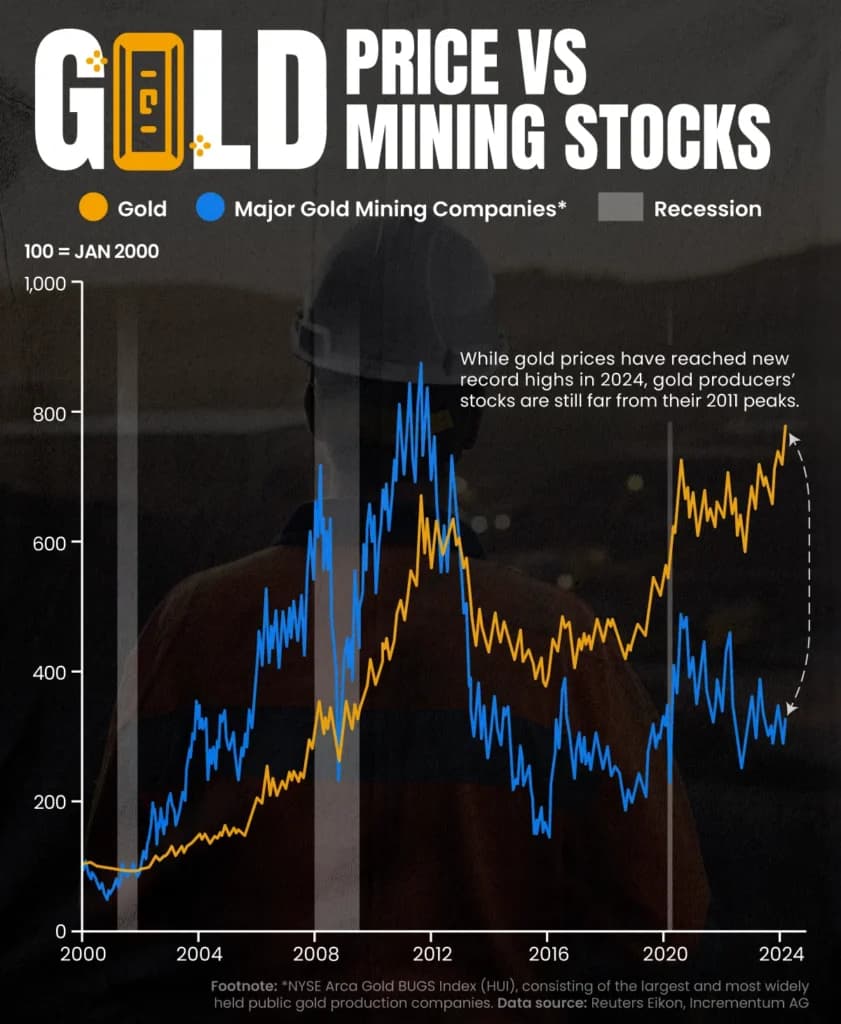
(This chart highlights the divergence between the gold stock price and gold mining stock performance since 2000. While gold prices have surged in recent years, gold mining stocks have lagged behind, offering key insights for those investing in gold. When gold prices rise, mining stock prices often inflate — and when they fall, mining stocks tend to drop more sharply — making them more volatile and potentially riskier investments)
A £10,000 Gold Investment Return
To illustrate gold’s investment performance, let’s look at a concrete example. What would a £10,000 investment in gold in 2010 be worth today?
Say you had £10k in January 2010 and used it to buy gold at around £700 per ounce (that was roughly the price at the start of 2010. You would have acquired about 14.3 troy ounces of gold. If you held onto that gold, today – in 2024 – each ounce is worth around £1,600. Your 14.3 oz would now be worth roughly £23,000. In other words, your initial £10,000 would have grown to about £23k, not counting any storage or transaction fees. This is an approximate 130% total return, which corresponds to a CAGR (compound annual growth rate) of ~6.2% per year over the 14-year period.
To put this in perspective, £10,000 in a savings account over the same period (with interest rates near zero for much of the 2010s) would have grown far less, and inflation would have eroded the purchasing power. Gold not only preserved the buying power of that £10k but roughly doubled it in real terms.
The chart shows the investment’s value rising from £10,000 in 2010 to approximately £23,300 in 2024.
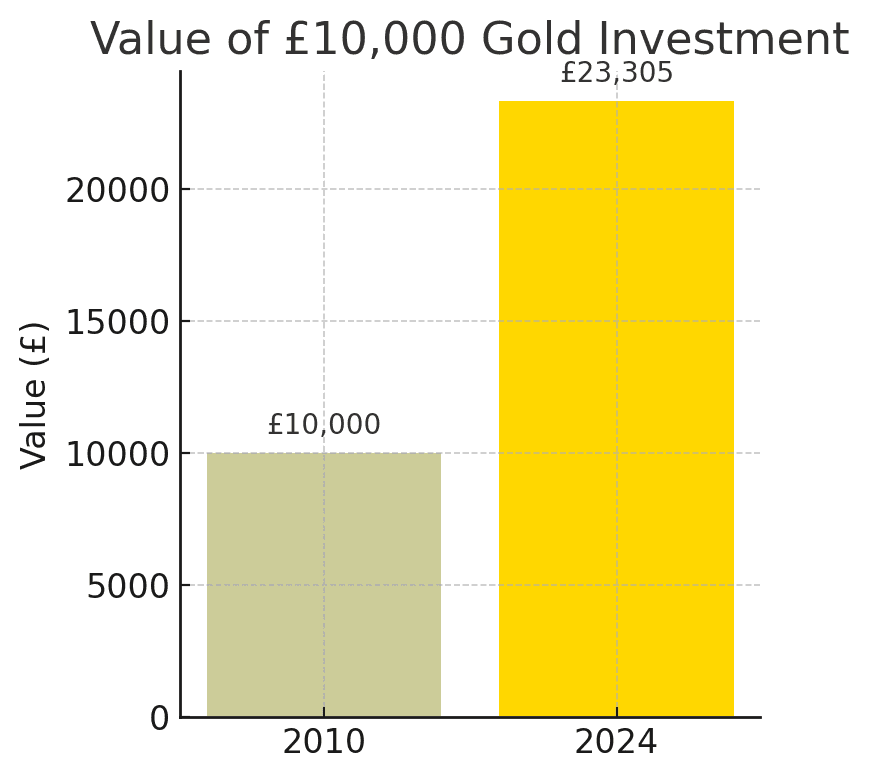
(Growth of a £10,000 gold investment (2010–2024)
It’s worth noting the ride wasn’t entirely smooth. That 2010 investment would have seen its value rise sharply in 2011, then pull back around 2013–2015 (gold prices dipped in those years), then surge again in 2020. But by 2024, the overall trend was clearly up. This example underscores gold’s ability to deliver solid long-term returns. £10k to £23k in ~14 years is decent growth – not as high as a booming stock might achieve, but remember it came with far less volatility than equities like emerging market stocks, and with downside protection during the 2020 crash.
Using the above, you can calculate that gold’s price in GBP approximately doubled from 2010 to 2024. Meanwhile, UK inflation over that period (2010–2024) cumulatively was around 40% (i.e., prices of goods ~1.4× higher on average), so gold more than kept pace with inflation, increasing the real value of the investment.
This kind of real return is why many include gold in their portfolios. That said, past performance doesn’t guarantee future results – future returns could be higher or lower. But gold’s track record over multiple decades has demonstrated an ability to protect and grow wealth modestly.
Gold Price Investment Calculator
Disclaimer: Understanding This Gold Investment Calculator
This gold investment calculator is designed to provide a rough projection of potential gold returns by using historical growth data (1999–2024) and factoring in average UK inflation rates over the same period. By inputting an investment amount and a time horizon, you’ll see an estimate of both nominal (pre-inflation) and real (inflation-adjusted) returns. Please remember that past performance does not guarantee future results, and this tool should not be taken as financial advice.

Gold Investment Calculator
Disadvantages Of Investing In Gold
We’ve talked a lot about gold’s virtues, but it’s important to also consider the disadvantages of investing in gold. Like any investment, gold has its downsides:
- No Yield or Passive Income: Gold is not a productive asset. It doesn’t generate interest, dividends, or rental income . A gold bar sitting in a vault will be the same gold bar years later – it doesn’t multiply on its own. This means the only way to profit is through price appreciation. In contrast, stocks may pay dividends and grow their earnings, bonds pay interest, and property can yield rent. Over long periods in a growing economy, those assets can compound, whereas gold simply keeps value. For an investor seeking income (say for retirement), gold won’t directly provide it (unless you lend it, which is uncommon for retail investors). This opportunity cost is a key drawback – if the gold price stays flat for 5 or 10 years, your investment will have effectively earned nothing in that time (and actually lost value after inflation).
- Storage and Insurance Costs: Holding physical gold securely isn’t free. You’ll likely incur storage and insurance fees to protect your gold. Whether you use a bank’s safe deposit box, a home safe plus insurance rider, or a professional vault service, there’s a cost involved – and over many years those costs add up. For example, if storage/insurance runs 0.5%–1% of the gold’s value per year, that effectively reduces your return. These costs eat into the advantage of holding the asset. By contrast, an investment in a stock index fund might cost practically nothing to store (just an account entry) and could be paying you dividends while you hold. The hassle factor is also worth noting: you must ensure the gold’s safety (to avoid theft or loss). This is one reason some investors prefer “paper” or digital gold products – to avoid the logistics of storage – but then you trade off the tangible ownership.
- Liquidity and Transaction Costs: Gold is generally quite liquid in the global sense – you can usually sell it at market price relatively quickly. However, selling physical gold can involve finding a dealer and possibly accepting a slight discount (the bid/ask spread). Large bars might need an assay or established chain-of-custody to ensure purity when selling. If you need to raise cash fast, selling coins/bars through mail or at a shop could take days, whereas selling stocks or ETFs is done in seconds online. Also, when you buy physical gold, you often pay a premium (perhaps 3-5%), and when selling, you might get a few percent under spot if selling to a dealer. These transaction costs mean gold is not as efficient for frequent trading. It’s best as a long-term hold where such costs are minor in the grand scheme. If you think you might need cash in an emergency, physical gold isn’t as convenient as a savings account.
- Price Volatility: While gold is seen as stable in value over the very long term, its market price can be volatile in the short-to-medium term. It has had stretches of significant decline. For instance, as noted, gold fell in value through the 1980s and 90s – someone who bought a lot in 1980 saw the nominal price drop for 20 years before recovering. More recently, from 2011’s peak around $1,825/oz, gold fell to about $1,050 by end of 2015 (a ~40% drop) before climbing again. If you have a shorter investment horizon, gold’s price swings could result in you selling at a loss. Also, unlike equities, which tend to grow with the economy over the long run, gold doesn’t have a clear expected upward trajectory aside from inflation – so timing matters. If you bought at a high, it might take years to break even. That said, gold’s volatility is still generally lower than that of, say, cryptocurrencies or even many stock indices, but it’s not as steady as a savings account or short-term bond. Important: Gold can underperform during certain periods – for example, in a strong economic growth phase with low inflation, gold may stagnate while stocks soar, leading to opportunity cost (the cost of missing out on other investments’ gains).
- No Credit or Leverage Benefits: Some investments allow you to use leverage (like buying property with a mortgage) or the company behind it uses leverage to grow (companies taking loans to expand). Gold just is; you generally wouldn’t take a loan to buy physical gold (as that’d be risky if price moves against you). This isn’t a “disadvantage” per se, but it means gold might not grow as fast as leveraged investments in good times.
- Potential Premiums Over Melt (for certain gold products): If you buy collectible coins or jewellery as an “investment”, you often pay a substantial premium for craftsmanship or rarity, which is not recovered when you sell for melt value. It’s usually advised not to view jewellery as a gold investment (it’s first a consumption good). Even bullion coins have some premium (though small). Thus, stick to low-premium bullion if investing, otherwise you face an additional hurdle to overcome (needing price to rise enough to cover the premium).
In summary, the disadvantages of investing in gold include the lack of passive income, the costs and inconvenience of storage, potentially significant short-term price fluctuations, and the fact that it may underperform other investments during boom times. Gold should not be viewed as a magic asset that only goes up – it has dull periods and carrying costs. Understanding these drawbacks helps set realistic expectations. Many of these cons can be managed (for example, using a low-cost storage solution, holding gold as a long-term hedge rather than expecting quick profits, etc.). The key is to use gold appropriately (for stability and inflation protection) rather than expecting it to behave like a growth stock or a cash cow, which it won’t.
It’s worth noting the ride wasn’t entirely smooth. That 2010 investment would have seen its value rise sharply in 2011, then pull back around 2013–2015 (gold prices dipped in those years), then surge again in 2020. But by 2024, the overall trend was clearly up. This example underscores gold’s ability to deliver solid long-term returns. £10k to £23k in ~14 years is decent growth – not as high as a booming stock might achieve, but remember it came with far less volatility than equities like emerging market stocks, and with downside protection during the 2020 crash.
Using the above, you can calculate that gold’s price in GBP approximately doubled from 2010 to 2024. Meanwhile, UK inflation over that period (2010–2024) cumulatively was around 40% (i.e., prices of goods ~1.4× higher on average), so gold more than kept pace with inflation, increasing the real value of the investment.
This kind of real return is why many include gold in their portfolios. That said, past performance doesn’t guarantee future results – future returns could be higher or lower. But gold’s track record over multiple decades has demonstrated an ability to protect and grow wealth modestly.
What Is The Best Way To Invest In Gold?
With multiple options available – physical gold, ETFs, mining stocks, etc. – you might wonder “what is the best way to invest in gold?” The truth is, there is no one-size-fits-all answer. The best way for you will depend on your investment goals, budget, and risk tolerance. Here are some guiding points to decide the optimal approach:
- For Long-Term Wealth Preservation: If your goal is to hold gold for the long haul as a form of wealth insurance or legacy asset, physical gold (coins/bars) is often the best choice. You eliminate third-party risks and have direct ownership. Within physical, consider gold coins like Britannias or Sovereigns for tax efficiency (no CGT) and easy divisibility. Store them securely (home safe or vault). This way, you know you have a real asset outside the financial system that you can liquidate if needed. The peace of mind of physical gold is hard to replicate. Just purchase from a reputable dealer to ensure authenticity.
- For Convenience and Liquidity: If you want exposure to gold but prefer a hassle-free experience, gold ETFs are likely the best way. They allow you to buy or sell in seconds through your brokerage account, and you don’t need to worry about storage. They closely track the gold price and are very cost-effective. This is ideal for portfolio adjustments, shorter-term holds, or if you simply don’t want to deal with the logistics of physical gold. Just remember to hold them in an ISA/Pension if possible to shield any gains from tax, since they don’t benefit from the coin CGT exemption.
- For Maximizing Returns (with Higher Risk): If you’re aiming for growth and are willing to take on more risk, consider a mix of gold and gold stocks. The “best way” here might be to hold a core position in physical/ETF gold, and allocate a smaller portion to quality gold mining stocks or a mining fund. This way, you have the stability of gold and some extra upside potential from the miners. Ensure you diversify and perhaps stick to larger, well-capitalized miners or a fund that spreads risk. This approach isn’t necessary for those who just want a hedge, but for an investor comfortable with equities, it can enhance returns during gold bull phases.
- For Small or Regular Investments: If you only have a small amount to invest at a time (say you want to put in £100 per month into gold), using a digital gold savings platform or buying small denomination gold coins over time might be best. Some platforms let you accumulate gold in fractional amounts and even swap for physical once you’ve accrued enough. Alternatively, you can save up until you can afford an ounce coin or a 10g bar periodically. ETFs also work for regular investing (you can buy fractional shares of some gold ETFs with certain brokers, or just one share at a time which might be ~£150 if that’s manageable).
- For Emergency Preparedness: If you’re investing in gold partly as a disaster hedge (financial crisis or even for extreme scenarios), having some small physical gold on hand is wise. Many “preppers” like having a portion in small gold coins (and silver) that could be used for barter or quick private sales. While this is not a primary investment strategy, it feeds into the idea that the “best” way in such a case is the way that gives you access to the metal when you need it – which means personally held bullion.
- Context Matters: The best way can also depend on the market context and your strategy. For example, if gold prices are very low and you want to load up heavily to sell at a profit later, physical could yield more (thanks to CGT-free gains on coins). If gold is high and you’re wary, maybe you just want a smaller exposure via an ETF as a hedge. If you’re an active trader, you might even consider futures or leveraged ETFs – but those are generally not recommended for most, as they require expertise.
In essence, combine methods to suit your needs. A common approach: keep a foundational holding of physical gold (for the “sleep at night” factor), and use ETFs for flexibility and additional exposure when you think the timing is right. This dual approach covers both security and agility. On the other hand, if you simply want simplicity and are investing through your ISA, an ETF alone could suffice.
One last thing: Whichever method you choose, buy from reputable sources. If buying physical, use established dealers (check reviews and ensure they offer insured delivery). If using platforms or ETFs, stick to well-known ones with proper regulation and backing. Gold is valuable, and unfortunately that attracts scams – avoid any scheme that promises gold at below-market prices or unrealistic returns.
To summarize, the best way to invest in gold depends on your goals:
- For pure, hands-on wealth protection, go physical.
- For ease and lower cost, go ETF.
- For growth, consider some miners alongside.
- Often, a mix is the best way to cover all bases.
Frequently Asked Questions
Is gold a good investment?
Gold can be a good investment as a long-term hedge and diversifier. It has a track record of preserving wealth by keeping up with or outpacing inflation over many decades.
Is it a good time to buy gold?
It could be a good time to buy gold, especially if you’re concerned about inflation or market volatility right now. Gold prices are near historic highs, reflecting the current economic uncertainties (inflation, war, etc.). Many analysts expect gold to remain strong or even climb higher in the coming year, as central banks are buying gold and potential interest rate cuts could boost demand. That said, since gold is at high levels, it’s wise to invest gradually. Consider averaging in – buying some now and more if prices dip – rather than putting all your money in at once. In short, if you have little or no gold exposure, now is a reasonable time to start, but keep a long-term perspective and don’t chase short-term gains.
How to invest in gold?
You can invest in gold in several ways:
- Buy physical gold: like coins or bars from a reputable dealer (e.g., GoldSell). This gives you direct ownership; store it securely.
- Buy a gold ETF: through a brokerage account. An ETF (Exchange-Traded Fund) like SGLN or PHAU in the UK will track the gold price and is easy to trade.
- Invest in gold mining stocks or funds: for indirect exposure. You can buy shares of gold miners or a fund that holds multiple mining companies.
- Use digital gold platforms: that allow small, frequent gold purchases which are stored for you. Choose the method that fits your needs – physical for long-term hold, ETF for convenience, or mining stocks for growth (with higher risk). Many investors use a combination.
Should you invest in gold stock?
It depends on your risk tolerance. Gold stocks (mining companies) can offer higher upside than physical gold if the gold price rises, but they come with higher risk and volatility. If you’re comfortable investing in equities and want to potentially earn dividends or greater gains, you could allocate a portion of your portfolio to gold stocks or a gold miners ETF. However, remember that gold stocks can behave more like regular stocks – they might drop in a market downturn even if gold prices are stable. They also depend on company performance. So, they’re not a substitute for holding physical gold or gold ETFs for safe-haven purposes. Think of gold stocks as a more speculative way to invest in gold. Many experts suggest that if you do invest in gold stocks, it should be with a modest portion of your total gold allocation.
What are the disadvantages of investing in gold?
Key disadvantages include:
- No passive income: Gold doesn’t pay dividends or interest; you only profit if the price goes up.
- Storage and insurance costs: Holding physical gold securely can cost money, which can eat into returns.
- Volatility: Gold’s price can swing in the short term and it may go through long flat or down periods (e.g., early 1980s to late 1990s).
- Liquidity inconvenience: While gold is globally liquid, selling physical gold might take more effort/time than selling stocks or bonds, and you’ll incur buy/sell spreads.
- Underperformance in some periods: During strong economic growth with low inflation, gold can lag other investments. In summary, gold is stable in value over the very long run but it’s not a growth asset, it costs money to hold, and it can test an investor’s patience at times. These cons are the trade-off for gold’s safety benefits. Investors should be aware of them and allocate to gold in moderation as part of a balanced strategy.
What is the gold investment forecast?
Gold prices are projected to rise to approximately $3,100 (£2,440) per ounce by late 2025, with Goldman Sachs and Deutsche Bank forecasting continued growth due to strong central bank demand (over 1,000 metric tons purchased in 2024) and persistent geopolitical tensions in Ukraine and the Middle East. While short-term volatility may occur, the long-term outlook remains bullish as gold serves as a hedge against inflation and economic uncertainty.
Is gold investment good?
Gold can be an excellent portfolio diversifier, typically performing well when other assets struggle. Its historical role as a store of value makes it particularly valuable during economic downturns and periods of high inflation. Unlike stocks or bonds, physical gold offers no income, but instead provides insurance against market volatility and currency devaluation. Most financial advisors recommend allocating 5-10% of your portfolio to gold.
What are the advantages of gold investment?
Gold offers unique investment benefits: it serves as a hedge against inflation and currency devaluation; provides portfolio diversification as it typically moves independently of stocks and bonds; offers tax advantages in the UK (no VAT on investment gold, no CGT on certain coins); provides physical security outside the banking system; maintains privacy in wealth holding; and has preserved wealth throughout centuries of economic changes.
Is gold investment safe?
Gold is generally considered a safe investment, particularly during economic uncertainty. Physical gold removes counterparty risk associated with financial institutions and paper assets. It has maintained value for thousands of years and tends to move independently from conventional markets. However, like all investments, price fluctuations can occur, particularly in the short term. Proper storage and insurance are essential considerations.
Where to invest in gold?
In the UK, you can invest in gold through: physical gold bars and coins from reputable dealers like BullionByPost, Gold Investments, or ATS Bullion; vaulted storage options provided by companies like Sharps Pixley; gold ETFs through investment platforms; gold mining stocks and funds as well as digital gold platforms. Always verify dealer reputation and seek professional advice when needed.
Is gold jewellery a good investment?
Gold jewellery typically commands significant premiums above the metal's intrinsic value due to craftsmanship, design, and retail markups. This makes it less efficient as a pure investment compared to bullion. However, high-quality pieces from renowned designers may appreciate over time. For investment purposes, consider 22-24 carat pieces with minimal craftsmanship costs, and be aware that selling prices are usually below retail price so bullions coins and bars are typically better options for investors.
What are some gold investment tips?
For successful gold investing: diversify across different gold assets; consider tax-efficient options like UK Sovereigns and Britannias which are CGT-exempt; verify authenticity by purchasing from reputable dealers; understand storage options (home safe vs. secure vaults); dollar-cost average rather than timing the market; maintain realistic expectations about returns; compare premiums across dealers before purchasing; and consider gold as a long-term holding rather than for short-term gains.
Gold investment companies in the UK?
The UK has several reputable gold investment companies: Gold Investments (operating since 1981 with 50+ years of staff experience); BullionByPost (the UK's self-described #1 online bullion dealer); Hatton Garden Metals (London-based with physical and online presence); Sharps Pixley (historic London dealer); The Pure Gold Company (offering personal broker services); and ATS Bullion.
Interested in selling gold with the UK’s highest paying gold buyer? Visit our Sell Gold page to get a competitive valuation – we provide fully insured postage and fast payment.
For more insights and the latest gold price today, keep an eye on our live charts and blog updates.