How Is Gold Formed?
Gold is formed through cosmic events like supernova explosions and neutron star collisions, which create heavy elements and disperse them across the universe. These processes seeded Earth with gold billions of years ago, leading to the deposits we mine today.
Key Takeaways
- Cosmic Origins: Gold is created in space during supernova explosions and neutron star collisions, producing heavy elements that are scattered across the universe.
- Earth’s Gold Acquisition: After Earth’s formation, a meteorite bombardment approximately 200 million years later delivered gold and other precious metals to the planet’s crust.
- Geological Formation: Over billions of years, geological processes such as erosion, sedimentation, and tectonic activity concentrated gold into deposits found in the Earth’s crust.
- Major Deposits: Significant gold reserves, like those in South Africa’s Witwatersrand Basin, were formed through ancient sedimentary processes and microbial activity.
- Modern Mining: Today, gold is extracted from various types of deposits, including lode (vein) and placer (alluvial) formations, using methods like mining and panning.
Gold – that shiny, precious metal we all know – has an origin story that spans billions of years. Have you ever wondered where gold comes from, how it forms on Earth, or how much of it exists? In this article, we’ll explore where gold comes from, how gold is formed on Earth, and how much gold is in the world. By the end, you’ll understand why gold is so rare and valuable!
Where Does Gold Come From?
Gold is literally stardust – it comes from outer space. It forms when massive stars die in colossal explosions or collisions. In a supernova explosion (the violent death of a star) or in the merger of two neutron stars, conditions become extreme enough to forge heavy elements like gold.
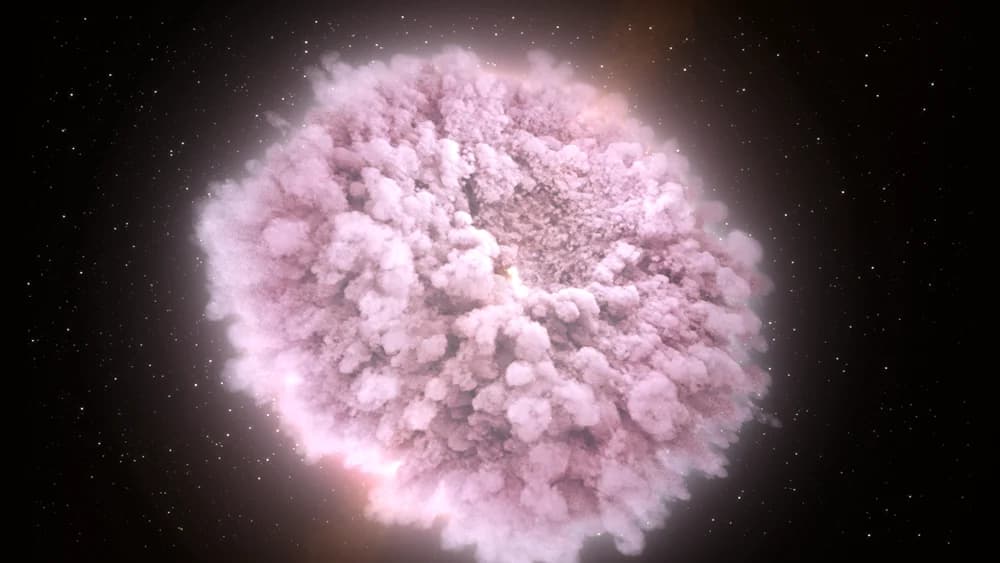
(Illustration of a neutron star collision explosion producing heavy elements like gold)
Gold is literally stardust – it comes from outer space. It forms when massive stars die in colossal explosions or collisions. In a supernova explosion (the violent death of a star) or in the merger of two neutron stars, conditions become extreme enough to forge heavy elements like gold.
When Earth coalesced about 4.5 billion years ago, some of that cosmic gold became incorporated into the planet. But early Earth was a molten ball, and gold (being extremely dense) mostly sank toward Earth’s core during this molten stage. So where does gold come from in the part of Earth we can actually reach – the crust? Geologists believe later meteorite bombardments were the answer. Meteorites (pieces of asteroids and comets) raining down on Earth around 4 billion years ago delivered additional gold to the planet’s surface. In essence, much of the gold in today’s mines arrived via meteorites long after Earth formed. Without those meteorite “gold deliveries,” most of Earth’s gold would be inaccessible far below our feet.
Even with help from meteorites, gold is incredibly scarce in the Earth’s outer layers. To give a sense of scale: scientists estimate there’s enough gold in Earth’s core to cover the entire planet in a 1.5-foot thick layer. That’s roughly 1.6 quadrillion tonnes of gold buried in the core, according to one geochemist’s calculations. Nearly 99% of Earth’s gold is thought to be down there, unreachable. By contrast, the amount of gold in the Earth’s crust (the part we mine) is a tiny fraction – on average only about 0.004 parts per million of crustal rock is gold. In practical terms, that’s a mere 4 grams of gold per 1,000 tons of rock! No wonder gold is so rare. It took the extraordinary events of cosmic history to put a little bit of gold in Earth’s crust for us to find.
So, where does gold come from? In summary, it comes from the stars. Every gold ring or necklace you own is made of an element formed by ancient supernovae and neutron star collisions. That gold then hitched a ride to Earth via meteoritic dust. It’s an epic journey: from cosmic explosions to meteorite impacts to finally resting in the rocks beneath our feet. This cosmic origin story is a big part of why gold is precious – it truly is extraterrestrial in origin.
Next, let’s see how gold is formed on Earth through geological processes, and how those tiny cosmic traces get concentrated into the gold deposits that humans mine.
How Is Gold Formed on Earth?
When we talk about how gold is formed on Earth, we’re really talking about how Earth’s geology collects and concentrates gold – the gold itself was created in space, but geological forces move it around and “deposit” it. Unlike elements like carbon or iron, new gold atoms aren’t formed by any Earthly process; instead, the gold that exists in the crust gets redistributed by heat, pressure, and chemical reactions over millions of years. These processes create the gold veins and nuggets that miners and prospectors hunt. In short, gold isn’t “made” on Earth, it’s found – but it’s found in certain places because of the way Earth’s geology works.
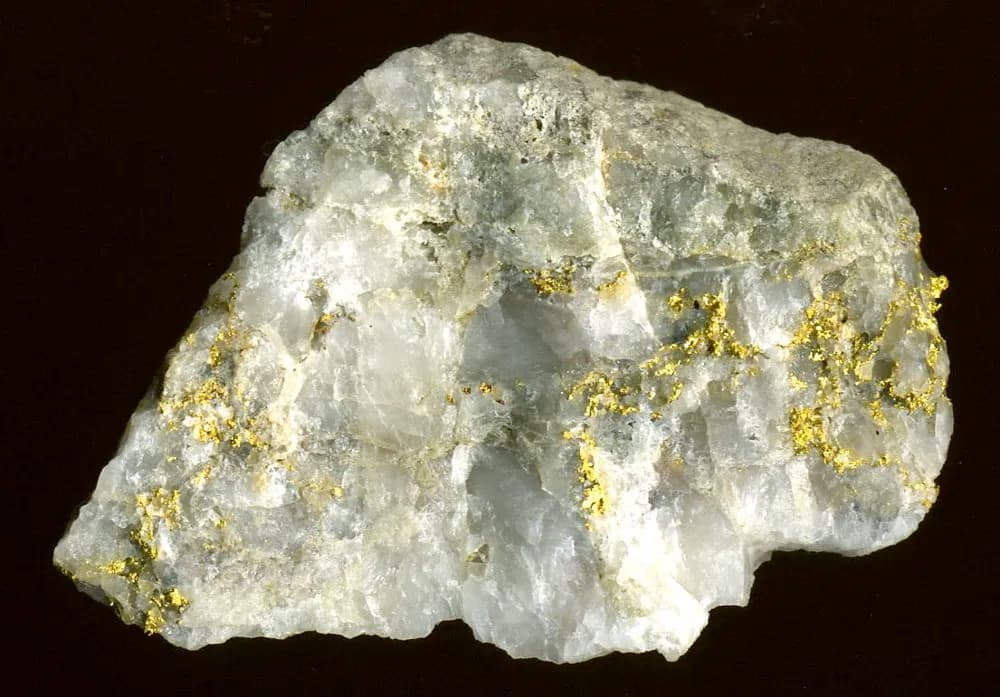
(High-grade gold ore specimen with visible gold in white quartz rock)
In the Earth’s crust, gold is often discovered in hard rock veins, typically alongside quartz and sulfide minerals (as seen in the image above). How do these gold-bearing veins form? They are the result of hydrothermal processes – basically, hot water flowing through rocks. Deep underground, water heated by the Earth’s heat can dissolve small amounts of gold from the surrounding rocks. This mineral-rich fluid travels through cracks and fissures in the Earth’s crust. When it cools or reacts with different rocks, it deposits the minerals it’s carrying – including gold – along the crack walls. Over time, this process builds up rich veins of gold. Many gold mines target these quartz-gold veins (also called lode deposits) where nature has concentrated gold into a much higher abundance than the ordinary rock. In fact, such hydrothermal gold veins are the primary source of most of the world’s gold. They can form in regions with volcanic activity or where continental plates push together, creating the right conditions for hot, gold-bearing fluids to circulate.
Gold can also be concentrated by magmatic and metamorphic activity. In some cases, gold is present in molten rock (magma) and gets concentrated as that magma cools into solid igneous rock. Certain types of intrusive rocks (like porphyry deposits) contain disseminated gold that crystallised out of a cooling magma. Additionally, metamorphic processes – where existing rocks are transformed by high pressure and temperature – can mobilise and reconcentrate gold. In mountain-building zones (called orogenic belts), for example, circulating fluids associated with metamorphism can form gold veins. Some of the world’s most famous goldfields were formed this way. A great example is the Witwatersrand Basin in South Africa, which along with similar belts (like the Canadian Shield in North America) was created by ancient geological processes that concentrated gold on a massive scale. These regions have yielded enormous amounts of gold historically.
After gold has been concentrated in veins or other hard rock deposits, it doesn’t always stay locked in place. Over geologic time, forces of erosion begin to act. Wind, water, and ice break down exposed gold-bearing rocks, freeing the gold. Because gold is heavy (about 19 times denser than water), those freed gold particles don’t travel far from their source before gravity causes them to settle. They accumulate in stream beds, riverbanks, and valleys, mixed with sand and gravel. These are called placer deposits. Placer gold is the kind you might find by panning in a river – flakes and nuggets that have been washed out of the rock and naturally concentrated by flowing water. Many historic gold rushes (like the California Gold Rush or the Klondike in the Yukon) were sparked by the discovery of placer gold. Placer mining (panning, sluicing, dredging) targets these easy-to-access accumulations. Though placers typically yield less total gold than hard rock mines, they were often the first places humans found gold, due to gold’s malleability and resistance to corrosion (placer gold can survive eons in a river).
So, where is gold found thanks to these geological processes? The short answer: on every continent. Gold is distributed widely around the world, but it’s not evenly spread out. It tends to be found in certain regions – typically areas with a history of geological activity like volcanic eruptions, hydrothermal activity, or tectonic collisions. For example, gold is abundant in the ancient shield areas of Canada, the quartz vein-rich mountains of California and Alaska, the volcanic regions of Australia, the massive gold belts of South Africa and West Africa, and the mineral-rich zones of Russia and China. Where is gold found will often coincide with where past geological processes created veins or placers. Even the UK has small amounts of gold; in fact, gold can be found in parts of Wales, Scotland, and southwest England (though in much smaller quantities than in the big mining countries). If you’re curious to learn more, we have a detailed post on where is gold found that explores specific gold-rich locations around the world.
In summary, how is gold formed on Earth? Through the natural geological concentration of gold that was originally scattered in the Earth’s crust. Hydrothermal fluids deposit gold into veins, magmatic and metamorphic processes concentrate gold in certain rocks, and erosion creates placer deposits. These processes explain why gold is often found in particular places and forms – like veins in hard rock or as nuggets in a river. Gold’s rarity and the effort required to gather it (digging up tons of rock or sifting through river sediment for a few ounces) are exactly what make it so valuable.
How Much Gold Is in the World?
After learning how gold forms, a natural question is: how much gold is in the world? In other words, how much gold have humans extracted, and how much is left? Despite gold’s cosmic abundance, the amount of gold available to us is limited – and surprisingly small compared to other common materials.
Let’s start with the gold we’ve already obtained. All the gold ever mined in human history adds up to around 216,000 tonnes as of 2025. That’s 216 thousand metric tons – a huge number, yet gold is so dense that this quantity would form a cube only about 22 meters (72 feet) on each side. Another way to imagine it: that’s roughly enough gold to fill two Olympic-sized swimming pools. That’s it – all the gold ever mined would barely fill a small warehouse! Because gold is virtually indestructible (it doesn’t rust, tarnish, or decay), almost all of that gold still exists in one form or another. It might have been melted and re-used many times, but it’s still with us: in jewellery, bullion bars, coins, electronics, dental fillings, and so on. Gold’s rarity in the world’s crust, combined with its enduring nature, means every ounce we’ve pulled out of the ground is still part of the world’s above-ground gold stock.
Now, how much gold is on Earth if we include what hasn’t been mined yet? We know there’s a lot of gold left underground, though much of it may never be economically recoverable. As of recent estimates, about 50,000–60,000 tonnes of gold are considered “reserves” – gold in the ground that is reasonably certain to be minable with today’s technology. These reserves are spread across the globe in known mining regions (with the largest in Australia, Russia, South Africa, the U.S., and Indonesia, among others). Beyond these reserves, geologists estimate there are additional resources (gold that exists but is not yet proven to be minable at a profit) on the order of 100,000+ tonnes. And this still pales in comparison to the gold in Earth’s core we mentioned earlier (on the order of quadrillions of tonnes, which is completely out of reach). In short, the total physical gold on Earth is astronomically large, but the fraction accessible to humanity is tiny. Practically speaking, the world’s supply of gold that can be mined is measured in only tens of thousands of tonnes and is slowly shrinking as we continue to mine more each year.
Speaking of which – how much gold do we add to the world each year? In 2022, for example, around 3,100 tonnes of gold were mined globally. Annual production has hovered around 3,000 to 3,500 tonnes in recent years. This new gold enters the above-ground stock and gets accounted into that total 216,000 tonnes figure. Interestingly, about two-thirds of all the gold ever mined has been extracted just in the last 70 years or so – an indication of how modern technology and the 20th-century gold rushes dramatically increased our gold output.
Let’s consider gold ownership by country. A significant portion of the world’s gold (about 20% of that 216,000 tonnes) is held by governments and central banks as official reserves. Countries keep gold in their vaults as a store of value. So, which country owns the most gold? The United States is the clear leader – the U.S. government holds about 8,133.5 tonnes of gold in its reserves (mostly stored in places like Fort Knox and the New York Fed vault). That is by far the largest national gold stockpile. The next largest belongs to Germany, which has roughly 3,350 tonnes of gold reserves. After Germany come Italy (approximately 2,452 tonnes) and France (~2,437 tonnes). These four entities (plus the combined holdings of the Eurozone central banks) account for a large share of official gold. Russia and China have also built up substantial gold hoards in recent decades – each has on the order of 2,000+ tonnes in official reserves (China’s central bank reported about 2,264 tonnes in 2024, and Russia around 2,300 tonnes). Other countries with major gold reserves include Switzerland, Japan, India, and the Netherlands, each ranging roughly between 800 and 1,000 tonnes. Central banks collectively hold about one-fifth of all above-ground gold, underscoring gold’s importance in global finance. (This doesn’t even count private ownership like jewellery and investor gold, which makes up the majority of the remaining 80% in circulation.)
Which Countries Own The Most Gold?
Discover which country owns the most gold with this visual ranking of the top 50 gold-holding nations. See how much gold is held by global powers like the United States, Germany, and China.
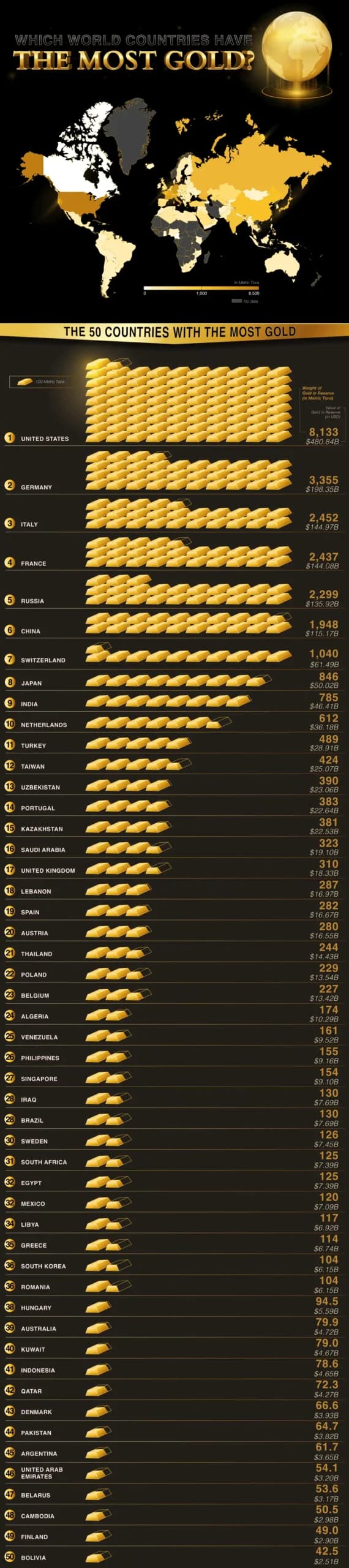
(Infographic showing which country owns the most gold, with the United States leading at 8,133 tonnes, followed by Germany, Italy, and France)
What about gold produced by country – i.e. which countries are mining the most gold today? Currently, China produces the most gold per year of any country. In recent years, China’s mines have been churning out roughly 370–380 tonnes of gold annually, which is about 12% of the world’s total mine production. The next largest gold producers are Australia and Russia, each mining around 300–320 tonnes per year. After that, the United States (around 170–200 tonnes), Canada (~200 tonnes), and countries like Ghana, Mexico, and South Africa are significant producers in the 100+ tonnes range. The exact rankings can change year to year (for example, in some years Australia might edge out Russia or vice-versa), but China has held the top spot for over a decade. So if you’re wondering which country produces the most gold, the answer is China by a considerable margin, followed by Australia and Russia. These three countries alone account for roughly one-third of global gold output each year.
Below is a table of the top gold-producing countries and how much gold they produced most recently (2022 data):
The Top Gold-Producing Countries
Around 31% of the world’s gold production in 2022 came from three countries—China, Russia, and Australia, with each producing over 300 tonnes of the precious metal.
| Rank | Country | 2022E Gold Production (tonnes) | % of Total |
|---|---|---|---|
| 1 | 🇨🇳 China | 330 | 11% |
| 2 | 🇷🇺 Russia | 320 | 10% |
| 3 | 🇦🇺 Australia | 320 | 10% |
| 4 | 🇨🇦 Canada | 220 | 7% |
| 5 | 🇺🇸 United States | 170 | 5% |
| 6 | 🇲🇽 Mexico | 120 | 4% |
| 7 | 🇰🇿 Kazakhstan | 110 | 4% |
| 8 | 🇿🇦 South Africa | 110 | 4% |
| 9 | 🇵🇪 Peru | 100 | 3% |
| 10 | 🇺🇿 Uzbekistan | 100 | 3% |
| 11 | 🇬🇭 Ghana | 90 | 3% |
| 12 | 🇮🇩 Indonesia | 90 | 3% |
| Rest of the World: 1,030 tonnes (33%) | |||
| World Total: 3,100 tonnes (100%) |
(Table showing the top gold-producing countries in 2022, with China leading at 330 tonnes, followed by Russia and Australia. Data sourced from (Visual Capitalist)
Frequently Asked Questions
How is gold formed?
Gold is formed during powerful cosmic events like supernova explosions or neutron star collisions. These extreme conditions fuse lighter atoms into heavier elements, including gold. The resulting gold particles scatter through space, eventually landing on Earth billions of years ago through meteorite impacts. Geological processes then concentrate this gold into accessible deposits.
How much gold is in the world?
Approximately 216,000 tonnes of gold have been mined worldwide throughout history. Nearly all of this gold still exists today due to its indestructible nature. Annual mining adds about 3,000 tonnes to this total. While Earth's core contains vast amounts (quadrillions of tonnes), most is unreachable, making gold extremely scarce in practical terms.
Where is gold found?
Gold is found worldwide, commonly in quartz veins (hard-rock deposits) or riverbeds (placer deposits). Regions rich in gold include South Africa, Australia, Russia, China, Canada, and the USA. Gold is usually found where geological activity, such as volcanic eruptions or tectonic movement, has concentrated it over millions of years.
How much gold is on Earth?
Earth contains massive gold reserves—around 1.6 quadrillion tonnes are in the core, entirely unreachable. Accessible gold reserves in Earth’s crust total approximately 50,000–60,000 tonnes, with potentially another 100,000+ tonnes undiscovered. Compared to the 216,000 tonnes already mined, only limited amounts remain economically viable to extract.
How much gold has been mined?
Around 216,000 tonnes of gold have been mined by humans throughout history. Most gold extraction occurred in the last 70 years, as mining technology improved. Because gold doesn't corrode or decay, nearly all the gold ever mined still exists today, primarily in jewellery, bullion, electronics, and national reserves.
Which country owns the most gold?
The United States owns the most gold, holding approximately 8,133 tonnes stored primarily at Fort Knox. Other top gold-holding countries include Germany (3,355 tonnes), Italy (2,452 tonnes), France (2,437 tonnes), Russia (2,299 tonnes), and China (1,948 tonnes). These countries hold gold mainly as central bank reserves.
How is gold ore mined?
Gold ore is mined by open-pit or underground methods, depending on depth and deposit type. Large, surface deposits use open-pit mining, removing rock layers to reach gold-bearing ore. Deep underground veins require tunnelling and shaft mining. Ore is crushed and processed chemically or physically to extract pure gold.
What is the gold chemical formula?
Gold is a chemical element, symbolised by "Au" (from Latin aurum), and has an atomic number of 79. Being an elemental metal, it doesn't have a chemical formula like compounds. Its chemical representation is simply "Au," reflecting pure, elemental gold.
Can gold be found in the UK?
Yes, gold is found in small quantities across parts of the UK, particularly in Wales, Scotland, and southwest England. Notable locations include the Dolgellau Gold Belt in Wales, river deposits in Scotland’s Highlands, and Cornwall in England. However, the UK lacks large-scale gold mines, and deposits are modest compared to global gold regions.
Where is gold found in the world?
Gold deposits occur worldwide, particularly in geological regions marked by volcanic activity, tectonic movement, or ancient river systems. Notable gold-rich areas include South Africa, Australia, Russia, China, Canada, the USA, Peru, Indonesia, Ghana, and Uzbekistan. Essentially, gold is found wherever natural geological processes have concentrated it into deposits.
Which country produces the most gold?
China is currently the world's largest gold producer, extracting around 330 tonnes per year, roughly 11% of global production. Russia and Australia closely follow, producing approximately 320 tonnes each annually. Other significant producers include Canada, the United States, Mexico, Kazakhstan, and South Africa.
Interested in selling gold with the UK’s highest paying gold buyer? Visit our Sell Gold page to get a competitive valuation – we provide fully insured postage and fast payment.
For more insights and the latest gold price today, keep an eye on our live charts and blog updates.