
How Much Is A Queen Victoria Gold Sovereign Worth?
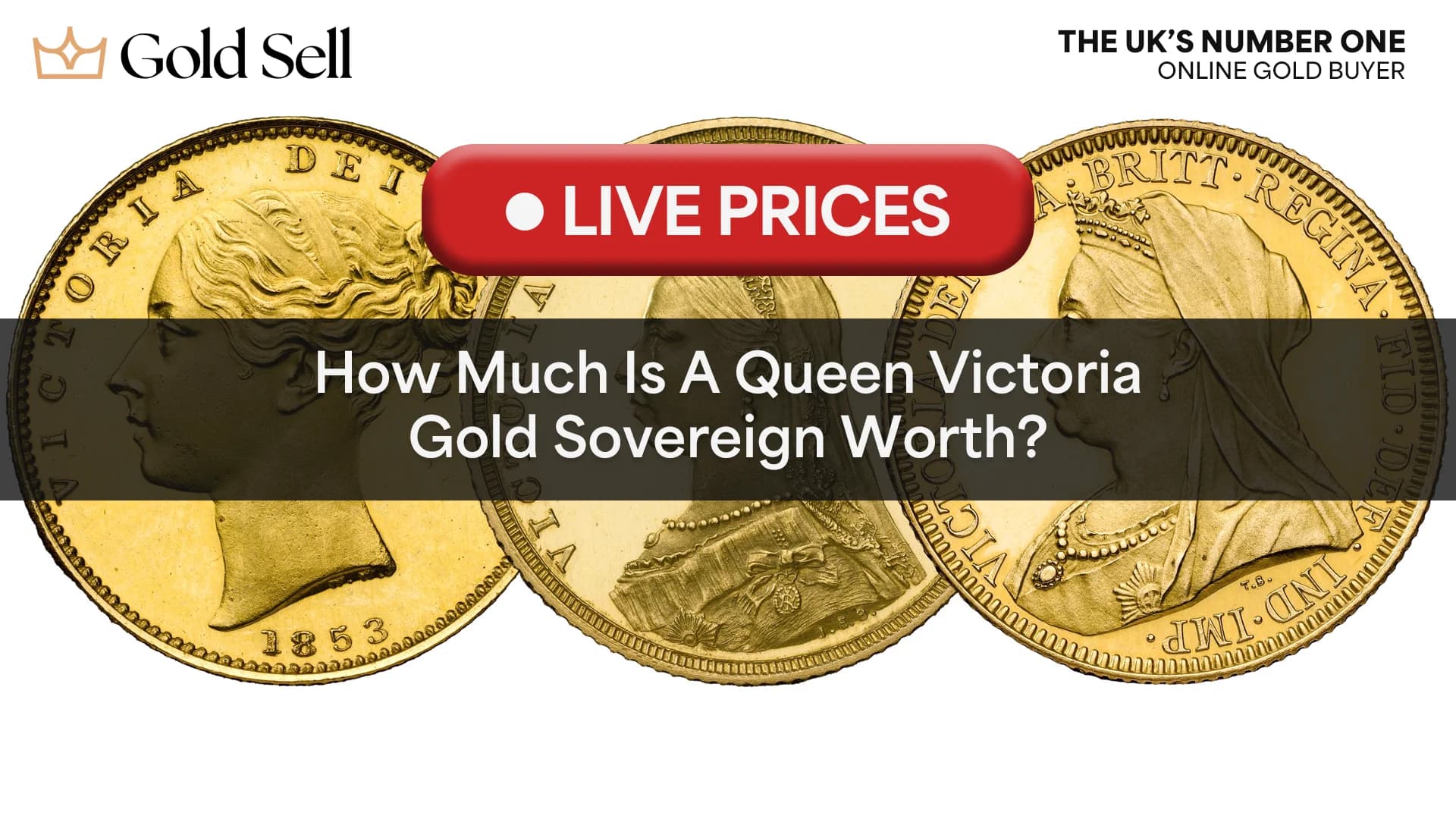
A Queen Victoria gold Sovereign is worth at least the value of its gold content – roughly 0.2354 troy ounces of gold (about 7.32 grams of pure 22-carat gold) – which equates to £727.15 based on the live gold spot price. However, certain Queen Victoria Sovereigns can be worth significantly more than their melt value if they are rare, in excellent condition, or have sought-after variations. The coin’s design portrait (Young Head, Jubilee Head, or Old Head), mint year, and mint mark all influence value, meaning most Victorian Sovereigns trade near bullion price while scarcer types fetch higher premiums.
Key Takeaways
- Intrinsic Gold Value: Every Queen Victoria Sovereign contains 7.322 grams of 22-carat gold (0.2354 troy oz) and is therefore worth at least its weight in gold – which is £727.15 based on the current gold spot price.
- Common vs. Rare Sovereigns: Most Victorian Sovereigns are common and sell close to their bullion value. Rare dates, mint marks (e.g. Sydney “S” or Melbourne “M” issues), or unusual varieties (like the 1887 “Hooked J” Sovereign) can command substantial premiums due to their scarcity.
- Factors Affecting Value: Key value drivers include the coin’s gold content, condition (uncirculated coins fetch more), rarity of the date or type, and the prevailing gold market price. Pristine, collectible examples are worth more than worn coins of the same year.
- Portrait Types Matter: Queen Victoria Sovereigns were issued in three main portrait types – Young Head (1838–1887), Jubilee Head (1887–1893), and Old (Veiled) Head (1893–1901). Certain early Young Head “shield back” sovereigns and other sought-after types often carry extra collector value, whereas later common dates may only be worth their gold content.
- Half Sovereign Value: A Queen Victoria Half Sovereign contains half the gold of a full Sovereign (about 3.66 grams fine gold) and is typically worth roughly half a full Sovereign’s value. Like full Sovereigns, Victorian Half Sovereigns’ worth depends on gold price and rarity – most track bullion value, but scarce dates or mint marks can elevate their price.
How Much Is A Queen Victoria Gold Sovereign Worth?
A Queen Victoria Gold Sovereign is typically worth at minimum its intrinsic gold bullion value, which fluctuates with the market price of gold. As a 22-carat gold coin containing about 0.2354 troy ounces of pure gold, its base price rises and falls in line with gold prices. For example, gold is currently trading at £3,088.73 per troy ounce, the bullion value of a Sovereign would be roughly £727.15 (0.2354 x £3,088.73). This intrinsic value serves as a floor – most Victorian Sovereigns will be worth at least this amount. Common-date coins from Queen Victoria’s reign often trade near this melt value, especially if they are circulated or lack numismatic rarity.
However, many factors can push the worth of a Queen Victoria Sovereign above its gold content. Collectors pay premiums for coins in better condition, for scarce dates or mint marks, and for specific design types. Queen Victoria’s reign saw three distinct portrait designs on the sovereign: the Young Head (1838–1887) featuring a youthful bust, the Jubilee Head (1887–1893) marking her 50th jubilee with a crowned mature portrait, and the Old (Veiled) Head (1893–1901) showing Victoria in later life with a widow’s veil. Most coins, regardless of type, share the same gold content — around 7.322 grams of fine gold — but certain issues have become more valuable due to rarity or collector interest.
As of today, the gold melt value of a Young Head Queen Elizabeth Sovereign is £727.15, based on a live 24ct gold price of £99.31 per gram. However, coins rarely trade at melt value. For example, bullion dealers currently list a standard Victoria Young Head gold Sovereign at around £828.95, which is 14% over its melt value. This price typically applies to a general stock coin from a date of the dealer’s choosing, rather than a specific year or grade. We include this example purely to illustrate how dealer premiums influence the retail price of a Queen Victoria gold Sovereign. While there’s no single fixed value for these coins—since worth depends on factors like condition, rarity, and specific year—most common-date Victorian Sovereigns without significant collector value are priced based on their gold content, plus a typical dealer margin.
Early Young Head Sovereigns with the “shield back” reverse, or those struck at colonial mints like Sydney (“S”) or Melbourne (“M”), typically command significantly higher prices than modern, common-date Queen Victoria Sovereigns. As a general benchmark, these rarer coins are often valued at 50–60% above the melt value of a standard Victorian Sovereign, due to their scarcity and strong collector demand.
For example, Sydney-minted Queen Victoria Sovereigns consistently achieve higher market prices. We analysed recent listings across multiple well-known bullion dealers and found that the average price for this coin was £1,111.16, which represents a premium of around 50–60% above melt value.
Please note, we aim to provide the most accurate and up-to-date insights possible in our blog posts. However, when discussing coins that carry numismatic value, their prices can fluctuate based on collector interest, market sentiment, and other unpredictable factors. While this example is well researched, it should be viewed as indicative only, designed to give a realistic sense of current market trends rather than a fixed valuation.
In summary, the majority of Queen Victoria gold Sovereigns are worth their weight in gold, but those that are numismatically rare, in excellent condition, or historically significant can be worth substantially more. It’s important to identify the coin’s date, mint mark, and type to assess if it carries any premium. A coin dealer or price guide can help determine if a particular Queen Victoria Sovereign is just a bullion piece or a collectible worth above melt value. But as a baseline, owning a Victorian Sovereign guarantees you the value of the gold it contains, with upside potential if your coin happens to be a special one.
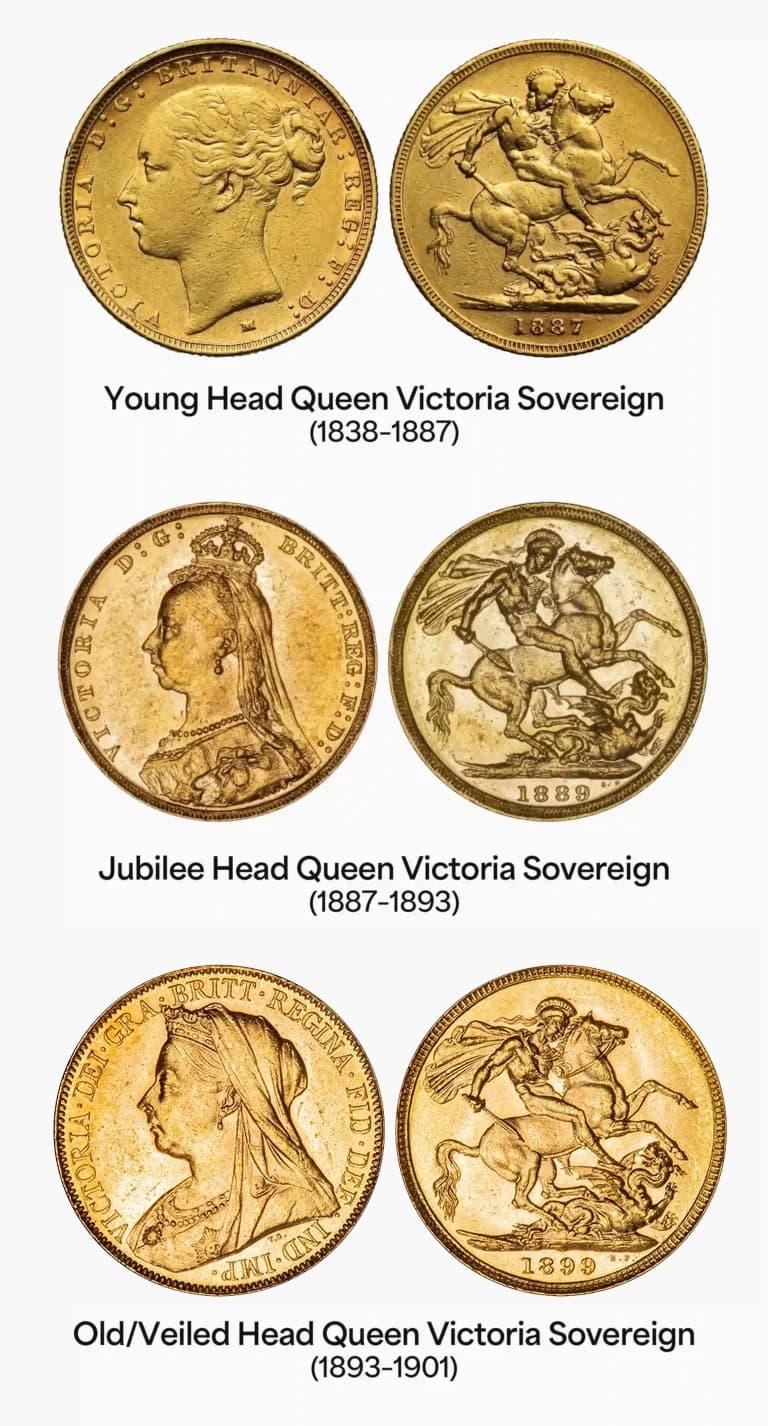
This visual compares the three portrait types of Queen Victoria gold Sovereign coins—Young Head (1838–1887), Jubilee Head (1887–1893), and Old/Veiled Head (1893–1901). Each design marks a distinct period in Victoria’s reign, influencing both historical significance and market value. Recognising the design type and year is essential when assessing a Sovereign’s collectability and potential worth above bullion value.
Queen Victoria Sovereign Value
Queen Victoria Sovereigns derive their value from a combination of their precious metal content and numismatic qualities. First and foremost, each Sovereign contains about 7.32 grams of pure gold (22-carat), so its base value is tied to the gold spot price. This means if the price of gold rises, the bullion value of the coin rises in tandem – and if gold falls, the coin’s intrinsic value falls accordingly. Investors and collectors track the gold market because a Victorian Sovereign’s worth will move in lockstep with gold prices when the coin is traded as bullion. In times of economic uncertainty or high demand for gold, Sovereign values increase, whereas stable markets can see gold (and thus Sovereign) prices dip with reduced demand.
Beyond the gold content, several key factors affect the value of a Queen Victoria Sovereign:
- Condition (Grade): Coins in pristine condition (e.g. uncirculated or extremely fine) are worth more than worn or damaged coins. Collectors will pay a premium for well-preserved details and lustre. A heavily worn Sovereign might only fetch bullion value, while a mint-condition Victorian Sovereign of the same year could sell for a notable premium due to its collectability.
- Rarity and Year: Some dates of Victoria Sovereigns had low mintages or high attrition rates and are thus scarcer today. For example, certain 19th-century years like 1838, 1839, or 1841 are much harder to find, greatly increasing their value to collectors. Generally, the rarer the year (or specific variety), the higher the coin’s numismatic value above gold content.
- Mint Mark (Origin): Queen Victoria Sovereigns were struck not only in London but also at branch mints of the expanding British Empire – notably in Australia (Sydney “S”, Melbourne “M”, and later Perth “P”). Coins from these colonial mints can sometimes be worth more due to their lower mintage quantities or collectability. If a Victorian Sovereign has a mint mark indicating it was minted abroad, its value may be higher than an equivalent London issue, especially if that mint’s output was limited. For instance, an 1893 sovereign from the Sydney Mint might be valued more by collectors than a common 1893 London sovereign because far fewer were made in Sydney.
- Collectible Variants: Certain design or error variants drive value. Examples include Sovereigns with a shield-back reverse design (as seen on many Young Head issues up to 1871), which are popular with collectors and often priced higher than the more common St. George reverse coins, or rare die varieties (discussed more below). Coins issued in proof or special editions also carry substantial premiums.
- Historical and Collectible Demand: Beyond pure numbers, the historical significance of Victorian Sovereigns can attract collector interest. Queen Victoria’s reign was long and influential, so coins from key years (like her coronation year 1838 or Jubilee year 1887) may have extra appeal. Likewise, a complete type set of Victoria’s three portraits is popular among collectors, supporting values for each type. In addition, if a particular coin has provenance or an interesting backstory, it could add intangible value.
Importantly, bullion-grade Victorian Sovereigns – the common coins without special rarity – will be valued almost entirely on gold content. These coins trade in the bullion market and their price on any given day is essentially the gold weight (0.2354 oz) times the gold price. As the gold spot price fluctuates, so does the value of these Sovereigns. Conversely, numismatic Sovereigns (rarer or high-grade examples) have an additional collectible value that can grow over time regardless of gold’s daily moves. For example, even if gold prices dip, a truly rare Victorian Sovereign could maintain or increase its price due to collector demand outstripping supply.
To put it simply, the value of a Queen Victoria Sovereign is influenced by its gold content, rarity, condition, and the prevailing gold market. An ordinary coin will be worth its gold weight, while a rare date in top condition might be worth many times more. Owners of Victorian Sovereigns should identify what kind of coin they have – bullion or collectible – to understand its true value.
Today's Live Gold Prices
If you’re trying to understand the value of a Queen Victoria gold Sovereign, it’s essential to know the current gold market rate. Since most Sovereigns derive their base value from the intrinsic worth of their gold content, the live gold price per gram provides a reliable benchmark. A full Victorian Sovereign is made from 22-carat gold and weighs 7.98 grams, but only 7.3224 grams of that is pure 24-carat (fine) gold. This is the weight used when calculating its melt value based on the live 24ct spot price.
Below, we’ve included our live gold price tracker, which updates every 60 seconds. This gives you real-time insight into what different gold purities (including 22ct, the exact fineness of Sovereigns) are currently worth. It’s an invaluable tool for anyone looking to estimate the base melt value of their coins before factoring in collector or numismatic premiums.
Live Gold Price Per Gram
Gold price last updated:
Wednesday, 21 October 2026, 14:15.
The LBMA (London Bullion Market Association) spot price changes daily.
The prices displayed are based on the global market rate for pure 24ct gold, known as the spot price. Like all gold dealers, GoldSell pays a percentage of this rate to account for assaying, refining, secure logistics, market volatility, and handling costs. We consistently offer among the highest payout rates in the UK, with the exact percentage increasing based on the weight and purity of the gold you sell.
Queen Victoria Sovereign 1887 Value
The year 1887 is an interesting case for Victoria Sovereigns because it marked a major design change and falls right in the middle of her reign. In 1887, the Royal Mint introduced the “Jubilee Head” portrait of Queen Victoria, depicting her wearing a small crown and veil in honour of her Golden Jubilee (50 years on the throne). This replaced the earlier Young Head design that had been used for decades. A vast number of 1887 Sovereigns were minted with the new Jubilee Head, particularly at the primary London Mint, making most 1887 coins quite common and usually worth close to their gold bullion value. If you have a standard 1887 London-minted Queen Victoria sovereign in average circulated condition, its value is likely just about the same as any other common-date Sovereign – which is essentially based purely on the gold content.
However, not all 1887 sovereigns are equal, and some can be more valuable. Firstly, 1887 Sovereigns were produced not only in London but also at branch mints in Australia (such as Sydney and Melbourne). The branch mints in that year actually issued three different types of sovereigns all dated 1887: some with the old Young Head and shield reverse (as they transitioned designs), some Young Head with St. George reverse, and the new Jubilee Head design – especially in Sydney/Melbourne where the changeover happened slightly later. The colonial-minted 1887 Sovereigns (those bearing an “S” or “M” mint mark) can carry a bit more value if they had smaller mintages or if they are in better condition than typically seen. Collectors often seek one example from each mint, so an 1887-S (Sydney) or 1887-M (Melbourne) sovereign might fetch a premium over a very common 1887 (no mint mark) from London.
Secondly – and most significantly – the 1887 Sovereign has a famous die variety known as the “Hooked J” that is highly sought after. On some 1887 Jubilee Head coins, the initial “J” (for designer Joseph Edgar Boehm, whose initials J.E.B. appear on the truncation of the Queen’s neck) has a distinctive hooked appearance. These “Hooked J” varieties were the result of specific dies and are extremely scarce. In particular, an 1887 Sydney Mint Sovereign with the Hooked J variation is considered extremely rare. This means that if your 1887 coin happens to be one of these Hooked J examples (or a similar rare variety), its value is much higher than a normal 1887 Sovereign. Such coins are true collector pieces – for instance, one London-minted 1887 Sovereign with a Hooked J die error is catalogued as a rarity (often cited as R5 on rarity scales), with only a few thousand struck, and can sell for hundreds or even thousands of pounds to specialist collectors.
In summary, a typical 1887 Queen Victoria Sovereign (especially from London) is worth roughly its gold value because it’s common. But certain 1887 Sovereign coins can be worth more, such as those from the Sydney or Melbourne mints or those exhibiting the rare “Hooked J” die variety. The Jubilee Head design itself does not automatically make the coin more valuable (since it was used from 1887–1893 and many were made), but any unusual features or low-mintage versions from that year will increase value. If you suspect you have an 1887 Sovereign with a mint mark or a Hooked J, it’s wise to have it examined – the difference in value between a regular 1887 and a rare variety 1887 can be substantial, often turning a coin worth £727.15 in gold to one worth many times that to a collector.
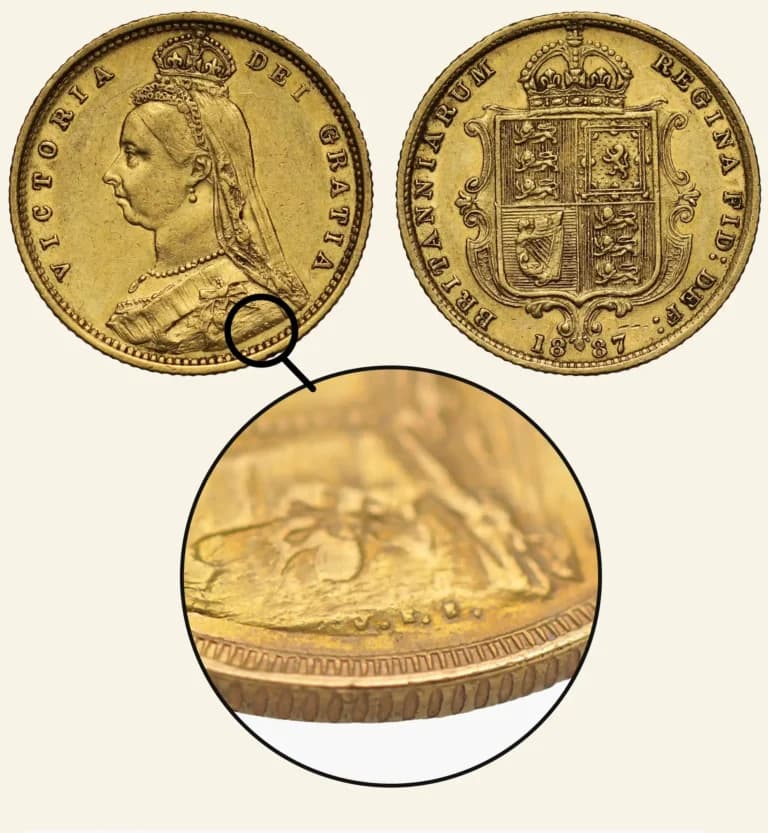
This image shows the 1887 Queen Victoria Half-Sovereign struck at the London Mint featuring the rare “Hooked J” variety, visible in the designer’s initials “J.E.B.” on the truncation of the bust. Recognised by collectors and catalogued as R5 in rarity, this subtle die variation makes the coin highly sought after and significantly more valuable than standard 1887 issues.
Price Of Queen Victoria Gold Sovereign Coins
When buying or selling a Queen Victoria gold Sovereign, it’s important to understand how market pricing works. The price you pay to buy one of these coins is usually a bit higher than the raw gold value, and the price you receive when selling is often a bit lower than the gold value. This difference is due to dealer premiums and margins, which cover costs like minting, testing, handling, and business overhead.
For buyers, gold Sovereigns (including Victorian issues) typically carry a small premium over the live gold spot price. No investor can purchase gold coins exactly at spot price, because refining costs and dealer expenses must be factored in. In practice, the spot price is the baseline, and you’ll pay that plus additional charges and a margin – known as a premium. This premium on common Victorian Sovereigns might be on the order of a few percent above gold content for bullion-grade coins. For example, the live spot value of a Queen Victoria gold Sovereign is currently £727.15, based on its pure gold content. This week, we reviewed listings from a range of popular bullion dealers and found that the average sell price for a standard bullion-grade Queen Victoria Sovereign was £828.95, representing a 14% premium over its melt value. This margin accounts for dealer operating costs, testing, insurance, and a modest profit. Premiums can vary based on demand and availability; if Victorian Sovereigns are in high demand or short supply, premiums might be a bit higher, whereas in a saturated market they could be relatively low.
When selling a Queen Victoria Sovereign, you’ll encounter the inverse situation: dealers often pay slightly under the spot gold value. This is the dealer’s buy-back margin. A coin dealer has to resell the coin and cover costs, so they typically offer a “wholesale” price, a bit below retail. For instance, if a Sovereign’s melt value is £727.15, a dealer might offer around £690.79–£705.34 for it. If the coin is very common or circulated, the offer might be close to melt; if it’s a desirable date or in superb condition, some dealers might pay a bit above melt (because they know they can resell it for a premium to a collector). But generally, dealers will only pay a price that leaves them room for profit when they sell your Sovereign onward. This is why selling a gold coin back usually yields slightly less than the metal’s market value at that moment.
Another aspect of pricing is the dealer premium on historic Sovereigns versus modern bullion coins. Victorian Sovereigns often trade as bullion interchangeably with newer sovereigns, but because of their age and historical nature, some dealers may apply a slightly higher premium to them compared to brand new coins. Conversely, if a particular Victorian Sovereign has no collector value (just a common date), some bullion buyers treat it the same as any sovereign. It’s worth noting that all Queen Victoria Sovereigns are legal tender in the UK (with a face value of £1, though their gold content is worth far more), and they are exempt from Capital Gains Tax for UK residents – factors that sometimes add to their appeal and liquidity, potentially influencing prices a bit.
In summary, the price to purchase a Queen Victoria gold Sovereign will be the gold value plus a small premium, and the price when selling will be around the gold value minus a small dealer margin. These premiums exist to cover refining, handling fees, and dealer business costs. Additionally, remember that if your particular coin has collectible value, you might secure a better price by selling to a collector or at auction rather than for bullion. On the flip side, if you’re buying a rare Victorian Sovereign, expect the price to be much higher than the gold content because you’re paying for its numismatic value, not just the metal.
Queen Victoria Half Sovereign
As the name suggests, a Queen Victoria Half Sovereign is a smaller gold coin that contains half the gold content of a full Sovereign. These coins were worth 10 shillings (or half a pound) in Victorian times and were minted to the same 22-carat purity. In terms of gold content, a Victorian half sovereign contains approximately 3.66 grams of fine gold, which is 0.1177 troy ounces. This means its intrinsic bullion value is about half that of a standard Sovereign. Right now, a full Sovereign is worth £727.15 in gold, so a Half Sovereign’s gold content puts its value at £363.58. Just like full Sovereigns, Half Sovereigns will always be worth at least their melt value, and their price rises and falls with the gold market.
Queen Victoria half sovereigns went through similar portrait design changes and were produced in significant numbers, particularly at the Royal Mint in London. The Victoria Old Head Half Sovereigns were struck in the final years of her reign, from 1893 to 1901, featuring the same “Veiled Head” portrait by Sir Thomas Brock as the full sovereign of that era. Over Victoria’s reign, millions of half sovereigns were produced at the London Mint, so many dates are quite common. For example, a London 1900 or 1899 half sovereign (Old Head) is usually valued mainly for its gold content, unless in unusually high grade.
However, some Victorian half sovereigns are scarcer, especially those from branch mints. In the late Victorian period, half sovereign production at the colonial mints was sporadic. The Sydney Mint in Australia, for instance, only struck half sovereigns in three years during the Old Head era: 1893, 1897, and 1900. The mintages for these were very low – only 250,000 in 1893 and 260,000 in 1900 at Sydney, and the 1897 mintage (though not officially recorded) is believed to be similarly small. These figures are tiny compared to the millions minted in London, making Sydney-issued half sovereigns of Queen Victoria notably scarce today. A collector seeking an “1893-S” or “1900-S” half sovereign (identified by a small “S” mint mark) will often pay a premium well above gold value to obtain one, especially in nice condition, because so few survive. The same goes for any Melbourne “M” mint half sovereigns if they exist in certain years (Melbourne minted some half sovereigns in earlier years of Victoria’s reign, but by the Old Head period Melbourne’s half sovereign output was minimal).
Another point of interest: Victorian half sovereigns sometimes carried different reverse designs than full sovereigns of the same period. Notably, during the Jubilee Head years (1887–1893), the half sovereigns continued to use the traditional shield-back reverse, whereas the full sovereigns featured St. George and the Dragon. This means an 1887 half sovereign shows Queen Victoria’s Jubilee bust on the obverse and a crowned shield on the reverse – a design combination unique to the half sovereigns. These nuances can attract collectors. In general though, the value of a Queen Victoria half sovereign is determined by the same factors as the full sovereign – gold content, condition, rarity, and demand. Most will be worth around half of what a full sovereign is worth in bullion terms, with additional value if the coin is a key date or in superb condition.
For practical pricing: if you’re buying a Victorian half sovereign from a dealer, you can expect to pay a small premium over its gold value (similar to full sovereigns, sometimes the premium on half sovereigns is proportionally slightly higher because smaller denomination gold can carry higher minting cost percentages). And if you’re selling one, a dealer will likely offer somewhat less than gold spot for it. But if the coin is one of the rarer ones – say an 1850s Sydney Mint half sovereign or a rare date in uncirculated grade, its collectible value can be many times the bullion value. In essence, a Queen Victoria half sovereign is “half a sovereign” in both gold weight and usually in price, unless numismatic factors intervene. It’s a valuable little coin that shares in all the same heritage and market dynamics as its bigger sovereign sibling.
Frequently Asked Questions
How much is a Queen Victoria gold Sovereign worth?
A Queen Victoria gold Sovereign is worth at least its gold melt value—currently £727.15 based on 7.3224g of pure gold content. However, many trade for more. Dealers typically sell standard bullion-grade Sovereigns at a 10–15% premium, bringing average retail prices to around £828.95. Rarer types (e.g. Sydney Mint, Shield Back, or special die varieties) can sell for £1,111.16+ depending on condition, making the true value dependent on both bullion content and collectability.
Are Queen Victoria coins valuable?
Yes, Queen Victoria coins—especially gold Sovereigns and Half Sovereigns—can be highly valuable. Even common examples hold strong intrinsic value due to their gold content, while rarer dates, branch mint marks (like “S” or “M”), and special varieties (e.g. the 1887 Hooked J) can significantly increase value. Their historical significance and collectability mean many Victorian coins carry premiums well above melt value, with some fetching several hundred pounds more depending on rarity and condition.
What is the rarest Queen Victoria Sovereign?
The rarest Queen Victoria Sovereign is generally the 1841 Young Head Sovereign, with an extremely low recorded mintage and high attrition rate. It is considered a key rarity and can sell for thousands of pounds in good condition. Other scarce examples include the 1839 Sovereign and certain Sydney Mint issues, especially those with low mintages or die variations. Collectors also prize 1887 “Hooked J” Jubilee Head coins for their exceptional scarcity and numismatic appeal.
What Queen Victoria coins are valuable?
The most valuable Queen Victoria coins are usually early gold Sovereigns and Half Sovereigns with low mintages or rare die varieties—such as the 1838–1841 Young Head Sovereigns, Sydney and Melbourne Mint issues, and the 1887 “Hooked J” Sovereign. Proof coins, uncirculated examples, and those in high grades also command strong premiums. While most Victorian coins hold intrinsic gold value, it’s these rarer, condition-sensitive coins that often fetch collector prices well above bullion rates.
How much is a Queen Victoria Half Sovereign worth?
A Queen Victoria Half Sovereign contains 3.66g of fine gold, giving it a melt value of £363.58 based on today's live gold spot price. Common-date coins in average condition usually trade near bullion value, while rare dates—especially from the Sydney or Melbourne Mints—can be worth significantly more. For example, a London-minted 1900 Half Sovereign might sell for £363.58, but a rare 1893-S could sell for £650+. As with full Sovereigns, rarity and grade affect the price most.
What affects Queen Victoria Sovereign coin's value?
A Queen Victoria Sovereign’s value is determined by its gold content, rarity, condition, year, and mint mark. All Sovereigns contain 7.3224g of pure gold, providing a baseline melt value. From there, collector demand drives premiums—especially for rare dates (e.g. 1841), colonial mints (Sydney or Melbourne), and special die varieties like the 1887 Hooked J. Higher-grade coins command more, and prices fluctuate with both the gold spot price and numismatic market sentiment.
Interested in selling gold with the UK’s highest paying gold buyer? Visit our Sell Gold page to get a competitive valuation – we provide fully insured postage and fast payment.
For more insights and the latest gold price today, keep an eye on our live charts and blog updates.





