Is Gold Magnetic?
Is gold magnetic? In a nutshell, no – pure gold isn’t magnetic. A high-purity gold coin or piece of jewellery will not stick to a magnet. However, the story gets more interesting when you consider gold alloys and lookalikes. Below, we’ll dive into details about gold’s magnetism (or lack thereof), magnetic tests for gold, and how other metals like white gold or “fool’s gold” behave around magnets.
Key Takeaways
- Pure gold is not magnetic: 24-carat gold (99.9% pure) will not be attracted to a magnet. In fact, gold is slightly diamagnetic – it weakly repels a strong magnet, but you’ll never see pure gold jump to one.
- Most gold jewellery isn’t magnetic either: Common gold alloys (18ct, 14ct, 9ct) mix gold with metals like copper or silver, which are also non-magnetic. So a typical gold ring or chain won’t react to a magnet. If it does stick strongly, it’s likely not real gold.
- Lower-purity and white gold can show slight magnetism: Some gold alloys include small amounts of magnetic metals (like nickel or iron) for strength or colour. For example, a 14ct white gold ring could have nickel and might respond faintly to a magnet. The magnetism comes from those other metals – not the gold itself.
- The “magnet test” is a handy at-home check, but not foolproof: It can catch obvious fakes (real gold will never strongly attract a magnet). But a non-magnetic result doesn’t guarantee purity – some counterfeit or low-value metals (like brass) also won’t stick to magnets. Always confirm with more reliable methods (like checking hallmark stamps or professional testing) if you need certainty.
- Fool’s gold isn’t real gold – and it’s usually not magnetic either: “Fool’s gold” refers to iron pyrite, a mineral that shines like gold. It contains iron, yet pure pyrite won’t cling to a magnet the way you might expect. This lookalike can fool beginners but there are other ways (colour, hardness) to tell it apart from genuine gold.
Is Gold Magnetic?
Let’s answer the main question clearly: pure gold is not magnetic. If you have a 24-carat gold bar or coin, a magnet will not attract it. Gold lacks the ferromagnetic metals (like iron, nickel, or cobalt) needed to stick to a magnet. In fact, gold is classified as a diamagnetic metal – it’s very slightly repelled by magnetic fields, but you’d need a strong lab magnet to ever notice. So under normal conditions, a magnet won’t stick to pure gold.
What about gold jewellery or coins? Most gold items aren’t made of 24ct pure gold because pure gold is soft. Jewellers mix gold with other metals to create alloys of various purities (like 18ct, 14ct, 9ct, etc.) and colours. The good news is that the common metals used (copper, silver, zinc) are also not magnetic. That means a real gold necklace or ring typically will not be attracted to a household magnet. If you do a “gold magnet test” at home – i.e. holding a strong magnet up to your jewellery – authentic gold pieces usually won’t react.
However, if your item does leap to the magnet or sticks strongly, that’s a red flag. A genuine gold item (even 9ct which is only 37.5% gold) shouldn’t contain enough magnetic metal to pull hard. So, a piece that snaps to a magnet is likely fake or not actually gold. For example, a gold-coloured coin that contains steel or iron will stick to a magnet, revealing it’s not real gold. Many counterfeit “gold” coins or costume jewellery items use cheap magnetic metals inside.
Beware: The magnet test is a useful preliminary check, but it isn’t foolproof for determining gold authenticity. Why? Because some real gold items can contain tiny amounts of magnetic metals (we’ll discuss white gold in a moment), and conversely, some fake gold or other metals (like brass, which is copper/zinc) won’t react to a magnet either. In other words, “non-magnetic” doesn’t automatically mean “real gold.” It simply means the item doesn’t contain iron-group metals. You could have a piece of lead or stainless steel (non-magnetic grades) and it wouldn’t stick to a magnet, but it’s not gold. So, use the magnet test as a quick screening tool – not as absolute proof.
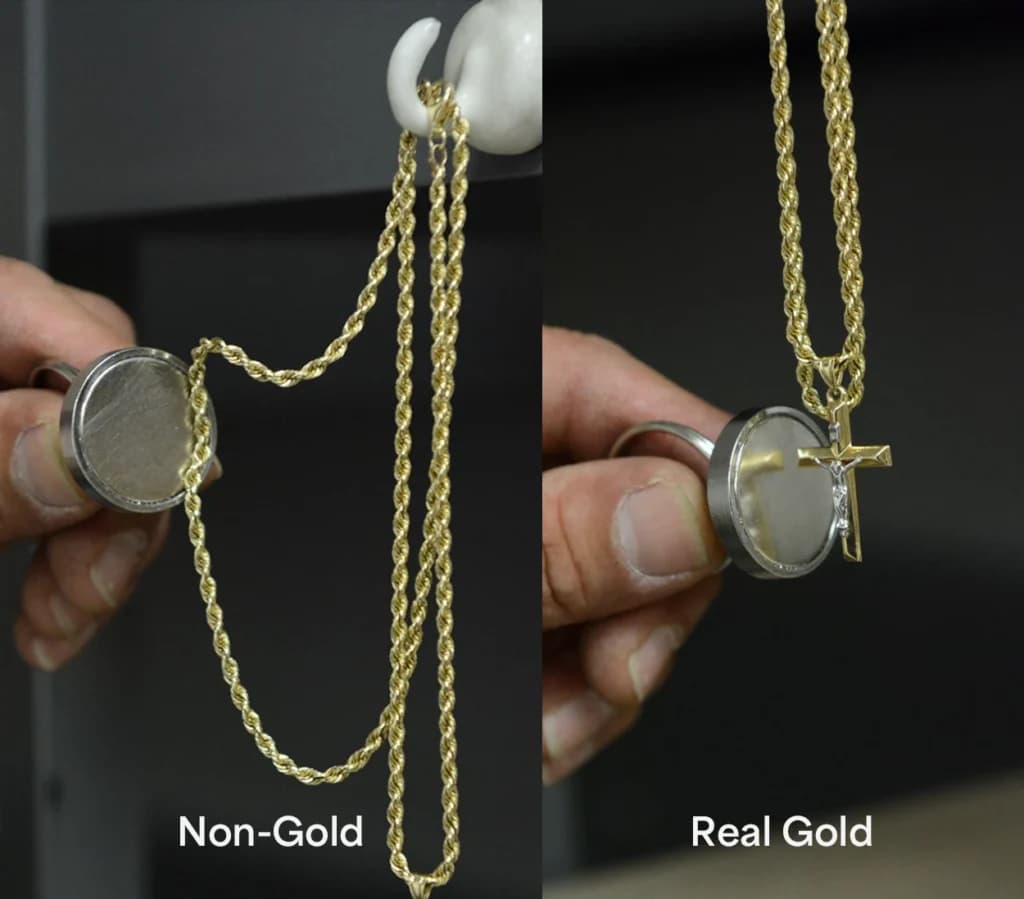
(Side-by-side image showing a gold magnet test comparing fake gold sticking to a magnet and real gold not reacting)
The Magnet Test vs. Hallmarks
Because of those caveats, experts recommend checking for official gold hallmarks to verify purity, rather than relying on magnetism alone. Hallmarks are tiny stamped symbols or numbers on gold items indicating their karat and origin of assay. For example, in the UK a hallmark might show “18” or “750” for 18ct gold. These stamps are a much more reliable indicator of real gold. A quick look with a magnifier for hallmarks can often tell you if an item is gold and its purity (you can refer to our guide on how to identify gold hallmarks for details). If an expensive-looking piece has no hallmark at all, be cautious – that’s often a red flag it might not be genuine.
In summary: high-purity gold won’t set off a magnet. If something purporting to be gold is strongly magnetic, it’s almost certainly not high-purity gold (or not gold at all). But if it’s not magnetic, you still should double-check its authenticity via hallmarks or other tests. When in doubt, consider having the item assessed by a professional. This is especially important if you plan to sell it – for instance, before you sell gold jewellery or any sell scrap gold items, you’d want to be sure they’re actually gold so you get paid correctly for the real precious metal.
Different Gold Purities and Magnetism
Not all “gold” is equal – magnetism can vary slightly depending on the purity and alloy composition. Here’s a quick rundown of common gold purities (in karats) and whether they are magnetic:
- 24ct gold (99.9% pure): Not magnetic. Pure gold contains no magnetic metals.
- 22ct gold (91.6%): Not magnetic. Very high gold content; remaining alloy metals (often silver/copper) are non-magnetic.
- 21ct gold (87.5%): Not magnetic. High purity gold with minimal other metals, none of which typically attract magnets.
- 18ct gold (75%): Not magnetic. Standard 18ct yellow/rose gold is usually alloyed with copper, silver, etc., which do not respond to magnets.
- 14ct gold (58.5%): Generally not magnetic. Most 14ct jewellery won’t stick to magnets. Note: 14ct white gold might show a very slight magnetic pull if nickel or cobalt is in the mix, but not a strong attraction.
- 9ct gold (37.5%): Mostly not magnetic. 9ct is low-purity gold, meaning 62.5% other metals. These are often copper, zinc, or silver – again, none of which are magnetic. If a 9ct piece does react to a magnet, it could be due to an unusual alloy component (e.g. a bit of iron/nickel), or it might not be legit gold.
So, across the board, authentic gold of any karat is unlikely to be magnetic. The higher the gold content, the less chance of any magnetism. Lower karats have more room for magnetic metals, but reputable gold alloys typically avoid metals like iron. The bottom line is that a magnet test can sometimes pick up a fake (like a steel core under gold plating), but it can’t confirm a piece is real gold – that’s where hallmark verification and other tests come in.
Is White Gold Magnetic?
White gold can sometimes be magnetic – it depends on what metals were used to make the alloy. White gold is not a pure metal found in nature; it’s an alloy of yellow gold mixed with white or silvery metals to give it a paler colour. Common metals for whitening gold include nickel, palladium, and silver.
- Nickel: is a key player in many white gold alloys (especially older or lower-cost jewellery). Nickel is a ferromagnetic metal – a magnet will attract it. However, usually only a small percentage of a white gold alloy is nickel.
- Palladium: (and platinum) are also used in higher-end white gold alloys. These metals are not magnetic. Silver, another possible component, is likewise not magnetic.
Whether a piece of white gold is magnetic comes down to the recipe. For example, a 14ct white gold ring might be 58.5% gold, ~20% nickel, plus copper and zinc. That nickel content could cause a weak magnetic attraction if you put a strong magnet near the ring. It won’t stick like steel, but you might feel a slight pull. On the other hand, a white gold ring alloyed with palladium or platinum would likely show no reaction at all to a magnet.
So the direct answer: White gold itself (the gold part) is not magnetic, but the alloy can be slightly magnetic if it contains nickel or other magnetic metals. Many white gold pieces won’t register on a magnet, especially modern ones that are nickel-free (jewellery standards in some regions now avoid nickel due to allergy concerns, using palladium instead). But if your white gold jewellery does react to a magnet, don’t panic – it doesn’t mean it’s fake. It just means there’s probably some nickel or similar in the mix. For instance, clasps or components in white gold chains may use spring metals that are magnetic, which can make the whole piece seem magnetic even though the gold is real.
Testing white gold with a magnet: You can try the magnet test on white gold items, but interpret carefully. A slight attraction could occur on authentic white gold with nickel. No attraction could mean either it’s real (with non-magnetic alloy metals) or it’s a different non-magnetic fake. As always, checking the hallmark stamp (like “18ct” or “750”) is a more definitive step. If in doubt, a professional appraisal or an XRF test can confirm if your white gold is genuine. The key is knowing that white gold may behave a bit differently around magnets than yellow or rose gold due to its unique alloy metals.
What is Fool’s Gold?
Fool’s gold is the popular nickname for a mineral called iron pyrite (chemical formula FeS₂). It earned this nickname because its shiny, metallic yellow appearance has tricked many amateur prospectors and gold-seekers into thinking they found real gold – only to be disappointed. Pyrite can form in lustrous, brassy-yellow crystals that superficially resemble gold nuggets, hence the “fool’s” gold moniker. It’s essentially nature’s most common gold lookalike.
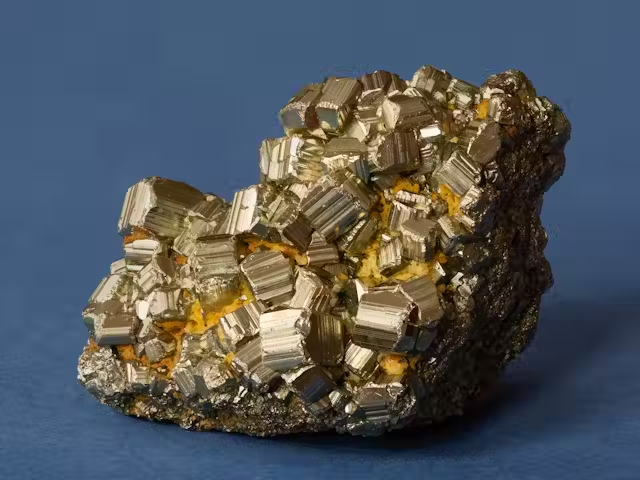
(Close-up of fools gold (iron pyrite) crystals showing metallic yellow lustre)
So, what is it exactly? Pyrite is iron sulfide – a compound of iron and sulfur. Unlike real gold (which is a metal element), fool’s gold is a mineral with a crystalline structure. It often forms cube-like or angular crystals with distinct edges (whereas gold usually appears as irregular flakes or rounded nuggets when found in the ground). Pyrite is also much harder and more brittle than gold. If you hit it with a hammer, it might shatter (gold would bend or flatten). If you scrape pyrite on unglazed porcelain, it leaves a dark grey-green streak, while real gold leaves a golden-yellow streak. These differences help miners tell pyrite and gold apart.
Why People Mistake Pyrite for Gold
The confusion comes from the colour and lustre. In good lighting, a chunk of pyrite can glint and shine with a yellow hue similar to gold. During famous gold rushes, inexperienced prospectors would often celebrate finding pyrite, thinking they struck gold. To the untrained eye, they do look alike at first glance. However, pyrite’s tone is usually a bit more brassy or faded yellow compared to the rich golden glow of true gold. Also, gold found in nature typically doesn’t form neat cubes; pyrite often does. Over time, people learned to recognise these clues (hence the old miner’s saying: “All that glitters is not gold”).
How Does Fool’s Gold React To A Magnet?
You might think that since pyrite contains iron, a magnet would attract it. Interesting fact: pure fool’s gold is not magnetic either – at least not in a way you can notice with a household magnet. In its normal state, iron pyrite won’t cling to a magnet like iron metal would. The iron in pyrite is locked up in a crystalline mineral structure, so it doesn’t exhibit strong magnetism.
This means a magnet test won’t reliably separate fool’s gold from real gold – neither one is strongly attracted to magnets. If you hold a magnet up to a chunk of pyrite, it most likely won’t react (just like real gold wouldn’t). Some pyrite samples might have trace impurities or be mixed with a truly magnetic mineral (like magnetite or pyrrhotite) – in those cases you could see a slight magnetic response. But generally, fool’s gold itself does not stick to magnets. So the common advice “use a magnet to tell if it’s real gold or fool’s gold” isn’t very dependable.
Better ways to tell apart gold vs. pyrite: Instead of magnetism, prospectors use other tests: the streak test (gold leaves a yellow streak, pyrite a dark streak), hardness test (gold is soft, can be bitten or bent; pyrite is hard and brittle), and simply the context (pyrite often forms crystals or is found in certain rock matrices). But if you’re simply dealing with jewellery or coins, you’re unlikely to encounter fool’s gold – that’s more a concern for rockhounds and gold panners.
In summary, fool’s gold may glitter like the real thing, but it’s a different mineral altogether. It has virtually no monetary value as a precious metal (though pyrite does have industrial uses and collector value). If you have a gold-coloured rock and you’re not sure what it is, don’t rely on a magnet alone. Consider its other properties or consult a jeweller/geologist. And remember the key point: real gold is a metal that’s not magnetic, and fool’s gold is a mineral that’s also not magnetic in practice, despite containing iron.
Frequently Asked Questions
Is gold magnetic?
Gold is not magnetic. Pure gold, such as 24ct, does not attract magnets and shows no magnetic properties. If a gold item is magnetic, it likely contains other metals or is not real gold.
Is white gold magnetic?
White gold can be magnetic. While gold itself isn't magnetic, white gold is mixed with metals like nickel, which can create slight magnetic attraction in some pieces.
Is rose gold magnetic?
Rose gold is not magnetic. It’s made from gold and copper, neither of which are magnetic metals. Authentic rose gold jewellery won’t react to magnets unless it contains other materials.
Is 9ct gold magnetic?
9ct gold is usually not magnetic. Although it's a lower-purity gold alloy, it typically contains non-magnetic metals like copper and silver. Strong magnetic reaction suggests it may be fake.
Is 14ct gold magnetic?
14ct gold is generally not magnetic. It contains 58.5% gold and non-magnetic metals. However, 14ct white gold may contain nickel, which can cause slight magnetic behaviour.
Is 18ct gold magnetic?
18ct gold is not magnetic. This high-purity gold alloy is made with non-magnetic metals like silver or copper, so authentic 18ct jewellery won’t be attracted to magnets.
Is 21ct gold magnetic?
21ct gold is not magnetic. With 87.5% gold content, this alloy contains minimal non-magnetic metals and won’t react to magnets if it’s genuine.
Is 22ct gold magnetic?
22ct gold is not magnetic. It’s a high-purity gold alloy containing mostly gold and trace amounts of non-magnetic metals, so it won’t stick to magnets.
Is 24ct gold magnetic?
24ct gold is not magnetic. It’s pure gold with no alloyed metals, meaning it shows no attraction to magnets. If it does, it’s likely not real 24ct gold.
Is fool’s gold magnetic?
Fool’s gold is not magnetic. Although fool’s gold (iron pyrite) contains iron, it doesn’t behave like magnetic metals and won’t stick to a magnet under normal conditions.
What is fool’s gold?
Fool’s gold is iron pyrite. It’s a shiny, yellow mineral that resembles gold but has no precious metal value. Despite its iron content, it is not magnetic like iron metal.
Interested in selling gold with the UK’s highest paying gold buyer? Visit our Sell Gold page to get a competitive valuation – we provide fully insured postage and fast payment.
For more insights and the latest gold price today, keep an eye on our live charts and blog updates.