
What Does 375 Mean On Gold?
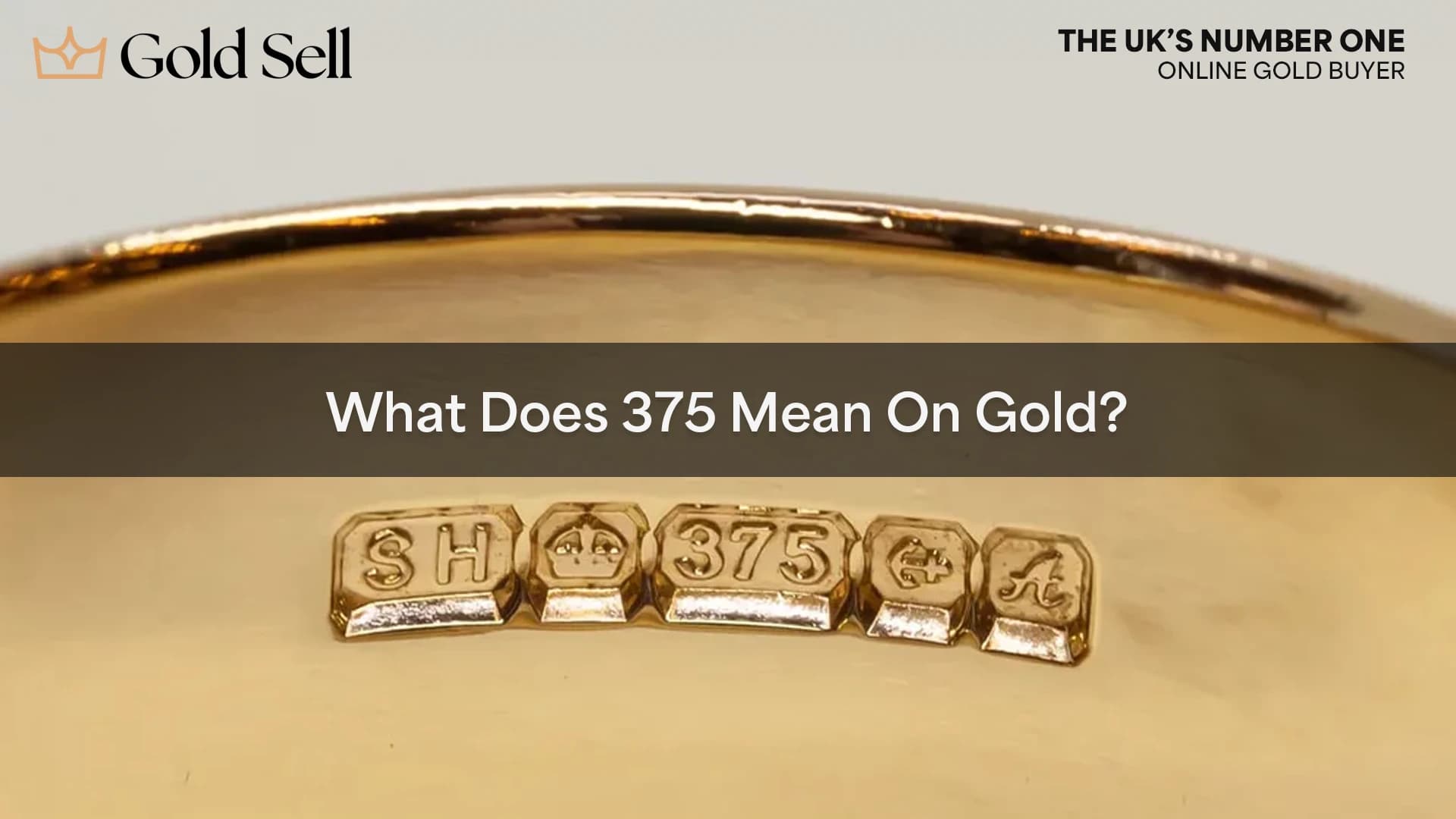
The mark “375” on gold means the item is made of 9 carat gold, i.e. it is 37.5% pure gold. In other words, a gold piece stamped “375” has 375 parts out of 1000 (37.5%) of pure gold content, with the rest being alloy metals. This hallmark is commonly seen on British gold jewellery and indicates a lower purity gold that’s more affordable and durable for everyday wear. In this article, we’ll explain the 375 gold meaning, the 9ct gold price per gram, how to identify a 375 gold stamp, and answer frequently asked questions about 9ct gold.
Key Takeaways
- “375” is a gold hallmark indicating: 9 carat gold, meaning the metal is 37.5% pure gold. The remaining 62.5% is made up of other metals like copper, silver, or nickel.
- 375 gold = 9ct gold: the lowest purity that can legally be called gold in the UK. It’s valued for its affordability and hardness, though it’s less valuable than higher karats since it contains less gold.
- Value: 9ct (375) gold is worth roughly 37.5% of the price of pure gold of the same weight. For example, pure 24ct gold is currently £99.23 per gram, therefore the 9ct gold price is £37.21 per gram based on the live gold spot price.
- Identification: A “375” stamp on jewellery (inside ring bands, on clasps, etc.) confirms it’s 9ct gold. This number may appear by itself or alongside other assay marks. All legally sold gold in the UK above a certain weight must carry such hallmarks to certify its purity.
- Common Hallmarks: Besides 375 for 9k, other gold hallmarks include 585 (14k), 750 (18k), 916 (22k), and 999 (24k), among others – these numbers correspond to the gold content in parts per thousand. We’ll compare these in a gold identification chart below for easy reference.
What Does 375 Mean On Gold?
The “375” hallmark on gold means the piece is 9 carat gold, containing 37.5% pure gold. In simple terms, 375 gold (sometimes written as “9ct gold”) is an alloy where only 375 out of 1000 parts are gold, and the rest (625 parts) are other metals like copper, silver, zinc or nickel. This 37.5% purity is the 375 gold meaning – it tells you how much real gold is in the item.
The tradition of using numbers like 375 comes from the millesimal fineness system, which expresses purity in parts per thousand. So “375” is just a shorthand for 375% fineness, equivalent to 9/24 or 9 karats (since 24 karat is 100% gold). By contrast, 18ct gold is stamped “750” (75.0% pure) and 24ct pure gold is “999” (99.9% pure). If you’re wondering what is 375 gold or what does 375 gold mean, it’s simply another way of saying 9ct gold purity.
Why 9ct Gold?
Pure 24k gold is very soft, so it’s often mixed with harder metals to create durable jewellery. A 9 carat (375) gold piece has a majority of other metals (about 62.5%) which makes it harder and more wearable for daily use. The trade-off is that 9ct gold is less yellow in colour and less intrinsically valuable than higher karat gold. Depending on the metals added, 375 gold can appear in different colours – yellow, rose (more copper), or white gold (more silver/palladium) – but it always contains the same 37.5% gold core.
Is 375 Gold Real Gold?
Yes – 9ct gold is legally considered real gold. In fact, 9 karat is the minimum standard to be called “gold” in the UK (in some countries like the US, the minimum is 10k). So a “375” stamped ring or necklace is indeed a gold item, just of lower purity. Because it’s lower purity, its market value is proportionally lower than 14k, 18k, or 22k gold, but it’s popular due to its affordability and strength.
History Of The 375 Hallmark
The practice of hallmarking gold with purity numbers has been around for centuries. The UK has a long hallmarking tradition – Goldsmiths’ Hall in London (where the term hallmark comes from) has been testing and marking gold since the 14th century. Over time, the hallmark system standardised numbers like 375, 585, 750, etc., to denote gold fineness. Today, “375” is a common hallmark on British gold jewellery, ever since 9ct gold was formally recognised. For more detail on how to read gold hallmarks and their history, you can refer to our in-depth Gold Hallmark Guide which covers various symbols and stamps used in different eras.
Value Of 375 Gold
Because 375 gold has only 37.5% gold content, its intrinsic value is roughly 37.5% of pure gold’s value by weight. The 24ct gold price is currently £99.23 per gram, the 9k gold price is £37.21 per gram in pure gold content (0.375 * £99.23) – this is the metal value contained in a 375-marked item. However, the actual price you can sell or buy 9ct gold for will depend on market rates and dealer margins. Many people with old or broken 9ct jewellery sell it as scrap gold, where dealers pay based on the gold content. (If you have unwanted 9ct gold jewellery, you can visit our Sell Gold Jewellery page or Sell Scrap Gold page to receive the highest price for your gold.)
In summary, 375 on gold means 9ct gold – a piece that’s 37.5% pure gold. It’s a legitimate gold standard, especially common in the UK, offering a budget-friendly option for gold jewellery. Now that we’ve explained the basics of what 375 gold is, let’s look at the 9ct gold price per gram and how to identify the 375 stamp on your gold items.
375 Gold Price Per Gram
375 gold / 9ct gold is currently £37.21 per gram based on the live gold spot price. This means each gram of 9ct gold contains £37.21 worth of pure gold at today’s spot price. Put another way, the 9ct gold price per gram is roughly one-third of the 24k gold price per gram, since 9ct is 37.5% pure.
The 375 stamp itself comes from this fraction (375/1000). So whenever gold prices move, the value of 375 gold moves in tandem at 37.5% of the pure gold rate.
It’s important to note that the above figure is a scrap gold or intrinsic value for 9ct gold. If you sell 9ct gold jewellery, gold buyers or pawn shops often pay a bit less per gram (to cover refining costs and profit). Reputable gold buyer’s live rates might show 9ct gold’s spot value their buy price around 10-15% lower. Always check the current rates – you can use a gold price calculator or visit our Sell Scrap Gold page for up-to-date 9ct prices if you’re looking to sell.
Pricing context: 9ct gold being 37.5% pure will always be cheaper per gram than higher carats:
- For comparison: 18ct gold (75% pure, hallmark “750”) is double the price of 9ct per gram, since it contains twice the gold content. The 18ct gold price is £74.42 based on the live gold spot price.
- 14ct gold (58.5% pure, “585”) will have a price 1.5 times the 9ct price per gram). The 14ct gold price is £57.88 based on the live gold spot price.
- 22ct gold (91.6% pure, “916”) is 2.4 times the 9ct price per gram. The 22ct gold price is £90.96 based on the live gold spot price.
Keep in mind the 9ct gold price is tied to the live gold market. When gold prices rise, the value of your 375 gold rises; when gold falls, 9ct follows. It’s wise to check the live 375 gold price (many gold buyers publish it online) before selling your gold, so you know you’re getting a fair deal. Our Sell Scrap Gold page updates the live gold spot price price every 60 seconds and offers the highest rates amongst all online gold buyers.
Next, let’s see what the “375” stamp looks like on gold items and how to identify other common gold hallmarks.
Live Gold Price Per Gram
Gold price last updated:
Wednesday, 21 October 2026, 13:15.
The LBMA (London Bullion Market Association) spot price changes daily.
The prices displayed are based on the global market rate for pure 24ct gold, known as the spot price. Like all gold dealers, GoldSell pays a percentage of this rate to account for assaying, refining, secure logistics, market volatility, and handling costs. We consistently offer among the highest payout rates in the UK, with the exact percentage increasing based on the weight and purity of the gold you sell.
Gold 375 Stamp
When you inspect a gold piece and find the number “375” stamped on it, you’ve found its hallmark of purity. The gold 375 stamp is usually tiny and often accompanied by other symbols. Here’s what to know about identifying hallmarks on 9ct gold jewellery:
- Appearance: The “375” mark might be stamped within a simple shape (like an oval or rectangular cartouche) or alongside a symbol. On older British jewellery (pre-1999), 9ct gold was often marked with a crown symbol + 375. Modern hallmarks might show just 375 by itself in a chamfered rectangle (the traditional shape for gold purity marks in the UK). Additionally, under the international Convention on Hallmarks, a common symbol of a scale with “375” inside may be used, recognised worldwide as 9ct gold.
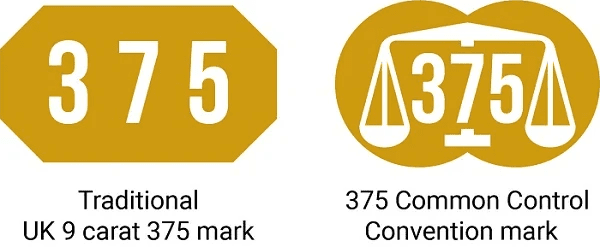
(Examples of 9ct gold hallmarks. Left – the traditional UK hallmark showing “375” (often in an oval or octagonal shield) to denote 9 carat gold. Right – the Common Control Mark (two scales with 375) used internationally, which also indicates 37.5% gold purity)
9ct gold hallmark location: You can typically find the 375 stamp in an inconspicuous spot on the item. Inside ring bands, on the underside of a necklace clasp, on the post or butterfly of an earring, or on the back of a pendant bale are common locations. The hallmark is deliberately placed where it doesn’t affect the design but is still findable with a close look (you might need a magnifying glass for very small pieces!).
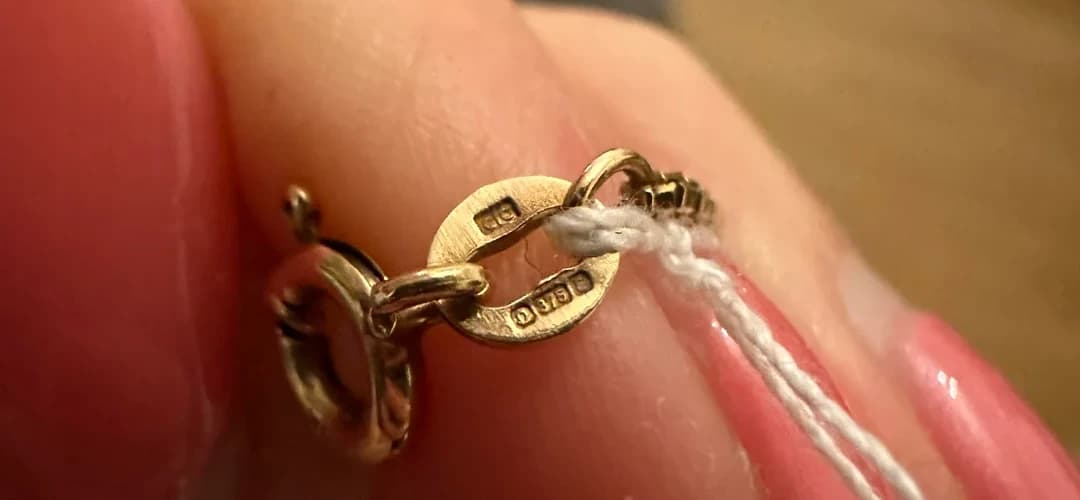
(Close-up image of a necklace clasp showing a small 375 gold hallmark, indicating the item is made from 9 carat gold – 37.5% purity)
- Other accompanying marks: Along with the “375” purity mark, a full UK hallmark will usually include a maker’s mark (initials or logo of the jeweller) and an assay office mark (such as a leopard’s head for London, an anchor for Birmingham, a rose for Sheffield, or a castle for Edinburgh). For example, a London-assayed 9ct gold ring might have something like “AB (maker)”, a leopard head, and “375”. The Hallmarking Act of 1973 standardised that all gold items over 1 gram in the UK must carry these marks from an approved Assay Office. So if your gold item is above a minimal weight and sold legally, it should have a 375 stamp plus those additional symbols verifying it was tested.
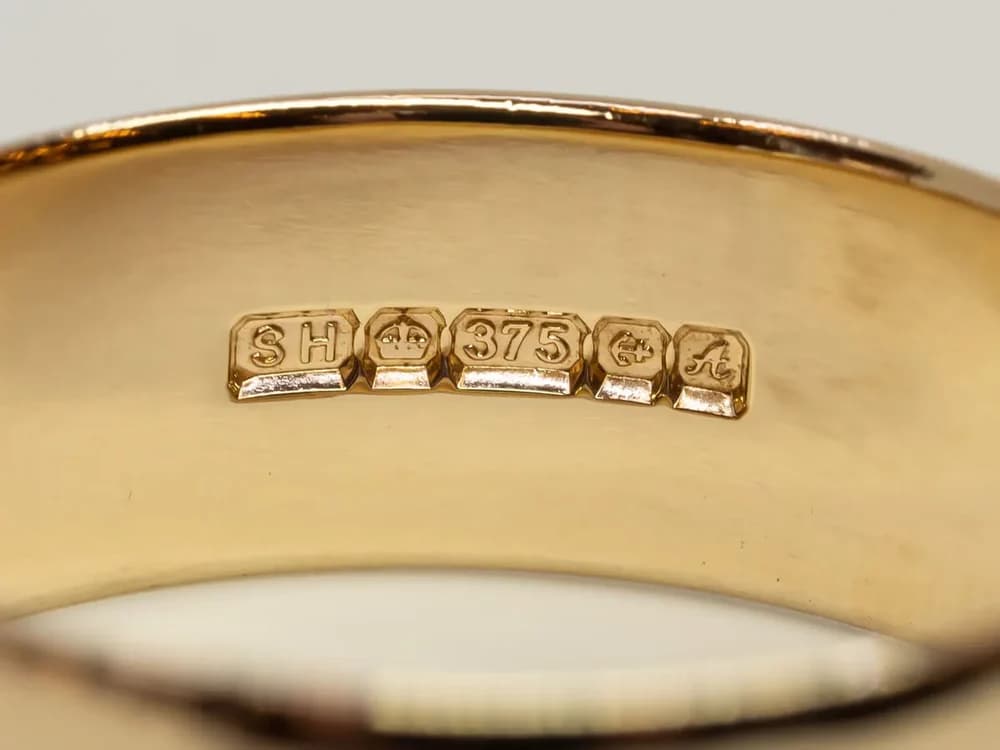
(Example of a 375 gold hallmark, indicating 9 carat gold (37.5% pure). The additional stamps confirm the maker, assay office, and year of hallmarking)
- Foreign gold items: If you have a gold item from abroad, it may still have “375” on it if it adheres to the convention or if that country uses the millesimal system. Many countries simply use the numerical hallmark (375, 585, etc.), sometimes with a national symbol. Thanks to international agreements, hallmarks like “375” are recognised across many countries. So a “375” ring from, say, Italy or France is understood to be 9k gold in the UK as well. The Common Control Mark (the scales with 375) was introduced in 1972 to help universally identify 375 gold regardless of origin. You can view our guide on gold hallmarks covers how to identify foreign gold hallmarks.
Knowing how to spot the 375 stamp is useful not only for confirming your jewellery’s gold content but also for differentiating it from higher or lower purities. Sometimes people confuse similar markings – for instance, “735” is not a standard hallmark (likely a misstamp or different code), and “925” is actually for sterling silver, not gold. The number 375 is unique to 9ct gold in the context of precious metal hallmarks.
Gold Hallmark Identification Chart
To put the 375 mark in perspective, here’s a quick reference chart of common gold hallmarks and what they mean in terms of gold purity and karat:
| Hallmark (Stamp) | Gold Purity (Fineness) | Karat (Carat) Rating | Common Usage / Notes |
|---|---|---|---|
| 375 | 37.5% gold (375/1000) | 9 carat (9k) | Used in UK jewellery; 9ct (375 gold) is popular for affordability and durability. Minimum standard for “gold” in the UK. |
| 585 | 58.5% gold | 14 carat (14k) | Common in US and Europe for mid-range jewellery. More valuable and richer in hue than 9k. |
| 750 | 75.0% gold | 18 carat (18k) | High-quality jewellery standard worldwide. Known for its rich gold colour in luxury pieces. |
| 916 | 91.6% gold | 22 carat (22k) | Very high purity; used in fine jewellery and many gold coins (e.g. British Sovereigns). Sometimes marked “917.” |
| 999 (or 999.9) | 99.9% gold | 24 carat (24k) | Pure or “fine” gold. Seen on bullion bars and investment-grade coins; often exempt from traditional hallmarking. |
Note: Some other hallmarks you might encounter include 333 (8k gold, common minimum in parts of Europe), 416/417 (10k gold, common in the US), and 625 (15k gold, an old standard Victorian era in UK, now replaced by 14k). But the table above covers the most common modern stamps. Any three-digit hallmark on gold essentially tells you its purity in per mil: just divide the number by 10 to get the percentage of gold. For example, “375” is equal to 37.5% gold, “750” is equal to 75% gold, etc.
Understanding these stamps can help you identify gold hallmarks on any jewellery. If you’re unsure about a marking on your piece, our Gold Hallmark Guide has detailed info and examples for all gold purity marks and other assay symbols.
Frequently Asked Questions
What does 375 mean on gold?
“375” on gold means the piece is made of 9 carat gold, or 37.5% pure gold. This hallmark indicates that out of 1000 parts, 375 are gold and the remaining 625 are other metals. In practical terms, a 375 stamp verifies the item’s gold content as 9ct – a common purity for affordable gold jewellery in the UK.
What is the live 375 gold price?
As of 21 Oct 2026, the 9ct gold price per gram is £37.21 based on the live gold price as of today in the UK.
Is 375 gold?
Yes, 375 gold is real gold – specifically, it’s 9 karat gold. The “375” stamp means the alloy contains real gold (37.5% of its composition). It is the minimum purity that can be marketed as gold in countries like the UK. Although it’s not pure, it is officially gold. (In contrast, in the USA anything under 10k can’t be called gold, but 9k is considered gold in the UK and Europe.)
Is 375 gold pawnable?
Yes, 375 gold is pawnable and sellable since it contains genuine gold. Pawn shops and gold buyers will accept 9ct gold jewellery or items. However, because it’s only 37.5% gold, its pawn value is lower than higher karat gold. You’ll typically receive payment for the gold content (about 37.5% of the item’s weight at the current gold price) minus any dealer fees. In short, you can absolutely pawn 375 gold, but expect a payout proportional to its gold purity.
What does 375 mean on a gold ring?
If a gold ring is stamped “375,” it means it is made of 9ct gold (37.5% pure). The stamp is usually found on the inner band of the ring. This marking assures you the ring’s metal has been tested by an assay office and confirmed as 9 carat gold. So a 375 mark inside a ring is proof of it being real gold of the 9k standard.
What does 375 mean on gold jewellery?
“375” on gold jewellery indicates the piece is 9 karat gold, or 37.5% pure gold. It’s a hallmarking number that tells you the item’s gold purity. You’ll often find “375” engraved in a hidden spot on the jewellery (like the clasp of a chain or the back of a pendant) confirming it’s made from 9ct gold. In essence, 375 = 9ct gold in any jewellery piece.
What carat is 375 gold?
375 gold is 9 carat gold. The number 375 represents 9 out of 24 parts gold (9/24 = 0.375). So any item with a “375” stamp is 9k gold. It’s the lowest carat that is still legally considered gold in many regions, notably the UK. Despite being lower in purity, 9ct gold is popular for jewellery due to its hardness and lower cost compared to higher carats.
What are the hallmarks for gold?
Gold hallmarks are the stamped numbers (and symbols) that indicate a gold item’s purity and origin. Common gold hallmarks (fineness marks) include 375 for 9ct, 585 for 14ct, 750 for 18ct, 916 for 22ct, and 999 for 24ct gold. These numbers tell you the gold content in parts per thousand (e.g. 750 means 75% gold). In the UK, gold hallmarks are usually accompanied by an assay office symbol and a maker’s mark, which together guarantee the piece’s authenticity and gold purity.
Does all gold have a hallmark?
Not all gold items have hallmarks, but any legally sold gold jewellery above a certain weight is required to. In the UK, gold pieces over 1 gram must be hallmarked by law – so virtually all gold rings, necklaces, etc. sold retail will have a stamp (like 375, 750, etc., plus assay marks). Exceptions include very tiny items (below the weight threshold) and gold coins or bullion bars, which are exempt from hallmarking laws. Those often have their purity indicated by the mint instead. If you find a gold item with no hallmark, it could be either below required weight, from a country without strict hallmarking, or possibly not genuine gold – further testing would be wise in that case.
When did gold hallmarks start in the UK?
Gold hallmarking in the UK began in medieval times – as early as the 1300s. The practice was formalised with the creation of the Goldsmiths’ Company Assay Office in London in 1327. By 1478, the Goldsmiths’ Hall in London was officially testing (assaying) and marking gold and silver items. Over the centuries the hallmarking system evolved, leading to the modern form (with numeric fineness marks like 375) we use today, especially after the Hallmarking Act 1973 standardised requirements.
What do gold hallmarks mean?
Gold hallmarks are codes that tell you the purity and authenticity of a gold item. They typically include a number (the purity in parts per thousand) and sometimes additional symbols. For example, a “375” hallmark means the item is 9ct gold (37.5% purity), “750” means 18ct gold (75% purity), and so on. These marks are like the DNA of the piece – they assure buyers and sellers of what the metal actually is. Alongside the purity number, hallmarks may also have an assay office mark and a maker’s mark, which together mean the item has been tested and verified by an official source.
Interested in selling gold with the UK’s highest paying gold buyer? Visit our Sell Gold page to get a competitive valuation – we provide fully insured postage and fast payment.
For more insights and the latest gold price today, keep an eye on our live charts and blog updates.





