What Is A Troy Ounce?
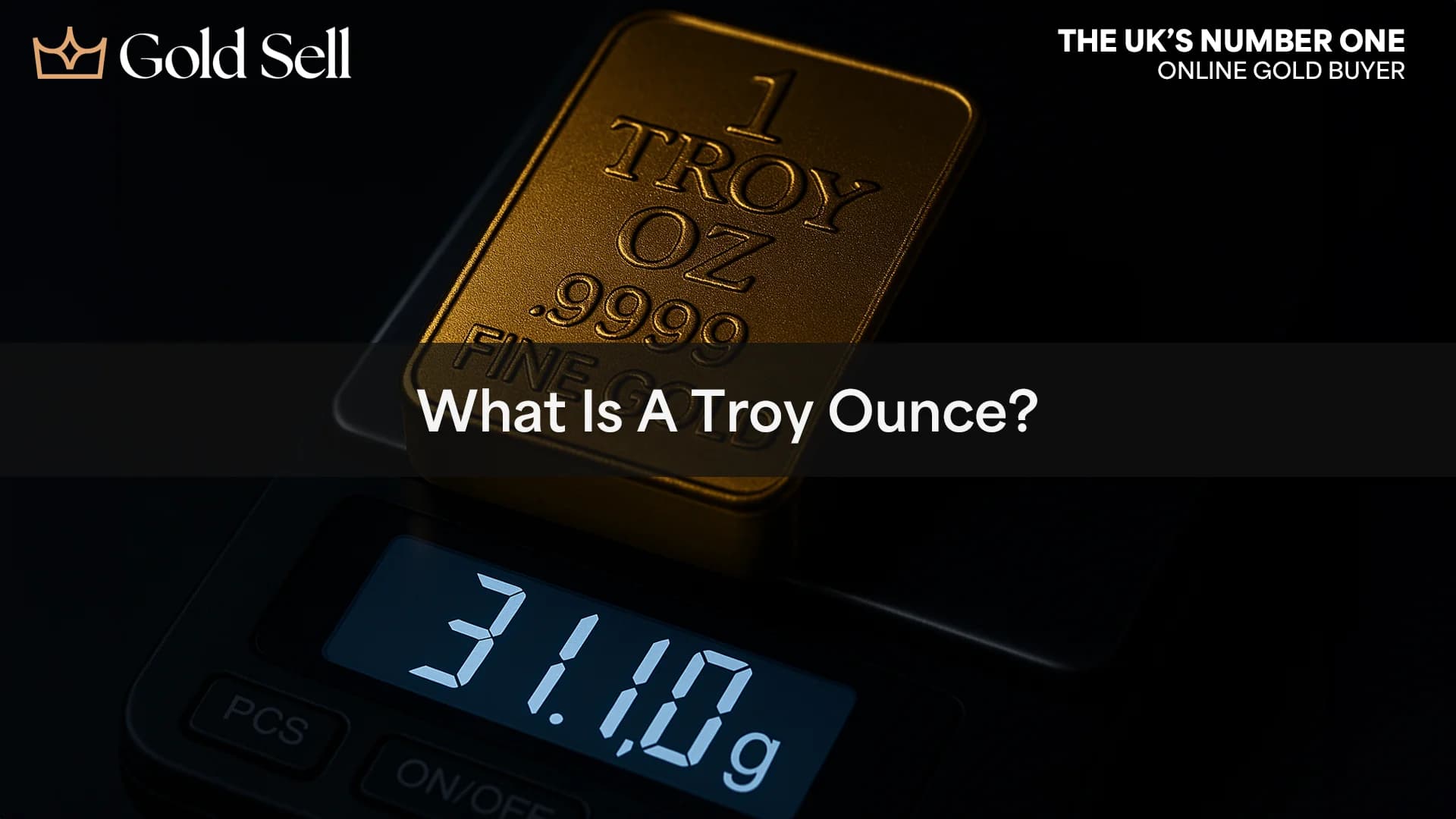
A troy ounce is a unit of weight used for precious metals like gold, silver, and platinum, equivalent to approximately 31.1035 grams. This measurement is heavier than the more common avoirdupois ounce, which weighs about 28.35 grams.
Key Takeaways
- Definition: A troy ounce equals approximately 31.1035 grams and is the standard unit for weighing precious metals.
- Comparison: A troy ounce is heavier than an avoirdupois ounce, which is commonly used in the UK and weighs about 28.35 grams.
- Usage: The troy ounce is predominantly used in the precious metals industry to ensure consistency in weight measurements.
- Historical Origin: The troy ounce system originated from the Roman monetary system and was later adopted in the medieval French town of Troyes, influencing its name.
- Subdivisions: One troy ounce is divided into 20 pennyweights, and each pennyweight consists of 24 grains, totalling 480 grains per troy ounce.
When it comes to buying or selling gold, you’ll often encounter weights listed in troy ounces. So, what is a troy ounce? A troy ounce (abbreviated “troy oz.” or “ozt”) is a special unit of weight traditionally used for precious metals like gold, silver, and platinum. It is not the same as the standard ounce you use in daily life for things like food. A troy ounce is a bit heavier – in fact, it equals approximately 31.1035 grams, whereas a regular ounce (known as an avoirdupois ounce, used for groceries and other goods) is about 28.35 grams. The difference might seem small (only around 10% heavier), but in large gold transactions that adds up, which is why it’s crucial to understand what a troy ounce is in the context of gold.
What Is A Troy Ounce?
Historically, the concept of the troy ounce dates back many centuries. The prevailing belief is that it originated in the Middle Ages at the trade fairs of Troyes, France. Merchants from around Europe needed a common weight system for trading precious goods, and the troy weight system became that standard.
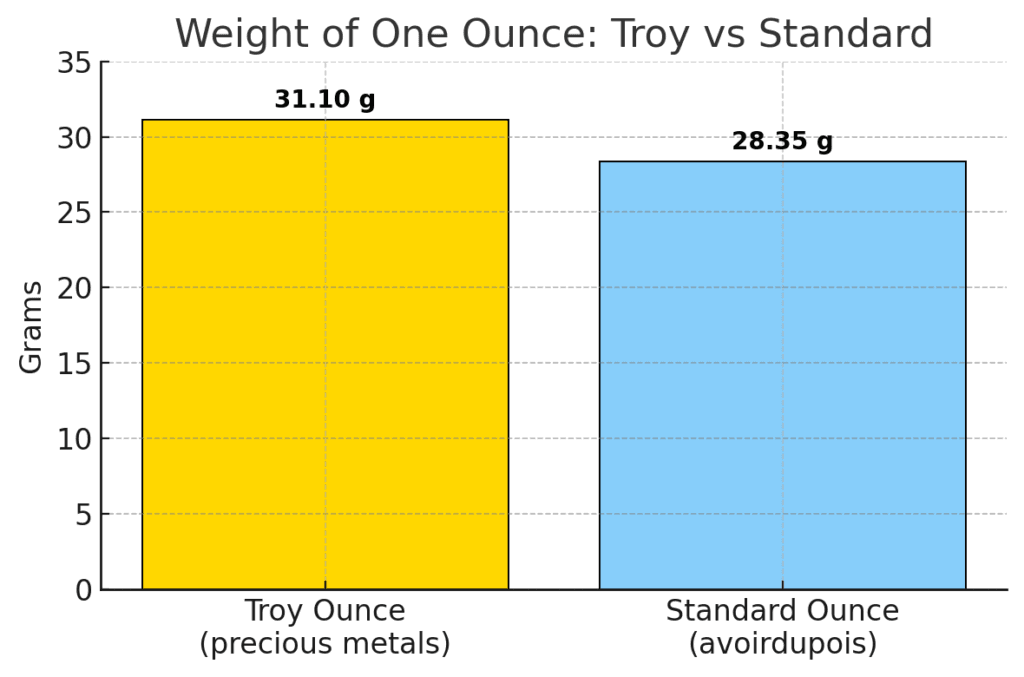
(Bar chart comparing one troy ounce (31.10 grams) versus one standard ounce (28.35 grams). The chart illustrates that a troy ounce is roughly 10% heavier than a typical ounce)
It was later adopted in England (King Henry II introduced it for coinage in the 12th century), and by 1527 the troy ounce had become the official unit for gold and silver in Britain, replacing older norms. The United States also followed suit in 1828, adopting the troy ounce for minting coins and valuing bullion. This long history explains what a troy ounce is today: a time-tested unit that has been used for generations to weigh gold. Even though most other goods switched to metric or avoirdupois units, gold and other precious metals stuck with the troy ounce tradition.
In practical terms, one troy ounce of gold is the unit upon which gold prices are based globally. If you see the gold price quoted as, say, $2000/oz, that “oz” is referring to a troy ounce. In one troy ounce, there are 480 grains (an old grain being another unit of weight), which also equals 20 pennyweight in the old apothecary system – just more historical trivia behind the troy measurements. For everyday understanding, remember that a troy ounce is 31.1 grams of gold. That consistency is important: everyone around the world knows what a troy ounce means in terms of grams, which helps avoid confusion in international gold trade.
What Is A Troy Ounce In Gold?
You might still wonder, why use this old-fashioned unit? Simply put, a troy ounce is all about tradition and accuracy in the precious metals industry. What is a troy ounce used for today? Primarily for ensuring that gold buyers and sellers are on the same page. Because a troy ounce is slightly heavier than the normal ounce, using the wrong ounce could cause someone to receive less gold than they thought. Over hundreds of years, the troy ounce became the trusted standard for gold transactions worldwide.
For example, the London Bullion Market and New York’s COMEX exchange – major markets where gold is traded – quote gold prices per troy ounce. This has practical implications: if someone in Europe buys a gold coin from the U.S., both parties know that “1 oz gold” means one troy ounce of gold, not an avoirdupois ounce. This uniformity is crucial for fairness and avoiding scams. In fact, historically some unscrupulous dealers tried to cheat customers by pricing gold per “ounce” (avoirdupois) instead of troy ounce – giving ~10% less gold for the same price. Using the troy ounce universally for precious metals prevents such tricks.
Additionally, the troy ounce’s continued use helps maintain consistent purity standards. Gold purity is often expressed in terms of karats or fineness, but the actual weight of pure gold in a bar or coin is measured in troy ounces. By sticking to troy ounces, refineries and mints can precisely track and guarantee that, say, a “1 oz gold bar” indeed contains one troy ounce of pure gold. The troy ounce unit is ingrained in gold pricing and bar specifications (for instance, a standard large gold bar, the “Good Delivery” bar held by central banks, weighs 400 troy ounces). So, what is a troy ounce in the modern gold market? It’s the cornerstone unit that underpins the entire industry’s weight measurements, ensuring everyone speaks the same language when trading gold.
Why Is Troy Ounce Used For Gold?
If the troy ounce is an ancient unit, you may ask: why is the troy ounce used for gold instead of just using grams or the normal ounce? There are a few key reasons. First and foremost, tradition and history. Gold has been valued in troy ounces for centuries, and that tradition carries a lot of weight (pun intended!). Gold traders, investors, and jewellers are all accustomed to pricing by the troy ounce. This inertia means there’s little incentive to change a system that everyone already understands.
More importantly, using troy ounces for gold provides a consistent standard worldwide. Precious metals are traded globally, and having one standard unit (the troy ounce) avoids the confusion that could arise if some countries used regular ounces and others used grams. Imagine if you had to constantly convert between grams and ounces in different markets – it would be a recipe for misunderstanding. The troy ounce became the universal unit for gold precisely to make international trade smoother. It’s much easier to say “one troy ounce of gold” and have everyone know the exact amount, than to say “31.1 grams of gold” (which could be mistaken for 31.1 regular ounces by the uninitiated). Essentially, why troy ounces are used for gold comes down to having a universal language in the gold world.
Another reason why the troy ounce is used for gold has to do with accuracy and avoidance of fraud. As mentioned earlier, a troy ounce is about 10% heavier than the everyday ounce. By insisting on troy ounces in gold deals, the industry makes sure that nobody tries to shortchange others by sneaking in the lighter ounce. It’s a way to protect buyers. Reputable dealers will always list gold weight in troy ounces (or grams), clarifying the unit. If you ever see a gold item sold by the ounce without specifying troy, that’s a red flag. Using the troy ounce thus maintains trust and transparency. The unit itself has become synonymous with precious metal weight – so much so that we often just say “ounce” for gold and assume it’s troy.
Lastly, tradition aside, there’s a practical note: precious metals are one of the few domains still using the imperial system internationally. While most commodities moved to metric units, gold and silver did not. By the time metric units (like grams and kilograms) became widespread, gold trading was already deeply rooted in the troy ounce standard. Changing it would have caused massive confusion in financial markets and among consumers. So, the answer to why is troy ounce used for gold is that it’s a time-tested, globally recognised standard that ensures consistency in trading. As the Royal Mint explains, it’s the one remaining unit from the old troy system that’s still in use because it “helps ensure purity and weight standards are consistently met” for precious metals. In short, gold is measured in troy ounces to keep everyone honest and on the same page.
Troy Ounce Gold Price
So, what’s the gold troy ounce price today? Gold prices fluctuate constantly with the market. We can provide a snapshot, but for more in depth prices, check out our live gold price page. At the time of writing, the live gold price today is around £3,088.06 per troy ounce. That equals roughly £99.28 per gram for 24-karat pure gold (since 1 troy ounce = 31.1 g). For common gold purities, the prices per gram are shown below:
Today's Gold Price Per Gram
Gold price last updated:
Wednesday, 21 October 2026, 12:32.
The LBMA (London Bullion Market Association) spot price changes daily.
The prices displayed are based on the global market rate for pure 24ct gold, known as the spot price. Like all gold dealers, GoldSell pays a percentage of this rate to account for assaying, refining, secure logistics, market volatility, and handling costs. We consistently offer among the highest payout rates in the UK, with the exact percentage increasing based on the weight and purity of the gold you sell.
The term “gold troy ounce price” simply refers to the current market price of 1 troy ounce of pure gold. Investors often check this to value their holdings. You might also see the live gold price quoted in other currencies like USD per ounce or in per-kilogram terms in some markets. But no matter the currency, “per ounce” means per troy ounce.
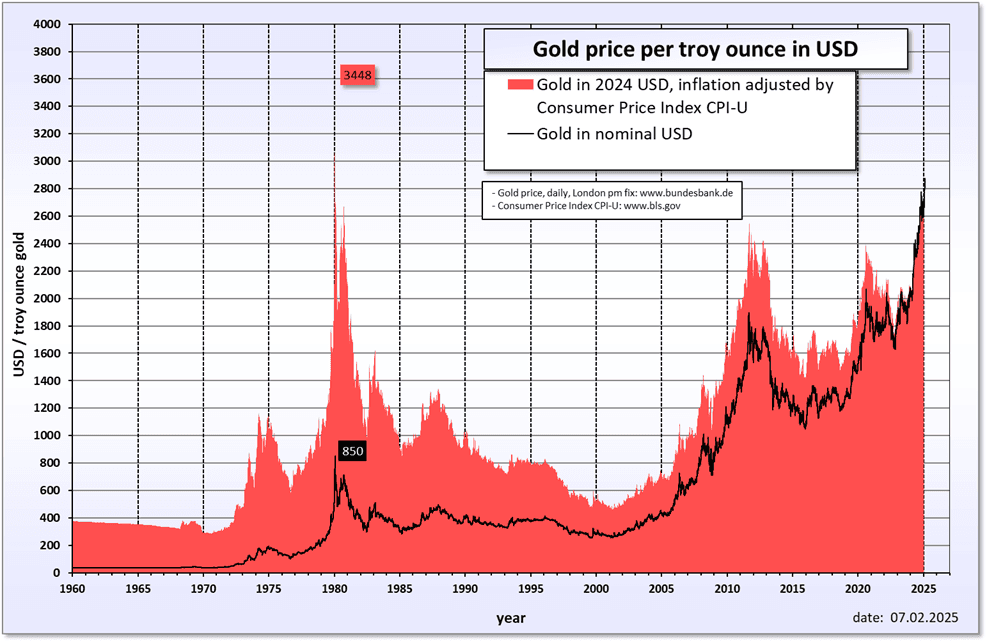
(Historical gold price chart (USD per troy ounce) from 1960–2025, showing nominal prices (black line) and inflation-adjusted prices (red area). The chart highlights gold’s spikes around 1980 and 2011, and a rising trend into the 2020s)
The gold market is constantly moving. As the chart above illustrates, gold prices have had dramatic ups and downs over the decades. In the late 1970s to 1980, gold spiked to then-record highs (around $850/oz in 1980) amid high inflation and economic uncertainty. Prices cooled off for a time, then surged again to new highs in 2011 (over $1,900/oz) and have risen to fresh records in the early 2020s. Today’s gold price (£3,088.06) reflects factors like global economic health, inflation rates, currency values, and demand from investors and central banks.
Looking ahead, many analysts have a bullish gold price projection for the coming years. With inflation concerns and geopolitical tensions, some forecasts predict gold will continue climbing. For instance, Bank of America recently raised its gold price projection for 2025 to around $3,063 per ounce Reuters, and other investment banks like Goldman Sachs see potential for gold to reach $3,300/oz by the end of 2025 Reuters. These are optimistic scenarios, and of course, projections are not guarantees. Gold can be volatile in the short term – prices might dip if, say, interest rates rise or if investors sell to take profits. However, over the long term, gold has trended upward, which is why many people consider gold investment as a way to preserve wealth. If you’re curious about investing in gold and what kind of returns it has offered historically, be sure to check out our detailed guide on investing in gold (it covers whether gold is a good investment and how to get started). In summary, the gold troy ounce price is a key indicator for the precious metals market, and staying informed on the live gold price and forecasts can help investors make smart decisions.
International Gold Measurement Practices
While the troy ounce is the global standard for gold pricing, not every country’s day-to-day gold trade relies on troy ounces. Different cultures have their own traditional units for measuring gold, often rooted in history. Let’s explore a few:
Grams and Kilograms: Most of the world is metric, so it’s common to see gold sold by the gram or kilo. For example, in Europe you might see jewellery advertised at a price per gram. Large institutional trades (and central bank reserves) are often quoted in kilograms or metric tonnes. One kilogram of gold is about 32.1507 troy ounces. Many gold investors in Asia also think in terms of 100g or 1kg bars. Even when using these units, the baseline is still the troy-ounce-derived price (since 1 kg = 32.15 ozt, they’re just converting the same weight).
Tola (South Asia): In countries like India, Pakistan, and much of South Asia, gold is traditionally measured in tolas. One tola is approximately 11.66 grams (which is 3/8 of a troy ounce). The tola has been used since ancient times (the word “tola” itself means “weight” in Sanskrit). Even today, you might hear families in India say “this necklace is 2 tolas of gold,” especially during festivals or weddings. Gold bars called “ten-tola bars” (weighing about 116.6 grams) are a common size in that region. It’s a fun example of how local tradition coexists with global standards – jewellers will still convert to grams or ounces for pricing, but the customer thinks in tolas.
Baht (Thailand): In Thailand, the traditional unit for gold is the baht (the same word as the local currency, but here it’s a weight unit). One baht of gold is about 15.16 grams of 96.5% pure gold in Thai standard, or roughly 15.244 grams of pure gold. Thai people commonly buy gold jewellery by the baht unit. So a “5 baht” chain would contain about 75 grams of gold. It’s an interesting cultural point: walk into a gold shop in Bangkok and prices might be listed per baht of gold rather than per ounce or gram. Yet, behind the scenes, that baht weight is still equivalent to about half a troy ounce.
Tael (East Asia): The tael (also known as liang in Chinese) is a traditional Chinese unit. Its weight has varied by region: historically in Hong Kong and China a tael was around 37.5 grams (1.2057 troy ounces), while in some parts of East Asia it could be slightly different (Japan’s tael was about 37.5 g, and in mainland China some use a 50 g unit for convenience). In Hong Kong and Singapore, gold shops still use taels for heavy gold jewellery and bars. For example, a common bar in Hong Kong might be “5 taels” (~187.5 grams). Again, internationally those get converted to troy ounces or kilos, but locally the tael remains a familiar reference.
Other units and fun facts: Many other old units persist in local gold markets. In Vietnam, a chi is 3.75 g of gold (and 10 chi make a tael of 37.5 g there). In the Middle East, you might hear about the mithqal or mesghal, an old Persian unit (~4.6 g) still used sometimes for gold and spices. And let’s not forget the pennyweight (abbreviated dwt) used occasionally in North America by jewellers, equal to 1/20 of a troy ounce (1.555 g). Every region had its own system in the past, but the beauty is that all these units can be converted back to grams and troy ounces. So even if gold is sold in baht or tola locally, its value is ultimately based on the global price per troy ounce.
In summary, while the troy ounce is used for gold pricing worldwide, local traditions in places like Thailand, India, or China use units like baht, tola, and tael for convenience and cultural legacy. It’s a reminder of gold’s universal appeal – treasured in different languages and units, but always precious. Whether you measure your gold in ounces, grams, tolas or baht, an investor in London and a jeweler in Mumbai can ultimately talk in the common denominator of pure gold content. And now, if someone asks you what is a troy ounce or why gold is measured that way, you’ll be well prepared to explain this quirky but important weight unit that underpins the gold market!
Frequently Asked Questions
What is today's price of gold per troy ounce?
Today's gold price per troy ounce is currently £3,088.06.
How many grams in a troy ounce?
One troy ounce of gold is equal to approximately 31.1035 grams. This is about 10% more than the 28.35 grams in a standard avoirdupois ounce. The troy ounce (31.1 g) is the internationally recognised unit for precious metals, ensuring that buyers and sellers agree on weight no matter where they are in the world.
What is troy ounce of gold?
A “troy ounce of gold” refers to 31.1035 grams of pure gold. It’s the standard unit of weight used in the bullion market. In practice, when you buy a 1 oz gold coin or bar, it contains one troy ounce of gold by weight. The troy ounce is used specifically for gold (and other precious metals) to maintain consistency in pricing and trading globally.
Troy ounce to kilogram – how do they convert?
Precious metals measured in troy ounces can be converted to kilograms since 1 troy ounce is approximately 0.031103 kilograms. In other terms, one kilogram contains about 32.15 troy ounces of gold. Large gold bars are often weighed in kilos (for example, a 1 kg gold bar is a common investment unit, which is equal to 32.15 troy ounces of gold).
What does troy ounce mean?
“Troy ounce” means a unit of weight used for precious metals, defined as 31.1034768 grams. The term comes from the ancient Troyes market in France. Unlike the regular ounce (used for everyday weights), the troy ounce is slightly heavier and is the trusted measurement for gold, silver, and other precious metals. In essence, when someone mentions ounces of gold, they almost always mean troy ounces – the longstanding standard in the bullion trade.
How much is a tola of gold?
A tola of gold is approximately 11.66 grams, or about 0.375 troy ounces.
Troy ounce vs ounce?
A troy ounce is heavier than a standard (avoirdupois) ounce. One troy ounce equals 31.1035 grams, while a regular ounce equals 28.3495 grams. Troy ounces are used for precious metals, while standard ounces are used for everyday goods.
How many troy ounces in a kilogram?
There are approximately 32.1507 troy ounces in a kilogram. This is based on the conversion that one troy ounce equals 31.1035 grams.
What are troy ounces traditionally used to measure?
Troy ounces are traditionally used to measure precious metals such as gold, silver, platinum, and palladium. This system ensures accurate, consistent valuation in global bullion markets.
What does a troy ounce of gold look like?
A troy ounce of gold typically appears as a small gold coin or bar, about the size of a UK £2 coin but heavier. It weighs 31.1 grams and is often stamped with its weight and purity.
How many troy ounces in a pound?
There are 12 troy ounces in a troy pound, unlike the avoirdupois system, which has 16 ounces in a pound. This is part of the traditional troy weight system.
How many troy ounces in a metric ton?
There are approximately 32,150.7 troy ounces in a metric ton, as 1,000 kilograms equals that many when using the 31.1035 grams per troy ounce conversion.
How many troy ounces in a gold bar?
A standard gold bar held by banks and traded globally weighs 400 troy ounces (around 12.4 kg). However, other common sizes include 1 troy ounce bars for investors, 100g bars (~3.22 oz), and 1 kilogram bars (~32.15 oz). The 400 oz “Good Delivery” bar is used in major exchanges, while smaller bars are popular for retail investment and ease of liquidity.
Why is troy ounce different?
The troy ounce is different because it comes from an ancient weight system used in trading precious metals. It’s slightly heavier than the standard ounce to provide accuracy in bullion valuation.
Why do we use troy ounces?
We use troy ounces for precious metals to ensure global consistency in weight and pricing. The system has been used for centuries and is still the standard in gold and silver markets.
Why is a troy ounce heavier?
A troy ounce is heavier because it is based on an older, specialised weight system designed for precision in precious metal trade, weighing 31.1035 grams versus 28.35 grams in a standard ounce.
Are troy ounces the same as ounces?
No, troy ounces and standard ounces are not the same. A troy ounce equals 31.1035 grams, while a standard (avoirdupois) ounce equals 28.3495 grams. Troy ounces are used for precious metals, whilst regular ounces are used for everyday goods.
Where does troy ounce come from?
The troy ounce originates from the medieval French town of Troyes, a major trading hub in the Middle Ages. Merchants needed a standardised unit for weighing precious metals.
Who invented troy ounces?
Troy ounces were developed by merchants in medieval Europe, particularly in Troyes, France, to create a consistent trading weight for precious metals like gold and silver.
Interested in selling gold with the UK’s highest paying gold buyer? Visit our Sell Gold page to get a competitive valuation – we provide fully insured postage and fast payment.
For more insights and the latest gold price today, keep an eye on our live charts and blog updates.