What Is Gold Vermeil?
Gold vermeil is a high-quality type of gold-finished jewellery, consisting of a sterling silver base coated with a thick layer of real gold. This combination offers the luxurious appearance of solid gold at a more affordable price point.
Key Takeaways
- Definition: Gold vermeil is jewellery made from sterling silver coated with a layer of gold, providing a luxurious look at a lower cost.
- Gold Purity: The gold used in vermeil is typically at least 10 karats, with common options including 14K, 18K, and 24K, each offering different hues and durability.
- Durability: The thickness of the gold layer in vermeil (minimum 2.5 microns) makes it more durable than standard gold-plated jewellery.
- Care Instructions: To maintain its appearance, gold vermeil jewellery should be kept away from water and harsh chemicals, and cleaned gently with mild soap and a soft cloth.
- Identification: Authentic gold vermeil pieces are often stamped with a “925” hallmark, indicating their sterling silver base.
Gold vermeil (pronounced ver-MAY) is a high-quality type of gold-finished jewellery. It refers to pieces made of sterling silver as the core, heavily coated with a layer of real gold. In other words, gold vermeil is essentially gold-plated silver, but done to a specific high standard. To legally qualify as “vermeil,” the gold must be at least 10 karat purity and plated to a thickness of at least 2.5 microns (much thicker than ordinary gold plating). This results in jewellery that looks like solid gold but is far more affordable.
In this blog, we’ll break down everything you need to know about gold vermeil. You can expect to learn what makes vermeil different from regular gold plating, the main types of gold karats used in vermeil (from 24k down to 10k), how gold vermeil compares to other gold jewelry in terms of durability and value, and tips on care and longevity. By the end, you’ll understand why gold vermeil is popular for achieving the luxe look of gold without the hefty price tag. Let’s dive in!
(Fun fact: In the UK, genuine gold vermeil jewellery is usually stamped with a “925” hallmark indicating its sterling silver base. So if you see a gold piece marked 925, it’s likely vermeil – see our guide on silver hallmarks explained for more on those little markings.)
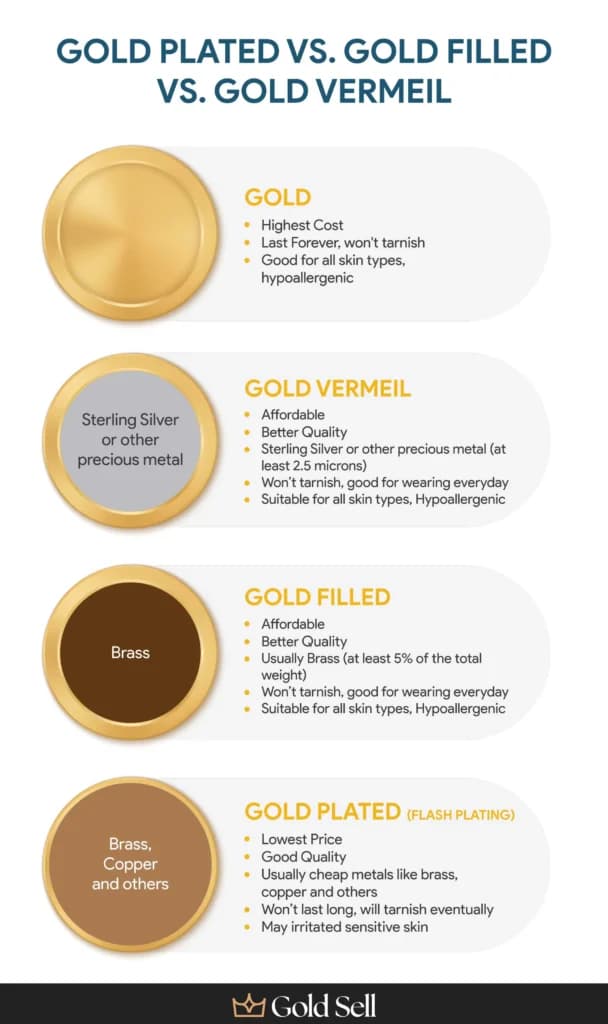
(Comparison chart showing gold vermeil vs gold plated, gold filled, and solid gold jewellery by quality, metal type, durability, and skin sensitivity)
Main Types of Gold Used in Vermeil
Gold vermeil jewellery can be made with different purities (karats) of gold in the outer layer. The karat (K) number tells us the percentage of pure gold: 24K is 99.9% gold, 18K is 75%, 14K is 58.5%, and 10K is 41.7% gold (the remainder being alloy metals). Each karat level gives the vermeil a slightly different colour tone and durability. Below we explore the main types – 24 karat, 18 karat, 14 karat, and 10 karat gold vermeil – and how each one stands out.
24 Karat Gold Vermeil
24 karat gold vermeil means the gold plating is pure 24K gold. This gives the jewellery an extremely rich, yellow-orange hue, since 24K is 99.9% pure gold. A 24 karat gold vermeil piece will have the deepest colour – often described as a bright marigold yellow. It truly looks luxurious. However, 24K gold is also very soft. In plating form this softness means the gold layer can scratch or scuff more easily with wear. For that reason, 24K gold vermeil is less commonly used in daily-wear jewellery. The colour can also be a bit too yellow for some tastes, and it may not match the tone of other gold pieces you own (since most fine jewellery is 14K or 18K). In summary, 24 karat gold vermeil offers the purest gold colour possible, but its softness and intense hue mean it’s usually reserved for special pieces rather than everyday jewellery.
18 Karat Gold Vermeil
18 karat gold vermeil is a popular and luxurious choice for vermeil jewellery. 18K gold is about 75% pure gold blended with 25% other metals, which results in a rich yellow tone that still has a hint of warmth without being as vividly yellow as 24K. This deeper golden colour gives 18 karat gold vermeil a classic high-end look – in fact, many fine jewellery pieces are 18K, so 18K vermeil can look virtually indistinguishable from solid 18K gold. Another advantage is that the added metals (like copper or silver) in 18K make it harder and more durable than 24K. Thus, 18K gold vermeil strikes a great balance: it has a luxe appearance but is a bit more resistant to scratches or wear than pure gold would be. It’s no surprise better vermeil pieces are often plated in 18K gold to give a “fine jewellery” appearance. If you want a truly premium look, 18 karat gold vermeil is an excellent option.
14 Karat Gold Vermeil
When it comes to gold vermeil, 14 karat gold vermeil is arguably the most common and versatile type you’ll encounter. 14K gold contains about 58.5% pure gold (usually marked 585) with the rest being alloy metals, and this composition offers an ideal mix of strength and colour. A 14 karat gold vermeil piece has a lovely warm yellow hue, slightly lighter than 18K, but still clearly golden. Many people consider 14K’s colour to be the “classic” gold tone they’re used to. Because of its higher alloy content, 14K gold is harder than 18K, so a 14 karat gold vermeil layer tends to be quite durable and resistant to scratching or rubbing off. It’s for this reason (and its balanced look) that 14K is the most popular choice for vermeil plating on jewellery. You’ll find that a huge range of gold vermeil jewellery – from rings to necklaces – uses 14K gold vermeil, since it gives you the best of both worlds: the richness of real gold colour with added toughness for everyday wear.
10 Karat Gold Vermeil
10 karat gold vermeil features 10K gold plating – the lowest karat gold that can still legally be called “gold” in many countries. 10K gold is only about 41.7% pure gold, heavily alloyed with harder metals like copper, zinc, or nickel. As a result, 10 karat gold vermeil has the palest color of the group – a light yellow tone that’s noticeably less saturated than 14K or 18K gold. The big benefit of 10K, however, is strength. Because it contains more alloy metals than gold, 10K gold is very hard and durable. A 10 karat gold vermeil coating will be highly resistant to scratches and wear-through, even more so than 14K vermeil. This makes 10K gold vermeil an attractive option for pieces that take a lot of abuse (like rings or bracelets) or for those who prioritise longevity. The trade-off is the colour – some may find it a bit lacklustre or “washed out” compared to higher karats. 10K gold vermeil is also a bit less common in jewellery stores (14K tends to be the standard). But if you don’t mind a subtler yellow and want maximum durability in your gold vermeil, 10K is a solid choice.
Gold Vermeil vs Gold Plated
It’s easy to confuse gold vermeil vs. gold plated jewellery, since both are essentially gold on the outside and not solid gold throughout. However, there are key differences in their makeup and quality that are important to understand. Let’s compare gold vermeil and ordinary gold plated jewellery across a few factors:
- Base Metal – Gold vermeil pieces have a base of genuine sterling silver (92.5% pure silver). By definition, vermeil is gold over silver. Gold plated jewellery, on the other hand, can have any base metal – often a cheap alloy like brass, copper or zinc – and not necessarily a precious metal. This means vermeil has a more valuable core (silver) while standard gold plate might be built on less expensive, less hypoallergenic metals.
- Gold Layer Thickness – Gold vermeil is required to have a relatively thick gold layer: at least 2.5 microns thick by US standards. Many vermeil pieces even exceed this minimum. Regular gold plated jewellery has no strict thickness requirement and typically the gold layer is much thinner – often well under 1 micron. In fact, some “gold plated” fashion jewellery is only flash-plated with a few atoms of gold. The thicker coating on gold vermeil makes it more durable and long-lasting compared to common gold plated pieces.
- Durability & Longevity – Thanks to that thicker gold layer, gold vermeil is generally far more durable than standard gold plate. Vermeil can withstand years of wear before the gold might start to rub off, whereas gold plated jewellery might show fading or tarnishing of its thin gold layer within a few months of frequent use. Also, sterling silver (the base of vermeil) doesn’t corrode or degrade the way cheap metals do, so even if a bit of silver is exposed over time, the piece will still be sturdy. By contrast, plated base metals like brass can oxidise or cause skin reactions once the gold rubs off. In short, vermeil lasts longer – it’s not unusual for well-cared-for vermeil jewellery to last for many years without needing replating.
- Appearance – When new, gold vermeil and gold plated pieces might look identical – both have an outer layer of real gold after all. However, because vermeil uses higher-quality materials and processes, it tends to maintain its appearance longer. The gold on vermeil is less likely to flake or discolour. Cheap gold plated items can sometimes have an overly bright or brassy tone (depending on the alloy and plating quality), whereas vermeil usually has a rich gold lustre that closely resembles solid gold. If the plating does wear, vermeil will reveal silver (which is white-grey) underneath, and plated jewellery will reveal a base metal (often yellowish brass or a dark metal) – this can affect how the piece looks as it ages.
- Value – There’s also a difference in monetary value. Gold vermeil, with its silver core and thick gold overlay, has intrinsic value in the metals. You’re at least getting a sizeable amount of sterling silver and a decent amount of gold in the piece. Gold plated costume jewellery usually has minimal gold (virtually negligible weight) and a low-value core metal. Accordingly, gold vermeil pieces tend to cost more than thinly gold-plated ones, but they are still much cheaper than solid gold. Vermeil is a nice middle ground for getting fine jewellery look and materials without the cost of full gold.
Gold Vermeil Jewellery Pros And Cons
- Gold Vermeil Pros: Thick gold layer (durable, long-lasting), sterling silver base (precious metal, usually hypoallergenic), looks identical to real gold jewellery, good value for quality, can often be heirloom-quality if cared for.
- Gold Vermeil Cons: More expensive than standard gold plated jewellery (due to higher quality), will still eventually wear/fade with heavy wear, needs some care to maintain the gold layer, not solid gold – resale metal value is mostly just the silver.
Gold Plated Jewellery Pros And Cons
- Gold Plated Pros: Very affordable price point, great for trendy or occasional jewellery you don’t plan to wear daily, wide variety of base metals and styles, gives the look of gold at the lowest cost.
- Gold Plated Cons: Extremely thin gold layer that wears off quickly (sometimes within weeks of daily wear), prone to tarnishing once base metal is exposed, base metals can cause skin irritation or allergic reactions (often not hypoallergenic if copper or nickel are present), lower overall quality and lifespan – not suitable for heirloom or daily pieces.
In summary, gold vermeil vs gold plated comes down to quality and longevity. Gold vermeil is a premium form of gold-plated jewellery – you get a thick layer of gold and solid silver underneath, which means the piece will look better and last longer. Regular gold plated items are more like budget or fashion jewellery – fine for occasional wear, but they don’t hold up well over time. If you want the best bang for your buck and plan to wear the item a lot, vermeil is definitely worth the upgrade. If it’s just for a one-off event or fun costume piece, gold plated might suffice.
How Long Does Gold Vermeil Last?
One of the most common questions about vermeil is “How long does gold vermeil last?” The good news is that gold vermeil can last a very long time – many years – especially if you take care of it. Because vermeil has that thick gold layer over sterling silver, it’s built to be more enduring than standard plated jewellery. In fact, the plating on gold vermeil is often thick enough that with occasional wear, you might not see any wear-through for decades. Some people report vermeil pieces staying shiny for 10+ years when worn infrequently and stored carefully.
Of course, how long gold vermeil lasts in practice depends on how you use it. Daily wear will wear down any gold finish faster. If you were to wear the same gold vermeil ring every single day, rubbing against your skin and the environment, you might notice the gold layer start to lighten or fade after several months to a year. Heavily-used vermeil (worn 24/7, even in shower and sleep) could show patches of silver base after about 6 months of hard use. On the other hand, if you wear a vermeil pendant only on special occasions and keep it in a jewellery box the rest of the time, it could look almost new even 5 or 10 years later.
The thickness of the gold layer also plays a role – some vermeil might have closer to 3 or 5 microns of gold, which would last longer than the minimum 2.5 microns. Higher karat gold (softer) might wear slightly faster than lower karat (harder) gold, though thickness is usually more important than karat for longevity.
Will Gold Vermeil Tarnish?
Tarnish is the darkening or dulling that happens when metals react with oxygen, sulfur, or moisture. Pure gold does not tarnish (it’s a noble metal). So the gold surface of vermeil will not tarnish or turn colours like copper or brass would. Gold vermeil is quite resistant to tarnish for this reason – you won’t see that greenish or blackish film on the gold itself. However, the sterling silver underneath can tarnish if exposed. In a well-made vermeil piece, the silver core isn’t exposed to air because it’s sealed under gold. But over a long time, if the gold layer gets microscratches or wears thin in spots, a bit of silver could contact the air and develop tarnish (sterling silver tarnishes by turning dark grey or black). This usually only happens in areas of high wear (edges of rings, underside of a pendant that rubs on skin). So, will gold vermeil tarnish? Generally, vermeil is very tarnish-resistant – far more so than plain sterling silver – because the gold plating shields the silver. It might eventually show some tarnish in spots if the gold wears away. The key is to care for it properly to minimise any tarnish.
Caring for Gold Vermeil to Extend its Life
With good care, you can significantly prolong the life of your gold vermeil jewellery and keep it gleaming. Here are some tips to make gold vermeil last:
- Avoid water and chemicals: Water, perfumes, cosmetics, cleaning products, chlorine from pools, etc., can all slowly break down the gold layer or cause underlying silver to tarnish. It’s best to take off gold vermeil jewellery before showering, swimming, or using cleaning chemicals. As a rule, put your vermeil on after applying perfume or lotion, and remove it before washing hands, swimming, or exercising (sweat can be acidic).
- Store properly: When you’re not wearing the piece, store it in a dry, airtight container (like a ziplock bag or a jewellery box with anti-tarnish lining). This limits exposure to air and moisture, preventing any tarnish. Storing pieces separately is also wise – vermeil can get scratched if jumbled with other jewellery. Keep each item in a soft pouch or separate compartment so nothing rubs harshly against the gold layer.
- Gentle cleaning only: To clean gold vermeil, do not use harsh metal polishes or abrasive cleaners meant for solid metal – those can strip away the gold! Instead, just use a soft, non-abrasive cloth (like a microfibre or jewellery polishing cloth) to gently rub the surface after wearing, removing oils and dirt. If more cleaning is needed, use mild soap and warm water: soak the piece for a minute, gently wipe, and dry thoroughly. Never use rough brush bristles or toothpaste (an old trick for solid gold that would be too abrasive for vermeil). And make sure the piece is completely dry before storing it away, since moisture trapped on vermeil can lead to tarnish over time.
- No polishing wheels: Jewellers’ polishing wheels or cloths with polishing compound should be avoided on vermeil, because they actually wear down a thin layer of metal to polish – which would mean removing gold. Stick to just gentle hand cleaning. If your piece gets very tarnished or dull, you might consider having it professionally replated instead of polishing through the gold layer.
By following these care practices, your gold vermeil can remain bright and beautiful for a long time. Many owners find that well-cared-for gold vermeil will not wear off for years and requires minimal maintenance beyond the occasional gentle clean. It offers a wonderful combination of the longevity of precious metals and the splendour of gold, without the solid gold price tag.
Does Gold Vermeil Wear Off?
Since vermeil is a type of plating, a natural concern is “Does gold vermeil wear off?” The honest answer is yes – eventually, the gold vermeil layer can wear away with enough time and wear. No plated finish lasts forever, especially on pieces like rings or bracelets that see a lot of friction. However, gold vermeil is much slower to wear off than typical plating. As discussed, the thick gold in vermeil means you won’t typically see the silver underneath for a long while, unless the piece is subjected to heavy daily use. Where a cheap gold plated necklace might start fading in a few months, a gold vermeil necklace might take years before any silver peeks through.
You’ll usually notice vermeil wearing off first at high-contact points: edges of rings, the underside of a bangle, or the clasp of a necklace – places that rub against skin or clothing. The wear will appear as the silver base metal revealing itself (which looks greyish) against the remaining gold areas. If the contrast is stark, that’s a sign the piece may need replating to restore its uniform colour.
The good news is that replating vermeil is possible. A jeweller can electroplate a fresh layer of gold onto a worn vermeil piece, essentially renewing it. Because the base is sterling silver, it takes plating easily. So even when your gold vermeil eventually wears off in spots, the jewellery isn’t ruined – it can be refreshed like new. How often you might need to replate depends on wear: perhaps every few years for a heavily-used ring, or maybe never for earrings that see light use.
Is Gold Vermeil Waterproof?
A related question is whether it’s okay to get vermeil jewellery wet – in other words, “is gold vermeil waterproof?” Technically, water won’t destroy the gold vermeil immediately, but it’s not recommended to submerge vermeil regularly. Gold itself is unaffected by pure water, but moisture can speed up tarnish of the silver beneath and can also dull the appearance of the gold plating over time. Chemicals often present in water – like chlorine in swimming pools or minerals in hard water – can also be rough on the finish.
In short, gold vermeil is not truly waterproof. Occasional splashes (like if you forget to take off a vermeil ring while washing your hands once) won’t immediately harm it – just dry it off promptly. But you should avoid long exposure to water. That means take off your vermeil jewellery before swimming in pools or the ocean, don’t wear it in the shower, and try not to let it sit on a wet countertop. Prolonged wetness can lead to that darkening of silver at the edges (tarnish) and can weaken the bond of the gold layer. As a rule from jewellers: “No dunking!”. Keep your vermeil dry to keep it shining.
If your gold vermeil does get wet, gently pat it dry with a soft cloth as soon as possible. Don’t rub aggressively (wet gold plating can be more fragile). Once dry, it should be fine. Bottom line: treat gold vermeil as you would treat other fine jewellery – avoid water whenever you can for maximum longevity. It’s water-resistant for everyday life, but not 100% waterproof in the sense of withstanding regular soaking without effect.
Gold vermeil offers a wonderful balance of beauty and value. By understanding its qualities – the silver core, the gold layer, and how to care for it – you can enjoy vermeil pieces for a long time. Next, let’s address some frequently asked questions to recap and highlight key points about gold vermeil:
Frequently Asked Questions
What is gold vermeil?
Gold vermeil is a type of high-quality gold plated jewellery. It means a piece of sterling silver (92.5% pure silver) that’s coated in a thick layer of real gold (at least 10K purity). By definition, gold vermeil must have a gold layer around 2.5 microns thick – much thicker than ordinary plating – making it more durable. In short, it’s sterling silver jewellery with a luxurious gold exterior.
Gold vermeil vs gold plated
Gold vermeil is gold-plated sterling silver with a thick gold layer, while gold plated jewellery can use any metal (like brass) underneath and usually has a very thin gold layer. Vermeil uses precious metals (gold over silver), so it’s higher quality, longer-lasting, and often hypoallergenic. Regular gold plated pieces are cheaper, but their gold coating wears off faster and the base metal can tarnish or cause skin reactions.
Will gold vermeil tarnish?
Gold itself doesn’t tarnish, and in vermeil the gold layer shields the sterling silver base from air. So, gold vermeil is highly resistant to tarnishing. Over a long time, if the gold layer wears thin or gets scratched, the exposed silver can tarnish (turn dark). But with normal care, vermeil won’t tarnish easily – it stays shiny gold. Always keep vermeil dry and clean to prevent any silver tarnish developing under the gold.
Does gold vermeil wear off?
Yes, eventually the gold layer on vermeil can wear off, especially on pieces you wear constantly. However, it takes a long time compared to ordinary gold plate. Gold vermeil’s plating is thick, so with occasional wear it can last many years before any silver shows. If worn daily, you might see slight fading on high-contact areas after maybe 6-12 months. The good news: you can have vermeil jewellery replated to restore the gold if it does wear off.
Is gold vermeil real gold?
Gold vermeil does contain real gold – the outer layer is genuine gold of at least 10K purity or higher. So when you touch a vermeil piece, you are touching real gold. However, the entire piece is not solid gold (the core is sterling silver). It’s a combination of precious metals: real gold on the outside, real silver inside. Vermeil gives you the look and feel of real gold jewellery without the cost of a fully solid gold item.
What is gold vermeil jewellery?
Gold vermeil jewellery refers to any jewellery items made with the vermeil technique. This could be gold vermeil rings, necklaces, bracelets, earrings, etc. – the unifying factor is that they are crafted from sterling silver and then plated with a thick layer of gold. For example, a “gold vermeil necklace” is a silver necklace heavily coated in gold. Gold vermeil jewellery is popular because it offers the appearance of solid gold pieces (and often even has a 14K or 18K gold finish) but is more affordable than solid gold.
What is vermeil on silver?
“Vermeil on silver” essentially describes the same thing as gold vermeil: it indicates that the item is silver with a gold overlay. The term vermeil inherently means gold-over-silver, so all vermeil is on silver by definition. If you come across a piece labeled “vermeil on silver,” it’s emphasising that the base is sterling silver with a gold coating. In practical terms, it’s a sterling silver piece that has been gilded/plated in gold to create gold vermeil.
Gold vermeil vs gold filled
Gold vermeil is sterling silver with a thick gold plating. Gold-filled jewellery mechanically bonds a thicker gold layer to a base metal, typically brass. Gold-filled often lasts longer, while vermeil provides a precious silver core.
How long does gold vermeil last?
Gold vermeil jewellery typically lasts several years or longer with proper care. Daily wear may cause the gold layer to fade after 1-2 years, but occasional wear can preserve its shine much longer, often beyond five years.
Is gold vermeil worth it?
Gold vermeil offers excellent value due to its quality materials—real gold over sterling silver—and durability compared to cheaper plated jewellery. It provides the look and feel of solid gold at a more affordable price.
Is gold vermeil hypoallergenic?
Generally, yes. Gold vermeil jewellery is hypoallergenic for most wearers due to its sterling silver base and thick gold coating, both usually nickel-free. It’s an excellent choice for sensitive skin compared to cheaper plated jewellery.
Interested in selling gold with the UK’s highest paying gold buyer? Visit our Sell Gold page to get a competitive valuation – we provide fully insured postage and fast payment.
For more insights and the latest gold price today, keep an eye on our live charts and blog updates.