What Is Rolled Gold?
Rolled gold is a type of jewellery material made by bonding a thin layer of real gold to a base metal (like brass) using heat and pressure. In simple terms, rolled gold items aren’t solid gold, but they have a thicker gold coating than typical gold-plated pieces. This gives them the look of pure gold at a fraction of the cost.
If you’re wondering about the rolled gold meaning or what does rolled gold mean, it basically means the piece has a rolled-on layer of gold – more gold than electroplated jewellery, but much less than an all-gold item.
In this post, we’ll explain rolled gold in detail, how to identify rolled gold hallmarks, rolled gold prices, and how it compares to other gold terms.
Key Takeaways
- Rolled gold = real gold layer on base metal: It’s made by mechanically bonding a sheet of gold to another metal. The result looks like solid gold but is much cheaper because most of the item is a non-gold metal.
- Thicker than plating, thinner than solid gold: Rolled gold contains far more gold than standard gold plating (often ~100× more), making it more durable and valuable than gold-plated jewellery. However, it’s still not as pure (or expensive) as solid gold or fully gold-filled pieces.
- Unique hallmarks: Rolled gold items have their own markings (like “RG”, “RGP” or fractions such as 1/40 12K RG) to indicate gold content. These hallmarks differ from solid gold hallmarks (which show karat or purity like 9K, 14K, 18K, etc.). Despite lower gold content, rolled gold does have value for its gold.
- Has resale value: You can sell rolled gold for cash – typically as scrap gold – because it does contain real gold. A single piece won’t fetch as much as solid gold jewellery, but a collection of rolled gold items can add up in value. Buyers consider the gold percentage and weight to quote a price.
- Comparison to other gold types: In summary, pure gold (24K “999” hallmarked) is the most valuable; gold-filled has a thick gold layer (often marked “1/20 14K GF”); rolled gold has a thinner gold layer (e.g. marked “1/40 12K RG”); and gold-plated has a very thin electroplated gold coat (marked “GP” or “HGE”), which is least valuable.
What Is Rolled Gold?
Rolled gold (sometimes called rolled gold plate or gold overlay) is a material where a layer of gold alloy is permanently bonded to a base metal by rolling under heat and pressure. This process was invented in the 19th century to give jewellery the look of solid gold without the high cost. The rolled gold layer is much thicker than the microscopic coating of gold-plated jewellery, making rolled gold items more durable and longer-lasting. However, rolled gold pieces are not “pure” gold – only a small percentage of their total weight is actually gold.
If you’re searching for the rolled gold meaning or asking “what does rolled gold mean,” the answer is straightforward: it means the item has a rolled-on gold layer rather than being made of solid gold throughout. The gold layer can vary in karat (often 10K, 12K, or 14K gold is used) and in thickness. For example, a hallmark like 1/20 12K RG would mean the item’s weight is 1/20th 12-karat gold (so 5% of the piece is 12K gold). Rolled gold gives you the appearance of gold jewellery at a lower price, which made it popular for quality costume jewellery in the past.
To better understand what rolled gold is, let’s compare it with other common gold terms:
- Pure Gold (Solid Gold 24K): This is gold in its pure form (24 karats, often hallmarked “999” in the UK for 99.9% purity). It contains no base metal – the entire piece is gold. Pure gold is very soft and bright yellow, and it’s the most valuable form of gold. Solid gold jewellery is usually mixed with alloys for strength (e.g. 18K or 9K gold) and will have official hallmarks indicating their purity (like “375” for 9ct in the UK). By contrast, rolled gold is not solid – only the outer layer is gold.
- Gold-Filled: Gold-filled jewellery is similar to rolled gold but with a thicker gold layer. Legally (in the US), gold-filled pieces must contain at least 5% gold by weight. For example, an item marked 1/20 14K GF has 1/20th of its weight in 14K gold (5%). This thick layer is mechanically bonded like rolled gold, making gold-filled items quite durable – many can last decades without wearing through. Gold-filled is essentially a high-quality rolled gold; in fact, rolled gold and gold-filled are often used interchangeably, though “gold-filled” usually implies the higher standard of gold content (5% or more). You might see hallmarks like “GF” or fractions (1/20, 1/10) on these items. They are second only to solid gold in terms of gold content in jewellery.
- Rolled Gold: Rolled gold sits between gold-filled and gold plated. It uses a layer of gold (often 1–5% of total weight) fused onto base metal, but sometimes the gold layer is thinner than the threshold to be called “gold-filled.” For instance, a vintage bracelet marked 1/40 12K RGP has only 2.5% of its weight in 12-karat gold. That’s why it’s labeled Rolled Gold Plate (RGP) instead of gold-filled. Rolled gold can also be marked with terms like “gold overlay.” The key point is that rolled gold has much more gold than electroplating, giving it better longevity and some resale value, but it’s not as valuable as an equivalent item made of solid or heavy gold-filled gold.
- Gold Plated: Gold-plated jewellery has only a very thin layer of gold applied, usually by electroplating. The gold layer can be as thin as a few microns (tiny fractions of a millimetre). This is often marked with stamps like “GP” (gold plated), “GEP” (gold electroplated), or “HGE” (heavy gold electroplate). Despite “heavy” in the name, even heavy electroplate has far less gold than rolled gold. Gold plating is mostly for colour; the gold content is negligible (a gold-plated piece is typically worthless for gold value because the gold layer is so thin). Gold-plated items are the least durable – the gold can rub off over time, revealing the base metal. They also do not have official gold hallmarks, only those GP/HGE marks to indicate plating.
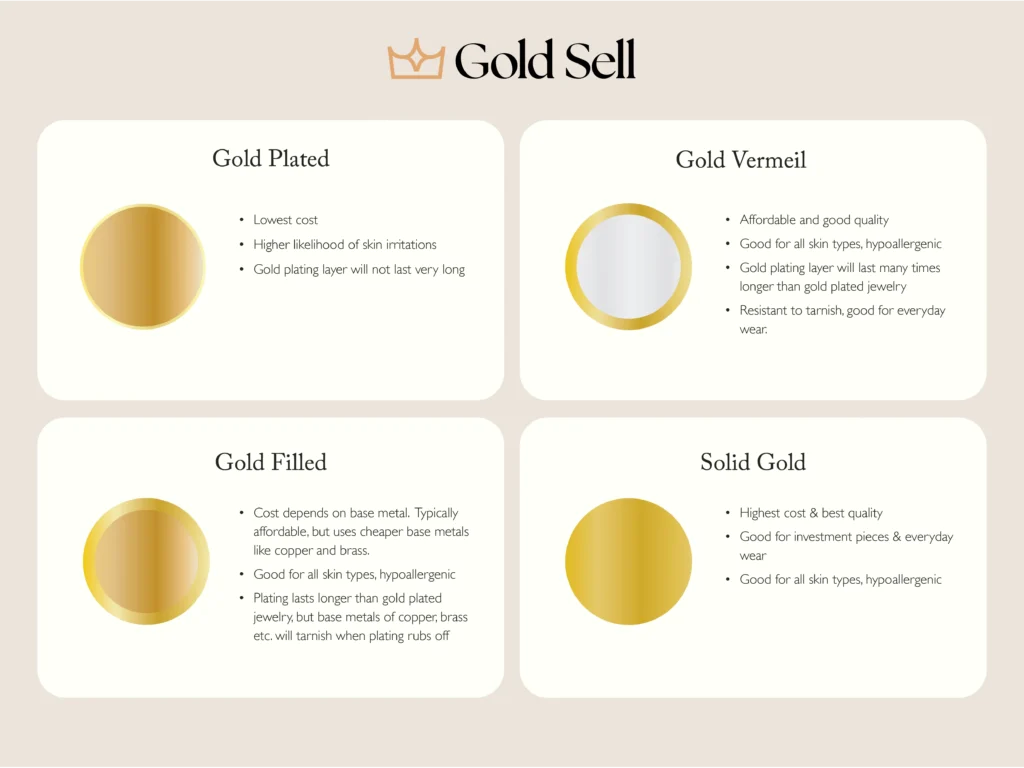
(Comparison chart showing different types of gold jewellery – Gold Plated, Gold Vermeil, Gold Filled, and Solid Gold – with details on cost, quality, and durability)
Rolled Gold Hallmarks
Rolled gold hallmarks are the stamps or markings on jewellery that indicate it’s rolled gold (i.e. gold layered on a base metal) rather than solid gold. These marks are different from the standard hallmarks you’d see on solid gold pieces. In the UK, solid gold jewellery usually has an official hallmark showing its purity (for example, “375” for 9ct, “750” for 18ct, etc., often accompanied by an assay office symbol). Rolled gold, on the other hand, isn’t pure enough to qualify for a standard gold hallmark, so it uses its own codes to show that there is gold present in a layered form.
Here are some common rolled gold hallmarks and their meanings (from most common to less common):
- Fractional Marks (e.g. 1/40 12K RGP): Many rolled gold items have a fraction and karat stamp. For example, 1/40 12K RGP means the gold layer is 12-karat gold and the gold makes up 1/40 of the item’s weight. In other words, 2.5% of the piece’s weight is 12K gold (12K is 50% pure gold, so overall about 1.25% of the item’s weight is pure gold). A stamp like 1/20 12K RG would indicate 1/20th of the weight is 12K gold (5% of the weight is 12K gold). The higher the fraction (1/20 is higher than 1/40), the more gold content in the item. These fractions tell you the rolled gold content directly.
- RG or RGP: A simple “RG” mark stands for Rolled Gold, and “RGP” stands for Rolled Gold Plate. If you see jewellery stamped with just RG or RGP, it indicates the piece has a gold layer bonded onto base metal. This marking is common on vintage items like watch cases, chains, or fountain pen caps. It’s basically an abbreviation to show the item is rolled gold. Sometimes you might see something like “14K R.G.P.” which combines a karat and the rolled gold plate notation.
- Gold-Filled Markings (GF): Occasionally, you might encounter a mark like “1/20 12K GF” on items that could be considered rolled gold. Technically this denotes gold-filled, but historically the terms overlap. GF means Gold-Filled, which as mentioned is a thicker rolled gold. If a piece is marked 1/20 12K G.F., it’s a high-quality rolled gold item containing 5% of 12K gold by weight. We include it here because gold-filled is essentially a type of rolled gold, just with a specific legal threshold of gold content. So if you see a fraction and “GF”, know it’s one of the best quality rolled gold variants.
- Other Marks: Less commonly, you might find terms like “Overlay” or foreign marks. For example, some vintage French pieces are marked “Fix” (a trade name for rolled gold process in France), or the word “Doublé” (meaning double, indicating double-layered gold sheet, often seen on European rolled gold items). In German, rolled gold is Walzgold, but you typically won’t see that on UK jewellery. You might also see hallmarks that spell out “Rolled Gold” or abbreviations like “O.M.” (for “overlay metal”) on antique pieces. These are all indicating some form of bonded gold layer.
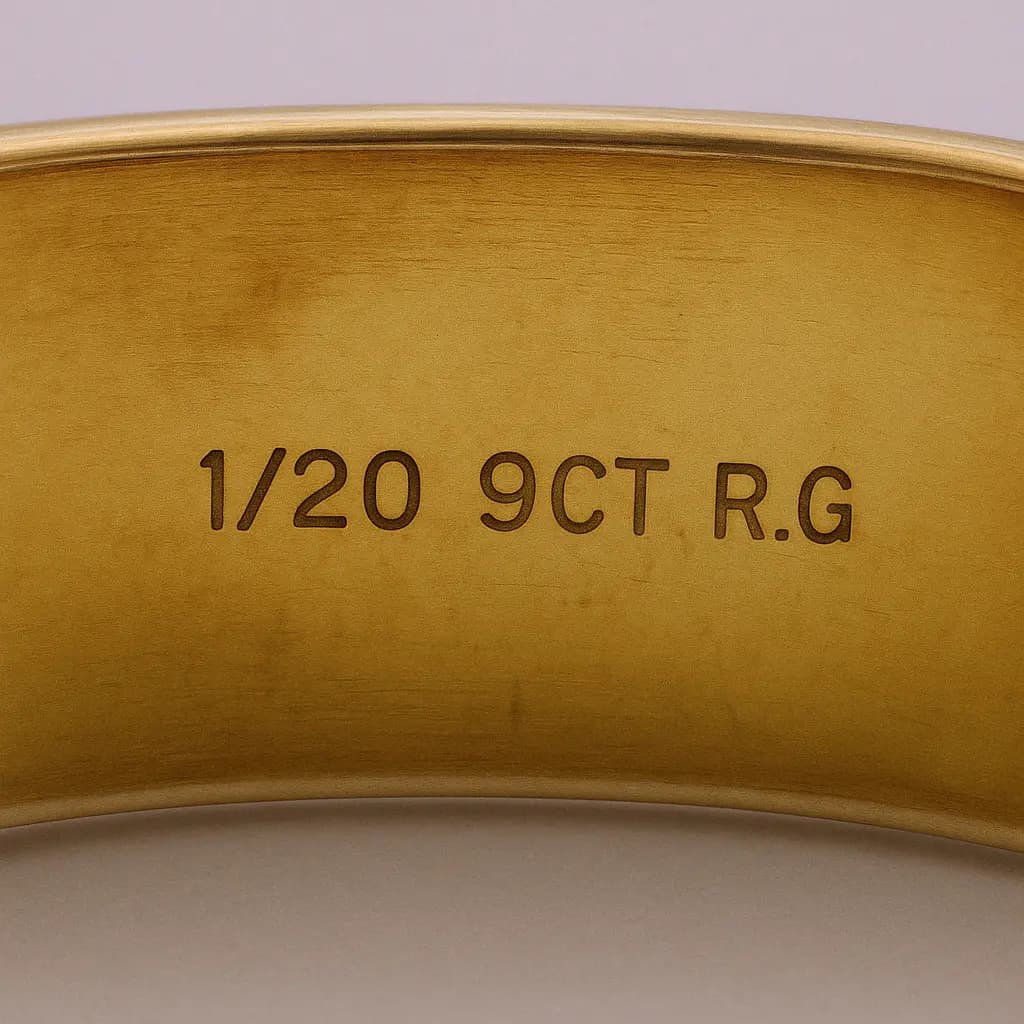
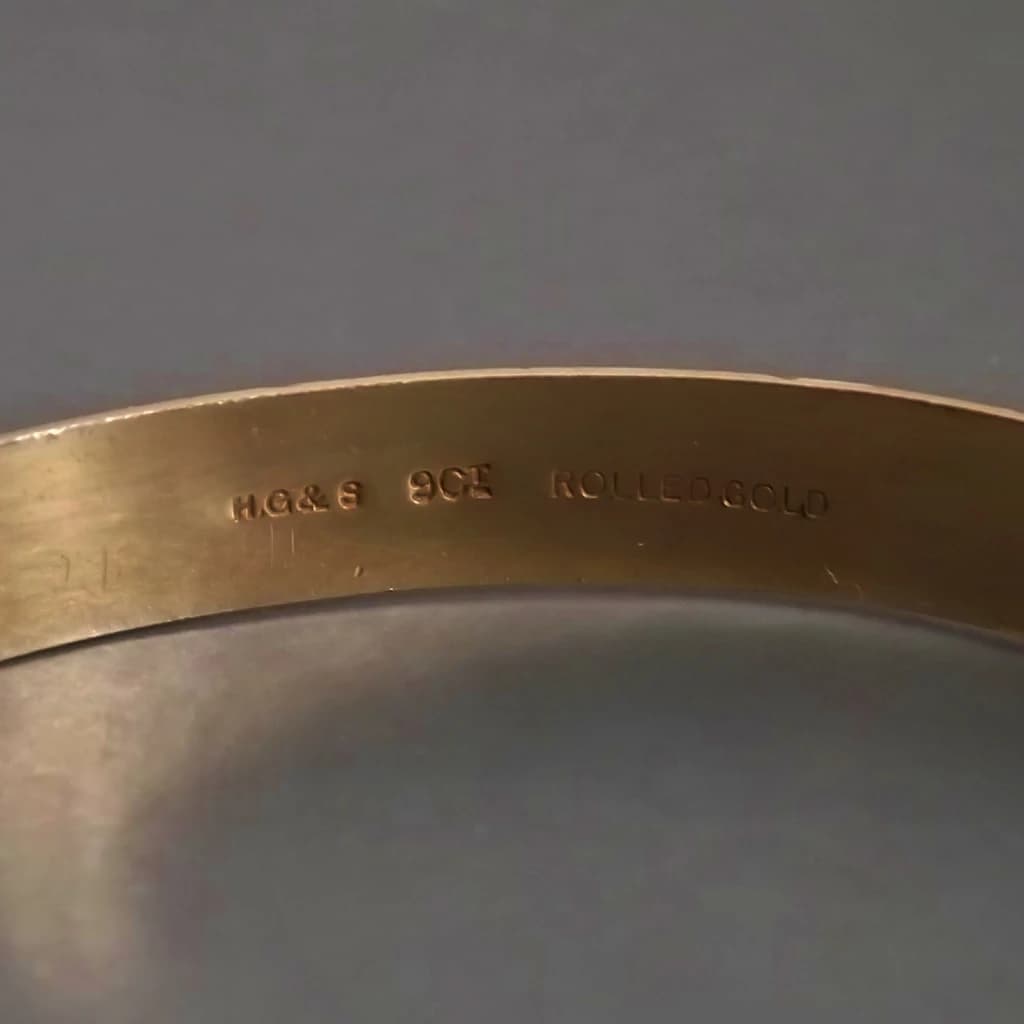
(Examples of rolled gold hallmarks: The left image shows a “1/20 9CT R.G” stamp, indicating the item is 1/20th 9-carat gold by weight. The right image shows a vintage “H.G&S 9CT ROLLED GOLD” hallmark, identifying the maker and confirming the rolled gold composition. These hallmarks help determine gold content and authenticity)
It’s important to note that rolled gold hallmarks are not the same as solid gold hallmarks. They don’t guarantee a purity like 9ct or 18ct; instead, they describe how much gold is layered onto the piece. Despite having less gold, rolled gold items do contain real gold, so these marks tell buyers and jewellers that the item has value beyond mere gold plating. In fact, jewellery buyers and scrap gold dealers will often purchase rolled gold items for refining, taking into account these hallmarks to estimate the gold content. So, even though a rolled gold stamp like “1/40 12K RGP” might look obscure, it actually tells you there’s a bit of gold in there – and that means the piece is worth something for its gold content.
Is Rolled Gold Worth Anything?
Yes – rolled gold is worth something because it contains real gold. While rolled gold jewellery is not as valuable as solid gold jewellery, it does have resale value due to its gold content. The phrase “rolled gold” might make some people think of cheap costume jewellery, but unlike thinly gold-plated items (which have almost no gold and are essentially worthless in gold value), rolled gold pieces have a measurable amount of gold in them, even if it’s only a few percent of the item’s weight. This means you can sell rolled gold items, typically to gold buyers or refiners who accumulate gold-bearing material.
For individual pieces, the cash value is modest – for example, a single rolled gold bangle might only contain a small fraction of a gram of gold. But if you have multiple pieces or sell rolled gold in bulk, the value adds up. Gold buyers often buy rolled gold as a type of scrap gold (gold material meant to be melted down) because when you gather a lot of rolled gold items, the total gold content can be extracted and refined. Despite the lower gold percentage, it’s still real gold that can be recovered.
The worth of rolled gold depends on three main factors: the karat of the gold layer, the fraction (thickness) of the gold layer, and the current market price of gold. For instance, an item marked 1/10 10K RG has 10% of 10-karat gold by weight, which is more gold (and thus more value) than an item marked 1/40 12K RGP (2.5% of 12K gold by weight). In general, older rolled gold pieces with marks like 1/5 or 1/10 (which are uncommon and close to gold-filled quality) will be worth more than 1/20 or 1/40 pieces of the same weight.
Many gold buyers will pay for rolled gold, though often at a lower price per gram than for solid gold. Selling rolled gold is usually done by weight – a dealer may use an XRF device to estimate the gold content, then offer a price accordingly. If you plan to sell, it could be beneficial to gather a number of rolled gold items together. For example, a few rolled gold chains and watch cases combined might yield a few grams of pure gold once processed, making it more worthwhile. Some sellers even mix rolled gold with higher-purity items when selling to get a better overall price (since the buyer might average the purity).
Keep in mind that rolled gold items won’t fetch as high a price per gram as solid gold jewellery or coins. A solid gold coin or bar (like a gold Sovereign or a gold bullion coin) contains 22K-24K gold and will be valued close to the market price of gold for its weight. In contrast, rolled gold might only contain, say, 1K or 2K worth of gold spread throughout the item. However, the rolled gold is still worth money – after all, gold is gold. If you have broken jewellery or vintage pieces marked as RGP/RG, don’t throw them away; a reputable gold buyer or jeweller will usually take them off your hands.
In summary, rolled gold is definitely worth something. It won’t make you rich overnight, but it has intrinsic value because of its gold content. As gold prices climb, even the small percentages of gold in rolled gold can become more valuable. So if you have rolled gold tucked away, it’s good to know it’s not just “fool’s gold” – you could convert it to cash if needed.
Rolled Gold Prices Per Gram
Rolled gold price per gram depends on three core factors—(1) the live spot price of gold, (2) the karat of the gold layer, and (3) the fraction stated in the hallmark ( e.g., 1/20 or 1/40 ) that tells you what share of the item’s weight is gold. Because rolled‑gold jewellery contains only a thin percentage of precious metal, the rolled gold price offered by buyers is a fraction of what you would receive for a solid‑gold piece of identical weight. In other words, the lower the fraction and karat, the lower the rolled gold worth per gram; the higher the fraction and karat, the closer it edges toward current rolled gold prices per gram today for high‑content scrap gold.
To make things simple, we’ve broken it down for you in the live rolled gold price‑per‑gram display below. Just find the hallmark that matches your rolled gold jewellery (we’ve included the most common ones), and you’ll instantly see today’s price per gram based on the live gold spot price (updated every 60 seconds.) It’s a quick and clear way to understand exactly what your rolled‑gold pieces are worth before you decide to sell.
Live Rolled Gold Price Per Gram
Gold price last updated:
Saturday, 31 October 2026, 18:07.
Our live rolled gold prices are based on the current gold trading rate in the global markets. The percentage of the spot price we pay is determined by the volume of gold you send us.
The percentage of the spot price we pay for your gold is based on the volume you send to us.
*We require a minimum of 10 grams of precious metals to offer our most competitive valuations as the UK’s highest paying online gold buyer.
Rolled Gold vs Gold Filled
Rolled gold vs. gold filled – what’s the difference? In truth, rolled gold and gold-filled jewellery are very similar; both are made by bonding layers of gold to a base metal. The distinction mainly comes down to how thick the gold layer is and how the terms are used.
- Gold Filled: “Gold-filled” is a term that usually implies a higher gold content. Gold-filled items legally must have at least 5% of the item’s weight in gold (in the US standard). They often use two layers of gold (sandwiching the base metal). Gold-filled jewellery is typically marked with specific hallmarks, like 1/20 14K GF or 1/10 12K GF, to denote the fraction of gold. Because of the thicker gold, gold-filled pieces are more valuable and longer-lasting – they can withstand many years of wear (often decades) before the gold layer might wear through.
- Rolled Gold: “Rolled gold” is essentially the same manufacturing process (mechanical bonding of gold to base metal), but the term is often used for items with a bit less gold than the “gold-filled” standard. For example, if the gold layer is only 2.5% of the weight (1/40), it wouldn’t meet the 5% requirement to be called gold-filled, so it might be referred to as rolled gold or rolled gold plate instead. Rolled gold items might be marked with RG or RGP, or with fractional hallmarks that are lower (like 1/30, 1/40). They are slightly less valuable per gram than gold-filled, simply because there’s less gold content. However, they are still far superior to gold plating in terms of durability and value.
In everyday conversation, people (and even jewellers) sometimes use “gold-filled” and “rolled gold” interchangeably, since both involve rolled/bonded gold layers. The main takeaway is that gold-filled is a type of rolled gold with a higher gold percentage. If you have gold-filled jewellery, you essentially have a high-quality rolled gold piece. Both rolled gold and gold-filled are considered real gold layered jewellery, and both will have a gold layer that doesn’t wear off quickly.
From a selling perspective, you can usually sell gold-filled and rolled gold pieces together as they’re processed similarly. Just note that a buyer may pay a bit more for gold-filled if they recognise it has a higher gold fraction. But whether you call it rolled gold or gold-filled, the process is similar – gold sheet fused to a base metal. Gold-filled is simply the premium tier of rolled gold.
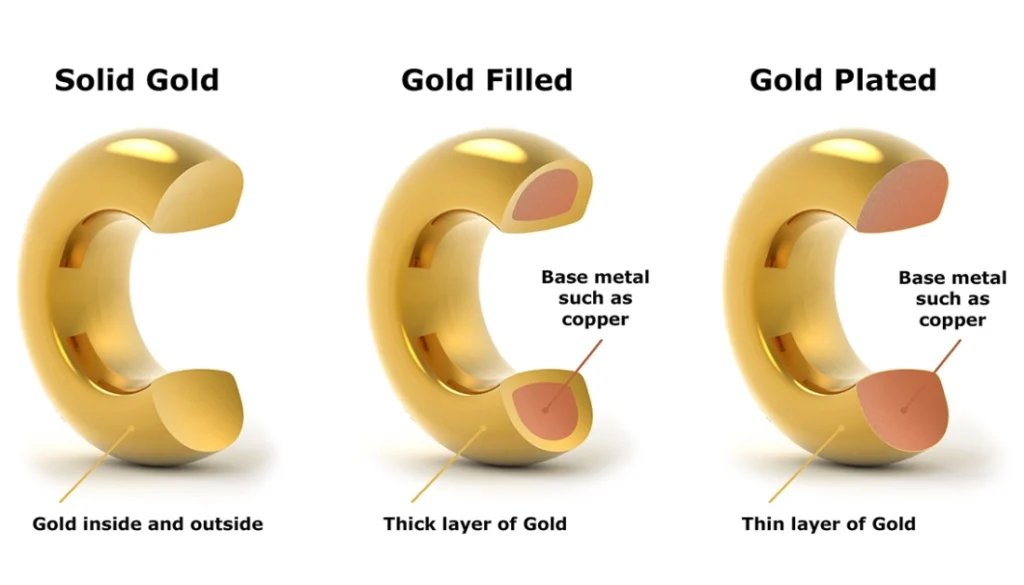
(Visual comparison of solid gold, gold filled, and gold plated jewellery showing gold filled vs rolled gold thickness and metal layers)
Frequently Asked Questions
What is rolled gold?
Rolled gold is a material made by bonding a thin layer of real gold to a base metal using heat and pressure. It’s essentially a thick gold plating (often using 10K–14K gold) over brass or copper. This gives jewellery the look of solid gold at a lower cost. Rolled gold has much more gold than standard electroplated jewellery, making it more durable and valuable than regular gold plate.
What does rolled gold mean?
“Rolled gold” means a sheet of real gold is bonded to a base metal core, usually brass or copper. It’s not solid gold, but it has a visible layer of real gold, often making up a few percent of the item's weight. The name comes from the rolling process used to bond the metals.
What is rolled gold worth?
Rolled gold is worth something due to its real gold layer, but much less than solid gold. It might contain 1/20th or 1/40th gold by weight. Buyers will pay for the gold content, especially if you have a large quantity, but expect a much lower price per gram than pure gold.
Does rolled gold tarnish?
Rolled gold is more tarnish-resistant than cheap plating, thanks to its real gold outer layer. However, if the layer wears thin or cracks, the base metal beneath may oxidise and cause discolouration. With normal use and care, rolled gold typically stays shiny and doesn’t tarnish easily.
How to clean rolled gold?
Clean rolled gold gently with warm water and mild dish soap. Use a soft cloth or toothbrush to remove dirt, then rinse and pat dry. Avoid harsh chemicals, abrasive cleaners, or ultrasonic machines. A gentle polish with a jewellery cloth helps maintain shine without damaging the gold layer.
Is rolled gold real gold?
Yes, the surface of rolled gold is real gold, usually 9K, 12K, or 14K. Beneath the gold is a base metal, so it’s not solid gold—but it isn’t fake either. You’re still seeing and touching genuine gold, just layered over a stronger metal.
What are the rolled gold hallmarks?
Rolled gold hallmarks include abbreviations like “RG” or “RGP,” and fractions such as “1/20 12K RG.” These indicate the proportion of gold by weight—e.g., 1/20 means 5% of the item’s weight is 12K gold. They differ from solid gold marks like 375 or 585.
Is rolled gold the same as gold plated?
No. Rolled gold has a much thicker gold layer, mechanically bonded to the base metal. Gold plated jewellery has a microscopically thin layer applied with electroplating. Rolled gold lasts longer, contains more gold, and is generally more valuable than gold plated.
Rolled gold vs gold plated?
Rolled gold has a gold layer up to 100 times thicker than gold plated. It lasts longer, holds some resale value, and resists wear. Gold plated jewellery may lose its gold layer within months of daily wear. Rolled gold is the better long-term choice.
How long does rolled gold last?
With proper care, rolled gold can last decades. The thick gold layer wears slowly, and many vintage pieces still look great after 50+ years. Daily wear may reduce its life to 10–30 years, but occasional wear and gentle cleaning can make it last a lifetime.
Interested in selling gold with the UK’s highest paying gold buyer? Visit our Sell Gold page to get a competitive valuation – we provide fully insured postage and fast payment.
For more insights and the latest gold price today, keep an eye on our live charts and blog updates.