9ct Gold Vs 18ct Gold
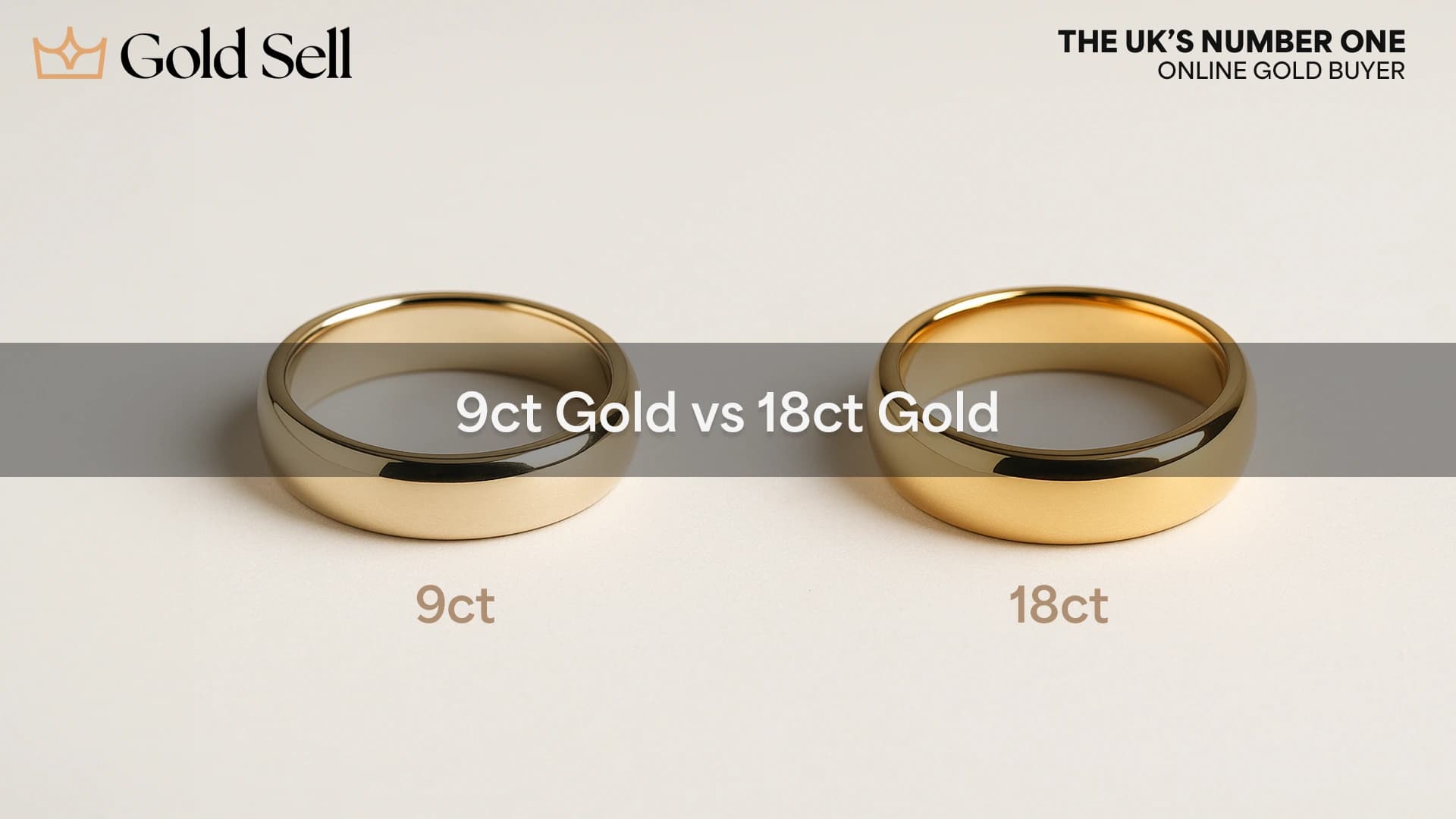
The difference between 9ct gold and 18ct gold comes down to purity and composition: 9ct gold is 37.5% pure gold, while 18ct gold is 75% pure gold. This higher gold content in 18ct gives it a richer colour and higher intrinsic value, whereas 9ct gold is more affordable and slightly harder. Both are real gold alloys, but they differ in appearance, durability, price, and suitability for different wearers.
Key Takeaways
- Gold Content: 9ct gold contains 9 parts gold out of 24 (37.5% purity), hallmarked “375”, while 18ct contains 18 parts gold (75% purity), hallmarked “750”. This means 18ct has double the pure gold of 9ct.
- Colour & Appearance: 18ct yellow gold has a deeper, more vibrant yellow hue, whereas 9ct yellow gold appears lighter and less lustrous. In white gold, 9ct alloys can look slightly warmer or brighter white, while 18ct white gold may appear a bit greyer without rhodium plating.
- Hardness vs Durability: 9ct gold is harder (more scratch-resistant) due to more alloy metals, but also more brittle. 18ct is softer (more gold) but tends to be tougher and more durable over many years.
- Cost: 18ct gold is roughly twice as expensive as 9ct gold by weight because of the higher gold content. For example, as of today, 9ct gold is £35.45 per gram, while 18ct is £70.90 per gram.
- Tarnish Resistance: Higher purity makes 18ct gold more resistant to tarnish and corrosion. 9ct gold’s greater copper/zinc content can tarnish or dull over time, especially in harsh conditions.
- Everyday Wear: 9ct’s hardness suits everyday wear and is less prone to scratches, but its brittleness means components (like prongs) may wear out faster. 18ct gold, though softer, withstands daily wear longer without metal fatigue, making it ideal for heirloom pieces.
- Skin Sensitivity: 18ct gold (with fewer base metals) is generally kinder to sensitive skin, with lower risk of allergic reactions. 9ct gold contains more alloy metals (like nickel or copper), which can trigger skin irritation or allergies in some people.
9ct Gold Vs 18ct Gold
Let’s compare 9ct vs 18ct gold across all the important factors – from purity and hallmarks to durability, looks, price, and practical wear considerations:
Gold Purity & Hallmarks
The carat (ct) number tells you how much pure gold is in the alloy. 9ct gold is 9/24 parts gold (37.5% purity), while 18ct is 18/24 parts gold (75% purity). In the UK hallmarking system, 9ct jewellery is stamped with “375” and 18ct with “750”, denoting their parts-per-thousand of gold. This means 18ct gold contains double the amount of actual gold compared to 9ct. Visibly, the difference in gold content influences their colour and weight – 18ct pieces feel heavier for the same size and have a richer yellow tone, whereas 9ct gold is lighter in hue and weight.
Appearance – Colour & Lustre
Due to the higher gold content, 18ct yellow gold has a noticeably deeper, more brilliant golden colour. By contrast, 9ct yellow gold tends to be paler or more subtle in tone. Many people find the warm glow of 18ct more luxurious and closer to pure gold, while 9ct’s colour is a bit more muted (some describe it as a “straw yellow”). With white gold, both 9ct and 18ct are typically rhodium-plated to appear bright white. In their un-plated state, 9ct white gold may actually look slightly more white (since it has less yellow gold to begin with), whereas 18ct white gold can have a faint pale grey or yellow tint. This is often academic, though, since most white gold jewellery is kept rhodium-plated for that shiny white finish. For rose gold, 9ct vs 18ct also differ: 9ct rose gold contains more copper proportionally, giving it a bold rosy-pink colour, whereas 18ct rose gold is softer pinkish-yellow due to higher gold content. In short, 18ct alloys exhibit richer colour saturation, and 9ct alloys yield a lighter colour in yellow or a more pronounced colour in rose due to alloy metals.
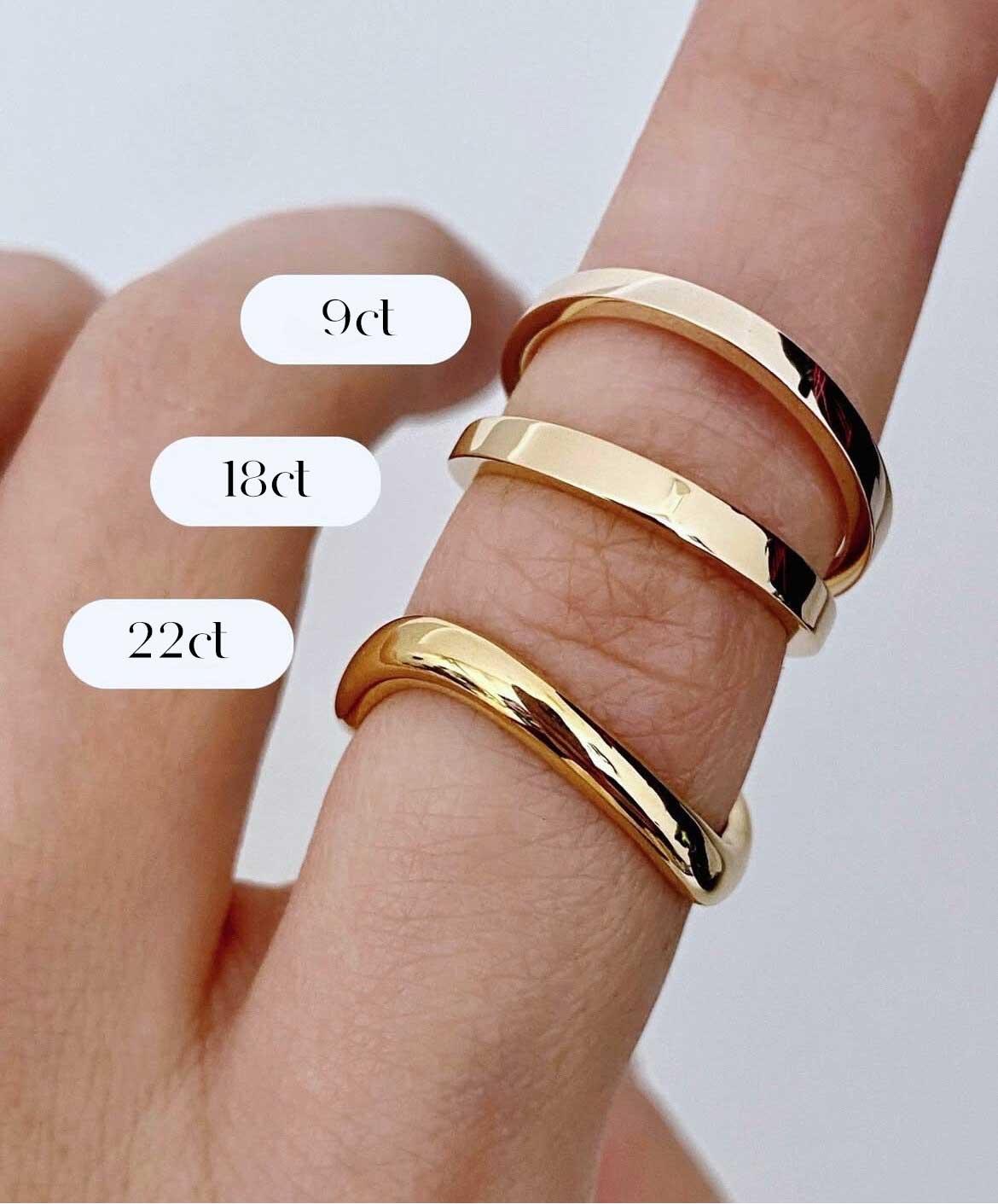
This visual comparison of 9ct gold vs 18ct gold (and 22ct) clearly shows how purity affects gold’s colour. The 9ct ring (top) has a paler, more muted yellow due to its higher alloy content, while the 18ct ring (middle) appears richer and warmer. The 22ct ring (bottom) has the deepest, most vibrant gold tone, reflecting its high purity. This illustrates why 18ct is often chosen for its luxurious colour over 9ct.
Hardness & Durability
There’s a trade-off between hardness and overall durability. 9ct gold is harder on the surface than 18ct – it’s more scratch-resistant because the added base metals (like copper, zinc, silver) increase its hardness. You might notice 9ct rings don’t scuff as easily as 18ct rings. However, “harder” doesn’t mean “stronger” in terms of longevity. 9ct is also more brittle. Over time, microscopic stress can cause 9ct alloy to crack or for prongs to snap more readily, especially if the piece is thin. 18ct gold is softer (easier to scratch) because of the higher gold content, but it’s also more malleable and tough – it can absorb knocks or bending without breaking as easily. In daily wear over years, an 18ct gold ring tends to hold up better against metal fatigue and stress cracks, whereas 9ct may become brittle or stressed in areas like prongs or settings. For example, an intricately engraved 18ct wedding band can last generations, while the same in 9ct might wear down or crack sooner. So, if you need a ring to last a lifetime (or to hand down), 18ct is often the preferred choice for durability, even though you might see more surface scratches. (Those scratches can be polished out; a fracture or break in 9ct is harder to fix.)
Tarnish & Maintenance
Gold itself does not tarnish – one of gold’s great properties is that it’s a “noble” metal resistant to corrosion. But remember, neither 9ct nor 18ct is pure gold; both have alloy metals that can react or tarnish. Because 9ct has a much higher percentage of other metals (62.5%), it is more prone to tarnishing than 18ct. Over time, 9ct gold jewellery can develop a slight dullness or darkening, especially if exposed to chemicals, moisture, or just the air and sweat over many years. It usually doesn’t tarnish in an obvious way like silver does, but if you place an older 9ct piece next to a brand new one, you might notice it looks less bright or a bit rosy/brassy – that’s tarnish and surface oxidation of the copper or other metals in the alloy. A quick polish with a jewellery cloth will restore 9ct’s shine in most cases. 18ct gold, with 75% gold, rarely tarnishes visibly. The small amount of alloy metal in 18ct might darken a tad in extreme conditions (for instance, 18ct that contains copper can get a faint patina after decades), but it’s uncommon. In practical terms, 18ct gold is largely immune to tarnish – it stays shiny with minimal maintenance, whereas 9ct might need more periodic cleaning to look its best. This also means 18ct is less likely to cause that green or black staining on skin that sometimes happens with lower-carat gold (from copper oxidation). To keep either 9ct or 18ct looking great, it’s wise to remove jewellery before using harsh chemicals or swimming in chlorinated water, and to clean them occasionally. But 18ct will generally require less frequent polishing due to its higher purity.
Weight & Heft
Because gold is a dense metal, an 18ct item will weigh more than an identical 9ct item. 18ct gold is denser than 9ct, so the same ring design cast in 18ct will feel more substantial on the hand than in 9ct. Some people like the solid heft of 18ct (it feels “high quality”), while 9ct can feel lighter. This doesn’t usually affect durability, but it’s a tactile difference you’ll notice.
Cost
One of the biggest practical differences is price. Since 18ct contains twice the amount of gold as 9ct, and gold is the expensive part, 18ct jewellery is significantly more expensive than 9ct. As a rough rule, if gold prices are stable, 18ct material value is about double that of 9ct. We can see this in scrap gold prices: Today in the UK, 9ct gold is worth £35.45 per gram, while 18ct is worth £70.90 per gram. That ratio (~2:1) holds for intrinsic value. In a retail setting, the price difference might be slightly more or less than double, depending on craftsmanship and other factors, but expect to pay a premium for 18ct. For example, a simple wedding band might cost £300 in 9ct and £600+ in 18ct. 9ct is popular for its affordability – you get the look of gold jewellery at a lower cost, which is why many everyday jewellery pieces and fashion items are made in 9ct. On the other hand, 18ct is viewed as more of a luxury or investment. Its higher gold content not only costs more upfront but can also mean it holds value better (if you were to resell or scrap it, there’s more gold to reclaim). So, if budget is a primary concern, 9ct will allow for bigger or more elaborate pieces for the same money. If long-term value or prestige matters, 18ct might be worth the investment.
Everyday Wear & Practicality
Both 9ct and 18ct can be worn daily, but there are some differences in how they handle wear-and-tear. 9ct gold’s hardness makes it quite good for daily wear – it resists scratching and bending, so things like a 9ct gold chain or ring can take some abuse without looking beat up. This is one reason 9ct became popular for men’s rings or pieces that see a lot of contact. However, if a 9ct ring does get bent forcefully or stressed (say, caught on something), it’s more likely to crack than a more malleable 18ct piece. 18ct gold, being softer, will scratch and scuff more easily with daily use, especially if you’re doing manual work while wearing it. But surface scratches on 18ct are usually shallow and can be polished out periodically; the metal underneath is still sound. Over many years of continuous wear, 18ct gold holds up well, often better than 9ct in terms of not breaking or thinning out. For something like a classic wedding ring that you want to still be intact decades later, 18ct is a top choice. In fact, heirloom rings are commonly 18ct or even 22ct and they survive generations. 9ct rings can also last a lifetime, but they might require a bit more care (like checking that prongs haven’t become brittle or loose). If you’re very active or work a lot with your hands, you might lean toward 9ct for a ring because it shows less immediate wear. But you’ll want to be mindful of removing it during heavy use to avoid sudden shocks that could crack it. Meanwhile, with 18ct, you’ll see scratches but it’s less likely to snap – still, you might have to polish it to keep it looking smooth.
Skin Sensitivity & Allergies
If you have metal allergies or very sensitive skin, the composition of the alloy matters. 18ct gold is purer and generally hypoallergenic for most people. There is less non-gold metal to potentially react with your skin. 9ct gold contains a larger proportion of other metals, and depending on what they are, they can cause allergic reactions. For instance, some 9ct gold (especially older alloys or certain white gold mixes) may contain nickel, a common allergen. In the UK and EU, nickel use in jewellery is restricted, but trace amounts might still be present or older pieces might have it. Copper and zinc (common in 9ct yellow gold) aren’t typical allergens for most, but a few people do react and get a greenish stain or rash. If you know you’re allergic to certain metals, 18ct reduces that risk simply by having less of those metals. According to jewellers, people with very sensitive skin often do better with 14ct or 18ct gold, or even platinum. That said, not everyone will have an issue with 9ct – many wear 9ct jewellery daily with no problems. It really depends on individual skin chemistry and the exact alloy used. White gold alloys can differ: 9ct white gold might contain more nickel (unless it’s a nickel-free alloy using palladium), whereas 18ct white gold often uses palladium which is hypoallergenic. If skin sensitivity is a major concern, one might lean towards 18ct or at least ensure the 9ct is nickel-free. And of course, platinum or sterling silver are other options for sensitive skin, but among golds, 18ct is the safer bet for allergy sufferers.
In summary, 18ct gold vs 9ct gold is a classic trade-off: 18ct offers higher purity, a premium look and value, and better long-term resistance to tarnish and metal fatigue. 9ct offers greater initial strength (hardness) and affordability, making it practical for everyday pieces or larger items on a budget. Neither is “wrong” – it truly depends on what matters most to you (cost, colour preference, durability, or purity). In the next sections, we’ll delve into specific questions and scenarios to help decide which gold is better for your needs.
Is 9ct Or 18ct Gold Better?
When asking “Is 9ct or 18ct gold better?”, the honest answer is: it depends on what you’re looking for. Both have their pros and cons, which we can break down:
18ct Gold – Pros
- Higher Purity & Value: 18ct contains 75% gold, giving it a high intrinsic value and prestige. It’s great if you want a luxurious, investment-worthy piece that holds value (18ct items retain more gold value over time).
- Rich Colour: The gold-rich alloy has a deep, classic yellow glow (or a vivid rose tone), often seen as more beautiful. Many fine jewellery lovers prefer the colour of 18ct for its unmistakable richness.
- Tarnish Resistant: With less alloy metal to react, 18ct is highly resistant to tarnish and corrosion. It stays bright with minimal upkeep, and won’t discolour your skin.
- Durability for Long Term: Despite being softer, 18ct gold tends to endure decades of wear without cracking. It’s the choice for heirloom-quality rings and pieces that you want to last for generations. Prongs and details in 18ct are less likely to snap with age (the metal “gives” a bit instead of breaking).
- Hypoallergenic: 18ct is less likely to cause allergies or irritation since it has fewer base metals. Ideal if you have sensitive skin or metal allergies.
18ct Gold – Cons
- Higher Cost: The biggest drawback is price. 18ct jewellery can be nearly double the cost of 9ct. It might stretch the budget, limiting size or forcing compromises if cost is a factor. For those on a tight budget, 18ct might simply be too expensive for larger pieces.
- Softer Surface: 18ct gold scratches and scuffs more easily. Daily wear will quickly put fine scratches on an 18ct ring or bangle (the patina of wear). If you’re very concerned about keeping a piece pristine, 18ct requires careful wear or periodic polishing.
- Slightly Less Hard: Related to softness, it’s not as hard as 9ct. Sharp edges may wear down a bit faster, and very fine details can blur over time due to the malleability of the metal (for example, crisp edges on an 18ct signet ring will soften more over years of wear compared to 9ct).
9ct Gold – Pros
- More Affordable: Price is the strong suit of 9ct. You can get a larger or heavier piece of jewellery in 9ct for much less money than in 18ct. This makes 9ct ideal for budget-conscious buyers who still want real gold. For instance, wedding rings for a young couple are often 9ct to save cost, or you might choose 9ct for jewellery that is trendy or occasional-use.
- Hard and Scratch-Resistant: 9ct’s alloy is significantly harder on the surface. It can take a beating without as many marks. This makes it great for everyday wear items – a 9ct gold ring or bracelet will resist scratches from keys, desk work, or occasional knocks better than 18ct. It’s also a good choice for items like cufflinks or tie bars that see friction.
- Durable for Active Wear: Because it’s harder, 9ct can be more structurally durable in certain scenarios (at least in the short to medium term). If you’re doing manual labour or outdoor activities and don’t want to take your ring off, 9ct might maintain its shape where a softer ring could bend. Some find 9ct rings don’t deform as easily when accidentally squeezed or dropped.
- Lighter Colour Preference: A matter of taste, but some people actually prefer the subtler pale gold colour of 9ct. It’s a less “yellow” gold which can appear more understated and might complement certain skin tones or gemstones nicely. And for rose gold, 9ct’s stronger copper colour can be a fashion preference for a really rosy look.
9ct Gold – Cons
- Lower Gold Content: With only 37.5% gold, 9ct is mostly other metals. That means it’s considered less prestigious or “fine.” It also has less resale value weight-for-weight – e.g. if you sell scrap gold, you’ll get considerably less for 9ct than 18ct. So it’s not as good for investment or heirloom value (the gold content is low).
- Potential for Tarnish: 9ct can tarnish or dull over time due to the high alloy content. Especially in things like 9ct white gold, if it’s not rhodium plated, it may yellow or tarnish faster. You might notice a 9ct necklace darken if left in a jewellery box for years unworn. It needs occasional cleaning to stay bright.
- Brittleness: Over the long run, 9ct gold can get brittle. Claws holding stones, for example, may become more prone to breaking after many years as the base metals in 9ct react to environment or stress. If a ring made of 9ct gets very thin from wear, it’s more likely to crack than bend (as 18ct would). Jewellers sometimes see old 9ct rings that have actually fractured, whereas 18ct ones usually just wear thin but remain intact.
- Allergy Risk: With more alloy metals, 9ct is more likely to trigger metal allergies if you’re sensitive. For example, some people can’t wear 9ct earrings because their ears react (often due to nickel content in older alloys), yet they can wear 18ct or platinum with no issues. Also, 9ct can leave a green mark on skin for some people (harmless discolouration from copper salts) especially if worn in humid conditions.
Which is Better? It really comes down to your priorities:
- If you want the best quality, richest colour, and long-term durability (and budget allows), 18ct gold is “better.” It’s the gold of choice for fine jewellery, engagement rings, and pieces with sentimental or investment value. It’s also better for sensitive skin.
- If you need something affordable, sturdy for daily wear, and don’t mind the lighter colour, 9ct gold can be the better choice. For everyday jewellery that might get roughed up or for larger pieces that would be cost-prohibitive in 18ct, 9ct is very practical. Also, for casual or fashion jewellery where you just want the look of gold without the high cost, 9ct is perfect.
In summary, neither is universally “better” – it depends on use-case. For a wedding ring meant to last forever, many jewellers will lean toward 18ct for its longevity and rich beauty (especially for rings that will be passed down). But for a chunky chain necklace or bracelet you plan to wear daily and maybe knock around, 9ct could be better since it’s tougher against wear and much cheaper to replace if lost. If you have very sensitive skin or want to minimise maintenance, 18ct is better (it’s inert and stays shiny). If you’re on a tight budget or want multiple jewellery pieces, 9ct lets you buy more for your money.
Often, the decision is a balance: for something like an engagement ring, some people choose 18ct for the ring itself (for strength of prongs and purity) but might get the matching wedding band in 9ct to save cost – however, jewellers usually recommend keeping those consistent (we’ll address mixing metals later). Ultimately, “better” is personal: 18ct gold is traditionally viewed as superior in quality, while 9ct offers its own advantages in durability and cost. Evaluate what matters most to you (price, purity, colour, resilience, skin-friendliness) and choose accordingly. Both 9ct and 18ct are gold that can serve well in the right context.
What Is The Hallmark For 9ct Gold?
In the UK, 9ct gold is hallmarked with the number “375.” This hallmark number reflects the gold purity: 375 parts per thousand gold, which is 9/24 carats (37.5% pure gold). So if you look inside a 9ct gold ring or on a gold chain clasp, you will usually see a tiny stamp that reads “375”. Sometimes it may also say “9CT” or “9K”, but the official hallmark is the numeric one.
A full UK hallmark has a few components. For gold, the fineness mark is stamped within a shaped shield (an octagonal shape for gold). The mark “375” inside that shape guarantees the item is at least 9 carat gold by law. Alongside that, you’ll also see a maker’s mark (usually two or three initials identifying the jeweller or manufacturer) and an Assay Office mark. The UK has four Assay Offices, each with its own symbol: for example, a leopard’s head for London, an anchor for Birmingham, a rose for Sheffield (after 1975), and a castle for Edinburgh. So a typical 9ct hallmark might look like: “ABC” (maker’s initials) + a symbol (like a crown or leopard’s head) + “375” + another letter or symbol indicating the year.
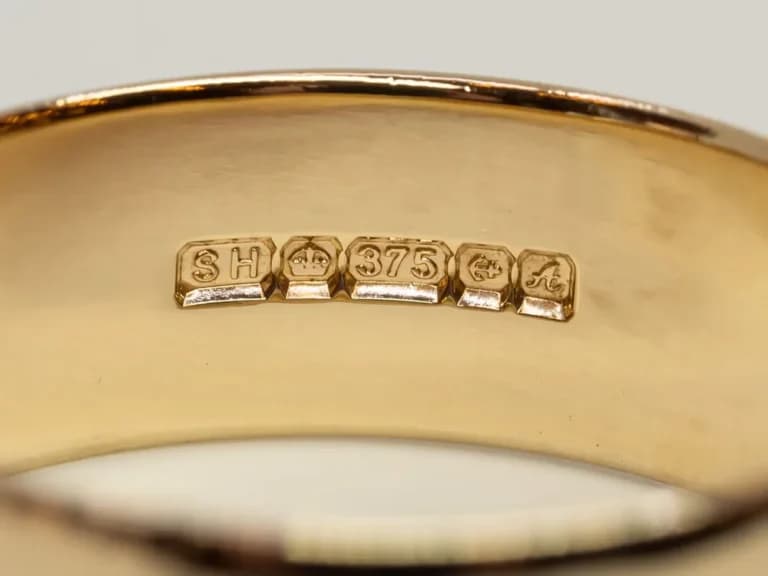
This image shows a genuine 9ct gold hallmark, including the legally required ‘375’ fineness stamp, denoting 37.5% gold purity. Also visible are additional UK hallmark components: the sponsor’s mark (maker’s initials), the traditional fineness symbol (crown), the assay office mark (e.g., Birmingham’s anchor), and a date letter. Together, these marks verify the gold’s authenticity and origin, providing assurance to buyers and collectors that the item meets strict UK hallmarking standards.
To answer plainly: the hallmark for 9ct gold is 375, signifying 9-carat. If you have a piece of gold jewellery and you find “375” engraved on it (often very small), that’s the telltale sign it’s 9ct gold. UK law requires gold jewellery over 1 gram to be hallmarked, so authentic 9ct gold items (above that weight) will carry this mark, giving you confidence that it’s genuine. To learn how to identify gold hallmarks easily, our experts have created a simple overview of what they mean and where to find them so you can identify gold purity and discover where your gold has come from!
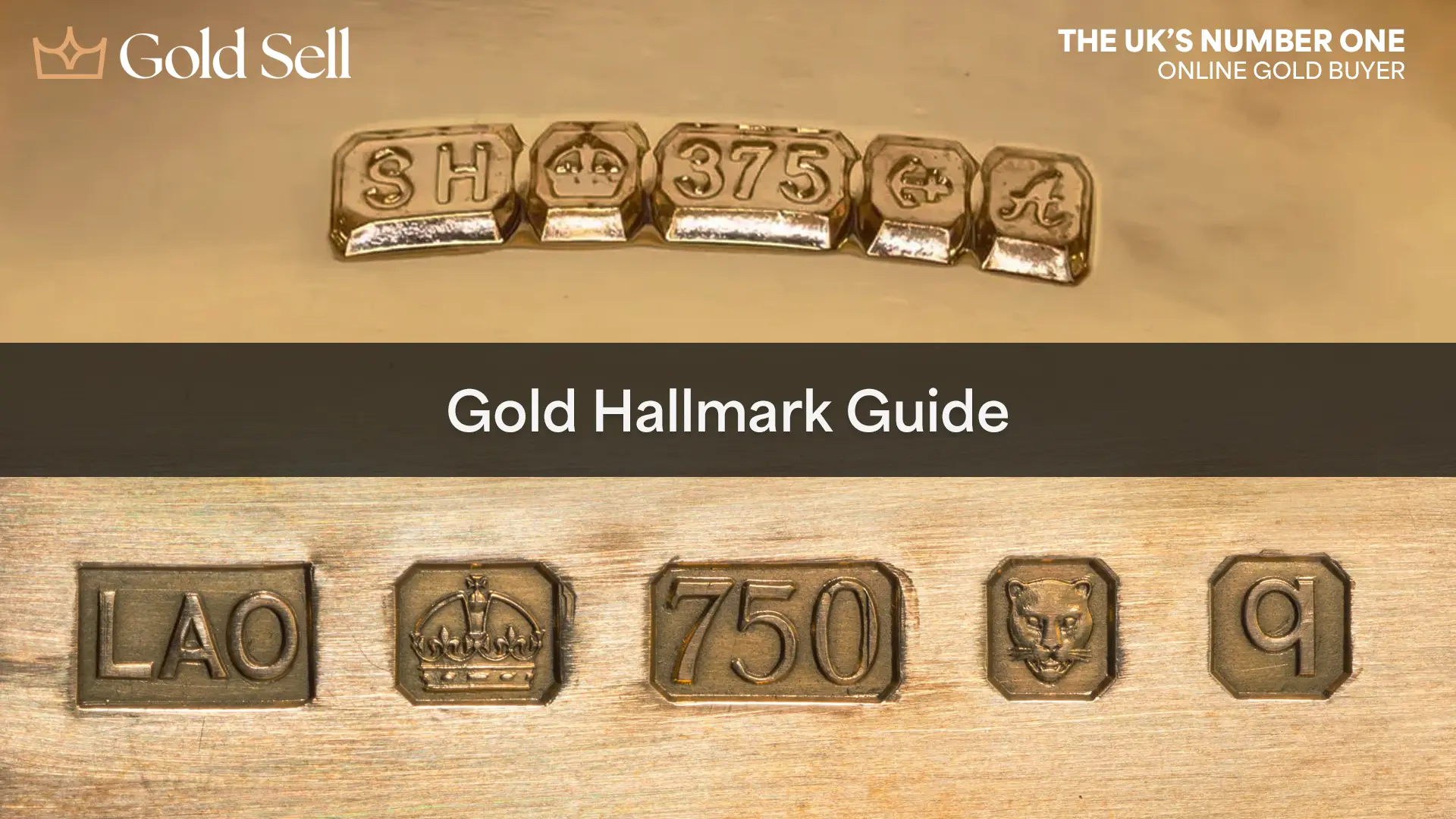
Gold Hallmarks Explained – Identify Gold Hallmarks
Learn how to identify gold hallmarks with our complete hallmark identification guide. Understand assay marks for gold on rings, coins, necklaces, and more.
What Is The Hallmark For 18ct Gold?
18ct gold in the UK is hallmarked “750.” The number 750 stands for 750 parts per thousand of pure gold, which corresponds to 75% purity or 18/24 carats. Thus, any genuine 18ct gold item (above the minimal weight that requires hallmarking) should have a “750” stamp as part of its hallmark. This is the easy identifier that you’ve got 18-karat gold.
Just like with 9ct, the full hallmark on 18ct gold will include the gold purity mark plus other symbols. You’ll typically see “750” stamped in a little trapezoid or rectangular cartouche (the standardised shape for gold marks). Next to it will be the Assay Office mark (e.g. an anchor for Birmingham, etc.) and the maker’s or sponsor’s mark (initials of the company or jeweller). There may also be a date letter (in older pieces) or other optional marks, but the key part is that 750 stamp.
In short, the standard UK hallmark for 18-carat gold is the number 750. If you’re examining jewellery and see “18K” or “18ct” text that’s fine, but the official UK hallmark is the 3-digit number. It’s worth noting that other countries use the same numbers too (750 is a common international mark for 18k), so even outside the UK, 750 on gold indicates 18k gold content. Always look for that hallmark when buying to ensure you’re truly getting 18ct gold. It’s your guarantee of purity under the Hallmarking Act.
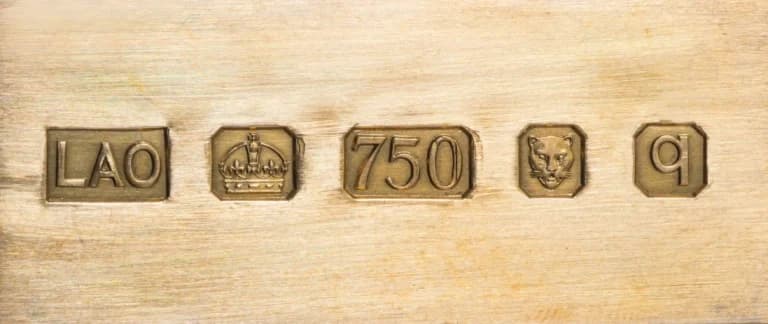
This hallmark confirms the authenticity of 18ct gold, with the central ‘750’ stamp representing 75% gold purity. Flanking it are other key UK hallmarking symbols: the sponsor’s mark, the traditional crown fineness mark, the London Assay Office leopard’s head, and a date letter. These collectively guarantee that the piece meets stringent UK legal standards for 18ct gold.
Is 9ct Gold Stronger Than 18ct?
If by “stronger” we mean resistant to wear and tear, then 9ct gold is harder than 18ct gold, but not necessarily overall stronger for all purposes. Here’s the nuance:
- Hardness (Scratch Resistance): 9ct gold is technically harder on the Mohs scale and other hardness measures, due to its alloy mix. It will resist scratches and dings more than 18ct. For example, a 9ct ring might not show scratches as quickly as an 18ct ring when both are worn under the same conditions. In that sense, you could say 9ct is “stronger” against scratching or surface wear.
- Toughness (Durability over Time): However, hardness isn’t the only factor in strength. 18ct gold, though softer, is more malleable and less brittle. 9ct’s extra hardness comes with brittleness – it can crack or stress-fracture more easily if bent sharply or worn thin. 18ct gold is more likely to bend rather than break. Over many years, an 18ct gold ring usually outlasts a 9ct ring without breaking. So for long-term structural strength (like prongs holding a gemstone, or the shank of a ring not snapping), 18ct might be considered “stronger” in that way.
To directly answer, you might say: 9ct gold is stronger in terms of hardness and scratch-resistance, but 18ct gold is stronger in terms of resisting metal fatigue and cracks.
For everyday understanding: 9ct won’t dent as easily – you could think of it like a tough but somewhat brittle metal, whereas 18ct is a softer but more enduring metal. If you hit both with a hammer (not recommended!), the 9ct might take a bit more force to deform, but if you do deform it, it could crack. The 18ct would bend more easily, but it wouldn’t break apart as readily.
In practical jewellery terms, 9ct is a bit more robust day-to-day, and 18ct is more reliable over decades. So there’s a balance. If your definition of “stronger” is “less likely to scratch or bend,” 9ct wins. If “stronger” means “less likely to fail or break under stress over time,” many would give that to 18ct.
To avoid confusion: 9ct gold is often cited as harder than 18ct, but remember that hardness isn’t the whole story of strength. Jewellers often note that 9ct, while hard, can be less resilient. Meanwhile, modern 18ct alloys are engineered to be very durable – so much so that experts confirm 18ct alloys can be equally durable or more durable than 9ct.
Bottom line: 9ct is harder (and thus in some ways “stronger”) on the surface, but 18ct is tougher and less prone to internal cracking. Depending on what kind of strength matters to you, each has an edge. In any case, both 9ct and 18ct can be strong enough for daily jewellery – they just exhibit strength differently.
Today's Live Gold Price Per Gram
Curious what your 9ct or 18ct gold is worth today? Use our live gold price chart below to see the current value per gram for different carats, including 9ct and 18ct gold. It’s a great way to understand how gold purity directly affects value—18ct gold is worth double 9ct’s value per gram. Whether you’re comparing jewellery or thinking of selling, this up-to-date pricing helps you make informed decisions based on real-time market rates.
Live Gold Price Per Gram
Gold price last updated:
Monday, 2 November 2026, 20:11.
The LBMA (London Bullion Market Association) spot price changes daily.
The prices displayed are based on the global market rate for pure 24ct gold, known as the spot price. Like all gold dealers, GoldSell pays a percentage of this rate to account for assaying, refining, secure logistics, market volatility, and handling costs. We consistently offer among the highest payout rates in the UK, with the exact percentage increasing based on the weight and purity of the gold you sell.
Will 9ct Gold Tarnish?
Yes, 9ct gold can tarnish over time, due to the high percentage of other metals in the alloy. However, the tarnish on 9ct gold is usually mild and slow-forming – nothing like the heavy black tarnish you see on sterling silver. Here’s what to expect and why:
- Cause of Tarnish: 9ct gold is about 62.5% base metals (often copper, with some silver and zinc). These metals can react with oxygen, moisture, and chemicals in the environment. Over months and years, the copper especially may oxidise, which leads to a subtle darkening or dull film on the jewellery. This is tarnish. It might also pick up sulphides from the air (from pollution or even from sitting in a box with certain papers or fabrics) causing a slight discolouration.
- Appearance: Tarnish on 9ct gold often just makes the piece look less shiny or a bit reddish-brown in spots if heavily tarnished. Yellow 9ct gold might develop a warmer tone or lose its bright yellow shine. In extreme cases (like exposure to chlorine or acids), 9ct gold can get darker blotches because the corrosion of alloy metals roughens the surface. For example, an old 9ct chain might look a matte, brassy colour compared to a new one.
- Speed: The tarnishing is usually gradual. You might not notice it happening day by day. One day you compare your ring to a new one and realise it’s a bit duller. Factors that accelerate tarnish include exposure to sweat, showers, pools (chlorine), perfumes, lotions, or cleaning chemicals. Also, 9ct rose gold (high copper content) tends to tarnish more visibly (it might get a darker rosy or brownish patina), while 9ct white gold (often plated with rhodium) won’t tarnish until the rhodium plating wears off – and even then, white gold tarnish is just a slight yellowing.
- Prevention: To prevent tarnish on 9ct gold, it helps to keep your jewellery clean and dry. Remove rings before dealing with harsh chemicals (bleach, cleaning agents) or swimming in chlorinated water. Wipe your gold jewellery after wear to remove sweat or oils. Storing 9ct jewellery in a dry, airtight container can slow tarnish when not in use (even putting a piece of chalk or silica gel in your jewellery box can absorb moisture and sulphur compounds).
- Cleaning: The good news is, tarnish on 9ct gold is usually easy to clean. Often, just a quick rub with a jewellery polishing cloth will remove the dullness and restore shine. For more stubborn tarnish, a gentle clean in warm soapy water with a soft toothbrush can help, or a dip in a gold jewellery cleaning solution (if the piece has no porous gemstones). Always rinse thoroughly and dry after cleaning. Because the tarnish is only on the surface of the alloy metals, once you polish it off, the gold’s shine comes back.
- Long-Term: Note that repeated tarnish and cleaning over many years might slowly wear the surface down a bit, but that’s usually negligible. If a piece severely tarnishes due to something like exposure to chlorine (which can pit the copper in 9ct), you might need professional repolishing. But in typical cases, tarnish is just cosmetic and doesn’t harm the gold significantly – it’s easily managed.
In summary, 9ct gold will tarnish slowly (especially if not worn often), because of its alloy metals. It’s not immune to it the way higher-purity gold is. The tarnish usually appears as a slight dulling of colour or shine, which most owners can live with until they notice and decide to clean it. Regular wear can actually help, as the friction from clothing and skin can polish the gold enough to keep tarnish at bay. But if your 9ct gold does lose its lustre or starts looking a bit “off colour,” a simple polishing will make it gleam like new again. Think of tarnish on 9ct as a gentle reminder to give your jewellery a quick clean now and then. If your gold has developed some tarnishing, our experts have put together a simple guide on how to clean gold jewellery at home without causing any damage to your pieces.
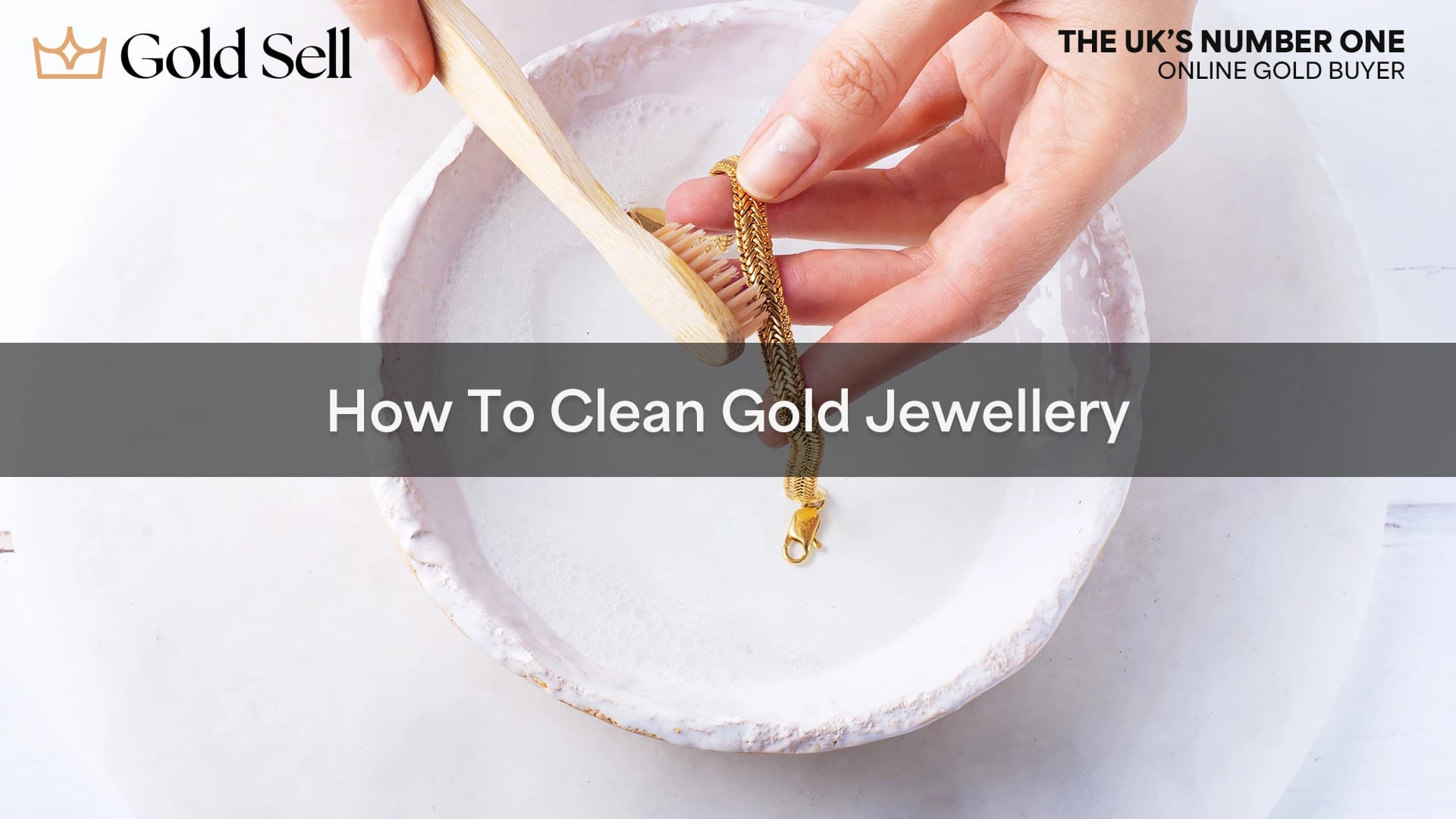
Discover easy tips on how to clean gold jewellery at home safely using simple household products. Restore shine and keep your gold jewellery sparkling!
Can 18ct Gold Tarnish?
18ct gold very rarely tarnishes. Thanks to its high gold content (75% pure gold), it’s largely resistant to the kind of oxidation that causes tarnish. In normal conditions, an 18ct gold piece will stay bright and shiny for many years with minimal care. Here’s a closer look:
- Why 18ct resists tarnish: Pure gold (24ct) doesn’t tarnish at all – it’s a noble metal and doesn’t corrode or react easily. In 18ct gold, three-quarters of the material is this non-tarnishing gold. The remaining 25% is other metals (commonly copper, silver, perhaps a bit of zinc or palladium). Because the fraction of reactive metals is relatively low, any potential tarnish is greatly reduced. There’s simply less base metal available at the surface to oxidise. As a result, 18ct gold is much more resistant to tarnishing and corrosion than 9ct gold.
- Real-world behaviour: For most wearers, 18ct gold will not show tarnish. Your 18ct yellow gold ring will likely maintain its golden shine with just routine occasional cleaning from everyday dirt. You typically won’t see that dull film or discolouration that appears on lower carats. Many antique jewellery pieces from decades ago made in 18ct still look vibrant (they may be scratched or worn, but not tarnished).
- Extreme cases: It’s not to say 18ct gold can never tarnish at all. If the 18ct alloy contains a decent amount of copper (as in some 18ct rose gold, which might be 75% gold, 22% copper, 3% silver, for example), that copper could, in theory, oxidise a bit over a very long time. This might slightly deepen the colour in some old rose gold pieces (sometimes giving a richer patina that many actually like). Also, exposure to harsh environments – like being repeatedly exposed to chlorinated water, certain acids, or perhaps contact with sulphur (e.g. in some paper or fertiliser) – could cause minor tarnish on the alloy metals. But these situations are uncommon. An example might be an 18ct ring worn every day in a swimming pool for years could develop a haze from chlorine reacting with the alloy metals (and even that is more likely to cause stress corrosion cracking than surface tarnish). Generally, you won’t see tarnish on 18ct gold under normal wearing conditions.
- White gold note: 18ct white gold is often rhodium-plated. The rhodium (a platinum-group metal) definitely doesn’t tarnish. When that plating wears off after a couple years, the 18ct white gold underneath might have a slightly warm off-white colour. That’s not really tarnish, just the natural alloy colour. 18ct white gold’s alloy metals (often palladium and silver) are pretty tarnish-resistant too, so even without plating it stays fairly white (palladium doesn’t tarnish).
- Care: Even though tarnish is a non-issue, 18ct gold still benefits from care. It can accumulate grime or soap which dulls appearance (that’s not tarnish, just dirt). So cleaning your 18ct jewellery will keep it shiny. But you don’t have to worry about tarnish removers or frequent polishing like with silver. A quick wipe with a soft cloth occasionally is enough. For 18ct that’s been stored a long time and looks a tad dull, it’s usually just fine particles or slight surface oxidation of the minor metals – a polish will restore it fully.
In essence, 18ct gold’s tarnishing is extremely rare and minimal. It’s one of the reasons people love higher-karat gold: it stays beautiful with little maintenance. Jewellers often say 18ct “will not tarnish or corrode” in any noticeable way. So you can generally expect your 18ct pieces to remain as yellow and shiny as the day you got them, aside from normal scratches. If you do ever see a hint of discolouration on 18ct gold, it’s likely due to an unusual exposure; a gentle polish will take it right off. Most owners will never observe tarnish on their 18ct gold in their lifetime.
Is 9ct Gold Worth Buying?
Yes, 9ct gold is definitely worth buying in many cases – it offers real gold at a more accessible price and is quite durable for daily wear. However, whether it’s the best value for you depends on what you want from your gold jewellery. Let’s break down the considerations:
Affordability & Value: 9ct gold’s biggest benefit is its low cost relative to higher carats. You’re still getting a piece made largely of gold (over one-third pure gold), but because it’s diluted with other metals, the price is much lower. For anyone on a budget, this makes gold jewellery achievable. You can buy a nice 9ct gold chain, ring, or bracelet without breaking the bank. In terms of pure metal value, you might argue 9ct is “less value” since it has less gold. For example, if you’re investing in gold as a commodity, 18ct has more gold content per gram. But for wearing and enjoying jewellery, 9ct can be a smart buy – you get the look and feel of gold for significantly less money. If a certain design would cost £1000 in 18ct, it might only be £500 in 9ct, allowing you to own pieces you otherwise couldn’t. Many classic jewellery items (signet rings, charm bracelets, etc.) are traditionally done in 9ct in the UK for this reason.
Durability for Price: 9ct gold is hardy and long-lasting if cared for. It’s absolutely “real gold” – not gold-plated or gold-filled – so it won’t wear away like plated jewellery. A solid 9ct gold ring can last generations (we all know someone with grandma’s 9ct wedding band still intact). It might not be as lustrous or heavy as 18ct, but it’s still precious metal throughout. Given that it’s more resistant to scratches, some consider 9ct better for everyday wear items (like a chain you never take off, or earrings you leave in). If you’re rough on jewellery, you could get a 9ct piece and worry less about daily dings. So in terms of value for money, 9ct often wins for an everyday piece you want to use without too much fear.
Resale and Investment: If you’re thinking in terms of investment or resale, 9ct is worth less per gram. For example, the resale value (scrap value) of a 9ct ring will be roughly half that of an identical-weight 18ct ring. So, if you plan to sell jewellery in the future or you want a piece that holds more intrinsic value, 18ct might be a better choice. 9ct jewellery, when resold, is valued mostly by weight for its gold content (unless it has collectible value). That said, 9ct tends to have lower markups in retail too, so proportionally you’re not losing – you paid less to begin with. It’s just something to note: 9ct is more of a consumer good (you buy it to wear and enjoy), whereas 18ct can be both jewellery and a bit of an investment in gold.
Use Case – When 9ct shines: 9ct gold is worth buying for everyday jewellery, for gifts on a budget, for pieces that might get lost or worn heavily, or for trendy items you might not wear forever. It’s also a good choice for children’s jewellery or first pieces of gold – you get durability and lower cost. Many couples opt for 9ct wedding bands especially if they’re early in their careers and want to save money; the rings still symbolize the same commitment, just at a friendlier price. If you’re the type who likes to switch jewellery often or have multiple rings/necklaces to match outfits, 9ct lets you have a collection of pieces for the price of maybe one or two in 18ct.
Comparing with 18ct (Best Value?): The question of “best value” can be argued either way. Per gram of pure gold, 18ct gives you more gold for what you pay. 18ct retains value and can be considered “worth more” especially long-term or if gold prices rise (since a larger fraction of the piece is gold). From a legacy standpoint, 18ct might be “worth it” because future generations get a higher-purity piece. However, from a usage and cost perspective, 9ct can be a better value because you’re not over-spending on purity you might not need for a casual piece, and you’re getting the physical item you want at a price you’re comfortable with.
For many shoppers, 9ct offers the sweet spot of longevity and price. You’re buying something that’s genuine gold (not costume jewellery), and you can own more of it or larger designs compared to higher carats. That in itself is “worth it” if it brings you joy and utility.
In conclusion, 9ct gold is worth buying if you want real gold jewellery without the premium cost. It’s especially worthwhile for everyday-wear items or when budget is a primary concern. If you’re after pure luxury, long-term investment, or have very specific needs (like an allergy avoidance or a piece to cherish and perhaps resell later), then splurging on 18ct might be worth it instead. But there is no shame in 9ct gold – it’s been a popular and practical choice for over a century. It gives you that warm gold shine and durability at great value. So yes, 9ct gold is worth buying, as long as you set your expectations: you’re getting a beautiful, durable piece of gold jewellery, even if it’s not the highest purity available.
(And remember, if down the line you ever want to upgrade to 18ct, you could even sell or trade in your 9ct pieces – they will always have some gold value. In the meantime, you get to enjoy wearing them.)
Does 9ct Gold Change Colour?
Solid 9ct gold does not fundamentally change colour – the gold in it remains gold-coloured forever. However, the appearance of a 9ct gold piece can dull or slightly alter over time due to tarnish or wear on the alloy metals, which might be interpreted as a colour change. Let’s clarify what happens:
- Gold vs Alloy Metals: The pure gold (37.5% of the alloy) is a bright yellow metal that doesn’t change colour; it’s chemically stable. But the other 62.5% of 9ct gold is made up of metals like copper, silver, zinc, etc., which can undergo slight chemical changes (oxidation/tarnish) or wear. These changes can affect the overall look of the gold piece.
- Tarnish/Oxidation: As discussed, 9ct gold can tarnish. Tarnish is basically a thin layer of corrosion on the surface of the non-gold metals in the alloy. This often appears as a slight darkening or loss of brightness. For example, if copper in the alloy oxidises, it can impart a faint reddish or brownish tint on the surface. So a 9ct gold ring that was once bright yellow might look a little more reddish-yellow or a bit dull brown in crevices after years if not cleaned – that can be perceived as a colour change. It’s important to note this is just surface-level and can be polished off, restoring the original hue.
- Wear of Plating: Sometimes 9ct gold jewellery, especially white gold, is plated with rhodium (for white gold) or even with a thin layer of higher carat gold for colour uniformity. If that’s the case (more common with white gold), when the plating wears off, the underlying 9ct might have a different colour (e.g., slightly yellowish). That could seem like a colour change to the owner. For instance, 9ct white gold often has a pale yellow-grey tone naturally; when rhodium plating (which is bright white) wears away, the piece might start looking more yellow – effectively a colour change from white back to a champagne tone.
- Rose vs Yellow shift: In some 9ct rose gold jewellery, the colour can deepen over time as the surface copper oxidises – some people find their rose gold becomes more “rosy”. Conversely, frequent polishing of rose gold can lighten its colour slightly (because you’re removing oxidised copper each time). These are subtle shifts, though.
- Environmental factors: Contact with chemicals can temporarily change the surface colour. For example, chlorine can create a darker discolouration on 9ct gold (a somewhat brownish film). Certain makeup, perfumes, or acidic skin chemistry can also make the metal look darker or greener (if copper reacts to produce copper chloride, that’s greenish). Again, these are surface reactions, not the gold itself changing colour.
- Does it turn green or red? No, 9ct gold doesn’t drastically change colour on its own. If you see green on a 9ct gold piece, it’s likely verdigris (copper salts) building up in areas (common on old chains or around clasps) due to exposure to moisture or acids. If you see red, it could be copper oxide or just wearing of yellow surface making copper more visible. But the core colour of the metal (a mix of yellow from gold and reddish from copper) stays the same.
- Maintenance of Colour: To keep 9ct gold the same colour as when you bought it, regular gentle cleaning is key. Polishing removes any oxidised layer and reveals the true gold colour beneath. So even if your 9ct piece looks a bit brownish or dull now, a quick polish will likely bring back the original bright gold colour (thus “undoing” any apparent colour change). Also, storing jewellery properly and avoiding harsh environments will prevent unusual colour shifts.
In summary, the gold content in 9ct doesn’t fade or change hue, but the alloy metals can cause the jewellery to appear a different shade over time if they tarnish. This is usually reversible. Unlike fake gold or heavily plated pieces, which might change colour when plating wears off (e.g., reveal a different metal underneath), a solid 9ct gold item is the same metal throughout – so you won’t suddenly see a completely different colour base metal. It will remain gold-toned; at most it might get a bit darker or less vibrant until cleaned. So, don’t worry that your 9ct gold will “turn” colour drastically – any changes are typically superficial and can be managed with proper care.
Can You Shower With 9ct Gold?
Technically, yes, you can shower with 9ct gold jewellery on – water won’t instantly ruin it – but it’s not recommended. Regular showering with 9ct gold can lead to a dull appearance over time and possibly speed up tarnishing of the alloy metals. Here’s why you might want to take that ring or chain off before hopping in the shower:
- Water Itself: Pure water (like just H₂O) doesn’t harm gold. 9ct gold won’t rust or dissolve in water. However, most tap water isn’t 100% pure – it can contain minerals and chemicals (like chlorine, in treated water). Over time, these can affect the metals in 9ct gold. Chlorine is a particular concern: repeated exposure to chlorinated water (even the small amounts in tap water or especially in swimming pools/hot tubs) can cause a reaction with the copper and zinc in 9ct gold. This can lead to tarnish or even stress cracking in extreme cases. A daily shower likely has minimal chlorine, but it accumulates.
- Soaps and Shampoos: When you shower, you’re probably using soap, shower gel, shampoo, etc. These products often leave a residue on jewellery. A 9ct gold chain or ring can collect a film of soap scum that makes it look dull or filmy. Some soaps are slightly basic or acidic which can, over time, etch or discolour the surface of gold alloys. Also, soaps can cause temporary patina – ever notice a ring looks less shiny after doing lots of washing up? It’s the soap. Shampoo, conditioner, body wash – all can create buildup. That buildup can make 9ct gold less lustrous and might make any tarnish more likely to form under the grime.
- Hard Water: If your water is “hard” (contains minerals like calcium), that can deposit on jewellery too, making it appear cloudy or whitish over time.
- Steam and Heat: Hot showers create steam which can go into tiny crevices and cause slight oxidation as well. Not a huge issue, but it’s a factor over time.
- Safety of Jewellery: Another reason unrelated to chemistry is that wearing jewellery in the shower can be risky in terms of losing it – wet fingers shrink slightly in warmth, so rings can slip off more easily in soapy water and go down the drain. Earrings or chains could snag on a washcloth or loofah and break. So removal is generally safer for the jewellery’s physical well-being too.
- Tarnish Acceleration: The combination of water + soap + oxygen can potentially speed up tarnish on 9ct. If water gets trapped under a ring against your skin, that moist environment can encourage a bit of greenish buildup or tarnish in areas like under a ring or around a chain clasp.
Given these points, most jewellers will advise: remove 9ct gold jewellery before showering (and especially before swimming in pools or hot tubs, which have higher chlorine). It’s a simple step that keeps your gold shining longer. If you occasionally forget and shower with your gold on, it’s not the end of the world – just dry it off afterward and clean it gently. The problems arise with habitual exposure.
If you absolutely insist on wearing, say, a 9ct gold necklace all the time including in the shower, be prepared to clean it more often. Using a mild dish soap to clean your jewellery separate from you (ironic, right?) will help remove the residues from your shower. And avoid any shampoos or body washes that are labelled “moisturising” or contain sulphur compounds – those tend to stick to jewellery more.
In summary: While water and 9ct gold don’t react, the overall shower environment can diminish the beauty of your 9ct gold. The alloy metals can tarnish from chlorine and become grimy from soaps. To keep your gold gleaming, it’s wise to take it off, store it dry, and put it back on after you’re done. A little caution will save you from having to do a deep clean on your jewellery later or from potentially losing a precious item in the drain.
Frequently Asked Questions
What is the live 9ct gold price per gram?
As of 2 Nov 2026, the live 9ct gold price per gram is £35.45 based on the live gold price as of today in the UK.
What is the live 18ct gold price per gram?
As of 2 Nov 2026, the live 18ct gold price per gram is £70.90 based on the live gold price as of today in the UK.
Is 9ct or 18ct gold better?
18ct gold is better for purity, colour richness, tarnish resistance, and hypoallergenic properties, while 9ct gold is better for affordability and surface durability. 18ct suits heirloom or sentimental pieces due to its long-term resilience and gold content. 9ct, though harder, is more brittle and can tarnish faster. Choose 18ct for longevity and skin sensitivity; 9ct if you're prioritising cost or everyday toughness on a budget.
Is 9ct or 18ct white gold better?
18ct white gold is better for purity and allergy resistance, while 9ct white gold is harder and more affordable. Both are rhodium-plated to appear bright white, but 18ct may look slightly yellower when unplated due to higher gold content. 9ct can tarnish faster if the plating wears off and may contain nickel unless specified as nickel-free. Choose 18ct if skin sensitivity or luxury matters; 9ct if budget is the priority.
Can i wear 9ct and 18ct rings together?
You can wear 9ct and 18ct rings together, but it's not ideal for long-term wear. 9ct gold is harder and can slowly wear down the softer 18ct gold if they rub constantly. This is especially true for rings stacked on the same finger. If worn together occasionally or with a spacer ring, the risk is reduced. For matching bands (e.g. engagement and wedding rings), using the same carat is generally advised.
What is the difference between 9ct and 18ct gold?
The main difference between 9ct and 18ct gold is purity—9ct is 37.5% gold, while 18ct is 75% gold. This affects colour, cost, weight, durability, and tarnish resistance. 18ct has a deeper yellow hue, is more resistant to tarnish, and hypoallergenic. 9ct is lighter in colour, harder but more brittle, and prone to tarnish. 18ct costs more but holds value better; 9ct offers affordability and is better for budget-conscious buyers.
Is 9ct gold more expensive than 18ct?
No, 18ct gold is more expensive than 9ct gold because it contains double the amount of pure gold—75% compared to 37.5%. This makes 18ct gold more valuable per gram and more costly to buy new. For example, 18ct gold is roughly twice the price of 9ct gold by weight. While 9ct is more budget-friendly and suitable for larger pieces, 18ct offers higher long-term value and is considered more luxurious.
9ct white gold vs platinum
Platinum is superior in purity, hypoallergenic properties, and long-term durability, while 9ct white gold is more affordable but requires rhodium plating. Platinum is naturally white, heavier, and doesn’t need replating, making it ideal for engagement rings and everyday wear. 9ct white gold can tarnish when plating wears off and may contain nickel unless labelled otherwise. Choose platinum for premium, lifelong pieces; opt for 9ct white gold for budget-conscious jewellery with a similar appearance.
Is 9ct gold good for everyday wear?
Yes, 9ct gold is excellent for everyday wear due to its hardness and scratch resistance. It handles knocks and friction better than higher-carat gold, making it suitable for rings, chains, and bracelets worn daily. However, it's also more brittle, so settings or thin bands may be prone to cracking over time. With proper care, 9ct gold can last decades and offers a cost-effective solution for durable, practical, and stylish daily jewellery.
Will 9ct gold tarnish?
Yes, 9ct gold can tarnish over time because it contains a high percentage of base metals like copper and zinc. These metals react with air, moisture, and chemicals, causing dullness or mild discolouration. Tarnish usually appears gradually and is easily cleaned with a polishing cloth or mild jewellery cleaner. Frequent exposure to water, sweat, or chemicals can accelerate tarnishing, so regular cleaning and careful storage help maintain its shine.
Will 18ct gold tarnish?
18ct gold rarely tarnishes because it contains 75% pure gold, which is highly resistant to oxidation. The small proportion of alloy metals (typically copper or silver) may react in extreme conditions, but under normal use, 18ct gold retains its colour and shine for decades. Unlike 9ct, it requires minimal maintenance and is ideal for those wanting low-maintenance, long-lasting jewellery. For most wearers, 18ct gold remains bright with little to no tarnish.
Is 9ct gold magnetic?
No, 9ct gold is not magnetic. Pure gold and the common alloy metals used in 9ct gold—such as copper and silver—are non-magnetic. If a 9ct gold item is attracted to a magnet, it may contain iron-based components (like a clasp spring) or not be genuine solid gold. A simple magnet test can help detect fakes, but professional testing is needed for certainty. Authentic 9ct gold should show no magnetic pull.
Is 9ct gold worth buying?
Yes, 9ct gold is worth buying if you want real gold at an affordable price. It's durable, scratch-resistant, and widely available in the UK. While it has lower gold content than 18ct, it’s still genuine gold and lasts well with proper care. It’s ideal for budget-friendly everyday wear or statement pieces you don’t plan to resell. If long-term value or skin sensitivity matters, 18ct may be a better choice.
Is 18ct gold better than 9ct?
18ct gold is better than 9ct in terms of gold purity, colour richness, tarnish resistance, and suitability for sensitive skin. It contains 75% gold, making it more luxurious and valuable. However, it’s softer and more expensive. 9ct is harder and more affordable, but also more likely to tarnish and cause skin reactions in some people. Choose 18ct for prestige and purity; 9ct for practicality and price-conscious purchases.
Is 18ct gold vermeil good?
Yes, 18ct gold vermeil is a good quality alternative to solid gold. It features a thick layer of 18ct gold (at least 2.5 microns) over sterling silver, offering better durability and value than standard plating. It looks and feels like real gold, lasts longer with care, and is hypoallergenic thanks to its silver base. While not as permanent as solid gold, vermeil is ideal for affordable luxury pieces with longer-lasting wear than typical gold-plated items.
Is 9ct gold stronger than 18ct?
Yes, 9ct gold is stronger in terms of surface hardness—it’s more resistant to scratches due to its higher proportion of alloy metals. However, 18ct gold is tougher overall, being more ductile and less prone to cracking under stress. So while 9ct is harder, it can be more brittle, especially in thin sections. 18ct may dent more easily but tends to wear better over time. Strength depends on the context—hardness vs. long-term durability.
Interested in selling gold with the UK’s highest paying gold buyer? Visit our Sell Gold page to get a competitive valuation – we provide fully insured postage and fast payment.
For more insights and the latest gold price today, keep an eye on our live charts and blog updates.