Can The Gold Price Go Down?
Yes – the price of gold can absolutely go down. While gold is known as a stable store of value, it is not immune to price drops. Like any commodity or investment, gold’s price rises and falls over time due to changing market forces, economic conditions, and investor behaviours.
Key Takeaways
- Gold prices can and do fall: Despite gold’s reputation as a safe asset, its value fluctuates and has seen significant declines in the past (e.g. a steep drop in 2013).
- Multiple factors drive gold’s price: Interest rates, inflation, the US dollar’s strength, and supply-demand dynamics (investor sentiment, central bank buying, etc.) all affect whether gold prices go up or down.
- Gold is currently up: As of mid-2025, gold prices are near all-time highs after a strong rally, though small pullbacks have occurred. UK gold prices in GBP are similarly at record levels.
- Why gold is rising now: Recent surges are fueled by high safe-haven demand (due to global uncertainty, inflation, and central bank buying). Investors worldwide have flocked to gold amid economic and geopolitical worries.
- Outlook varies: Many analysts expect gold to remain elevated or climb further (some even project $4,000+ in coming years), but others warn it could retreat if conditions change. Always be prepared for volatility in the gold market.
Can The Gold Price Go Down?
Absolutely. The price of gold can go down as well as up – sometimes sharply. A permanent bull market in gold is impossible; in reality, its price “clearly rises and falls” with market conditions. History provides proof: after hitting a peak around $1,895/oz in 2011, gold tumbled to nearly $1,180 by mid-2013 – a drop of over 35%. During the 2008 financial crisis, gold first plunged about 30% in a matter of months as investors sold assets in panic, even though it later recovered strongly. Periodic corrections and downswings are normal for gold.
Gold is valued for its long-term stability, but it isn’t a one-way escalator. Short-term, it can lose value due to shifting economic tides or investor sentiment. The key is that gold’s price is determined by supply and demand in the market, just like stocks or oil. If more people are selling or if other assets become more attractive, gold’s price will fall. Understanding why gold can go down is important for anyone investing in it.
What Affects The Gold Price?
Many interconnected factors influence gold’s price, causing it to rise at times and fall at others. Here are some of the main factors that affect the gold price:
- Interest Rates and Inflation: Gold has no yield, so when interest rates are high, holding gold can be less appealing (investors prefer interest-bearing assets). For example, signals of tighter monetary policy in 2013 (reducing inflation fears) led to gold’s steepest price drop in decades. Conversely, low or negative real interest rates boost gold’s allure as an inflation hedge, since there’s little “opportunity cost” to holding gold instead of cash or bonds.
- Currency Strength (U.S. Dollar): Gold is globally traded in USD, so a strong dollar often pushes gold prices down. If the dollar surges, gold becomes more expensive for buyers using other currencies, dampening demand. For instance, a rapid 5–10% rise in the U.S. Dollar Index could “put serious pressure on gold” prices. On the flip side, a weakening dollar tends to lift gold prices – in late 2024, a dollar plunge helped fuel a gold rally.
- Safe-Haven Demand & Investor Sentiment: Gold is a traditional safe-haven asset. During times of crisis, war, or economic anxiety, investors rush to gold for security, driving prices up. But during calm or risk-on periods, investors may leave gold for higher-return assets, and its price can fall. For example, if stock markets roar back in a bull run, capital often rotates away from gold. Likewise, any easing of geopolitical tensions can remove the “fear premium” in gold’s price.
- Central Bank Buying or Selling: Central banks around the world significantly impact gold demand. In recent years, they have been massive net buyers of gold, which has underpinned prices. (Global central bank purchases hit a record 1,087 tonnes in 2024!) Such buying supports gold’s price. However, this can change – if central banks slow their purchases or sell gold (as seen in the 1990s and early 2000s), it adds supply and can push prices down. Analysts note that if inflation cools and economies stabilise, central banks may taper gold buying, removing a key pillar of support.
- Gold Supply and Mining Production: Gold mining output grows only slowly, about 1–2% per year, so supply is relatively steady. But sustained high prices can encourage more mining activity (or recycling of gold), gradually increasing supply. Over time, higher supply exerts downward pressure on prices. For instance, after years of rising prices, gold mine production expanded in the 2010s – one analyst predicts growing supply, alongside waning demand, could contribute to lower gold prices long-term. On the flip side, if production stalls or major mines shut down, reduced supply can help lift prices.
- Speculation and Market Momentum: Short-term price swings in gold are often amplified by speculative trading. Large investors, hedge funds, or algorithmic traders might pile into gold futures or ETFs when prices are rising, and exit quickly if momentum fades. These flows can overshoot prices above or below fundamental value. As Investopedia notes, speculators can create temporary imbalances that lead to rapid price changes. Sudden profit-taking (investors selling to lock in gains) can likewise spur a sharp pullback in gold, even if the long-term trend is up.
- Jewellery and Industry Demand: Unlike many financial assets, a significant portion of gold demand comes from jewellery buyers (especially in India, China, and the Middle East) and some industrial uses (electronics, dentistry, etc.). When gold prices spike too high, jewellery demand often slackens – consumers buy less at expensive levels – which can cap the price. (In mid-2013, for example, Chinese and Indian gold demand fell when prices jumped, contributing to the downturn.) Conversely, during festive seasons or when prices dip, jewellery purchases can surge and help support the market. While investor and central-bank demand set the price direction most of the time, strong or weak consumer demand can amplify trends.
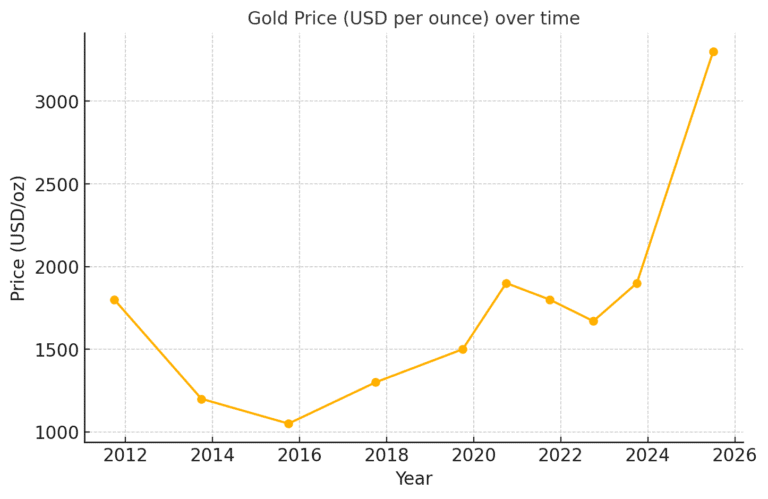
This chart shows the gold price per ounce in USD over the past decade, illustrating that it doesn’t just rise steadily – there have been significant dips. Notably, the chart shows gold falling from ~$1,800 in 2012 to $1,050 in 2015, before climbing in waves to reach new highs by 2025 ($3,300). This visualises gold’s up-and-down volatility over time.
As the chart above illustrates, gold’s price history includes periods of decline. It’s not a straight upward line; bull markets (rising phases) have been interspersed with bear markets or corrections. The good news for long-term holders is that gold has a multi-millennia track record of maintaining value, and downturns have often been followed by recoveries. However, anyone investing in gold should be prepared for short-term drops along the way. Understanding the factors above can help you anticipate why gold might go down at times – and not be caught off guard when it does.
Are Gold Prices Up Or Down?
Right now, gold prices are up – significantly. In fact, as of mid-2025, gold is trading near record highs. The trend over the past couple of years has been strongly upward. Gold rallied throughout 2024 and continued surging in 2025, gaining roughly 25–30% so far this year. In April 2025, it even notched an all-time peak, briefly touching about $3,500 per ounce.
To put this in perspective, gold is up about 29% in 2025 alone (year-to-date), on the heels of double-digit gains in 2024. Compared to a year ago, the price is roughly 40% higher, reflecting how strong the bull run has been. This jump has been fuelled by robust demand (more on the reasons in the next section).
It hasn’t been straight up every single day or week – there have been minor pullbacks. For example, after the April peak, gold saw a slight correction in May 2025 (finishing the month down ~0.7%). These kinds of small dips and consolidations are normal even in an uptrend. But importantly, any short-term dips have so far been shallow, with gold prices quickly stabilising at high levels. Even after pulling back from the peak, gold remains dramatically higher than it was last year or even at the start of 2024.
For UK readers, gold prices in pounds have similarly surged. In fact, gold in GBP hit record levels alongside the USD price. Over the past year, the price of gold in pounds jumped from around £1,700–£1,800 per ounce up to well over £2,400 per ounce in 2025. That’s also roughly a 30–40% rise year-on-year. So by any measure, gold prices are “up”, not down, in the current environment.
It’s worth noting that gold’s rise hasn’t been a steady, smooth line upward each month – volatility is part of the journey. But the overall trajectory in recent times has been upward. In summary: gold prices are up, near all-time highs, and have been on an impressive upswing, especially throughout 2024 and into 2025.
Why Is The Gold Price Increasing?
Gold’s impressive climb in 2024–2025 has been driven by a perfect storm of supportive factors. In essence, surging demand – from both investors and central banks – in the face of global uncertainties has pushed the gold price higher. Here are the key reasons behind gold’s increase:
- Safe-Haven Demand & Economic Uncertainty: We live in turbulent times. Ongoing geopolitical tensions (for example, the war in Ukraine and new trade conflicts) and concerns about the global economy (slower growth, high debt levels, risk of recessions) have made investors nervous. Many are seeking the safety of gold. Whenever there’s political or financial stress, gold tends to shine as a refuge. In the past year, demand for safe-haven assets skyrocketed amid volatility and gold hit record highs as investors sought shelter. Essentially, gold thrives when fear and uncertainty are in the air, and unfortunately there has been plenty of that lately – from inflation worries to banking system jitters – driving more people to buy gold.
- High Inflation and Fear of Currency Erosion: Inflation has been running hot in many countries (including the UK, Eurozone, and US). Although it has come off its peak, it’s still above central bank targets. Gold is widely seen as an inflation hedge – a way to preserve purchasing power when paper money is losing value. Over 2024 and 2025, persistently high inflation (and concerns it could flare up again) have bolstered gold’s appeal. Notably, real interest rates (interest rates minus inflation) turned negative for a while, which historically is very bullish for gold. With prices rising in shops and markets, both consumers and big investors have bought gold as a store of value. This inflation-hedge demand has been a major factor behind gold’s rally.
- Central Bank Buying (De-Dollarisation): Central banks around the world have been on a gold-buying spree. In an effort to diversify away from the US dollar, central banks from China, Russia, India, Turkey and many others have amassed gold reserves at record rates. In 2022 and 2023, central banks collectively bought over 1,000 tonnes of gold each year – an unprecedented pace – and 2024 saw an all-time high of ~1,086 tonnes purchased. This trend has continued into 2025, with central banks on track to buy another ~1,000 tonnes. Such enormous consistent demand from the official sector effectively floors the gold price – it creates a large, price-insensitive buyer. Behind this wave of buying is a strategic motive: concerns about the US dollar’s future. Factors like the weaponisation of the dollar in sanctions, huge US debt and deficits, and an “unpredictable” policy climate in the US have “further eroded confidence in the U.S. dollar and Treasuries” as safe assets. Gold, by contrast, is no one’s liability. So central banks are hedging their bets by holding more gold. This central bank demand has been a key driver of gold’s price increase. Curious how much gold the UK actually holds? Check out our detailed blog post on how much gold does the UK have?
- Lower Interest Rates & Dollar Weakness: As mentioned, interest rates and currencies play a big role in gold’s fortunes. In 2025, markets began to anticipate that major central banks (like the Federal Reserve and perhaps the Bank of England) might pause or cut interest rates in the near future as economies slow. These expectations have contributed to gold’s rise – when rate hikes are thought to be ending, gold becomes more attractive. Moreover, the US dollar’s value peaked in late 2024 and then slid, partially due to these shifting rate expectations and U.S. policy uncertainty. A weaker dollar directly boosts gold’s USD price (and often reflects global investors moving to gold). In April 2025, for example, a steep drop in the dollar helped propel gold upward. Gold’s strong performance in late 2024 (up ~28% that year) was aided by “lower yields and a weakening US dollar” providing a tailwind. In short, the monetary backdrop turned favourably for gold: real yields fell and the dollar softened, both of which tend to send gold higher.
- Momentum and Market Dynamics: Sometimes the fact that gold is rising feeds on itself. As gold broke into record territory, it garnered more media attention and investor interest, which in turn brought in new buyers (fear of missing out). Gold’s price momentum in early 2025 was strong – it hit 28 new record highs in the first part of the year. That kind of streak attracts trend-following traders and algorithms. We also saw sizeable inflows into gold ETFs (exchange-traded funds) as investors poured money into gold funds at the fastest pace in years. This momentum can create a virtuous cycle pushing prices further up. Analysts often say “strength begets strength” in commodity markets like gold, at least for a time. However, as gold became a standout performer, some speculative froth likely built up too – which means we should be mindful that the trend can reverse if those fast-money flows pull out. Still, so far in 2025, any time gold has dipped, eager buyers (including central banks) have stepped in, keeping the upward trend intact.
In summary, gold’s price is increasing because demand is very high (investors large and small, as well as central banks, all buying) at a time of global economic worry. Gold is fulfilling its role as a safe haven and inflation hedge. Meanwhile, factors that would normally hold it back – like high interest rates or a strong dollar – have been shifting in gold’s favour. The result: a potent rally that’s driven gold to record levels.
It’s a reminder that gold often shines brightest when confidence in other assets or currencies is shakiest. In mid-2025, we’re seeing that dynamic play out: gold is up because the world is uncertain. Until those uncertainties ease or buyers relent, gold’s price can stay elevated – though day-to-day it will still fluctuate.
What Is The Gold Price Today?
Live Gold Price Per Gram
Gold price last updated:
The LBMA (London Bullion Market Association) spot price changes daily.
The prices displayed are based on the global market rate for gold, known as the gold spot price. Like all gold buyers, GoldSell pays a percentage of this rate to account for assaying, refining, secure logistics, market volatility, and handling costs. We consistently offer among the highest payout rates in the UK, with the exact percentage increasing based on the weight and purity of the gold you sell.
As of today, the gold price is hovering near its record level. In global terms, gold is trading at £3,088.06 per troy ounce, not far from the peak of £2,500 per troy ounce that was reached in April. This price is extremely high by historical standards – in fact, it’s only slightly below the all-time high of about £2,565/oz set in late April 2025 when gold in USD terms hit its record as well (at a price of around $3,500 per troy ounce).
To put this in context, one year ago the gold price was closer to ~£1,750 per ounce in the UK. So it has jumped by hundreds of pounds per ounce within a year. Today’s gold price reflects gold’s strong performance we’ve discussed.
The gold price today is constantly changing, reflecting real-time market conditions. At GoldSell, we provide live, dynamic gold pricing updated directly from the global spot market, so you always have the most accurate information available.
You can quickly check today’s live gold price per troy ounce or per gram in various popular carats right here:
- 9ct gold price per gram: £37.23 per gram based on the live gold price today
- 18ct gold price per gram: £74.46 per gram based on the live gold price today
- 21ct gold price per gram: £86.87 per gram based on the live gold price today
- 22ct gold price per gram: £91.01 per gram based on the live gold price today
- 24ct gold price per gram: £99.28 per gram based on the live gold price today
- Gold price per troy ounce: £3,088.06 per troy ounce based on the live gold price today
The figures above are pulled directly from the LBMA (London Bullion Market Association) spot market and update every 60 seconds. This ensures that whenever you visit, you’re seeing the most current gold prices available.
Historically, gold has seen significant fluctuations. Over recent years, we’ve observed dramatic increases, particularly driven by economic uncertainty, inflation concerns, and geopolitical tensions. Although the exact daily figures may vary, the broader trend shows that gold remains near historically high levels.
Whether you’re looking to sell gold jewellery, sell gold bullion, sell gold coins, or sell scrap gold, knowing today’s live market rate helps you make informed decisions. GoldSell consistently offers among the highest payouts in the UK by using these live market prices as a baseline, giving you transparent and competitive valuations for your gold.
Keep in mind, gold prices fluctuate continually, driven by global economic conditions, market sentiment, and demand. Bookmark this page or our live gold price page to regularly check the gold price, ensuring you always have accurate and reliable information when considering selling your gold.
Gold Price Projection
What might be next for gold? Forecasting future gold prices is tricky (even experts often get it wrong), but it’s a question on every gold investor’s mind. Projections for gold’s future vary widely – some analysts believe gold will keep climbing to new highs, while others think it could pull back from its current peak. Here’s a look at prominent forecasts and expectations for the gold price in the coming years:
- Major Banks’ Outlook – Further Upside: Many big financial institutions remain bullish on gold looking ahead. For instance, Goldman Sachs recently raised its forecast, predicting gold could reach around $3,700 per ounce by the end of 2025 (up from the ~$3,300 they had forecast previously). J.P. Morgan analysts are even more optimistic – they project that gold will cross $4,000/oz by mid-2026. In their April 2025 outlook, J.P. Morgan expected prices to average about $3,675 in Q4 2025 on the way to above $4k in 2026. They noted that strong investor and central bank demand (over 700 tonnes per quarter) underpins their bullish case. Similarly, other banks like Bank of America and UBS have issued upbeat forecasts, seeing potential for gold to tack on another 5–15% over the next year or two. The general rationale: with economic uncertainty, possible interest rate cuts, and continued central-bank buying, the conditions for gold could remain favourable.
- Industry Analysts – New Records in 2025: Specialist precious metals research firms also largely foresee high gold prices ahead (though perhaps not as extreme as the banks’ “blue sky” scenarios). Metals Focus, a leading consulting firm, forecasts that the annual average gold price in 2025 will jump 35% to a record high ($3,210/oz). That implies gold staying at very elevated levels through the year (for context, the average in 2024 was much lower, around $2,380). The London Bullion Market Association’s 2025 analysts survey (a poll of industry experts) predicted an average price of about $2,736/oz for 2025, which would be ~15% above 2024’s average. Notably, gold’s rapid surge has already exceeded that level – mid-2025 prices are higher than $2,736 – suggesting those surveyed may have been too conservative. Many analysts have had to revise their forecasts upward as gold continually beat expectations. Overall, the consensus in early 2025 was that gold would trend higher, and so far that’s proven true.
- Factors Behind the Forecasts: The bullish projections rest on several assumptions: that global interest rates will stop rising (perhaps even fall), keeping real yields low; that recession or stagflation risks will spur haven demand; that central banks will continue buying (diversifying reserves); and that there’s potential for further U.S. dollar weakness or financial market volatility. If those hold, gold could indeed see “another glittering year” in 2025 and beyond, as one commentator put it. Some even point to a scenario where if, say, a severe banking crisis or geopolitical event occurs, gold could spike dramatically (numbers like $4,500/oz have been floated in high-stress scenarios). It’s important to remember such lofty targets often assume worst-case catalysts.
- Contrarian Views – Possibility of a Pullback: Not everyone agrees that gold will simply keep climbing. A few analysts are cautiously contrarian, arguing that current high prices might not be sustainable long-term. For example, Morningstar’s commodities strategist, Jon Mills, predicts gold could retreat in coming years as the market normalises. He points out that today’s high prices have encouraged increased mining supply and a flurry of activity (mergers, new gold funds, etc.) reminiscent of market tops. Mills forecasts that gold might ultimately slide to around $1,820/oz over the next five years – which would be a ~38% plunge from current levels, essentially erasing the recent run-up. His reasoning: as inflation comes under control and interest rates eventually settle, and as mining output grows, both investment and central-bank demand for gold could ease off (they “will ebb” over time). In his view, the gold market is cyclical and what goes up fast can come down if conditions shift. While this is a minority view, it’s a reminder that risks exist. If, for example, geopolitical tensions resolved and economies strengthened, gold could lose some of its shine, at least temporarily.
- Bottom Line – Caution on Forecasts: It’s wise to take any gold price forecast with a pinch of salt. Even the experts acknowledge how hard it is to predict. Gold’s future will depend on how reality unfolds relative to the assumptions. Will inflation stay high or fall quickly? Will central banks keep buying at record pace? Will interest rates in 2025–2026 be cut due to recession (boosting gold) or remain higher for longer (headwind for gold)? These unknowns explain the wide range of targets. As of mid-2025, momentum is on gold’s side and many fundamentals (central bank buying, etc.) look supportive, so the bias among analysts is upward. But markets have a way of surprising us. If you’re planning for the future, consider scenarios: gold could be $4,000 in a couple years or it might consolidate or pull back to the $2,000 level. Having a balanced perspective (and not overextending at one extreme or the other) is prudent.
In summary, most projections see gold staying elevated in the near term, with a good chance of setting new highs, barring any major changes in the economic backdrop. There’s even talk of $3,500–$4,000 gold on the horizon from reputable sources. However, a few contrarians warn that current highs could represent a cyclical peak, with gold possibly cooling off in the longer run. As always, reality will be the final judge – and it will be interesting to watch where gold goes from here.
How Is The Gold Price Determined?
Gold’s price is not set by any one government or individual – it’s determined by the global market through the forces of supply and demand. However, there are specific mechanisms and benchmarks that the market uses to find a uniform price. Here’s how it works:
- 1. Continuous Trading: Gold trades virtually 24 hours a day across various exchanges and markets worldwide. In London and Zurich, there is a huge over-the-counter (OTC) market where banks, bullion dealers, and refineries trade gold directly. In New York, gold futures contracts trade on the COMEX exchange. In Shanghai, there’s the Shanghai Gold Exchange, and so on. All these venues contribute to price discovery – buyers and sellers transact based on current market conditions, and the price moves up or down accordingly. Essentially, if at a given moment there are more buyers (demand) than sellers, the price will rise until it reaches a level where balance is restored; if sellers outweigh buyers, the price falls. This continuous haggling is happening in real time, and prices are quoted live.
- 2. The London Bullion Market & LBMA Gold Price: London has traditionally been the centre of the gold trade. The LBMA Gold Price (formerly known as the London Gold Fix) is the key daily benchmark price for gold. It is set via an electronic auction twice each business day – at 10:30 AM and 3:00 PM London time – by a group of major banks and traders authorised by the London Bullion Market Association (LBMA). In this auction, participants submit buy or sell orders in a series of rounds until a price is found where the total ounces demanded and supplied are matched. That equilibrium price becomes the official fixing. The LBMA Gold Price is quoted in US dollars per troy ounce (though it is also published in other currencies like British Pounds, euros, yen, etc., for reference). Yes, it’s still in USD even in London – reflecting gold’s status as a globally traded commodity. The afternoon LBMA price (3 PM) is often used as the daily reference for pricing jewellery, settling contracts, valuing portfolios, etc. It’s important to note this price is a snapshot – the market can and does trade at different levels before and after the fix, but the LBMA fix provides a standardised benchmark widely used in the industry.
- 3. Role of Currency Exchange Rates: In the UK, you’ll hear gold price quoted in GBP (pounds per ounce) as well. How is that derived? Simply by taking the international USD price and converting it by the GBP/USD exchange rate. For example, if the gold price is $3,300/oz and the pound is worth $1.30, then the price in GBP is $3,300 ÷ 1.30 ≈ £2,538/oz. So the local currency price depends on both the global gold price and the currency value. That’s why sometimes UK gold prices hit a record in pounds even if the USD price hasn’t changed – because the pound weakened. (We saw this after the Brexit vote in 2016: GBP fell, making gold in GBP terms shoot up even though gold in USD was relatively flat.)
- 4. No Fixed Gold Standard: Unlike many decades ago, gold’s price is not fixed by governments. It floats freely. Up until 1971, the US had a fixed gold price (and by extension so did other currencies under Bretton Woods). But today, gold trades just like any commodity. The market – millions of buyers and sellers worldwide – sets the price. There is no cap or floor imposed; it can theoretically go as high or low as the market takes it. In practice, the factors we discussed (central bank actions, mining costs, jewellery demand, etc.) create a sort of range of plausible prices, but there’s no official peg.
- 5. Transparency and Regulation: The process of determining the gold price is quite transparent nowadays. The LBMA Gold Price auction is administered by ICE Benchmark Administration, under regulations to ensure fairness (after some past concerns about manipulation). Prices are published openly. Additionally, the bulk of gold trading (London OTC) is overseen by the LBMA with adherence to global financial rules, and futures exchanges like COMEX are regulated. So while the price is market-driven, there are systems in place to prevent unfair practices and to ensure that the quoted prices truly reflect actual trades.
- 6. Retail Pricing: If you’ve tried to buy physical gold (coins or bars) from a dealer, you might notice a small premium over the “spot” market price. That’s because the quoted gold price (like the LBMA or spot price) is for large wholesale transactions. Retail products include refining, minting, and distribution costs, plus dealer margins. So the price you pay to buy a Gold Britannia coin, for example, will be a bit higher than the raw market price. Conversely, if you sell, you might get slightly below spot, as the dealer takes a commission. But those differences are usually only a few percent. The fundamental driver for all is still the underlying market price of gold. For more of an interesting and in-depth look at dealer premiums in action, our experts have compared dealer premiums in our blog post on ‘How much is a gold bar worth?‘, and covered the cheapest place to buy gold in the UK based on avoiding high dealer premiums.
In short, the gold price is determined by open market trading, with the LBMA Gold Price serving as a twice-daily anchor point for reference. It’s a fluid price that responds to sentiment and events around the clock. When big news hits – say, a central bank announcement or geopolitical shock – you’ll see gold prices react immediately in the live market. But at the next fix or trading session, those moves will be formalised into the “official” price.
For everyday observers or investors, the important thing to know is that gold’s price at any moment reflects the balance of buyers and sellers worldwide. No single entity unilaterally controls it. So when we see the price go up or down, it’s essentially the sum total of countless decisions by central banks, institutional traders, jewellery shoppers, technology manufacturers, and so on, all interacting in a dynamic marketplace.
Frequently Asked Questions
Can the gold price go down?
Yes, the gold price can go down due to factors like rising interest rates, a strong US dollar, or reduced investor demand. While gold is a long-term store of value, it remains a traded asset subject to market forces. Historical data shows periods of decline, including major drops in 2013 and 2018, proving gold isn’t immune to volatility.
Are gold prices up or down?
As of 21 Oct 2026, gold prices are currently up and trading near historically high levels. Over the past year, prices have climbed significantly in both USD and GBP due to central bank demand, global uncertainty, and inflation concerns. However, minor dips still occur in the short term.
What is the current gold price projection?
As of 21 Oct 2026, current gold price projections suggest further upside, with some analysts forecasting $3,700–$4,000/oz by 2026. However, projections vary: some expect a pullback if inflation eases or interest rates remain high. Most experts agree gold will remain strong while uncertainty persists.
What affects the gold price?
Gold prices are affected by interest rates, inflation, currency strength (especially the US dollar), central bank activity, investor sentiment, and geopolitical risk. For example, central bank buying and economic uncertainty have helped push gold prices higher in recent years.
Are gold prices going up?
Yes, gold prices have been rising steadily, driven by strong demand, global uncertainty, and central bank buying. While prices fluctuate daily, the overall trend in recent years has been upward, making gold one of the top-performing safe-haven assets.
What is the gold price today?
The gold price today in the UK is £3,088.06 per troy ounce. This live price reflects the live gold price in British Pounds and updates throughout the day based on global trading activity and currency fluctuations.
Are gold prices high?
Yes, gold prices are currently considered high compared to historical averages. In both USD and GBP, gold is trading near record levels due to sustained demand, economic instability, and inflation concerns. Prices remain elevated by long-term investor and central bank interest.
Are gold prices expected to rise?
Gold prices are expected to rise further according to many analysts, particularly if interest rates fall, the US dollar weakens, or geopolitical tensions escalate. However, projections vary, and any easing in global uncertainty could trigger a price correction.
How do gold prices work?
Gold prices work through global supply and demand. They’re influenced by interest rates, inflation, central bank actions, currency strength, and investor sentiment. Prices are quoted per troy ounce and traded continuously on major global exchanges like COMEX and the LBMA.
How is the gold price determined?
The gold price is determined by global market trading and benchmarked twice daily by the LBMA Gold Price auction. It reflects real-time demand from investors, central banks, and industries, and varies based on factors like interest rates, inflation, and currency movements.
What is the live gold price per troy ounce?
As of 21 Oct 2026, a troy ounce of gold is £3,088.06 based on the live gold price as of today in the UK.
What is the live 9ct gold price per gram?
As of 21 Oct 2026, the live 9ct gold price per gram is £37.23 based on the live gold price as of today in the UK.
What is the live 14ct gold price per gram?
As of 21 Oct 2026, the live 14ct gold price per gram is £57.92 based on the live gold price as of today in the UK.
What is the live 18ct gold price per gram?
As of 21 Oct 2026, the live 18ct gold price per gram is £74.46 based on the live gold price as of today in the UK.
What is the live 21ct gold price per gram?
As of 21 Oct 2026, the live 21ct gold price per gram is £86.87 based on the live gold price as of today in the UK.
What is the live 22ct gold price per gram?
As of 21 Oct 2026, the live 22ct gold price per gram is £91.01 based on the live gold price as of today in the UK.
What is the live 24ct gold price per gram?
As of 21 Oct 2026, the live 24ct gold price per gram is £99.28 based on the live gold price as of today in the UK.
Interested in selling gold with the UK’s highest paying gold buyer? Visit our Sell Gold page to get a competitive valuation – we provide fully insured postage and fast payment.
For more insights and the latest gold price today, keep an eye on our live charts and blog updates.