
Can You Find Gold In The UK?
Yes – the United Kingdom does contain gold, though only in modest amounts. Geologists confirm that gold-bearing quartz veins and alluvial deposits exist in several parts of Britain. Historically, small gold rushes occurred (for example in Wales and Scotland in the 19th century), and hobby prospectors continue to find flakes and nuggets today. The UK’s gold was formed in Earth’s crust by ancient geological processes. Overall, gold is rare in Britain – it’s not like California – but it is there in streams and old mines across Wales, Scotland, and parts of England.
Key Takeaways
- Location: Gold exists in several locations across the UK, primarily in Wales, Scotland, and Northern Ireland.
- Panning Sites: Popular gold panning spots include rivers in Dolgellau (Wales), Kildonan Burn (Scotland), and Mourne Mountains (Northern Ireland.)
- Legality: Amateur gold panning is legal in most UK waterways with landowner permission.
- Reporting: Any significant gold finds must be reported under the Treasure Act 1996.
- Mining: The UK has active commercial gold mines, including Cononish in Scotland.
- Reserves: While naturally occurring gold in the UK is limited, the Bank of England holds substantial gold reserves (over 300 tonnes.)
Can You Find Gold In The UK?
Yes – gold is naturally present in parts of the UK. Britain’s ancient mountains and valleys host small gold deposits that miners have exploited since Roman times. For example, North Wales (Dolgellau area) produced most historic British gold, and Scotland’s Dalradian rocks (around Loch Lomond and Sutherland) are rich in gold-bearing quartz. Geologically, these are “mesothermal” veins where mineral-rich fluids left gold in quartz fissures deep underground. Over millennia erosion has washed gold into rivers and gravels (alluvium) in regions like the Lake District and Cornwall. Modern geologists use geochemical surveys and mining records to map UK gold hotspots. See our blog post on ‘How Is Gold Formed‘ for a deeper look at gold’s origin, and note that finding gold in the UK usually means sifting tiny flakes – massive nuggets are extremely rare.
Where To Find Gold In The UK
Gold In Wales
The famous Dolgellau gold belt (Snowdonia) once yielded thousands of ounces; mines like Clogau St David’s and Gwynfynydd (Ganllwyd) were active until the late 20th century. Although commercial Welsh gold mining has mostly ceased, prospectors still pan creeks (e.g. at the Dolaucothi Roman mine) and search streambeds for flakes.
Gold In Scotland
Gold has been found across the Highlands – notably in Strath of Kildonan (Sutherland), Aberfeldy, Tyndrum (Cononish) and Helmsdale. The Kildonan Burn is so gold-rich that landowners allow limited free panning sessions each year.
The Kildonan Burn in Sutherland was the site of Scotland’s own gold rush in the 1860s when thousands of prospectors flocked to the area. Today, this remains a favored location for amateur gold hunters. The Leadhills-Wanlockhead district in southern Scotland also has a rich history of gold discovery, with the nearby Museum of Lead Mining offering guided gold panning experiences.
Gold In England
In Cumbria, trace gold occurs in copper-lead vein zones (Coniston, Calderdale), though no commercial gold mine operated. Hobbyists prospect in Lake District streams and the Northern Pennines.
While less renowned for gold than other UK regions, parts of the Lake District, particularly around Caldbeck Fells, have yielded small amounts of gold historically. Devon and Cornwall also have minor occurrences associated with other mineral deposits.
The British Museum’s natural history collection features spectacular specimens from these regions, including a 121.3-gram nugget discovered in Wales in 1843, the largest known gold nugget found in the UK to date.
Gold In Northern Ireland
Gold was recently discovered in Tyrone’s Sperrin Mountains; significant deposits (Curraghinalt, Cavanacaw) are now being developed. Even outside these areas, any UK land with quartz veins or glacial gravels could theoretically yield a bit of gold. It pays to check local geologic maps (BGS) and historical records, but all these “hot spots” are where most hobbyists start hunting today.
Can You Pan For Gold In the UK
Yes – many hobbyists pan for gold in UK rivers and streams. A basic gold pan (metal or plastic pan with riffles) and classifier sieve are the usual tools. You sluice soil from stream beds in the pan to let lighter material wash away, leaving heavier gold flakes at the bottom.
Legal Rights Behind Gold Panning In The UK
You must have the landowner’s (or estate’s) permission before panning – otherwise it’s trespassing. In practice, places like Scotland’s Suisgill Estate (Strath of Kildonan) or Mennock Water (Dumfries & Galloway) offer licensed gold panning sessions. Metal detectors can also find gold nuggets, but must follow the Portable Antiquities Scheme and treasure laws. The Portable Antiquities Scheme is a voluntary programme (run by the British Museum and National Museum Wales) that asks finders to report any archaeological objects they discover so experts can record and map them. Under the Treasure Act 1996, however, “treasure” — typically items less than 10 % precious metal or coin hoards over 300 years old — must be reported to a local coroner within 14 days; a valuation is then set and any reward is shared between the finder and the landowner.
UK Gold Panning Success Stories
Hobby panners do strike gold occasionally – for example a metal detectorist found a 64.8-gram gold nugget in Shropshire (England’s record to date) in 2023. However, most finds are tiny flakes or bits of coarse gold. If you do pan, respect the environment (no heavy dredging in protected areas) and follow the NCMD detectorists’ code.
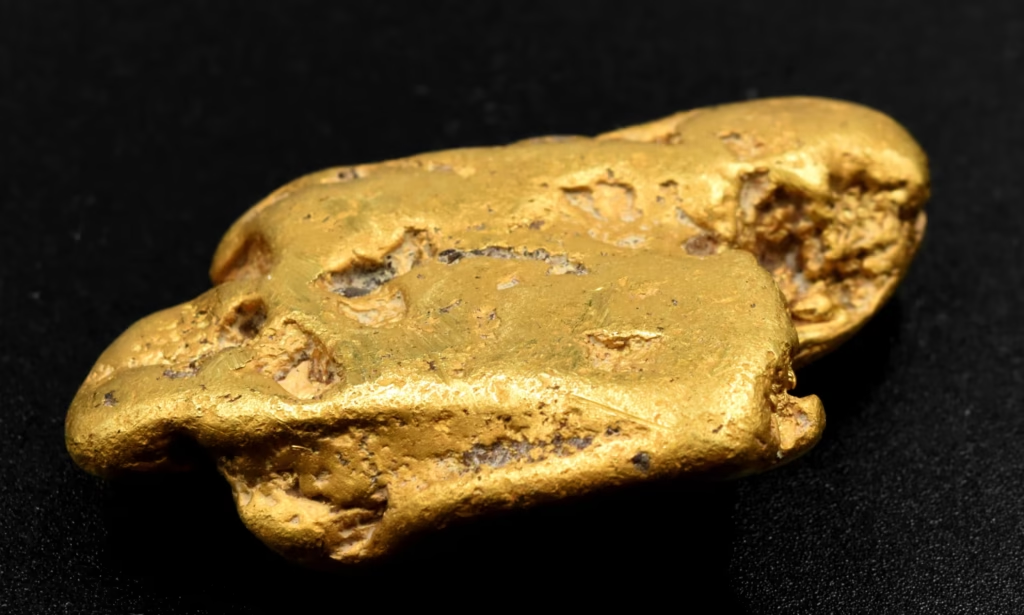
(This 64.8-gram gold nugget was discovered in Shropshire in 2023 by a metal detectorist, marking the largest gold nugget ever found in England. While most UK gold finds are small flakes, this record-breaking discovery highlights that natural gold can still be found in Britain today — albeit rarely)
What Happens If You Find Gold In the UK
If you uncover gold, especially historic artifacts, UK law treats it carefully. Under the Treasure Act 1996, any find that is at least 10% gold (or silver) and over 300 years old must be reported to the local coroner (via a Finds Liaison Officer) within 14 days. Failing to report treasure can result in an unlimited fine or up to 3 months’ imprisonment. After reporting, a coroner’s inquest will assess the item. Museums have first refusal to acquire the find at fair market value (set by the Treasure Valuation Committee). If they decline, the finder (and landowner) can keep or sell the gold legally. Both finder and landowner share any monetary reward (typically 50/50).
Even non-archaeological gold finds can be sensitive. By custom and Crown law, all gold (and silver) in the ground is considered “royal metal” – the Crown technically owns it. In practice, this means a gold nugget found on private land legally belongs to the landowner (unless expressly granted to a miner). Honest detectorists generally try to negotiate a split of any modern gold find with the owner. If you weren’t authorised to prospect on the land, you have no legal claim to the gold. For non-treasure finds of historical interest (like a Victorian coin or old jewellery), you should report them voluntarily to the Portable Antiquities Scheme or local museum for recording.
Are There Any Gold Mines In The UK?
Commercial gold mining in the UK has always been very limited. In history, the main mines were small scale. For example, North Wales’ Gwynfynydd Mine produced ~45,000 troy ounces (~1,400 kg) of Welsh gold by 1998, and Clogau St. David’s Mine (Bontddu, Gwynedd) yielded large amounts in the 1800s. Scotland had several 19th-century gold rushes (Leadhills, Helmsdale, etc.) but none remain active today.
Today, the only modern UK gold operations are tiny. Scotland’s Cononish mine (Loch Lomond area) began producing gold concentrate recently and is being restarted under new ownership. In Northern Ireland, Dalradian’s Curraghinalt project in Co. Tyrone is being developed as an underground mine with ~1.44 million ounces of gold (≈44 tonnes). Apart from these, no large-scale gold mines exist. Many historic mine sites (e.g. Devon/Cornwall old workings, Wales’ Dolaucothi and Dolgellau valleys) now serve as heritage sites or exploration targets. In short, gold can be found in old mine areas, but you won’t stumble onto a new Cornish “Mother Lode” – just a few specialised projects and rich historical mines.
How Much Gold Does The UK Have?
The UK’s official gold stock is very large: the Bank of England holds about 310 tonnes of gold bullion in its vaults (17th largest reserve globally). These bars date from the gold standard era; the UK even sold off ~415 tonnes around 2000–2002 (Gordon Brown’s “Brown’s Bottom” sale). By contrast, the total gold mined in Britain is tiny – only a few tonnes over all time. In practical terms, UK gold reserves are almost entirely imported or financial; domestic mining contributes almost nothing. The Bank of England’s holdings (worth tens of billions of pounds) far exceed any expected finds here. For a deeper understanding of UK gold reserves, see our article on how much gold the UK has.
Frequently Asked Questions
Can you find gold in the UK?
Yes – UK rocks and river gravels do contain gold, especially in Wales, Scotland and northwestern England. Historically it was mined in the Dolgellau area (Wales) and parts of Scotland, and hobbyists still pan gold in streams. However, the quantities are very small – you won’t strike it rich with a pan, but some people do find tiny flakes and nuggets.
Are there any gold mines in the UK?
Only a handful. Most historic gold mines (e.g. Gwynfynydd and Clogau in Wales) have closed. Currently, the Cononish mine in Scotland is being revived and Northern Ireland’s Curraghinalt project is under development. There are no large gold mines like those in Canada or Australia; UK operations are minor by global standards.
How much gold does the UK have?
In terms of reserves, the UK holds about 310 tonnes in official vaults. In terms of domestic production, only a few tonnes of gold have ever been mined in Britain. So the country has a lot of gold on paper (mostly owned as bullion) but only minute amounts of natural gold deposits.
Are there gold deposits in the UK?
Yes – geological surveys have identified gold deposits in the Welsh gold belt, Scottish Highlands, Lake District and elsewhere. Many are low-grade (hard to mine profitably) but detectable. For example, geologists found significant gold in Tyrone, Northern Ireland (Curraghinalt). So there are gold deposits, but most are small and far from the huge veins found in other continents.
What happens if you find gold in the UK?
If the object is less than 10 % gold and over 300 years old it counts as “Treasure.” You must report it to the local coroner within 14 days via a Finds Liaison Officer. Museums may buy it at market value, with the reward split between you and the landowner. Modern nuggets belong to the landowner unless you’ve agreed otherwise, so always secure permission first and share proceeds fairly.
Can you pan for gold in the UK?
Yes—gold panning is legal if you have the landowner’s consent (or a Crown Estate permit on tidal rivers). Scottish estates such as Suisgill and Mennock Water offer day licences, and supervised sessions run on Welsh streams near Dolgellau. Basic kit—a riffled pan, classifier and waders—is sufficient; motorised dredges are banned in most UK waters. Respect environmental rules and back-fill holes to avoid prosecution.
Where to find gold in the UK?
Popular places include Wales’s Dolgellau area, Scottish Highland streams (Kildonan Burn, Cononish area), the Lake District rivers, the Camborne area of Cornwall and the Northern Pennines. Wales’s gold-bearing rocks and Scotland’s Dalradian rocks are prime targets. In practice, check local prospecting reports or join a club. Keep in mind that success stories (like a 64.8 g nugget found in Shropshire) are rare, so even “good” spots yield only small flakes.
Are there abandoned gold mines in England?
Yes — England has several abandoned gold mines, particularly in regions like the Lake District, Northern Pennines, and Cornwall. Notable sites include the Bailey Level Gold Mine in the Forest of Dean, which was briefly active in the early 1900s before closing due to uneconomical yields. While these sites are of historical interest, many are unsafe or protected, so exploration should be approached with caution and respect for local regulations.
Interested in selling gold with the UK’s highest paying gold buyer? Visit our Sell Gold page to get a competitive valuation – we provide fully insured postage and fast payment.
For more insights and the latest gold price today, keep an eye on our live charts and blog updates.





