How Much Gold Is On Earth?
Earth holds approximately 244,000 metric tonnes of gold, with about 187,000 tonnes mined to date and roughly 57,000 tonnes still in known reserves. In this article, we’ll break down how much gold exists, what remains accessible, and how it’s distributed across people, mines, and countries.
Key Takeaways
- Total Gold on Earth: Approximately 244,000 metric tonnes of gold have been discovered on Earth so far, but most of it lies inaccessible deep in the planet’s core. Only about 187,000 tonnes have been mined historically, with the rest still underground.
- Remaining Unmined Gold: Roughly 50,000–60,000 tonnes of gold are estimated to remain in Earth’s crust as mineable reserves – beyond that, additional gold likely exists only in undiscovered or currently unreachable deposits.
- Gold per Person: If all the world’s known gold were divided evenly, each person would get only about 30 grams (roughly one troy ounce – about the weight of 6 gold rings). This highlights how scarce gold is relative to the global population (8 billion+ people).
- Largest Gold Mine: The Muruntau gold mine in Uzbekistan is the world’s largest, producing on the order of 2–3 million ounces of gold per year. Other top-producing mines like Grasberg (Indonesia) and Olimpiada (Russia) yield over 1 million ounces annually.
- Top Gold-Holding Countries: The United States holds the most official gold reserves (about 8,133 tonnes). Germany, Italy, and France follow behind. However, China is the largest gold producer today, mining ~380 tonnes in 2024, even though its official reserves are smaller than the U.S.
- Gold’s Physical Rarity: All the gold ever mined in history would fit into a cube about 20–21 meters on each side – that’s small enough to sit under the Eiffel Tower or inside an Olympic-size swimming pool. In other words, gold’s total volume is shockingly small, underscoring its extreme rarity.
How Much Gold Is On Earth?
All told, Earth contains an immense amount of gold – but nearly all of it is beyond our reach. In total, about 244,000 metric tonnes of gold have been discovered to date (including what’s been mined and known reserves). To put this in perspective, if you gathered every ounce of above-ground gold humans have ever mined (around 187,000 tonnes), it would form a cube only ~20.5 meters on each side . That’s a single cube that could fit under the Eiffel Tower – a surprisingly small volume for all the gold extracted in history.
However, the Earth actually holds far more gold than this, only it’s locked away. Scientists estimate that almost all of Earth’s gold sank into the molten core during the planet’s formation. The core is thought to contain 1.6 quadrillion tonnes of gold – enough to cover the entire surface of the planet in 1.5 feet of gold if it were somehow extracted. Of course, this gold 1,800 miles below our feet is completely inaccessible with any technology; it’s effectively unreachable, trapped at Earth’s centre. What we count as “gold on Earth” in practical terms, therefore, refers to the much smaller portion dispersed in the crust and mantle, some of which has been concentrated into deposits we can mine.
Accessible gold is that which lies in the crust and has been concentrated into minable ore deposits (often thanks to ancient geological processes, or even meteorite impacts eons ago that delivered gold closer to the surface). Humans have been progressively finding and extracting this gold for thousands of years. In modern times, we continue to add to the above-ground gold stock at a modest rate. Global gold mining output over the last decade has averaged around 3,000–3,300 tonnes per year goldsell.co.uk. For example, in 2024 alone about 3,300 tonnes of gold were mined worldwide. This annual production increases the total supply of above-ground gold by roughly 1.5% each year goldsell.co.uk – a growth rate that illustrates gold’s relative scarcity (compare that to global population or money supply growth, which is much higher). Notably, gold production hit record highs in the mid-to-late 2010s and has since plateaued, suggesting we may be nearing peak output.
It’s incredible to think that all the gold collected through history – the sum of pharaohs’ treasures, king’s ransoms, investment bars, and jewellery boxes – is so limited that it could be stored in a single large room. This reality (often visualized by that 20m cube under the Eiffel Tower) is a big part of gold’s allure: it’s rare, and no matter how technology advances, we cannot easily access much more of it beyond what’s in the crust.
How Much Gold Is Left On Earth?
Only about fifty to sixty thousand tonnes of gold are estimated to remain in Earth’s crust that is economically mineable with today’s technology**.** In other words, we’ve already mined the majority of readily accessible gold. According to the U.S. Geological Survey, roughly 57,000 tonnes of known reserves (gold that’s been identified and could be mined at a profit) were left as of recent years. At current mining rates (~3,000 tonnes per year), that implies just about 15–20 years of gold mining before known reserves might be depleted – though of course, new discoveries or technological advances could extend that timeline.
It’s important to clarify that “gold left on Earth” usually refers to gold remaining in the ground that we can potentially mine. There may well be additional gold in undiscovered deposits, or gold in known locations that is currently too low-grade or inaccessible to mine economically. As gold prices rise or mining technology improves, some of those resources might become viable to extract in the future. However, gold is a finite resource, and all signs point to the fact that the “low-hanging fruit” has largely been picked: most of the big, rich gold deposits have already been found and exploited. Miners today often have to work with ores that contain only a few grams of gold per tonne of rock.
For context, modern gold mining is an intensive process (see our guide on how gold is mined for more details). As the remaining gold gets harder to find, mining companies are drilling deeper and in more remote regions, or reprocessing old mine tailings. There’s also increasing interest in recycling gold from electronics and old jewellery as a supplementary source; recycling already accounts for a substantial portion of the annual gold supply. So, while Earth isn’t about to run out of gold tomorrow, the era of easily striking it rich with a gold nugget is largely behind us.
(Fun fact: If mining continues and those last 50,000+ tonnes are extracted, they would add only another few meters to that hypothetical gold cube. Gold’s total above-ground volume might then be a cube ~25m per side – still tiny enough to fit comfortably on a tennis court!)
How Much Gold Exists For Every Person On Earth?
Dividing all the gold in the world by the number of people alive today works out to only about 30 grams per person**.** That’s roughly the weight of a small gold necklace, or in more visual terms, about one troy ounce of gold (since one troy ounce is ~31.1 grams). In jewellery terms, it’s equivalent to maybe five or six gold rings per person, nothing more.
That calculation comes from an estimate of roughly 244,000 tonnes of total discovered gold (historic production + remaining reserves) divided by ~8 billion people. It’s a purely hypothetical average — in reality, most individuals don’t personally possess 30g of gold, because ownership of gold is very unequal. Large portions of the world’s gold are held by central banks and investors (and some people own far above the “average” share, while many others own none at all). But it’s a striking way to illustrate gold’s scarcity: there’s not a lot to go around for each person on the planet.
Where is that ~30g per person actually located? The majority of gold in circulation is tied up in certain forms. About 50% of all above-ground gold is fashioned into jewellery. (Think of all the wedding bands, necklaces, and heirloom jewellery around the world.) Another significant chunk (roughly 17–20%) is held by central banks as bullion reserves , and about the same amount is owned by private investors in the form of bars and coins. The remainder is spread among industrial uses (electronics, dentistry, etc.).
In practical terms, your personal share of the world’s gold might be sitting in your jewellery box. Perhaps you have a couple of gold rings, a chain, or some gold earrings – that might be 20 or 30 grams right there. (In fact, many people have old or broken pieces of scrap gold tucked away that they don’t even realize could be valuable.) If you have gold jewellery that you’re not wearing, remember that you’re literally holding a piece of that limited global supply – and it can always be converted back into cash given gold’s high demand. (For instance, you can easily sell gold jewellery or coins to a reputable buyer when you need liquidity.) The key point is that gold’s rarity means even a small personal stash is significant on a global scale.
This per-person figure of 30g also highlights why gold is so precious. Unlike something like iron or aluminum, which we can use by the ton per person, gold is a luxury that only ever exists in gram-level quantities for most individuals. If you physically gathered your “share” of 30 grams, it would be a nugget about the size of a large raisin. That’s all each of us would get! No wonder gold has maintained value and allure for millennia – there’s just not much of it to go around.
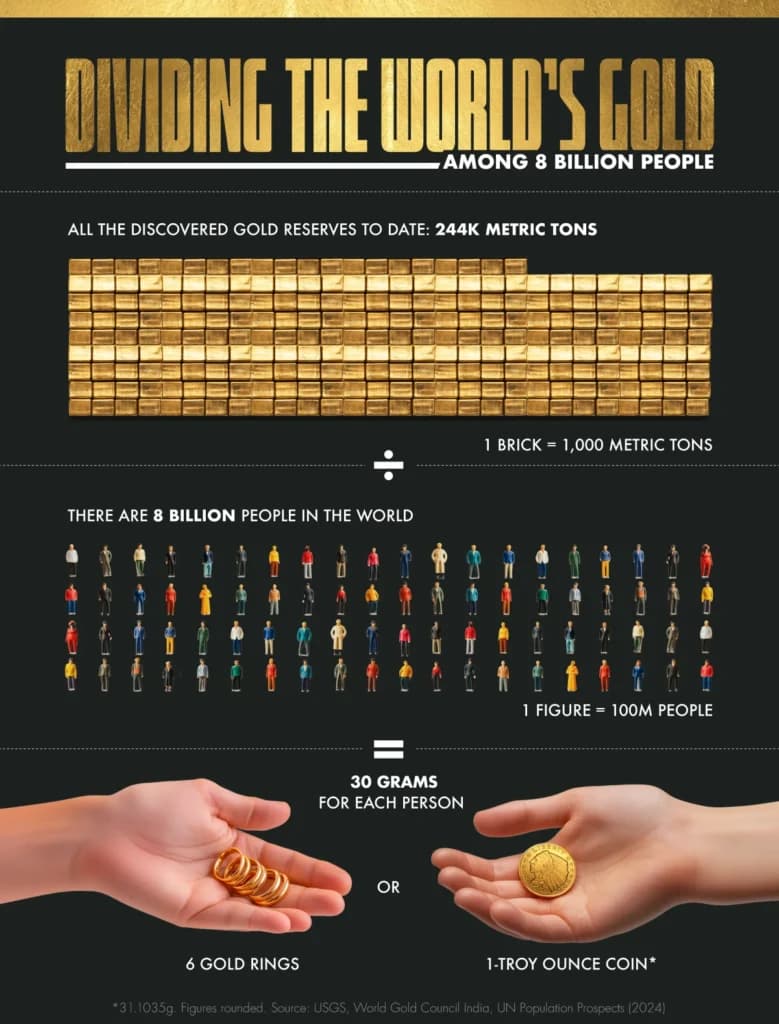
(Infographic showing how much gold is on Earth—244,000 metric tonnes represented as gold bricks—divided among 8 billion people yields 30 g per person (six rings or one troy‑ounce coin)
What Is The Largest Gold Mine In The World?
The world’s largest gold mine by production is the Muruntau Mine in Uzbekistan, an enormous open-pit operation often topping the global output lists. Muruntau produces roughly 2 to 3 million ounces of gold per year (about 60–85 tonnes), which by itself accounts for over 80% of Uzbekistan’s annual gold production. To put that in perspective, this single mine yields around 3% of all the gold mined worldwide each year – a truly massive contribution from one location.
Muruntau isn’t just notable for how much gold it produces; it’s also colossal in size. The mine is essentially a man-made canyon in the Kyzylkum Desert. The pit is currently about 3.5 kilometres wide and over 600 meters deep – so large it can be seen from space. Mining at Muruntau began in the late 1960s, and the deposit is so vast that it’s still going strong decades later. Geologists consider Muruntau one of the largest single gold deposits ever discovered on Earth.
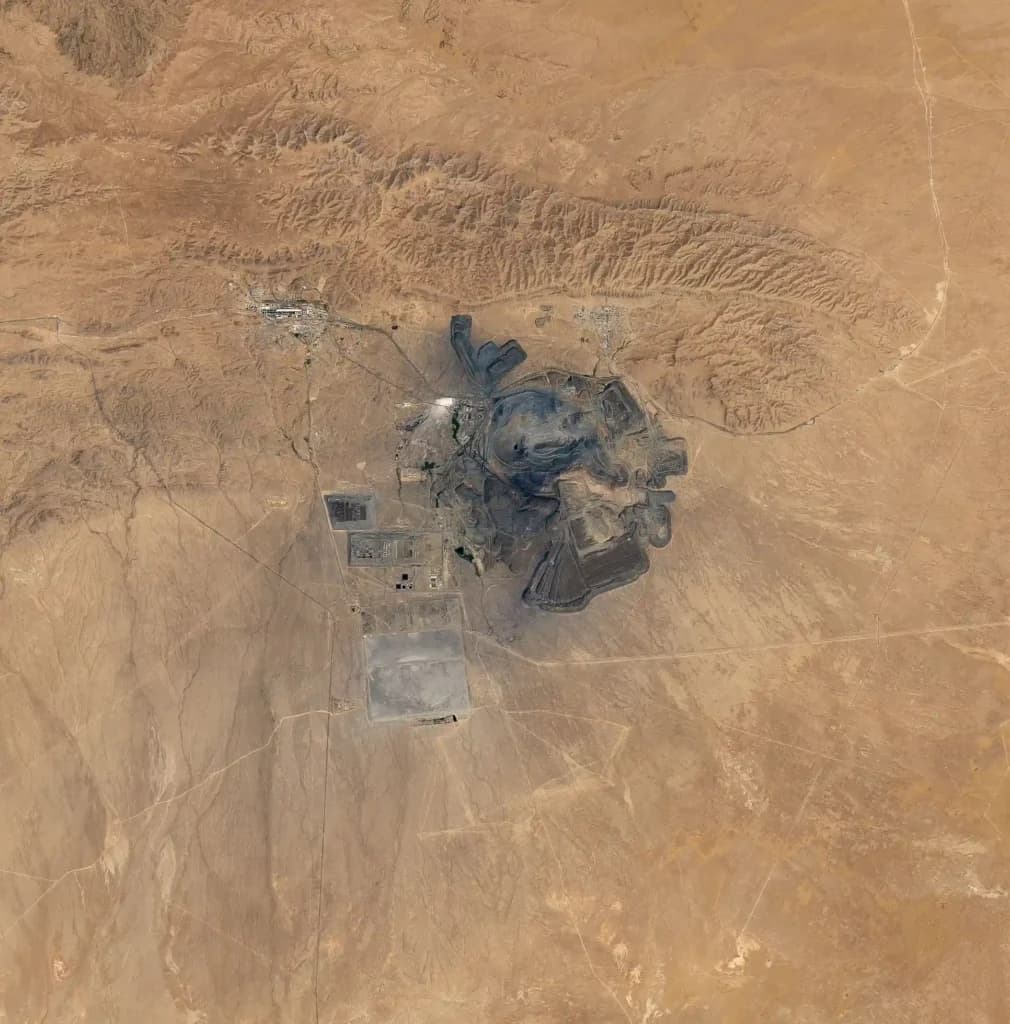
(Satellite image of the Muruntau gold mine in Uzbekistan – the world’s largest open-pit gold mine by output. The circular gray area in the centre-right is the Muruntau pit. This massive mine has been operating since 1967 and has grown to 3.3 km by 3 km across. Each year Muruntau can produce up to ~3 million ounces of gold, keeping it at the top of the global gold mine rankings. (Image credit: NASA Earth Observatory)
While Muruntau is the largest, it’s not the only giant. Other notable gold megamines include the Grasberg mine in Indonesia and the Olimpiada mine in Russia. Grasberg is famous for being rich in both gold and copper – it was the world’s second-largest gold producer for many years, with over 1 million ounces of gold produced annually (and at times much more, though its output has fluctuated as the mine transitions from open pit to underground). Olimpiada, operated by Russia’s Polyus, also produces over 1Moz (million ounces) of gold per year and boasts enormous reserves (estimated ~26 million ounces in the ground).
It’s worth noting that sometimes the “largest gold mine” can be defined in different ways. By annual production, Muruntau leads. However, if you consider an integrated mining complex, the Nevada Gold Mines joint venture in the USA (which includes famous sites like Carlin and Cortez) collectively produces even more – over 3 million ounces per year as a complex. But as a single contiguous mine, Muruntau is king. In terms of known gold reserves in the ground, South Africa’s deep mines (like Mponeng or South Deep) historically held vast amounts of gold as well, though their yearly output is lower today.
In any case, the top gold mines are marvels of engineering. They move unbelievable quantities of ore and employ thousands of workers to wrest precious ounces of gold from the earth. From the remote deserts of Uzbekistan to the high mountains of Papua (Indonesia) and the Siberian taiga, these mines show how far we go to secure the world’s limited gold supply.
Gold Reserves By Country
The country with the largest gold reserves in the world is the United States, which holds about 8,133 metric tonnes of gold in its central bank vaults. This U.S. hoard has been #1 in the world for decades and accounts for roughly a quarter of all global official (government) gold reserves. For context, 8,133 tonnes is a truly massive pile – it’s more than Germany, Italy, and France’s gold holdings combined goldsell.co.uk.
Other top nations in terms of official gold reserves include:
- Germany – around 3,350 tonnes (stored in part in Frankfurt, New York, and London vaults).
- Italy – ~2,450 tonnes.
- France – ~2,436 tonnes.
- Russia – ~2,336 tonnes (Russia increased its gold reserves significantly in the 2010s).
- China – ~2,264 tonnes (China has also been steadily buying and now has the sixth-largest stash). Following these are countries like Switzerland (~1,040 t), Japan (~846 t), India (~781 t), and the Netherlands (~612 t). (These figures are as of 2024 and can change if countries buy or sell gold.)
It’s fascinating that central banks globally hold about one-fifth of all the gold ever mined as national reserves goldsell.co.uk. Governments value gold as a strategic asset – a hedge against inflation and currency crises. For example, the U.S. famously keeps much of its gold in Fort Knox, and countries like Germany and Italy have long seen gold as a cornerstone of monetary stability. In recent years, we’ve seen central banks (especially in emerging economies) on a buying spree, adding hundreds of tonnes to their reserves as a safeguard in uncertain times goldsell.co.uk.
When asking “which country has the most gold,” we’re usually talking about these official reserves. But it’s also interesting to consider gold production – essentially, who is the largest producer of gold in the world? On that front, the leader is currently China. China has been the world’s top gold producing country for several years, mining about 380 tonnes of gold in 2024 alone. (China’s annual output peaked at ~455 tonnes in 2016, and it remains #1.) After China, the next largest producers are Russia (~310 tonnes in 2024) and Australia (~290 tonnes in 2024). Countries like the United States, Canada, and Ghana also rank high in gold mining output. It’s noteworthy that being a top producer doesn’t always mean the country keeps that gold – for instance, China and Russia do keep much of their domestically mined gold (contributing to their growing reserves), whereas a country like Canada produces a lot but has relatively small official reserves.
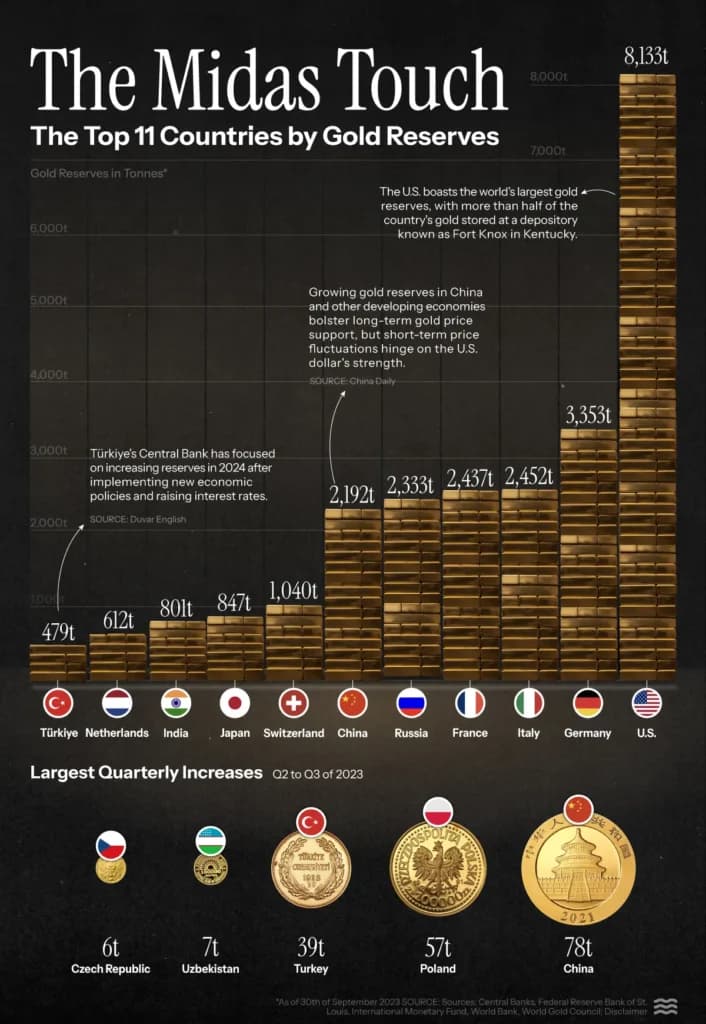
(Infographic illustrating gold reserves by country, showing stacked gold bricks for the top 11 nations)
There’s a clear distinction between gold ownership vs. gold production: The U.S. no longer mines nearly as much gold as China or Russia do today, but it accumulated a huge reserve in the past (especially mid-20th century). Meanwhile, some big producers (like Australia or Canada) export a lot of their gold, so it doesn’t end up in their central bank vaults. And some countries with large reserves barely produce any gold at all (e.g., Italy).
It’s also interesting to consider that, beyond governments, a lot of gold is held by private investors and institutions. In countries like India and China, vast amounts of gold are held by citizens in the form of jewellery and bars (Indian households collectively are said to hold over 20,000 tonnes of gold in jewellery!). In the West, many investors hold gold coins and bars as a hedge. Popular bullion coins – for example, the British Gold Sovereign or the South African Krugerrand – are widely owned and traded. Private holdings don’t show up in the “by country” reserve rankings, but they are part of the above-ground gold circulating in the economy.
For those who do hold gold privately, it’s worth remembering that it can be easily sold or traded nearly anywhere in the world. Gold’s universal value means that whether you have a government vault of it or a personal coin collection, it’s a highly liquid asset. (If you ever needed to liquidate, services exist to buy gold coins or gold bullion bars for cash, ensuring that even individual owners can tap into the value of their gold when needed.)
All the Gold in the World Visualized
When you visualize all the gold in the world, it truly emphasises how rare this metal is. As mentioned, if you took every ounce of gold humans have mined and melted it together, you’d get a cube roughly 20 meters (67 feet) per side. That’s it – a single cube that could sit in the middle of a city block. By volume, that cube is on the order of only 8,600 cubic meters. For comparison, that’s about 3.5 Olympic swimming pools worth of gold (an Olympic pool is ~2,500 m³). Imagine all of humanity’s gold gathered and dropped into just a few swimming pools – it’s mind-bogglingly small. No wonder gold often feels “rare” when you hold it; there just isn’t much to hold in the first place. Gold’s high density means that even a huge fortune in gold doesn’t take up much space – a billion dollars in gold (at current prices) could fit on a pallet. All gold ever mined would form a modest stack of bars that could be hidden in a large warehouse, underscoring gold’s rarity and high value in a compact form.
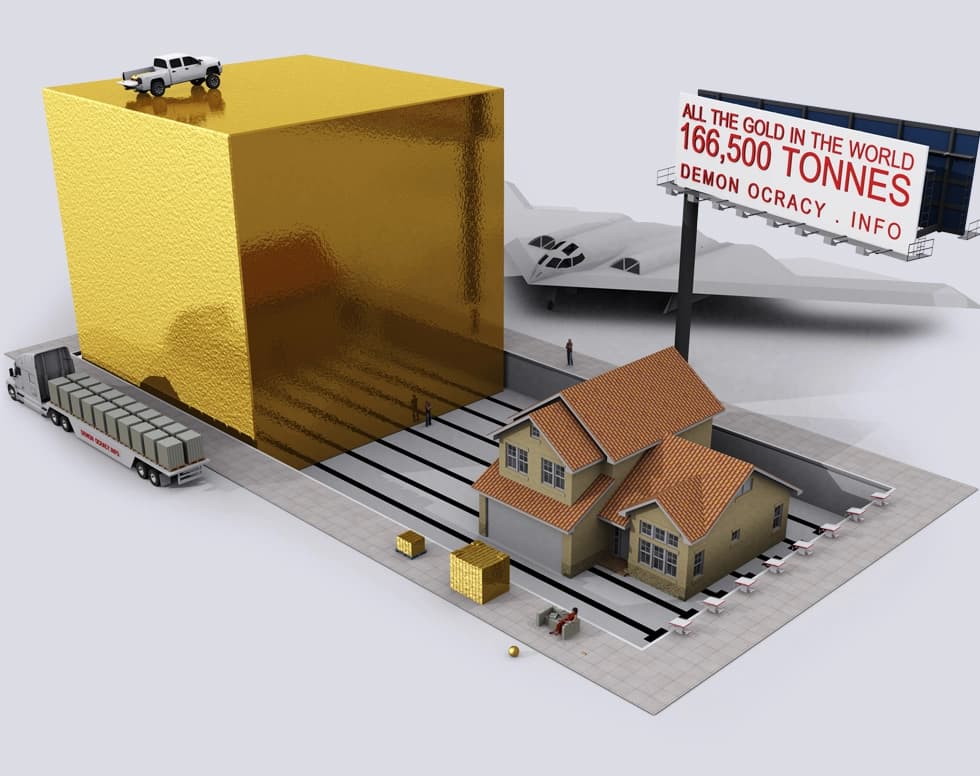
(Infographic illustrating how much gold is on Earth: a massive golden cube (≈166,500 tonnes) dwarfs a house, truck, and jet, with a billboard labelling the total weight for scale.)
Another striking way to visualize gold’s rarity is to consider ore grades and scarcity in the ground. The average grade of gold ore in the world is on the order of 1 gram of gold per tonne of rock. That means if you trucked 1 tonne (1000 kg) of typical gold-bearing ore to your backyard and crushed it, you’d likely end up with a tiny flake of gold about the size of a grain of rice (1 gram). Think about that – miners often have to move and process a literal tonne of earth just to get a gram of gold. In many large mines, they go through tons and tons of rock for one small gold coin’s worth of metal. This dilution illustrates why large-scale gold mining is so capital- and labor-intensive, and why gold stays rare. Nature doesn’t hand out gold in rich veins very often; it’s usually dispersed in minute quantities.
Over history, there have been a few rich bonanzas (like South Africa’s Witwatersrand basin, which alone has produced an estimated 50% of all gold ever mined). But even those have limits. Most of the easy gold has been collected, and what remains is ever more visually elusive – microscopic flecks in ore, or thin seams hidden deep underground.
So, all the gold in the world visualized is still a pretty small heap. It might be a big cube, or a few stacks of bars that could fill, say, a small two-story house. This is precisely what gives gold such unique value. It condenses an incredible amount of economic worth into a very small physical space. Unlike, say, piles of copper or iron, which would form mountains, gold’s total volume is modest. Yet that small gleaming cube carries immense weight (both literally and figuratively) in the global economy.
When you see those pictures of gold bars stacked in vaults, or imagine the gleam of a huge gold nugget, remember how exceptional those images are. Gold’s rarity is real – every single bar or coin is a noteworthy fraction of the planet’s entire yield of this precious metal. This visual understanding helps explain why people and governments alike are so fascinated by gold and why it has been treasured across every civilisation. In the end, there’s just not much of it to go around, and that’s exactly the point.
Frequently Asked Questions
How much gold is on Earth?
About 244,000 metric tonnes of gold exist on Earth, with roughly 187,000 tonnes already mined and about 57,000 tonnes remaining in known reserves. Most of the planet’s gold lies deep in the core and is inaccessible, so these figures represent the gold humans can actually reach in the crust and mantle.
How much gold is left on Earth?
About 50,000–60,000 tonnes of gold remain in the Earth’s crust that can be economically mined with today’s technology. At current production rates (~3,000 t/year), that supply would last around 15–20 years, though new discoveries or improved methods could extend it.
How much gold exists for every person on Earth?
Roughly 30 grams of gold exist per person, based on dividing the world’s ~244,000 tonnes of known gold by 8 billion people. That’s about one troy ounce (or six small rings) each—underscoring how scarce gold is relative to the global population.
What is the largest gold mine in the World?
The Muruntau mine in Uzbekistan is the world’s largest gold mine by annual output, producing 2–3 million ounces of gold each year. This massive open-pit operation spans over 3 km across and has been a top global producer for decades.
Which country has the most gold?
The United States holds the most official gold reserves, with about 8,133 tonnes stored in its central bank vaults (e.g., Fort Knox). Germany, Italy, and France follow with roughly 3,350 t, 2,450 t, and 2,436 t respectively.
Who is the largest producer of gold in the World?
China is the largest gold producer today, mining around 380 tonnes in 2024. It’s followed by Russia (~310 t) and Australia (~290 t), with these top producers contributing a significant share of the annual global output.
How many gold ounces in a pound?
Precious metals are weighed differently than everyday items. In the troy system, there are 12 troy ounces in a troy pound. However, the standard avoirdupois pound (the one with 16 ounces that we use for things like food) would equal about 14.58 troy ounces of gold. In simpler terms: a “pound of gold” is usually meant to be a troy pound (12 troy oz), but if you used the normal pound, that same weight would contain more than 12 troy ounces (approximately 14.58).
Interested in selling gold with the UK’s highest paying gold buyer? Visit our Sell Gold page to get a competitive valuation – we provide fully insured postage and fast payment.
For more insights and the latest gold price today, keep an eye on our live charts and blog updates.