
How Much Is Scrap Gold Worth?
Scrap gold prices move in line with the global market rate for gold, minus a small percentage that gold buyers deduct to cover costs like insurance, refining, testing, market risk, and profit. In other words, even broken or old gold jewellery can still hold significant cash value based purely on its gold content. With today’s high gold prices, scrap gold is more valuable than ever—making now an ideal time to sell.
Key Takeaways
- Scrap gold’s value: Scrap gold’s value is based on its weight and purity, and it moves in line with the live global gold market. For example, if you have 15g of 9ct gold (which is 37.5% pure), the current spot price for 9ct gold is £37.23 per gram, meaning that item could be worth up to £558.47 in gold content. However, most buyers pay slightly below the gold spot price to cover costs like refining, insurance, and testing.
- Payout rates: Gold buyers pay a percentage of the spot price (often around 80–90% for competitive buyers) to account for refining costs and profit. You won’t get 100% of the market price per gram, but by choosing a high-paying buyer like us — we refine gold in-house — you can get much closer to the spot value than at a typical high-street jeweller (who might offer only ~60–70%). Because we don’t need to pass your gold on to a third-party refiner like many other buyers do, we avoid middleman fees — and we pass that saving directly onto you through higher payouts.
- How to sell: Selling scrap gold is straightforward and safe when you use a reputable service. You can sell via insured post using our free Royal Mail Special Delivery envelopes — fully tracked and insured — or visit local jewellers or pawnshops for an on-the-spot offer. However, these high street services typically offer a lower percentage of the gold spot price when you sell gold with them. Always compare current scrap gold prices and check reviews to make sure you’re getting the best price for your gold.
- Current prices: Scrap gold is absolutely worth money – in fact, prices are at historic highs now. Gold’s price has surged in recent years, reaching record levels (around $3,500/oz in April 2025). This means your scrap gold is worth much more today than a few years ago. Even a small amount of scrap gold can fetch a considerable sum due to these high prices.
- Sustainability: After you sell, scrap gold is recycled sustainably. Gold buyers send it to refineries where it’s melted down and purified. The pure gold recovered is then cast into new bars, coins, or jewellery. This recycling helps meet demand without new mining, so by selling your scrap gold you’re not only getting paid but also contributing to a circular economy.
What Is Scrap Gold?
“Scrap gold” refers to any gold item valued only for its metal content (intrinsic gold value) rather than its form or craftsmanship. In other words, if a gold item (like an old ring, broken necklace, coin, or dental gold) isn’t worth more as a collectible or piece of jewellery, it’s treated as scrap gold. The term “scrap” might sound like the gold is worthless, but that’s a misconception – scrap gold still holds significant value because of the gold itself. Whether it’s damaged jewellery, outdated gold coins, or even gold industrial pieces, their worth is determined by the weight and purity of the gold they contain, not their aesthetic or historical value.
Importantly, all gold buyers in the UK use the term “scrap gold” for items they purchase to melt down. This doesn’t mean the gold is trash; it simply means the buyer is paying for the precious metal content only. For example, an intricately designed gold earring that’s missing its pair will likely be bought as scrap gold – the buyer will pay based on its gold weight, not the design. (If you believe a piece might have antique or designer premium value above its metal content, you’d be better off selling to a collector or at auction, since scrap gold buyers generally won’t pay extra for craftsmanship.)
In summary, scrap gold is any gold item – from broken 9ct chains to old coins – that you sell for its melt value. When you gather up old gold jewellery and sell it by the gram, you’re selling scrap gold. It’s a hugely common practice, especially given high gold prices, and a great way to turn unused gold items into cash.
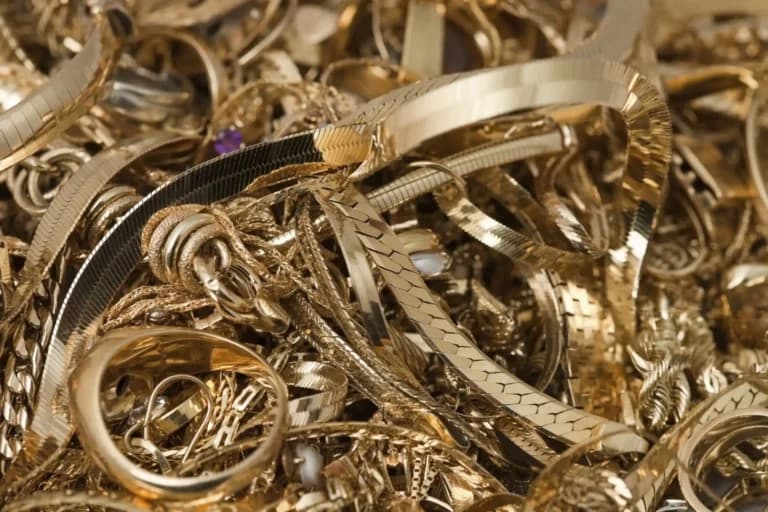
Even tangled, broken or outdated jewellery like this can hold significant value when sold as scrap gold. The worth is based on the gold content, not appearance, meaning items like these are weighed, tested for purity, and priced accordingly. With gold prices at historic highs, many are surprised just how much their old or unwanted gold is actually worth.
Scrap Gold Prices
Scrap gold prices are based on the live market price of gold (the “spot” price) multiplied by the item’s gold purity and weight – minus a small margin for the buyer’s costs. In practical terms, gold buyers will never pay 100% of the spot price, because they need to cover refining costs, overhead, and some profit. Each buyer sets their own scrap gold rates, so offers can vary.
Reputable gold buyers typically offer around 85–90% of the live gold spot price to cover essential costs like refining, testing, insurance, and overheads. In many cases, the higher the volume or value of gold you’re looking to sell, the more competitive the rate we can offer. By contrast, less competitive gold buyers — especially those who can’t refine gold themselves — often pay significantly less, sometimes only 60–70% of the spot price. That’s because they have to sell your gold on to a refiner, and those extra steps eat into your final payout. In fact, many gold buyers in the UK bring the gold they’ve purchased from customers directly to us because we consistently offer the highest rates in the UK.
Why don’t gold buyers pay 100% of the gold’s value? The difference covers a wide range of essential operating costs — including refining, testing, insured shipping, business insurances, tax, storage fees, staffing, and the margin needed to keep the business running. When a gold buyer purchases scrap gold, they typically send it to a contracted refinery to be melted and purified. Refiners charge processing fees, often based on a percentage of the gold’s value. While experienced gold buyers may have long-standing agreements with refiners to achieve rates close to spot, no one — not even trade professionals — receives 100% of the live market price once all costs are factored in. Essentially, gold buyers make their profit by taking a small slice of the gold’s value — for example, paying you 93% of spot and recovering slightly more once the gold is refined and sold, after fees.
At GoldSell, we’ve built a reputation as the UK’s highest-paying gold buyer. Our online-only business model helps us avoid the costly overheads of running physical storefronts, like rent, retail staff, and utilities, which means we can pass those savings onto our customers in the form of higher prices for gold. We also refine gold ourselves, so we avoid the third-party refining fees that many other gold buyers face. Combined, this allows us to pay more per gram than other popular gold buyers in the UK. Most other gold buyers (both online and on the high street) don’t have their own refinery – they simply buy your gold and then resell it to a smelter or a specialist (often to us!). By coming directly to GoldSell, you effectively skip those middlemen and get a higher price for every gram of gold. We even compare our rates daily to ensure they’re the best, and we offer a Best Price Guarantee to beat any genuine competitor quote.
It’s worth noting that while gold prices do fluctuate throughout the day on global markets, no gold buyer — including us — offers valuations based on live minute-by-minute changes. That’s simply because the gold market can be highly volatile, and most buyers operate on small, consistent margins. Instead, like all reputable gold buyers in the UK, we update our rates twice daily in line with the LBMA Gold Price — also known as the gold ‘fix’.
This fix happens at 10:30am and 3:00pm every weekday and is set by a group of major financial institutions in London. It provides a globally recognised benchmark for gold pricing, ensuring fairness, transparency, and consistency across the market. By aligning our rates with the LBMA fix, we can give you an accurate, stable price for your gold while protecting you (and us) from the unpredictability of real-time market swings.
You’ll always see our most up-to-date gold prices per gram for each purity — such as 9ct, 14ct, 18ct, 22ct, and 24ct — clearly displayed on our website. We also protect you from gold price fluctuations with our 7-day price lock. When you return your gold to us, we lock in that day’s gold price and base your valuation on it. Although we typically receive your items the next day, a lot can happen in the gold market overnight, especially during volatile conditions. If the price drops after you’ve posted your items, we take on that risk and honour the higher price from the day you sent them. If, on the other hand, the gold price increases, we simply base your valuation on the new, higher rate. We might not be the UK’s biggest gold buyer, but that’s exactly why we try harder to prove ourselves as the best.
Today's Live Scrap Gold Prices
The chart below shows the live gold spot price per gram for each carat — including 9ct, 18ct, 21ct, 22ct and 24ct — and provides a reliable benchmark for understanding the value of your gold. Scrap gold prices move in lock step with these market rates, but it’s important to note that no gold buyer pays 100% of the live spot price. That’s because gold buyers need to cover refining, testing, handling, insurance, and business costs.
We aim to pay the UK’s highest percentage of these values and can offer more competitive rates depending on the purity and volume of the items you send to sell. So while the spot price sets the reference point, your actual payout will reflect the percentage we, or other gold buyers will pay at the time of valuation. Our in-house refining means fewer middlemen, lower overheads, and higher payouts for you.
Live Gold Price Per Gram
Gold price last updated:
Wednesday, 21 October 2026, 12:32.
The LBMA (London Bullion Market Association) spot price changes daily.
The prices displayed are based on the global market rate for pure 24ct gold, known as the spot price. Like all gold dealers, GoldSell pays a percentage of this rate to account for assaying, refining, secure logistics, market volatility, and handling costs. We consistently offer among the highest payout rates in the UK, with the exact percentage increasing based on the weight and purity of the gold you sell.
These rates are based on the live global market rate, known as the gold spot price, and give a strong indicator of how much your scrap gold could be worth, as scrap gold prices move in tandem with the spot price.
-
9ct gold price per gram:
£37.23
-
14ct gold price per gram:
£57.92
-
18ct gold price per gram:
£74.46
-
21ct gold price per gram:
£86.87
-
22ct gold price per gram:
£91.01
-
24ct gold price per gram:
£99.28
-
Current gold price per troy ounce:
£3,088.06
Scrap Gold Calculator
Sell gold with confidence using our live scrap gold price calculator to see how much you could get for your gold.
Our pricing is updated in real time based on the LBMA live gold today and benchmarked daily against leading UK buyers. GoldSell’s Live Price Checker™ analyses competitor rates twice a day to ensure we consistently offer the highest price for gold in the UK. Simply enter your item’s weight and purity to see how much you could receive — instantly and transparently.
Fix this price by ordering your Gold Selling Pack below and turn your gold into cash today. If the gold price increases in the meantime, we will increase your valuation to reflect this.
We automatically check competitor pricing every business day to ensure we honour our positioning as the UK’s highest paying gold buyer.

How Do You Sell Gold?
Selling gold is straightforward: you bring or send your gold items to a reputable gold buyer, who will test their purity, weigh them, and offer you a price based on the current gold value. The process essentially turns your gold jewellery, coins, or scrap into cash. Here are the common ways to sell and how GoldSell makes it easy:
-
Online Postal Gold Services: This has become one of the most popular and convenient ways to sell gold in the UK. With our , you can sell your gold from the comfort of home. We’ve partnered with Royal Mail to offer Special Delivery, so when you send your items to us, they’re fully tracked and insured up to £2,500. Once we receive your parcel, our experts test your items using XRF technology — a highly accurate, non-destructive method to verify gold purity. We then make you an offer based on the weight, purity, and that day’s market price. If you accept, we send your payment within minutes by bank transfer, PayPal, or whichever payment method you selected on the form included in your pack. The entire process typically takes just a day or two — it’s fast, simple, and completely secure. Because we operate exclusively online, we avoid high street rents and middlemen, which means we can pay you more when you sell gold with us.
-
High Street Jewellers & Pawnshops: You can take gold jewellery into a local jeweller or pawn shop. They will typically do an acid test or use a small electronic tester to check karat, weigh the item, and give you an immediate offer. This can be a quick way to sell, especially for smaller amounts. However, be aware that high street buyers often can’t match the rates of online specialists. They have higher overheads and usually lower volume, so as mentioned, a jeweller might offer perhaps 60–70% of spot value. It’s still an option if you prefer face-to-face, but you might earn less.
-
Bullion Dealers (for coins/bars): If you have gold coins or bars, you can sell them to bullion dealers or coin shops. Many offer buy-back programmes and may pay close to the gold spot price for popular items such as Sovereigns, Britannias, and standard bullion bars, as these are easy to resell. However, it’s important to approach these offers with a degree of caution.
Many bullion dealers advertise high buy-back rates to reassure customers purchasing investment gold that they’ll be able to sell it back at a favourable price later. But if you’ve looked closely, you may have noticed non-committal phrases like “up to” in these offers. From our experience, and from what many of our customers have told us, these advertised rates often fall short when it actually comes time to sell. In some cases, the price offered can be significantly lower than expected, particularly if market conditions have changed or if the item wasn’t originally purchased from that dealer.
If you choose to sell to a bullion dealer, make sure they are well-established, transparent about their pricing, and clear on any minimum quantity requirements or additional testing fees. We discuss selling coins and bars in more detail in the sections below.
-
Private Sale: Sometimes people choose to sell gold privately – for example, selling gold jewellery on an online marketplace or even social media ‘classifieds’ such as Facebook Marketplace. This can occasionally fetch a higher price if the item has decorative value to the buyer. But be cautious: private sales carry risks (safety meeting up, risk of scams, no guarantee of price). For most, selling to a certified buyer is simpler and more secure.
GoldSell’s Recommendation: We naturally recommend using our online selling service for the best combination of high price and convenience. As the UK’s highest paying online gold buyer, we offer a fast and seamless service that allows you to sell gold from home with complete confidence. Our Live Price Checker™ does all the legwork for you, so you don’t need to spend time visiting local gold buyers or high street jewellers to compare offers. We use advanced, expert testing methods to ensure our valuations are accurate and reflect the true value of every gram of gold in the items you send us.
It’s a reflection of our genuine commitment to paying the best prices for your gold.
Whichever route you choose, here are some tips to get the most when selling gold:
- Know your gold’s details: Determine karat purity (hallmarks can tell you, e.g., “375” for 9ct, “750” for 18ct) and weigh your items if possible. This lets you estimate value ahead of time using a scrap gold calculator and gold prices per gram. To help you identify gold hallmarks, our experts have put together a simple overview of UK gold hallmarks and what they tell you about your gold’s purity.
- Check the market price: Gold prices fluctuate. Check the current spot price (per gram or per ounce) on our Gold Price Today page. This gives you a baseline.
- Compare offers: Don’t hesitate to get quotes from multiple buyers — any reputable gold buyer should welcome the comparison. That said, we’ve done our best to remove the legwork for you. Our proprietary Live Price Checker™ tracks competitor scrap gold prices twice a day, allowing us to adjust our rates to stay ahead. This means you don’t have to take time out of your week visiting local gold buyers or high street jewellers, many of whom won’t even offer a valuation unless you commit to selling.
- Read reviews: A trustworthy gold buyer should have strong customer feedback and, ideally, independent recognition. We’re proud to have thousands of positive reviews and a Trustpilot score that reflects the care we put into every transaction.
In summary, to sell gold you simply: (1) find a reputable buyer (online or offline), (2) get your gold assessed for purity/weight, and (3) receive payment based on the day’s live gold price. The process is now very streamlined – especially with insured postal services – making it easier than ever to convert old gold into money safely and at a great rate.
How Do You Sell Gold Coins?
To sell gold coins, you’ll want to go through a bullion dealer or a gold buying service that handles coins, as they can offer you close to the coin’s gold value (and sometimes a premium if the coin is collectible). The good news is that gold coins – like Sovereigns, Krugerrands, Britannias, Maple Leafs, etc. – are generally very liquid and sought after. Here’s how to sell them:
- Identify your coins and their gold content: Know what coin you have. For example, a British Sovereign is about 7.32g of 22ct gold, a Krugerrand is 1 troy ounce of 22ct gold, a Gold Britannia (post-2013) is 1 troy ounce of 24ct gold, etc. The value of common bullion coins is mostly in their gold content (e.g., a Krugerrand’s value is essentially one ounce of gold). Some coins might have a small collector’s premium if they are rare or numismatic, but for most standard coins, expect to get paid for the gold weight.
- Choose where to sell: Many bullion dealers, both online and on the high street, advertise that they buy gold coins. However, it’s worth being cautious when it comes to their buy-back promises. While they often promote high rates, we’ve heard from many customers who struggled to sell coins back at those advertised prices, facing delays, vague excuses, or even outright refusals — especially if the market has moved unfavourably since the original purchase. We take a different approach. We’re always ready to buy gold coins, and we pay based on their gold content as close to the live market price as possible. Whether it’s a Sovereign, Britannia or Krugerrand, we’ll give you a fair, accurate valuation without the runaround.
- Process of selling a coin: If you sell to us online, the process is very similar to selling gold jewellery. You send your coin to us securely and fully insured using our Royal Mail Special Delivery service. Once we receive it, we verify the coin by checking its weight, dimensions, and, where needed, using XRF scanning to confirm authenticity and purity. The advantage with well-known bullion coins is that their purity and weight are standard, which makes valuation straightforward. We’ll then offer you a price based on the current gold price. For coins like Britannias or Sovereigns, we typically pay very close to the full value of the gold content, as these are easy for us to refine or resell with minimal handling. If a coin has collectible value beyond its gold content — for example, a rare or older coin — we’ll factor that in, or advise you if another route might be better for maximising its value.
- What if the coin is rare or proof? If you suspect your gold coin is a numismatic collector’s item (for example, a rare historical coin, or a proof coin in pristine condition with box/papers), do a bit of research. In some cases, such coins can be worth more than their gold content. A bullion buyer will usually only pay for the gold content, so for a true collectible coin, you might consider an auction or a specialty coin dealer for the best price. However, for 90% of gold coins out there (especially modern bullion coins), the “melt value” is the main value, and that’s what gold buyers will pay.
We buy gold coins of all types — from Sovereigns and Krugerrands to Chinese Pandas, American Eagles, Canadian Maple Leafs, and everything in between. We’ve made the process simple and straightforward for anyone looking to sell. Many of our customers come to us after discovering that the bullion dealer they originally bought from either wouldn’t honour their advertised buy-back rates or refused to buy the coins back at all. That’s never the case with us. If you have a gold coin, we’ll buy it, and because we refine gold ourselves, we can offer you the best possible price for it.
When sending coins, our free Gold Selling Pack contains everything you need, including simple instructions and a protective padded envelope. If you’re sending more than one coin, we may advise separating them within the pack. While scratches and scuffs don’t usually affect the valuation of bullion coins, we understand that in the rare case you’d want your coin returned, it’s never nice to send a pristine item and receive it back marked. If your coin is a proof or special issue, feel free to include any original documentation, though this isn’t necessary for most bullion coins. Once your items arrive, we’ll confirm receipt and provide a valuation within a few hours.
In summary, selling gold coins involves finding a reputable buyer, confirming the coin’s details, and getting paid for its gold content at a competitive rate. Bullion coins are one of the easiest forms of gold to sell because their value is transparent and well-known. With current high gold prices, gold coins can fetch excellent prices, often hundreds or even over a thousand pounds per coin depending on size – making now a great time to sell gold coins if you wish.
How Do You Sell Gold Jewellery?
You sell gold jewellery much the same way as other scrap gold – by taking it to a gold buyer or jeweller who will pay for its intrinsic gold content, not the design. To do this, the piece’s purity (karat) and weight are assessed, and you receive an offer accordingly. Let’s break down some specifics and tips for selling gold jewellery:
- Understand your jewellery’s purity: Gold jewellery in the UK is typically 9ct, 14ct, 18ct, 22ct, or 24ct. Check for a hallmark stamp (for example, 9ct might be stamped “375”, 18ct “750”, etc.). The carat tells you what percentage gold the item is. 24ct is pure gold, 22ct is 91.6%, 18ct is 75%, 14ct ~58.5%, 9ct is 37.5%. This matters because when selling, a 9ct gold ring will be worth roughly half (or less) of what a same-weight 18ct ring is worth, due to gold content.
- Condition and gemstones: Most gold buyers who purchase jewellery for scrap don’t pay for stones or craftsmanship, but we take a more considered approach. If your jewellery contains gemstones, we’ll factor in any that are large or valuable enough to carry market value — such as diamonds over 0.25ct — and include them in our valuation based on current market rates. For smaller or less valuable stones, we always offer to safely dismantle and return them free of charge when you sell gold jewellery with us. Alternatively, if you’d prefer, we can responsibly recycle them as part of our refining process. If your item is an antique or a designer piece and you believe it may be worth more than its gold content, a private sale or auction might be the better route. But for broken chains, odd earrings, or outdated styles, selling as scrap gold with us is a fast, simple, and rewarding option.
- Where to sell jewellery: High-street gold buyers, like pawn shops, cash-for-gold kiosks, and local jewellers, will often buy jewellery on the spot. While that offers immediacy and face-to-face service, these outlets usually have higher overheads, which means lower payout rates. We operate entirely online, which allows us to offer consistently high prices across the UK — whether you’re in London, Bristol, or a small village, you’re not limited to the rates of the nearest shop. Online competition has driven payouts up significantly in recent years, and we’ve embraced that by offering strong rates backed by our Best Price Guarantee, so you can feel confident you’re getting the most for your gold without the hassle of going from shop to shop.
- The GoldSell difference for jewellery: We specialise in buying gold jewellery of all kinds, and the condition of your items doesn’t matter to us. Whether it’s a twisted chain, a dull ring, or a broken clasp — it’s all gold, and we value it for its precious metal content. Because we melt everything down ourselves, we don’t need your jewellery to look perfect. Many high-street gold buyers actually sell the gold they purchase to larger refiners — often to us — because we pay more for bulk gold. That makes them middlemen. When you sell directly to us, you skip that step and keep more of the value for yourself. In fact, it’s not uncommon for customers to tell us our offer was nearly double what they were quoted by a pawn shop, especially for lower-carat or mixed lots. We put that down to our in-house refining and streamlined operation. We also buy dental gold, gold watches, and gold bullion — if it’s gold, we’ll buy it, no matter the condition or age.
- Safety and convenience: When sending precious jewellery through our postal service, use the Special Delivery envelope provided in your , which is insured and trackable. It’s very safe – Royal Mail Special Delivery is very reliable for valuables. In fact, it’s the method used by banks and businesses to send cash and gold. We completely understand that sending sentimental jewellery through the post can feel a little daunting. But rest assured, your items are fully insured, and in our experience, we’ve been fortunate to have never experienced a loss. Royal Mail’s Special Delivery service is highly reliable, it’s a more bespoke service that guarantees delivery by 1pm the next working day and is continuously tracked throughout its journey until it arrives safely with us. If you’re still unsure, you’re welcome to start with a small trial, send us one item first, see how the process works, and experience our great prices and fast payment firsthand before sending the rest.
In summary, selling gold jewellery involves converting it to its raw gold value. You won’t typically get paid for design or sentimental value, but with today’s high gold prices, even scrap gold jewellery can be worth a lot. For example, a simple 9ct gold chain that you bought years ago and never wear might fetch a tidy sum now due to gold’s price surge. GoldSell allows you to sell your jewellery easily, securely, and for the best price in the UK, which is why thousands of people use us to declutter their jewellery boxes and get cash in the bank.
Where To Sell Gold Bars
The best place to sell gold bars is through a specialist gold bullion buyer or refinery who can pay close to the full market value, as gold bars are pure, high-value assets. Gold bars (whether small 5g or 10g bars, or larger 100g, 1kg, or even 400oz Good Delivery bars) are a bit different from scrap jewellery: they are usually 24ct pure gold and come with certificates or hallmarks from recognised mints. This makes them very straightforward to value – essentially, a bar is worth its weight in gold (literally). So when selling, you should expect a very high percentage of the spot price.
Options for selling bars include:
- Bullion Dealers: Many established bullion dealers encourage customers to sell bars back to them. They often advertise buy-back prices on their websites. These can be quite competitive – often 95% to even 98% of spot for larger bars, since the processing is simple. However, note that some customers have reported difficulties with certain big dealers, especially if they didn’t originally buy the bar from them or if the market is volatile. There have been instances where a well-known dealer advertised a high buy-back price but, when contacted, either offered less or created hurdles, resulting in frustration and the customer having to find somewhere else to sell gold bars.
- Online Gold Buyers (like GoldSell): We purchase gold bars of all sizes and types. Because bars are easy for us to refine or resell, we typically pay among the highest rates. Our process is the same postal method – you ship the bar (for high-value bars we can arrange special insured courier if needed), we verify its authenticity (checking serial numbers, assays, or using XRF). If it’s a common minted bar with a certificate (say a Pamp Suisse 1oz bar), verification is quick. For large bars, we might do a thorough assay. Then we make our offer. GoldSell’s rates for bars are very close to spot – often just a tiny deduction that covers minimal handling. Many times, the difference is so small (maybe a few percent) that sellers effectively get nearly full market value without the hassle of finding a private buyer.
- Refineries: If you have a very large quantity of gold bars (like dozens of kilos), going directly to a refinery is an option – they’ll melt and pay you the pure content minus a fee. However, most refineries deal with businesses and require minimum volumes. In essence, using a gold buyer who refines in-house like we do, achieves the same outcome for individual sellers.
- Banks: Regular banks in the UK do not buy gold bars from customers (unlike some countries where certain banks trade gold). One exception is that the Royal Mint (not a bank, but a government mint) has a program to buy back its own bullion coins and bars. But they usually require the bars to be their brand and in good condition, and their prices may or may not be the best available.
- Local Jewellers/Pawnshops: Most local jewellers are not well-equipped to evaluate large bars or may simply give you scrap rates which could be lower. They might even turn you away if you walk in with a kilo bar, because it’s a big outlay for them. It’s generally better to deal with a dedicated bullion buyer for bars.
GoldSell frequently handles gold bars – from tiny 1g novelty bars to hefty ingots. We’ve even handled cases where customers had multiple 1kg bars to sell; we facilitated a secure pickup due to the high value and completed the transaction smoothly with same-day payment. Our experience is that many customers tried going back to the dealer they bought from and either got a low offer or encountered delays, and so they came to us for a great price and faster service. We’re proud to fill that gap.
Key tip for selling bars: Keep any certificates or original packaging if possible. While the gold content speaks for itself, having the cert from a mint (like Perth Mint or Credit Suisse) can smooth the authentication. If you don’t have it, it’s not a deal-breaker; we can still test the bar. Also, know the exact weight of your bar (in troy ounces or grams) – gold bars are typically marked (e.g., “100g Fine Gold”). Your payout will of course be based on that weight. For large bars, be mindful of price timing; because they’re high value, even small moves in the market price can mean a difference of hundreds of pounds.
In summary, sell gold bars to a professional gold buyer or bullion dealer who has the capacity to pay top prices. You should get very close to spot price since bars don’t require complex refining. With gold prices up, that means a 100g bar (which is £5,000+ value at current rates) will get you almost that full amount. We ensure you receive the maximum value possible for your gold bars with minimal fuss.
Is Scrap Gold Worth Anything?
Yes – scrap gold is absolutely worth a lot of money, especially now. Despite the unflattering name “scrap,” gold is gold. Even in scrap form (broken, old and tangled jewellery etc.), it has the same intrinsic value per gram as any other gold in the market. Many people are surprised just how much their scrap gold is worth, particularly given recent record-high gold prices.
To put it in perspective, let’s consider the market’s movement to answer “is scrap gold worth much?” Gold prices have been on a strong upward trend over the past decades and particularly in recent years. A decade ago (around 2013), gold was roughly £700 per troy ounce; today, gold is £3,088.06 per ounce. That’s nearly a threefold increase in sterling terms. In fact, in April 2025 gold hit an all-time high around $3,500/oz (about £2,800/oz), smashing previous records. This means the scrap gold price per gram that buyers pay has correspondingly climbed to historic highs.
For example, imagine you had a broken 9ct gold bracelet weighing 50 grams. Back in 2005, when gold was much cheaper, that might have fetched only around £200–£250 as scrap. Today, with gold’s current rates, those same 50g of 9ct is worth on the order of up to £1,861.56 or more. That’s a substantial difference – your “junk” gold item could be worth hundreds or thousands of pounds now.
Another angle: Gold has outpaced inflation. £1000 worth of scrap gold 20 years ago would be several times that value today. So holding onto old gold over time often results in a nice windfall when you do decide to sell. This is why many people are digging through drawers and jewellery boxes now – scrap gold is worth a lot, and it can help pay bills, fund holidays, or just pad your savings.
It’s also worth noting that even very small amounts of gold have value. If you have a single gold earring (maybe 2 grams of 14ct gold) – that’s still about 1.17g of pure gold content. At current prices, that could be worth up to £115.83. It adds up. Pile together a few bits and pieces and suddenly you have a tidy sum. Many customers are shocked (in a good way) when they get our valuation – they might’ve thought their scrap was “not worth much,” only to find it’s worth hundreds.
If you’re wondering “is scrap gold worth much right now?” – the answer is emphatically yes because of the high market price. In Q1 2025, global gold demand hit a 9-year high and prices surged ~28% in a matter of months. That translates directly into higher offers for your scrap gold. Essentially, the stronger the gold market, the more cash you get for the same necklace or ring.
Bottom line: Scrap gold is one of the few “garage sale” items that has real monetary value regardless of age or condition. Unlike an old phone or fashion item that loses value, gold never spoils or goes out of style in terms of its metal content. 10 grams of 24ct gold will always be worth what 10g of gold is worth on the commodities market – which today is quite a lot. So don’t let the term “scrap” mislead you; your scrap gold could be a hidden treasure in terms of value, especially in today’s golden age for gold prices.
What Happens To Scrap Gold?
Scrap gold is melted down and refined into pure gold, which can then be reused to make new jewellery, bars, coins, or even electronics components. In essence, when you sell your scrap gold, it enters the recycling stream of the gold industry. Here’s a step-by-step of what typically happens:
- Testing and Sorting: First, the buyer (or later the refiner) will test the purity of each lot of scrap gold. This can be done with XRF machines, touchstone acid tests, or other methods. Items are sorted by karat or type. Non-gold parts (like clasps that might be steel, or gemstones in settings) are separated out. For example, if we receive a mixed batch of 9ct and 18ct jewellery, we’ll sort them because they’ll be refined in separate batches for efficiency.
- Melting (Smelting): The gold is then melted in a crucible or furnace. Scrap gold, especially jewellery, often contains other metals (copper, silver, zinc in the alloy). When it’s melted, it turns into a molten blob and other metals can be separated. If it’s a small batch, sometimes a flux is added to help collect impurities. The output might be a dore bar (a rough gold bar) that’s, say, 90% pure if done in a basic melt.
- Refining: To get it to 99.9%+ purity, the dore bar or molten gold undergoes refining. Refining can be done by chemical processes. Two common methods: electrolysis and aqua regia. In electrolysis, the impure gold bar is dissolved and then an electric current plates out pure gold onto a cathode, yielding very high purity gold. In the aqua regia process, the gold is dissolved in a mixture of nitric and hydrochloric acid, which separates gold from other metals; the gold is then precipitated out of solution. These are technical, but the upshot is the gold is purified to bullion-grade.
- Casting or Granulating: The pure gold from refining is then typically cast into bullion bars or ingots, or sometimes made into granules. If it’s going to be used for jewellery fabrication, it might be made into small casting grains or sheets of gold. If destined for investment bars or coins, the refiner might produce large bars that are then sent to mints for manufacturing gold coins and gold bars.
- Reuse in manufacturing: Recycled gold re-enters the market. A lot of the gold in circulation has been recycled many times over history. Your scrap gold could end up as part of a new wedding ring, or part of a gold bar stored in a bank, or inside a high-end electronic device. Gold’s value and properties make it heavily recycled – it’s a very sustainable loop. According to industry data, about a third of annual gold supply in recent years has come from recycled gold (scrap), highlighting how important scrap gold is in meeting demand without mining.
- Environmental benefit: Refining scrap gold has a significantly lower environmental impact than mining new gold. Mining is resource-intensive and can be damaging to ecosystems. Every ounce of gold we recycle is an ounce less that needs to be mined. Recycling gold is a sustainable practice that reduces the need for new mining and lowers carbon emissions and pollution associated with extraction.
At GoldSell, after we buy your scrap gold, we aggregate it and it goes into our refinery process. We melt batches daily. It’s quite something to see – piles of assorted jewellery being turned into a glowing pool of molten gold. We then refine it and typically transform it into investment-grade gold bars. Some of those bars might go to jewellers or investors; others might be sold to electronics companies (gold is used in circuits, connectors, etc., due to its excellent conductivity).
In summary, when you hand over “scrap” gold, it doesn’t stay scrap. It gets cleaned and reborn as pure gold that will serve a new purpose. Perhaps the gold in the broken necklace you sold today will be part of someone else’s shiny new ring next year. This closed-loop cycle is why gold is often said to be “eternally recycled” – the gold mined centuries ago could very well be part of the jewellery or coins we use today. It’s also nice to know that by selling scrap gold, you’re contributing to recycling – getting paid while ensuring the materials are reused responsibly.
Are Scrap Gold Prices Good Now?
Yes – scrap gold prices are extremely high right now, because they closely follow the surging gold market prices. In fact, we are in one of the best periods in history to sell gold in terms of the price per gram you’ll receive. Let’s elaborate:
Scrap gold prices move in tandem with the spot price of gold. When gold prices in the global market go up, scrap prices offered by buyers also go up (after all, buyers can get more when they refine and sell the gold). Conversely, if the market falls, offers go down. Currently, gold prices have been hovering near record levels. In late 2023 and into 2024, gold hit new all-time highs in many currencies. By 2025, gold broke past previous records – for instance, topping $2,500/oz in mid-2024 and even reaching about $3,500/oz in April 2025 due to economic uncertainties and strong demand. In GBP terms, we saw prices well above £2,000 per ounce, unprecedented in nominal terms.
What that means for you as a seller is that scrap gold prices (per gram) are at historically high levels. To illustrate: not long ago (say in 2018), a 9ct gold scrap price per gram might have been around £10–£12. In 2023–2025, that same gram of 9ct could fetch £20–£25 or more, reflecting the higher market. Today, one gram of 9ct gold is worth £37.23. The exact “scrap” price offered also depends on the buyer’s percentage, but with competition pushing payouts closer to spot, sellers are effectively getting most of that market increase in their pockets.
Many people ask, “Are scrap gold prices good now or should I wait?” While no one can predict the market perfectly, we can say that we are near all-time highs. If you look at gold’s long-term chart, these current prices are at the very peak region. Selling scrap gold now means you are cashing in when gold is very expensive historically. Could gold go higher? Possibly – factors like inflation, currency fluctuations, and global events can drive it. But it’s also a traded commodity that can go down. What’s important is you’re certainly not selling at a low; these are historically excellent prices.
Another indicator: High volumes of scrap gold are coming to market now, which typically happens when prices are enticing to sellers. The World Gold Council noted that in times of high prices, gold recycling (scrap sales) jump as people take advantage of the rates. We have seen a huge influx of customers in recent months locking in these high prices. That’s a sign that many judge it a good time to sell.
For a bit of nuance, scrap gold prices can sometimes lag slightly if the market spikes very rapidly in a single day, especially as some buyers take a more cautious approach. However, in a sustained high-price environment like we’re seeing now, we raise our rates to stay competitive and ensure you get the best possible return. We’ve kept our payouts consistently at the top of the market range, so when the spot price hits a record, our price per gram for each carat does too. We’ve genuinely never seen scrap prices for 9ct, 18ct, and other purities this high before.
It’s also worth considering the economic context: With inflation and economic uncertainty, gold has been a refuge, pushing its price up. That implies the “cash in hand” value for your gold is very high now, relative to past years. So if you have been holding off selling some old jewellery or coins, thinking “maybe gold will go up more,” know that it already has gone up a lot. Selling now locks in that value for you. There’s a well-known saying in investing, “Don’t try to time the absolute top.” The reality is, only one person ever sells at the very highest price, and no one knows it is the top until afterwards. Trying to hold out for the perfect moment often leads to missed opportunities. If prices are already significantly in your favour, and they are right now compared to five or ten years ago, it is usually wiser to take advantage while the market is strong rather than risk waiting and losing out.
In summary, scrap gold prices are excellent right now – arguably among the best times in history to sell. You’ll get more pounds per gram today than almost any prior period. Every indication (from market price to buyer competition) points to now being a seller’s market for gold. Of course, if you prefer to hold gold as an investment, that’s a personal choice; but if your goal is to convert unused gold to cash, you’d be doing so at a time when payouts are at or near all-time highs. GoldSell is here to ensure you get the full benefit of these high prices with our top-tier rates and service.
Frequently Asked Questions
Is scrap gold worth anything?
Yes, scrap gold is absolutely worth something, often significantly so. Its value depends on purity, weight, and the current gold price. With market rates near record highs, even small amounts of old or broken gold jewellery can be worth hundreds of pounds. For example, a 10g 9ct gold item can easily fetch up to £372.31 in gold content value today. Many people are surprised by how much cash is hidden in their unwanted gold items.
Are scrap gold prices good now?
Yes, scrap gold prices are very strong right now, reflecting near-record highs in the gold market. Prices have risen sharply in recent years due to global economic uncertainty, inflation, and high investor demand. This means gold jewellery, coins, and other scrap items are currently worth significantly more than they were just five or ten years ago. Selling now could yield a much higher return than waiting, as you’re benefiting from historically favourable market conditions.
What happens to scrap gold?
Scrap gold is refined and recycled into new gold products. After testing and sorting, it is melted down and purified using chemical or electrolysis processes to remove other metals. The resulting pure gold is then reused to create jewellery, bars, coins, or industrial components. Recycling scrap gold reduces the need for environmentally damaging mining and helps meet ongoing demand in a more sustainable way. It’s part of a continuous, closed-loop precious metals economy.
How do you sell gold?
You sell gold by finding a reputable gold buyer who will assess the weight and purity of your items and pay you based on current gold prices. This can be done through online services like ours using insured post, or in person at local jewellers or pawn shops. Online gold buyers often offer higher payouts due to lower overheads, and using a trusted, transparent service ensures your gold is valued accurately and fairly.
How much is 1g of 9ct gold worth?
The 9ct gold price per gram is based on 37.5% of the pure gold content and is calculated from the live gold price today in the UK. If the current spot price for 24ct gold is £99.28 per gram, then 1g of 9ct gold contains £37.23 in raw gold value. Gold buyers usually pay a percentage of this, depending on market conditions and buyer competitiveness.
How much for scrap gold per gram?
Scrap gold prices per gram closely follow the live gold spot price, which is set by the global market. However, gold buyers typically pay a percentage of the spot price — usually around 85% to 95% — to cover costs such as refining, insurance, and overheads. While you’ll never receive 100% of the gold spot price, it still serves as a reliable benchmark for estimating the value of your scrap gold items.
How much is scrap gold worth?
Scrap gold is worth a percentage of its gold content based on purity and the current market price. For example, the spot price per gram today is: 9ct £37.23, 14ct £57.92, 18ct £74.46, and 22ct £91.01. Gold buyers generally pay between 85% and 95% of these values to cover refining and operational costs. The higher the gold purity and weight, the more your item is likely to be worth.
Can I sell gold without a receipt?
Yes, you can sell gold without a receipt. In the UK, reputable gold buyers are required to carry out anti-money laundering checks, which typically include verifying your identity and asking you to sign a declaration confirming you’re the rightful owner of the items. This process helps prevent the trade of stolen goods and ensures compliance with the HMRC and the Proceeds of Crime Act (2002). ID, like a passport or driving licence, is usually required for in-person selling.
Who pays the most for scrap gold?
The highest payouts for scrap gold typically come from online gold buyers with low overheads and in-house refining capabilities. At GoldSell, we’ve built our service specifically to cut out middlemen, reduce unnecessary costs, and pass more value back to our customers. We constantly monitor competitor rates using our Live Price Checker™ to ensure we remain the UK’s highest-paying online gold buyer — and our Best Price Guarantee means you’ll never get less than you deserve.
How do you sell gold coins?
You sell gold coins by choosing a trusted buyer who understands their true metal value and can verify authenticity. Bullion coins like Sovereigns, Britannias, and Krugerrands are easy to value and typically fetch close to the gold spot price. Avoid relying solely on advertised “buy-back” schemes from bullion dealers, which can be inconsistent. We pay competitive rates based on gold content, and can also factor in additional value for coins with collectable or proof status.
How do you sell gold jewellery?
You sell gold jewellery by sending it to a gold buyer who evaluates its gold content and pays you based on purity and weight. Most buyers, including us, don’t pay extra for craftsmanship or gemstones unless they have significant value. We test each item using XRF technology to ensure precise valuations and offer high payouts thanks to our in-house refining. Broken, worn, or outdated pieces still hold value based on their gold content.
Where to sell gold bars?
The best place to sell gold bars is through a professional gold buyer or bullion dealer who can test and authenticate your bar and pay close to the live market rate. We purchase gold bars of all sizes and brands, and because we refine in-house, we can offer extremely competitive rates without middleman deductions. Selling through us is secure, fully insured, and avoids the hassle and delays some customers report with traditional bullion dealers who do not honour the buy-back rates they advertise.
How do scrap gold buyers make money?
Scrap gold buyers make money by purchasing gold below its market value, then refining and reselling it. They typically pay a percentage of the live gold price — often around 85 to 95 percent — to account for refining fees, storage, insurance, testing, and their profit margin. Some buyers refine in-house, which reduces third-party costs, while others act as intermediaries and sell to refiners. Their profit comes from the margin between buying and resale.
Is scrap gold a good investment?
Scrap gold is not typically considered a good investment because it’s valued solely for its gold content, not for resale or collector appeal. Unlike gold coins or bullion, scrap gold often comes in the form of broken jewellery or mixed karat items, making resale less efficient. However, holding gold in general is seen as a hedge against inflation, and scrap gold can retain or increase in value as the gold market rises.
Can I sell gold to a bank?
No, you generally can’t sell gold to high street banks in the UK. Unlike in some countries, UK banks do not handle the buying or selling of physical gold. The Royal Mint does offer a buy-back scheme for its own branded bullion, but for most people, selling to a reputable online gold buyer is the simplest, most efficient option. Services like ours offer transparent pricing, fast payment, and valuations based on current market rates.
Can you scrap gold-filled jewellery?
Gold-filled jewellery can technically be scrapped, but its gold content is minimal, usually just 5% of the item’s total weight. As a result, most gold buyers, including us, do not accept small quantities of gold-filled items for refining unless submitted in bulk. The value is often too low to cover processing costs. For best results, it’s advisable to separate gold-filled items and check with your buyer before sending them to avoid disappointment.
Can you scrap gold-plated items?
Gold-plated items cannot be effectively scrapped for gold due to their extremely low gold content. The gold layer is often just a few microns thick and not recoverable through standard refining methods. We, like most professional buyers, do not accept gold-plated items because the cost of extracting such small amounts of gold outweighs any potential return.
What to do with scrap gold?
The best thing to do with scrap gold is to sell it to a trusted gold buyer who can value it based on its metal content. Items like broken jewellery, single earrings, or outdated pieces can still be worth a significant amount due to the high price of gold. Selling scrap gold is a smart way to turn unused items into cash.
Can you scrap rolled gold?
Rolled gold, also known as gold overlay, contains only a thin layer of gold bonded to a base metal. While it has more gold than plated items, the content is still too low for most buyers to refine profitably. We do not purchase rolled gold due to its low gold yield. If you have a large volume, it might be accepted by specialist refiners, but for most people, rolled gold has little to no resale value.
Interested in selling gold with the UK’s highest paying gold buyer? Visit our Sell Gold page to get a competitive valuation – we provide fully insured postage and fast payment.
For more insights and the latest gold price today, keep an eye on our live charts and blog updates.





