How To Invest In Gold In The UK

Investing in gold offers UK investors a way to diversify and hedge against inflation or market turmoil. This guide explains the options and considerations for putting money into gold, from buying coins and bars to using ETFs, stocks or digital platforms.
Key Takeaways
- Safe-haven asset: Gold is often seen as a “safe-haven” asset and inflation hedge when markets are volatile.
- Ways to invest: UK investors can buy physical gold (coins, bars), or use financial products: gold ETFs/ETCs, mining shares, gold-backed tokens, savings schemes or gold in SIPPs.
- Long-term performance: In GBP, gold has delivered strong long-term returns (nearly a 975% gain over 20 years) while diversifying portfolios.
- Considerations: Key drawbacks include storage/insurance costs, no income yield and possible tax on gains (except legal UK coins). Always weigh premiums, fees and tax effects when investing in gold.
Is Gold A Good Investment?
In today’s economy – with past pandemic shocks, high inflation and geopolitical tensions – many see gold as a strategic asset. Historically, gold has held or increased its value during crises. For example, during the six months to March 2025 gold (in sterling) jumped about 22% while UK and global equities rose only ~4%. This outperformance highlights gold’s role as a diversification tool when stocks or bonds falter. World Gold Council research confirms that gold tends to complement portfolios, providing returns and liquidity that boost risk-adjusted performance.
Recent data underscores gold’s appeal: UK central banks and private investors have been buying more gold. The Royal Mint reported a 26% surge in UK gold investment volume in 2022, reflecting growing demand. Globally, gold hit new highs; a Reuters survey shows analysts expect average prices over $3,000/oz by 2025. As Saxo Bank’s Ole Hansen put it, “Gold’s fortune will continue to depend on other markets’ misfortune,” meaning gold often rises when other investments suffer.
Looking over decades, gold’s track record is strong. In GBP, the 20-year gain is around 974% (nearly tenfold growth). It held up well during past recessions and has outpaced inflation in the long run. However, gold isn’t a guaranteed winner every year – it had pullbacks (e.g. modest drops in 2013 and 2021) – so it’s best viewed as a long-term portfolio buffer, not a quick profit scheme.
Considering today’s unprecedented market conditions—with gold prices reaching all-time highs—it presents a prime opportunity for UK investors to capitalise on their gold holdings. Whether you’re looking to rebalance your portfolio or maximise returns, now could be an optimal moment to sell your gold. Below, you’ll find the most current live gold prices per gram, updated every minute, ensuring you always make informed and timely decisions.
Live Gold Price Per Gram
Gold price last updated:
Wednesday, 21 October 2026, 12:32.
The LBMA (London Bullion Market Association) spot price changes daily.
The prices displayed are based on the global market rate for pure 24ct gold, known as the spot price. Like all gold dealers, GoldSell pays a percentage of this rate to account for assaying, refining, secure logistics, market volatility, and handling costs. We consistently offer among the highest payout rates in the UK, with the exact percentage increasing based on the weight and purity of the gold you sell.
How To Invest In Gold UK
UK investors have many ways to gain exposure to gold. Below are the main methods, with pros, cons and costs:
Physical Gold (Bars & Coins)
You can buy gold bullion from UK dealers or the Royal Mint in the form of bars or investment coins. Common options are 1oz gold bars or coins like the British Sovereign, Britannia or Krugerrand. These offer direct ownership of gold metal. Investment-grade gold (fine gold bars or gold coins with ≥ 99.5% purity) is exempt from VAT and UK Stamp Duty, though dealers charge a small premium above the spot price (often 2–5%). After purchase, you must arrange secure storage and insurance – either at home in a safe, or via a professional vault service (banks and private vaults in London, Zurich, etc.). (See storage and fees below.)
Gold ETFs/ETCs
These are exchange-traded funds that track the gold price. In the UK you can buy funds like the iShares Physical Gold ETC (SGLN) or the Xetra-Gold ETC (4GLD) through a stockbroker or ISA. These funds hold allocated gold bars in vaults and aim to match spot prices. ETFs are highly liquid (trade like shares on the London Stock Exchange) and have low annual fees (e.g. ~0.12% for SGLN). This avoids dealing with physical storage, but you pay an ongoing management fee. ETFs do carry some counterparty structure, though they hold real metal.
Gold Mining Stocks Or Funds
Investing in gold mining companies (e.g. Newmont, Barrick, or UK-listed gold mining stock) or mining-focused funds/ETFs (like the VanEck Gold Miners ETF, GDX) gives indirect gold exposure. Mining stocks often amplify gold’s moves – if gold rises, miner profits may jump, but if gold falls or costs rise, shares can be very volatile. These also carry corporate and operational risks.
When comparing gold mining stocks to physical gold ETFs, it’s essential to understand their distinct performance characteristics. Gold mining stocks often exhibit higher volatility compared to physical gold ETFs like the iShares Physical Gold ETC. This means that while gold mining stocks can offer amplified returns during bullish gold markets, they may also experience more significant declines during downturns. For instance, during periods of rising gold prices, mining stocks have historically outperformed physical gold due to operational leverage.
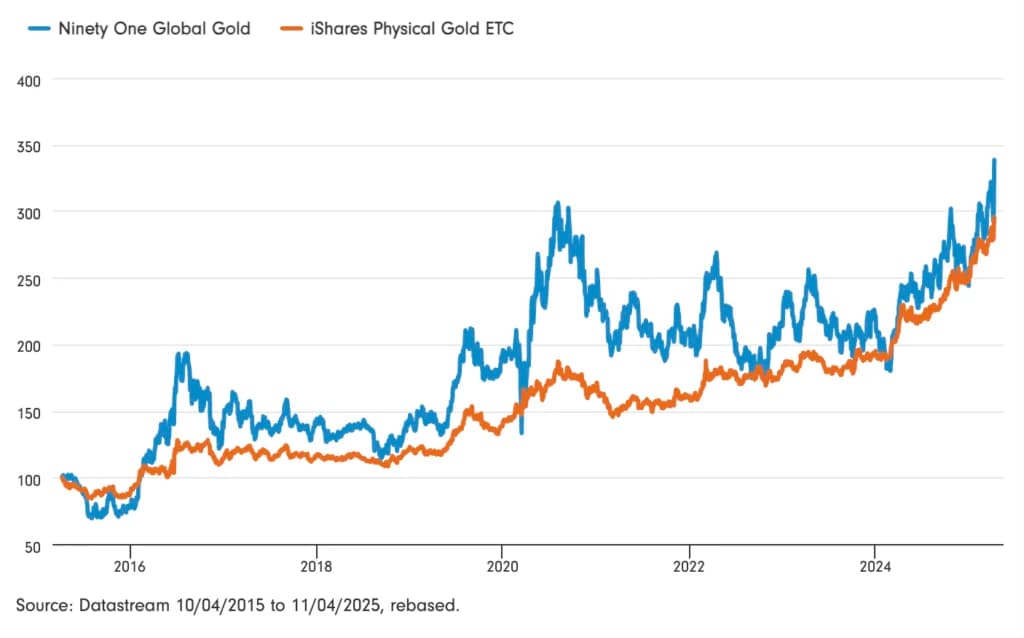
(This chart shows how gold mining stocks can underperform gold ETFs in the short term due to company-specific risks and lagging operational efficiency during volatile markets)
But it doesn’t always work. The chart below shows performance over a shorter period – just three years. Over that time span, the gold ETC has been both more stable and higher-performing. Gold mining stocks also carry company-specific risks, including management decisions, mining operations, and geopolitical factors affecting mining regions. In contrast, physical gold ETFs provide direct exposure to the gold price, offering a more stable investment that closely tracks the commodity’s performance without the added risks associated with mining operations. Investors should consider their risk tolerance and investment objectives when choosing between these two avenues for gold exposure.
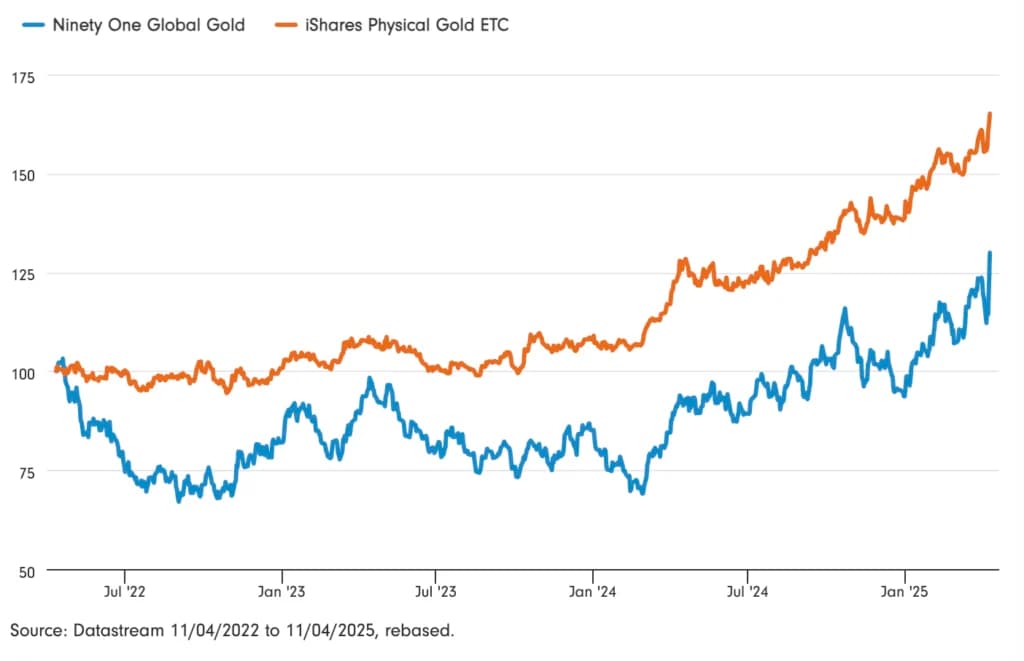
(This chart illustrates how gold mining stocks, represented by Ninety One Global Gold, have historically outperformed gold ETFs like the iShares Physical Gold ETC during periods of rising gold prices—while also highlighting their greater volatility)
Gold-Backed Digital Assets
Digital or tokenised gold lets you buy gold via apps or crypto platforms. For instance, Paxos Gold (PAXG) is a token where each PAXG equals 1 troy ounce of LBMA-certified gold stored in London. Royal Mint’s DigiGold is an online account that sells fractional gold (e.g. buy £25 worth) in large allocated bars (with 0.5% storage fee). These let you trade gold on-demand without handling bullion. They often have low minimums and may have no storage fee (PAXG, for example, advertises zero on-chain fees). But you rely on the platform’s security and terms.
Gold Savings Or Investment Accounts
While there aren’t mainstream “gold savings accounts” like cash ISAs, some services let you regularly invest small amounts in gold. For example, BullionVault offers a monthly savings plan, and platforms like Moneybox or others may let you add gold funds via monthly contributions.
Gold In SIPPs (Pension)
Self-Invested Personal Pensions can hold alternative assets. Some SIPP providers allow clients to include gold ETCs or even physical gold. For example, BullionVault partners with SIPPs to store gold bullion with pension tax relief. Holding gold in a SIPP (or ISA) can be tax-efficient, though you still face CGT rules on exit. Use a regulated provider if considering gold in a pension.
Online Dealers And Platforms
In the UK, well-known dealers include BullionByPost, The Royal Mint, and CoinInvest. They sell bullion and coins with clear pricing. Online platforms like BullionVault or Goldmoney let you buy allocated gold and store it (for a fee) in vaults. Always use reputable firms (look for LBMA accreditation or FCA regulation).
Premiums, Fees & Storage
Whatever method you choose, factor in costs. Physical gold buys come with dealer premiums (2-5% above spot is common for 1oz coins/bars). Vault storage typically costs ~0.5–1.0% of value per year (Royal Mint charges ~0.5% pa for DigiGold storage). ETFs charge an annual expense (e.g. 0.12% for iShares SGLN). Digital tokens may have smaller fees but check withdrawal or redemption costs. Also consider transaction costs or custodial charges. For example, Royal Mint’s DigiGold has a 0.5% buy/sell fee and 0.5%+VAT storage. Always review the fine print on fees and insurance before investing.
Why Invest In Gold?
Gold is often included in portfolios for diversification and protection. Unlike stocks and bonds, gold has a long history of preserving wealth. Analysts note that gold tends to perform well when other assets suffer: it is negatively correlated with equities during market crashes. This means adding even a modest gold allocation can smooth returns and reduce portfolio risk. World Gold Council research finds that gold “can materially enhance a portfolio’s risk-adjusted returns” through its diversification.
Gold also acts as an inflation hedge. When fiat currencies lose buying power, gold’s price generally keeps pace over time. As IG Group explains, “many traders and investors opt to get exposure [to gold] to protect their capital against value erosion” in rising inflation. Over decades, gold has roughly matched inflation, maintaining its purchasing power.
There’s also a safe-haven appeal: during geopolitical or economic crises, demand for gold often jumps. In fact, a recent survey showed a majority of precious-metals investors cite gold’s “safe haven” status as their motivation. Central banks too have been stockpiling gold. Such demand underpins expert forecasts: a Thomson Reuters poll finds gold averaging ~$3,065/oz in 2025 (setting new records), as analysts foresee continued uncertainty.
Finally, gold has delivered strong long-term growth. In UK pounds, the gold price has risen about 974% over the last 20 years. That compares very favourably to cash or low-risk bonds, which lost value after inflation. In a balanced portfolio, gold provides an insurance policy. For instance, even if equities drop, gold often cushions losses (its correlation with stocks becomes negative in sell-offs). Many financial advisors suggest a small gold allocation (often 5-10%) for this reason.
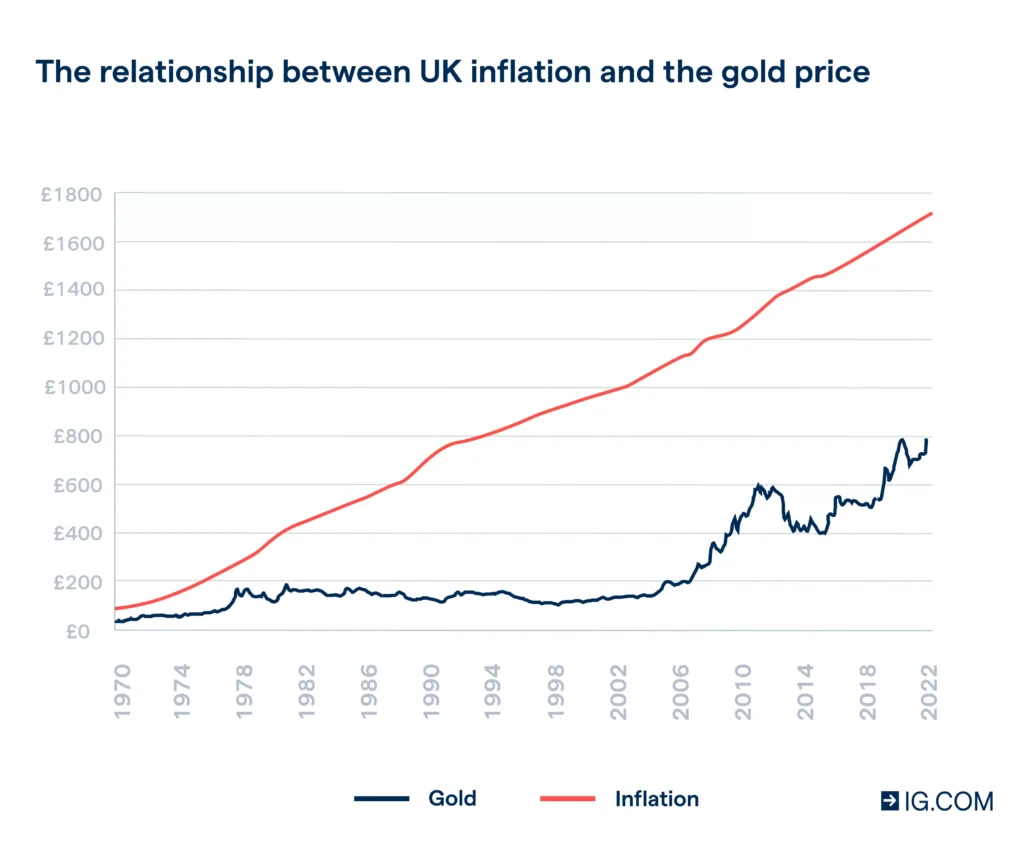
(The line graph above shows that gold prices in the past 50 years rose in relationship to the UK’s inflation rate, which is why many individuals have chosen – and continue to choose – gold as an inflation hedge)
Advantages Of Investing In Gold
- Liquidity: Gold is highly liquid globally. You can usually sell bullion or coins quickly through dealers, or ETFs/ETCs daily on the stock market. The market for bullion is deep, and central banks/states stand ready to buy. This ease of sale is a key benefit.
- Tangible Ownership: With physical gold (coins or bars), you literally hold the asset. There is no counterparty or default risk. In contrast to bonds or bank deposits, gold cannot go bankrupt or be devalued by policy. This physical control appeals to many (you can even store it at home).
- Long-Term Stability: Gold’s price has shown remarkable resilience over decades. It retained purchasing power even through wars and financial crises. For example, during past recessions, gold prices generally rose as investors fled stocks. Its scarcity and steady demand (jewellery, industry, reserves) support long-term stability.
- Inflation Protection: As a tangible asset, gold historically outpaces inflation. When inflation spikes, gold often rallies because its supply is fixed and it is priced in currencies losing value. Many investors add gold precisely for this hedge.
- Portfolio Balance: Gold’s low correlation with equities means including it can lower overall portfolio volatility. It can smooth returns over time. WGC analysis shows that during extreme market sell-offs, gold often moves opposite stock markets, thus balancing risk.
- Tax Advantages (UK coins): Certain gold coins (British Sovereigns, Britannias) are UK legal tender and exempt from Capital Gains Tax. This allows tax-free gains on those specific coins. (Note, this is a UK-specific benefit, unlike most assets.)
Disadvantages Of Investing In Gold
- Storage and Insurance Costs: If you hold physical gold, you need secure storage. Home safes must be insured; private vaults charge fees. These costs (often 0.5–1% of value annually) eat into returns. Even digital gold services and ETFs have custody costs (though built into fees).
- No Income/Yield: Gold produces no dividends or interest. In contrast to shares or bonds, you get no cash flow. The only gain is from price appreciation. Over long periods, that can be fine, but in flat markets, gold underperforms income-generating assets.
- Price Volatility: Gold can be volatile in the short term. Its price swings with currency moves, interest rates and investor sentiment. For instance, after surging in 2020-21, gold fell back in 2022, and similarly jumped in 2024. These swings mean it can lose value in the short run, so timing and holding period matter.
- Counterparty Risk (non-physical): Only physical gold is free of counterparty risk. Gold ETFs, tokens or contracts depend on issuers. In extreme scenarios (e.g. an issuer defaults), there’s risk. Similarly, digital gold tokens rely on blockchain or company management.
- Capital Gains Tax: Most gold investments (beyond UK legal-tender coins) are subject to CGT on any profit. This can reduce net returns, especially if selling large holdings. Be mindful of the annual exemption limit.
- Purchase Premiums: Buying gold typically costs above the spot price. Dealers add premiums (for minting and margins) of a few percent. When selling, you may not recoup the full premium, impacting returns if you trade frequently.
What Is Capital Gains Tax?
Capital Gains Tax (CGT) is the UK tax on profit when you sell an asset (like gold) for more than you paid. Only the gain is taxed, not the full sale amount. For individuals, the CGT allowance is modest (around £3,000 in 2024/25); gains below this yearly threshold are tax-free. Above the allowance, gains are taxed at 10% (basic-rate taxpayers) or 20% (higher-rate).
Example: If you bought £5,000 of gold coins and later sold them for £8,000, your gain is £3,000. If this is your only gain that tax year, it just hits the £3,000 allowance and incurs no tax. If you had another £3,000 gain (total £6,000), then about £3,000 would be taxable.
Notably, UK gold bullion coins (e.g. British Sovereigns or Britannias) are exempt from CGT because they are legal tender. This means any profit on these Royal Mint coins is tax-free. In contrast, all other gold (bars or foreign coins) is subject to CGT above the allowance. Always declare and report any taxable gains as required.
Frequently Asked Questions
How to buy gold for investment UK?
You can buy gold through authorised dealers or brokers. Popular options include The Royal Mint, BullionByPost, or online platforms (BullionVault, Goldmoney). Many UK banks don’t sell gold, so most people use specialised dealers or buy ETFs via a trading account. Always use regulated, reputable sellers and compare premiums.
Is it worth investing in gold?
Gold can be worth it as a portfolio hedge. It often preserves value during stock market downturns and inflation. However, it doesn’t pay interest or dividends. It’s typically advised as a small part of a balanced portfolio (e.g. 5–10%) for protection, rather than a high-return asset. Your personal goals and risk tolerance will determine if it’s suitable.
Are gold sovereigns a good investment?
Sovereigns are classic UK gold coins (7.98 g of 22ct gold). They’re durable, widely recognised and for UK residents they’re CGT-free. Their premiums can be higher than for bullion coins, and they earn no income. They’re good for collectors or investors who value a small, liquid, tax-advantaged holding. For raw investment purposes, generic bullion coins (like Britannias) may offer similar benefits with lower premiums.
How to invest in gold uk?
UK investors can choose physical gold (bars/coins), gold ETFs/ETCs (e.g. iShares Physical Gold SGLN), or gold funds. You can also buy shares in gold mining companies or use gold tokens (PAXG) and accounts (Royal Mint’s DigiGold). Some SIPPs and ISAs allow gold funds or coins. Compare costs: physical requires storage; ETFs have fees; digital tokens have blockchain fees. Choose based on convenience and costs.
Is buying gold bullion a good investment?
Physical bullion (bars or bullion coins) provides direct gold ownership. It’s widely seen as a safe store of value, especially when markets tumble. It can preserve wealth over time. The downsides are storage/insurance costs and lack of cash yield. Over the long term, it can be a reliable inflation hedge, but its price can swing in the short run. It’s generally good for wealth preservation, not quick growth.
Are gold coins a good investment?
Investment-grade gold coins (Britannias, Maple Leafs, etc.) are convenient and often CGT-free (if UK legal tender). They’re easy to buy/sell in small amounts. Numismatic (collector) coins might increase in rarity value, but they carry extra risk and VAT. For most investors, standard bullion coins are preferred: they track gold prices, offer liquidity, and (for UK coins) tax perks, making them a good way to hold gold.
Is gold a safe investment?
Gold is relatively safe in terms of not defaulting or becoming worthless. In crises it usually retains value better than stocks. However, it can still lose value in the short term (gold fell in early 2013, 2021, for example). It won’t provide income, so its “safety” is as a crisis hedge and store of purchasing power. It’s considered safer than high-risk assets, but like any investment it has some volatility.
Is gold or silver a better investment?
Both have investment roles. Gold is more scarce and less tied to industry, so it’s generally steadier and often favoured as a safe haven. Silver has larger industrial demand (electronics, solar panels), so its price is more volatile – it can rally strongly in a booming economy, but fall harder in a slump. Many investors hold both: gold for stability, silver for potential higher returns. If you want stability, gold is usually “safer”; if you can tolerate volatility for higher upside, silver could add extra growth.
Is gold tax free in the uk?
Buying gold bullion (bars/coins) has no VAT in the UK, because investment gold is VAT-exempt. However, selling for a profit usually incurs CGT on gains above the annual allowance. The exception is UK legal-tender bullion coins (Sovereigns, Britannias): these are exempt from CGT, so you pay no tax on those profits. There is no VAT on bullion purchases, and no stamp duty applies to gold either — but be mindful of other taxes like Capital Gains Tax when selling.
Does gold protect against inflation?
Gold is widely used as an inflation hedge. When consumer prices rise, gold often (though not always instantly) increases too, because it preserves purchasing power. Many investors buy gold when inflation is high. That said, gold doesn’t always move up perfectly with inflation in the short term; other factors (currency moves, interest rates) play roles. Over the long run, though, gold tends to outpace paper currency in periods of sustained inflation.
Where should i store my gold?
If you hold physical gold, you have two main options: home or professional. A good home safe (fire-resistant, bolted down) and a top-tier insurance policy can work for smaller amounts. For larger holdings or coins, many use secure vaults: banks or private vault companies (London vaults, Swiss vaults, etc.) provide allocated storage for a fee. Dealers like BullionVault and Goldmoney offer insured vault storage. Never just leave gold unsecured. Always insure stored gold and use a reputable vault or bank facility.
What is the best way to invest in gold?
For simplicity and safety, many start with a gold ETF or fund (e.g. SGLN) as it’s easy and low-cost. For direct ownership, buying bullion coins (CGT-free) or bars might suit. Digital tokens (PAXG, DigiGold) offer innovation and liquidity. Gold mining stocks add a leverage element. Often the best approach is a mix: perhaps some physical coins plus a small ETF or token stake. The key is to balance cost, convenience, and how easily you can access/sell your gold.
Physical gold vs digital gold?
Physical gold (coins, bars) means you actually hold the metal – it’s fully tangible. Digital gold (like tokens or custodial accounts) means you own a record of gold held by someone else. Physical offers ultimate security (no counterparty risk) but requires storage and is slower to trade. Digital gold is very convenient (24/7 trading, small buys, no vaulting on your part) but relies on the issuer/tech. Physical is “safest” in that you have the asset; digital is more flexible and liquid.
Physical gold vs ETF?
Physical gold gives real metal you can take delivery of, with no ongoing management fees beyond storage. It’s private and carries no trustee risk. ETFs (or ETCs) are paper proxies that trade easily on exchanges. ETFs have a small annual fee (e.g. ~0.12%) but you save on personal storage. ETFs are instantly tradable in a brokerage account, whereas selling physical requires a dealer transaction. Many investors hold a combination: e.g. physical for core security, ETFs for trading or ease.
Physical gold vs paper gold?
“Paper gold” refers to non-physical means like ETFs, futures or contracts. Physical gold means you own the bullion. Paper gold is very liquid and convenient (no vault needed), but is essentially a debt claim on metal. ETFs are mostly well-backed, but futures or CFDs carry full counterparty risk. Physical gold has no default risk (once you hold it), but is cumbersome. Many use paper gold for trading or allocations under 10% of portfolio, and keep some physical for long-term insurance.
Interested in selling gold with the UK’s highest paying gold buyer? Visit our Sell Gold page to get a competitive valuation – we provide fully insured postage and fast payment.
For more insights and the latest gold price today, keep an eye on our live charts and blog updates.