Why Is The Gold Price Going Up?
Gold prices are climbing to record levels in 2025 as investors flock to safe-haven assets amid economic uncertainty. A perfect storm of persistent inflation, geopolitical tensions, a weaker US dollar, and surging demand from central banks has fuelled this historic rise in gold’s value.
Key Takeaways
- Gold at Record Highs: Gold has hit all-time highs (over $3,400/oz or £2,560/oz) in 2025, driven by global economic worries, high inflation, and waves of safe-haven buying. Investors are turning to gold as a “stable” asset when confidence in currencies and stocks falters.
- Outlook Remains Strong: Most expert gold price predictions see prices staying elevated or even rising further. For example, Goldman Sachs forecasts gold reaching about $3,700/oz by end of 2025, and other analysts say even $4,000 is possible in a bullish scenario.
- Key Price Drivers: The gold price is primarily moved by a few big factors – inflation and interest rates (which affect the US dollar’s strength), geopolitical and economic uncertainty (spurring safe-haven demand), central bank buying, and basic supply-demand dynamics. Recent real-world example: Fears of a trade war and recession early in 2025 sent gold up ~18% in two months.
- Gold’s Role in Investing: Gold can be a good investment for diversification and wealth preservation. It tends to hold value during crises and can hedge inflation. However, it pays no interest or dividends and may lag stocks in boom times. Whether gold is “good” for you depends on your goals – it’s great for stability and hedging, but less useful if you need income or rapid growth.
- Downsides to Consider: Investing in gold has drawbacks. Prices can be volatile and can fall once a crisis passes, meaning timing is tricky. There are costs for storage and insurance if you hold physical gold, and you earn no yield for holding it. Scams and counterfeit gold are also risks for unwary buyers.
- Buying Now – Caution Advised: Is now a good time to buy? Gold’s climate is favourable long-term, but after such a big rally there is a risk of short-term pullbacks. History shows gold often dips when panic subsides. Analysts suggest any correction may be brief, yet new buyers might wait for dips rather than buying at peak prices.
- High Prices = Selling Opportunity: With gold at historic highs, selling gold now could lock in exceptional profits. Many investors have indeed been taking profits – April 2025 saw the heaviest gold selling in over a year as people cashed in gains. If you bought gold when prices were lower, now may be a smart time to consider selling (at least partially) to realise those gains.
Why Is The Gold Price Going Up?
Gold’s steep rise in 2025 comes down to a convergence of economic and political forces making the metal extremely attractive. In April 2025, gold broke above $3,500/oz for the first time, marking a 30%+ jump since the start of the year. Several key factors explain why the gold price is going up right now:
- Surging Safe-Haven Demand: Turbulence in the global economy and geopolitics has investors scrambling for safety. Notably, a new escalation in the US–China trade war and political uncertainty in the US have rattled markets. In early 2025, President Donald Trump’s tariff announcements (his so-called ‘Liberation Day’ tariffs) and attacks on the Federal Reserve sparked fears of a global slowdown. This “furious flight from U.S. assets” drove investors into gold, causing an 18% price spike between March and May. Stock markets fell (the S&P 500 dropped over 4% in that period) while gold shot up, highlighting its role as a safe haven when other assets lose trust. As one analyst explained, “gold remains heavily supported by a broadly weaker dollar, uncertainty around tariff announcements and fears about a global recession.”
- Inflation and Interest Rate Shifts: Stubbornly high inflation and shifts in central bank policy have boosted gold’s appeal as an inflation hedge. In the US and UK, inflation has been running above target, eroding confidence in paper currency. At the same time, there’s growing expectation that central banks will pause or cut interest rates to support growth. The mere hint of rate cuts weakens the dollar and lowers bond yields, which tends to lift gold. In fact, real interest rates (interest minus inflation) turned deeply negative in recent years, making the “opportunity cost” of holding non-yielding gold very low. By late 2024, traders anticipated the US Federal Reserve would start easing monetary policy – a prospect that helped push the dollar down and gold up. (A weaker dollar makes gold cheaper for non-US buyers, driving up demand.) During April 2025, a “significant plunge in the US dollar” was identified as a key driver of gold’s record surge. Essentially, when rates and the dollar fall, gold shines brighter.
- Central Bank Buying Spree: Central banks around the world have been buying gold at the fastest pace in decades, providing a major underlying boost to prices. Faced with geopolitical risks and currency uncertainties, many countries (particularly in Asia and the Middle East) are increasing their gold reserves as a safeguard. China, for example, tripled the gold share of its reserves to 8% by importing around 700 tonnes from the UK in 2022–2024. This is part of a deliberate move to reduce reliance on the US dollar – gold is seen as a neutral, sanction-proof reserve asset. Other central banks (from Turkey to India) have followed suit, collectively removing large quantities of gold from the open market. In late 2024, after Trump won the US election, official gold purchases jumped 54% year-on-year to 333 tonnes in a single quarter. Such massive central bank demand has helped push the price higher by tightening supply and signalling that big institutional players expect gold to hold its value. Unlike speculators, central banks are long-term holders, so their buying creates a solid price floor.
- Geopolitical Tensions and Market Volatility: Ongoing conflicts and fears of broader instability have added extra fuel to gold’s rise. The war in Ukraine (and bouts of Middle East turmoil in 2024) reminded investors that geopolitical shocks can come suddenly – and gold historically performs well during wars or crises. In the current climate, “elevated geopolitical risk” – from the East-West trade rift to high global debt levels – is driving a “widespread and fundamental shift in confidence” away from fiat money towards gold. Even bond markets, typically seen as safe, have been volatile, which has some investors preferring gold as an alternative haven. “Gold is recalibrating to reflect…epic changes in the global financial system,” notes one analyst, citing eroding confidence in the US dollar and its bond market. In short, when uncertainty is everywhere – be it political or financial – gold’s appeal soars because it’s a tangible asset with no political attachments.
All these factors combined have created a “perfect storm” for gold. By mid-2025, spot gold was trading around $3,300–3,400/oz, roughly double its price just three years prior. Every time a new risk emerged – a shaky bank, a currency wobble, a geopolitical headline – gold saw another wave of buying. As Fidelity International’s investment director Tom Stevenson put it, “Gold is seen as a safe haven during times of geopolitical and financial uncertainty and attracts buyers when the outlook is unclear, despite its lack of income.” That pretty much sums it up: gold is rising because the world’s economic outlook has been unclear (or downright scary), and people with money are seeking cover. Gold offers that sense of security when other assets don’t.
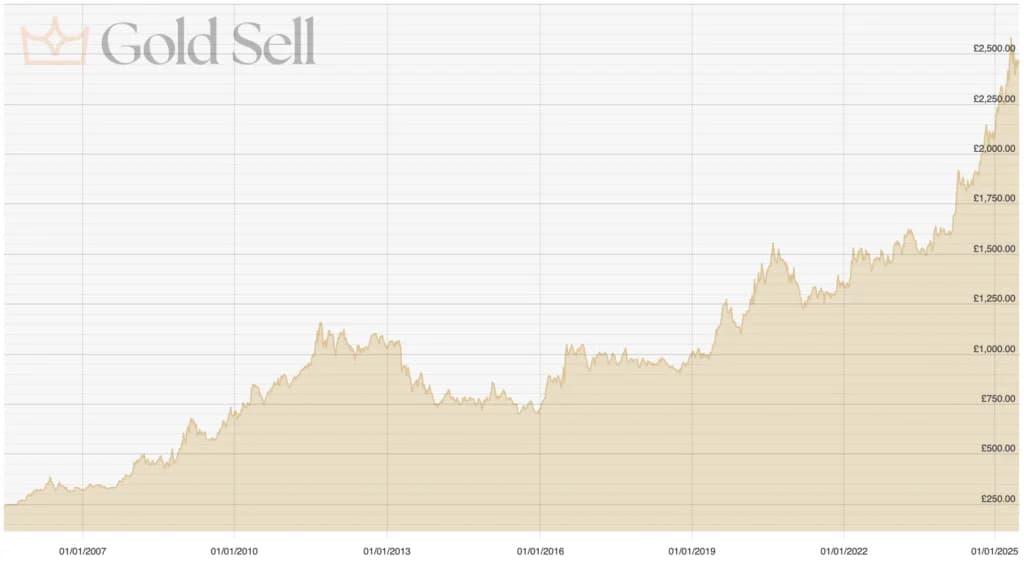
This gold price chart highlights the dramatic surge in value seen throughout 2024 and 2025. Driven by rising inflation, currency instability, and strong central bank demand, the upward trend reflects growing investor uncertainty and the shift toward gold as a safe-haven asset. Understanding this trajectory helps explain why so many people are now choosing to sell or invest in gold amid ongoing economic volatility.
Today's Live Gold Prices
Below are today’s live UK spot prices, giving you a snapshot of just how high the market has climbed. Use them to gauge the real-time value of any scrap jewellery you’re thinking of selling—or to sense-check whether buying now still makes sense at these elevated levels.
Live Gold Price Per Gram
Gold price last updated:
The LBMA (London Bullion Market Association) spot price changes daily.
The prices displayed are based on the global market rate for gold, known as the gold spot price. Like all gold buyers, GoldSell pays a percentage of this rate to account for assaying, refining, secure logistics, market volatility, and handling costs. We consistently offer among the highest payout rates in the UK, with the exact percentage increasing based on the weight and purity of the gold you sell.
| Gold Fineness | Live Price per Gram |
|---|---|
| 9 carat (37.5 % pure) | £37.24 |
| 14 carat (58.5 % pure) | £57.93 |
| 18 carat (75 % pure) | £74.48 |
| 21 carat (87.5 % pure) | £86.89 |
| 22 carat (91.6 % pure) | £91.03 |
| 24 carat / Fine gold (99.9 % pure) | £99.31 |
Gold Price Per Troy Ounce: £3,088.73
To put this in context, the 24 ct figure is more than double its 2020 level—underscoring why so many owners are cashing in old chains and bangles right now. Remember, these numbers fluctuate minute-by-minute with global trading, so lock in a quote quickly if you’re looking to sell or hedge at today’s record highs.
Gold Price Projection
Even after its huge run, the outlook for gold over the next year or two remains broadly optimistic according to many analysts. In fact, recent gold price forecasts from major institutions suggest that gold could hold near current highs or climb further. Here’s a roundup of what experts are predicting for the gold price in late 2025 and into 2026:
- Goldman Sachs has raised its forecast, expecting gold to reach about $3,700 per ounce by the end of 2025. Their analysts cite sustained central bank buying and lingering economic risks as reasons gold’s rally can continue. If central banks keep adding ~100 tonnes of gold a month, Goldman even sees scope for $3,810 by end-2025.
- ANZ Bank likewise boosted its projections, now targeting around $3,600/oz by year-end 2025.
- UBS (a Swiss bank) reportedly revised its forecast up to roughly $3,500 in 2025, while Citibank sees prices averaging about $2,900 next year. (Citi’s figure implies a belief that gold might pull back from current highs, yet still average higher than ever before.)
- J.P. Morgan researchers have also turned bullish, predicting gold could “rise toward $3,000/oz in 2025”. Earlier bank forecasts that seemed optimistic (like ~$2,500) have been surpassed by reality – forcing analysts to continually revise upwards. For context, gold already hit $3,500 in April 2025, so banks are adjusting to the new normal.
- State Street’s gold outlook in mid-2025 noted that even if there’s a short-term correction, they expect gold to sustain record price levels between $3,100 and $3,500 through this year. In a more bullish scenario, where global stagflation worsens or de-dollarisation speeds up, they see gold potentially approaching $4,000 within 6–9 months.
In summary, the consensus gold price prediction for the next 12–24 months leans positive. Forecasts cluster around the mid-$3,000s, with $3000 now viewed by many as the new floor rather than the ceiling. Of course, these are projections, not guarantees – events could change (for better or worse). But it’s telling that reputable analysts from Goldman, JPMorgan, UBS, Citi, Deutsche Bank and others all foresee gold staying at historically high levels through 2025. The drivers behind gold’s rise – inflation, geopolitical tension, central bank demand – are expected to persist. Unless there’s a dramatic improvement in the world economy or a big policy shift, gold is likely to remain in demand. In practical terms, that means gold hovering around record highs with potential to breakout higher if a new crisis hits.
What Affects The Gold Price?
Several core factors drive gold’s price, often pushing it up or down. Here are the primary factors and how each has recently influenced the gold price:
- Inflation & Interest Rates: Gold thrives on high inflation and low interest rates. When inflation erodes the value of cash, people turn to gold as a store of value. Likewise, lower interest rates (or yields) make non-yielding gold more attractive. Example: In late 2024, as US inflation stayed above target and the Fed signalled possible rate cuts, the dollar weakened – helping to push gold higher heading into 2025. Conversely, if central banks were hiking rates aggressively, that can strengthen currencies and dim gold’s appeal (as seen in 2022 when gold stagnated under rapid Fed rate hikes).
- Currency Movements (U.S. Dollar Value): Gold and the US dollar typically move opposite each other. A weaker dollar makes gold cheaper for buyers in other currencies, boosting demand (and vice versa). Real-world example: April 2025 saw a “significantly weaker US dollar” which was identified as a key driver behind gold breaking the $3,500/oz mark. In fact, the dollar index had fallen ~9% in early 2025, removing a major headwind for gold. Many times when you see gold’s price jump, you’ll also see the dollar falling in tandem.
- Geopolitical & Economic Uncertainty: Gold is the go-to “fear asset.” During wars, political crises, or recession fears, investors flock to gold for safety, driving the price up. Recent example: The announcement of new US–China tariffs and fears of a global recession in March 2025 triggered a rush into gold, with prices surging ~18% in two months. Similarly, the ongoing war in Ukraine and other global tensions throughout 2024–2025 have underpinned gold demand as a hedge against unknown outcomes. Whenever markets get jittery (e.g. stock sell-offs, debt ceiling standoffs), gold tends to benefit.
- Central Bank Reserves: Central banks buying or selling gold in bulk can sway the market. In recent years, central banks have been huge net buyers of gold, adding support under prices. They buy for long-term reserve diversification (often when they lose faith in the US dollar or euro). Example: In Q4 2024, after the US election, central bank gold purchases jumped 54% year-on-year to 333 tonnes. China’s central bank alone bought gold five months in a row up to March 2025. These sizeable purchases helped push prices higher by reducing available supply. On the flip side, if central banks were to dump gold (as some did in the late 1990s), it could depress prices – but at the moment they’re doing the opposite, effectively backstopping the market.
- Investor Demand & Market Sentiment: Beyond central banks, demand from private investors (retail and institutional) is crucial. This often shows up in investment inflows to gold exchange-traded funds (ETFs), bullion bars/coins, or futures. When investors are bullish on gold, new money flows in and lifts the price. Example: During early 2025’s turmoil, gold investment demand spiked – one major platform saw 121% more new gold investors in April – and concurrently, a surge of buying helped propel gold to record highs. Likewise, gold often rises when stock markets are falling, as investors rebalance into safe assets. We saw this inverse relationship in spring 2025: as the S&P 500 slid, gold jumped (and when stocks rebounded in mid-May, gold cooled off). Investor sentiment can swing quickly, so gold’s price sometimes overshoots on fear and pulls back when calm returns.
- Supply & Fabrication Demand: Unlike paper money, gold supply is relatively fixed and grows slowly (via mining). Gold mining output adds only ~1–2% per year to the above-ground stock. Sudden surges in demand from jewellery or industry can therefore tighten the market and raise prices – though the effect is usually gradual. For instance, in 2024 global gold demand (across all uses) reached a record annual high, which supported higher prices. However, if prices get too high, some demand (like jewellery buying in price-sensitive countries) can drop off, removing support. A case in point: in early 2025, China’s jewellery demand fell ~27% year-on-year because record gold prices deterred shoppers. Such demand pullbacks can cap gold’s upside. On the supply side, geopolitical issues (like export bans or mine strikes) can momentarily impact prices, but large swings in supply are rare compared to the swings in demand driven by investors.
In summary, gold’s price is the result of a constant tug-of-war between these factors. Inflation, interest rates, and the dollar set the overall trend, while geopolitical crises and investor sentiment drive short-term spikes. Central bank actions and physical demand add longer-term support or resistance. Lately, almost all these forces have been pointing upward for gold – explaining why we’ve seen such a strong rally.
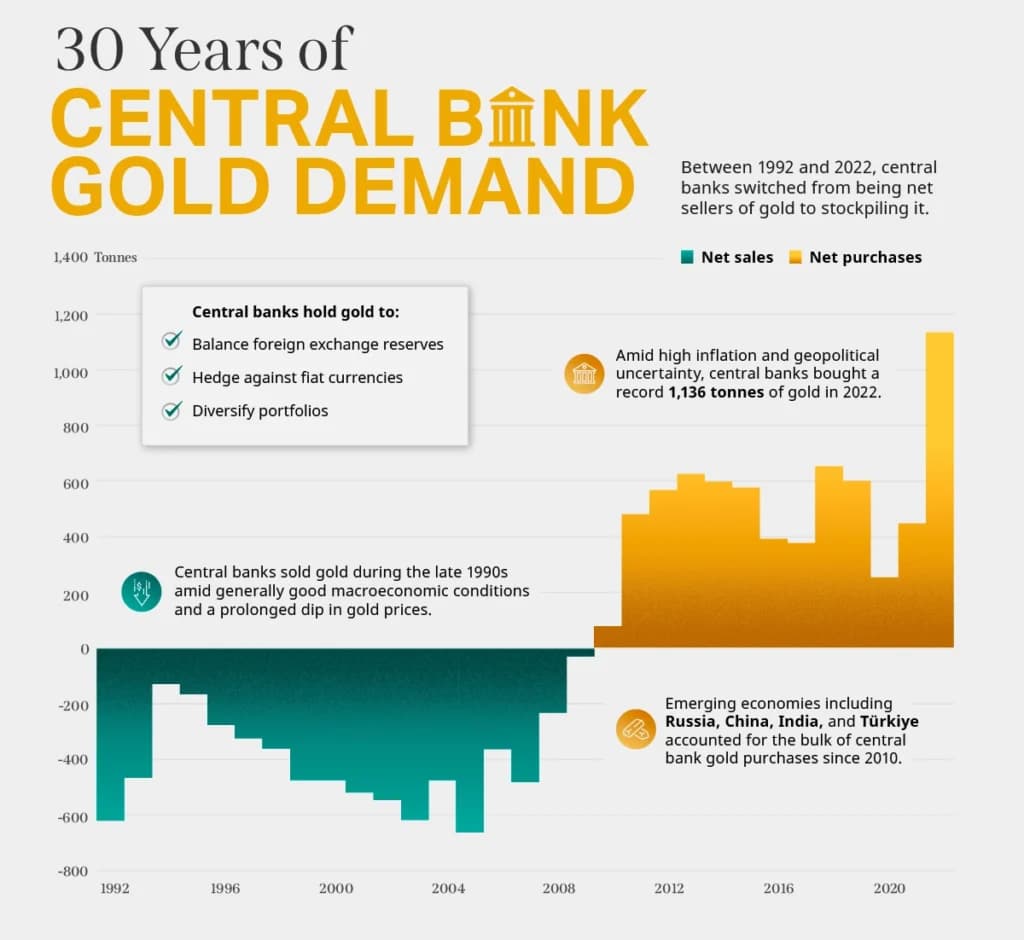
Central bank reserves have become a major driver of gold price movements over the past decade. This chart shows how, since 2010, countries like China, Russia, and Turkey shifted from selling to aggressively buying gold to hedge against currency risk, inflation, and geopolitical instability. These large-scale purchases are a key factor affecting the gold price today, reinforcing gold’s role as a strategic reserve asset during uncertain economic times.
Is Gold A Good Investment?
When deciding if gold is a good investment, context is everything. It really depends on your investment goals and what you want gold to do for you. Gold plays a unique role: it’s neither a traditional growth asset (like stocks) nor an income asset (like bonds). Instead, gold is often viewed as portfolio insurance – a way to preserve wealth and diversify risk. Here’s a breakdown of how gold fits (or doesn’t fit) various investment goals:
- Long-Term Wealth Preservation: Goal: Protect the real value of your money over decades. – Gold shines here. It has a centuries-long track record of maintaining purchasing power. Investors often buy gold to hedge against inflation and currency debasement. For example, over the 20 years from 2000 to 2020, gold’s value increased roughly 8-fold, outpacing inflation and even beating stock market returns over that period. In times of severe inflation or currency crises, gold has historically been one of the few assets that hold value (or even gain value). Thus, for long-term savers worried about the pound, dollar, or euro losing value, gold can be a good store of wealth.
- Portfolio Diversification & Safety: Goal: Reduce overall risk and protect against market crashes. – Gold is very useful as a diversifier. It has a low or even negative correlation with major asset classes (meaning when stocks or real estate go down, gold often goes up). Holding some gold can balance your portfolio during turbulent times. Many financial advisers suggest a small allocation to gold (commonly 5–10%) precisely because it can offset losses elsewhere during a crisis. For example, in the 2008 financial crisis and again in 2020, gold prices jumped while equities tanked, helping cushioned portfolios that held gold. It’s essentially a form of insurance – you hope you won’t need it, but you’re glad to have it when things go wrong.
- Capital Growth: Goal: Grow your investment significantly in value (capital appreciation). – Gold is a mixed bag. It does appreciate over the very long term, but typically gold’s gains come in concentrated spurts during crises or high inflation periods. Over an extended period in a stable economy, gold might only hold steady or grow modestly. Assets like equities tend to outperform gold in strong economic times, since companies grow and pay dividends whereas gold just sits there. For instance, from 2011 to 2015, gold’s price actually trended down and delivered negative returns, while stock markets gained in those years. That said, gold has delivered about 25–30% annual gain in 2025 so far, which beats most other asset classes. The key point: gold can grow your capital, but it usually excels when other assets are struggling. It’s not reliably a high-growth investment in peaceful, low-inflation conditions.
- Income Generation: Goal: Generate regular income (interest, dividends, etc.) – Gold is not the investment for this goal. One of the biggest downsides of gold is that it provides no yield. Gold doesn’t pay interest or dividends. A gold bar will be the same gold bar next year – it won’t produce cash flow. So if you need income from your investments (say for retirement spending), gold won’t give you that. In fact, if you hold physical gold, it may cost you money (for storage or insurance) rather than paying you. Income-focused investors typically prefer bonds, dividend stocks, or property instead of gold.
- Short-Term Trading or Speculation: Goal: Make quick profits from price changes. – Gold can work, but caution is needed. Gold prices can move sharply day-to-day based on news and sentiment, so active traders do ride its volatility. There are liquid markets and derivatives (futures, options) for gold that day-traders use. However, gold is also known for sudden reversals. It’s “an inherently volatile commodity” – double-digit percentage swings in months are not uncommon. Short-term trading in gold is essentially a bet on political or economic news (e.g., you’d profit if another bank collapsed and gold spiked in panic). This is high-risk-high-reward territory. Unless you really know the market, using gold for quick speculative gains isn’t “investing” so much as gambling. Many small investors have been burned trying to time gold spikes.
In conclusion, gold is a good investment for some purposes but not others. If your aim is to hedge against tail risks, diversify your portfolio, or safeguard wealth over the long haul, gold can play a valuable role. It provides trust and stability when other assets might not. On the other hand, if you seek regular income or explosive growth, gold is less suitable. It’s best viewed as a form of financial insurance – a stable asset that will be there for you when other investments falter. Most balanced investors use gold in moderation as part of a broader strategy, rather than betting their whole future on it. For a deeper dive on the topic of ‘is gold a good investment?‘ our experts have created a simple overview to determine if gold is the right investment for you.
Investing In Gold: Is Gold A Good Investment?
Investing in gold: Discover how to invest in gold and use our gold investment calculator for smart, profitable wealth strategies.
What Is The Downside Of Buying Gold?
While gold has its advantages, it’s important to go in with eyes open about the downsides of buying gold. Here are the main drawbacks from an investor’s perspective:
- No Yield or Income: Gold does not generate any interest, dividends, or rental income. Unlike a savings account or a stock, which might pay you for holding it, gold simply “is.” This means the only way to profit is price appreciation. If gold’s price stays flat for 5 years, you earn nothing in that time (and actually lose ground after inflation). Many investors hold gold as a defensive asset, but that comes with an opportunity cost – for example, not investing that money in assets that could be yielding 5% per year. As Fidelity’s Tom Stevenson notes, gold attracts buyers in uncertain times “despite its lack of income”. That lack of income is a trade-off you accept for gold’s stability.
- Price Volatility & Risk of Loss: It’s ironic, but an asset known for stability can also be quite volatile in price. Gold prices can swing significantly in the short and medium term. If you buy at the wrong time, you could see the value drop and take years to recover. For instance, gold hit a peak in 2011 around $1,900, then fell to about $1,200–$1,300 over the next few years – a drop of ~35%. Gold’s price often falls once a crisis or panic passes, as recent events illustrate. In May 2025, news of easing trade tensions saw gold quickly pull back ~5% from its highs. The Commodity Futures Trading Commission (CFTC) has warned that precious metals can be “highly volatile,” and that when “economic anxiety is high, the people who typically profit… are the sellers” – implying late buyers can get hurt when the frenzy subsides. In short, if you buy gold during a hype peak, you risk a sharp downside if conditions normalise. It’s not guaranteed steady growth; timing matters.
- Storage, Security & Liquidity Challenges: Holding physical gold (bars, coins, jewellery) comes with practical drawbacks. You need to store it securely, which might mean a safe at home, a safety deposit box, or using professional vault storage – all of which can incur costs. Insurance is also advisable for physical gold, adding more cost. Large bars are not easy to sell piecemeal and may need assaying (verification) when you sell them. Even with allocated accounts or ETFs, there can be management fees. Gold is reasonably liquid (you can usually sell it at market price), but selling physical gold through dealers might involve a price spread (buy/sell difference) or wait times to find a buyer. These frictions mean gold isn’t as instantly convenient as, say, selling a stock with one click.
- No Ongoing Value Creation: Businesses and many investments create value – companies innovate and grow, real estate generates rent – but gold is a static asset. A gold bar today will still be the same bar years from now; it won’t become more valuable through productivity or earnings. This means gold’s long-term returns rely solely on market sentiment and monetary conditions. If the world economy enters a strong boom with low inflation, gold could underperform other investments for a long stretch. There are long periods (sometimes a decade or more) where gold prices stagnate. For example, during the 1990s, gold prices were fairly flat to down even as equities soared. Investors should be aware that gold doesn’t automatically increase in value over time – there have been times when holding gold yielded no real growth, whereas a diversified stock portfolio did.
- Potential Scams and Counterparty Risk: Unfortunately, the gold market has its share of scams and dodgy dealers – especially for retail buyers. There have been cases of counterfeit gold coins/bars or companies that charge exorbitant fees. As a buyer, you need to ensure you’re purchasing genuine gold from a reputable source. The UK’s Financial Conduct Authority (FCA) has in the past warned about gold investment scams targeting consumers. Sky News also cautions investors to “educate yourself on safe trading practices and be cautious of potential scams and counterfeits” when entering the gold market. If you’re using an online platform or ETF, there’s also a reliance on that provider’s trustworthiness (though major ones are well-regulated). The key is to do due diligence – but it’s an extra worry that, say, buying government bonds doesn’t entail.
To sum up, the cons of investing in gold include the lack of income, price volatility, storage/security costs, no intrinsic growth, and some market pitfalls like scams. None of these are deal-breakers – they’re just factors to weigh. Many people still find gold worth it for the protection it offers. But you should be aware of these downsides and manage them (e.g. allocate only a sensible portion of portfolio to gold, choose reliable storage or gold funds, and keep realistic return expectations). Gold is best used as a supporting player in your investments, not the sole star, precisely because of these limitations.
Is Now A Good Time To Buy Gold?
This is a natural question given gold’s recent performance. The answer is nuanced: it depends on your perspective and time horizon. Gold is at record highs, which on one hand reflects strong momentum that could continue, and on the other hand raises the risk of a short-term pullback. Let’s break down the considerations to determine if now is a good time to buy:
Reasons it might be a good time: If you don’t have any gold exposure, adding some now can provide a hedge in your portfolio. The factors driving gold’s rise (high inflation, geopolitical strife, central bank buying, etc.) are still in play and could continue to intensify. Historically, gold tends to perform well in late-cycle economies or when recessions loom – exactly the kind of environment many analysts see over the next year or so. 2025 has shown that gold can quickly hit new highs when surprises occur. Some investors buy a little at a time (a strategy called pound-cost averaging) regardless of price, to build their position steadily. If you share the view that economic risks remain elevated, then having gold sooner rather than later makes sense as insurance. Notably, even after a huge run-up, many experts are not calling gold a bubble but see it supported by fundamentals like central bank demand. For example, commodity strategists have noted that any near-term dips in gold are likely to be short-lived and met by buyers, given the strong undercurrent of demand. So, entering the gold market even at high levels could still work out if those supportive conditions persist (and if you’re patient through any volatility).
Reasons to be cautious now: On the flip side, jumping in at an all-time high price has obvious risks. Markets rarely move in a straight line up. We’ve already witnessed some profit-taking – gold briefly pulled back from ~$3,500 to ~$3,300 in May 2025 as some fears (like a US-China tariff war) eased. If the global situation stabilises or if interest rates tick up unexpectedly, gold could retrace more of its gains. A common strategy is to wait for a dip rather than buy at the peak. Given gold’s volatility, a 5-10% dip at some point would not be surprising, which might offer a better entry point. Another factor: the gold/silver ratio and other indicators are at extreme levels, which sometimes signal that gold is “overbought” in the short term (though these indicators are not foolproof). Also consider your own needs – if you’re looking for quick profit, buying after a 30% run-up might not yield an immediate reward; gold could as easily consolidate for a while.
Historical context: Looking at history can be instructive. Those who bought gold during past peaks had to sometimes wait years to see new highs again. For instance, someone who bought at the 2011 peak ($1900) had to wait until 2020 for gold to decisively surpass that level. However, that 2011 peak was followed by a period of economic recovery and rising interest rates (a headwind for gold). Today’s conditions – with debt levels high and central banks inclined to be dovish – are different. Another historical example: in 2020, gold spiked to then-record highs ($2070) during the COVID shock, then fell back to ~$1700s in 2021 before resuming an upward trend in 2022–2023. The lesson is that even in a long-term bull market, gold can have multi-month corrections. So, if you buy now, be mentally prepared that the price could dip in the near term. That doesn’t mean it won’t go higher later; it’s just part of gold’s journey.
A balanced approach: Many analysts would say it’s neither a screaming “buy” nor a “avoid at all costs” moment – it’s a time for balance. If you have no gold, you might start with a modest allocation now in case prices run even higher (so you’re not left completely on the sidelines if gold goes to $4,000). If you already have some gold, you might hold off adding a lot more at these levels, or even consider slight profit-taking (as discussed next). Essentially, assess your portfolio and risk appetite. Gold’s current price reflects a lot of bad news; if you believe more bad news is coming (e.g., deeper recession, geopolitical conflict), then now is still a good time as gold could climb further. If you think the fears are overblown and the world will calm down, then gold might be near a top, and waiting could be smarter.
In practical terms, one might compromise: perhaps buy a small amount now to establish or top-up a position, but keep some cash on hand to buy more if there’s a downturn. That way, you’re somewhat protected either way. Remember, gold is a long-term store of value – if your reason for buying is long-term safety, today’s price may look fine a decade from now (especially if currencies lose value). But if your goal is short-term profit, be aware you’re late to the party and the easy gains have been made; tread carefully. In any case, ensure any gold purchase aligns with your broader financial strategy (and doesn’t leave you overexposed).
Should You Sell Your Gold Now?
With gold prices hitting all-time highs, it’s a very logical question to ask if now is the moment to cash in. Selling gold now could indeed be a strong option to consider, especially if you bought at lower levels in the past. Here’s why many are tempted to sell gold – and some points to weigh before you do:
Why selling now makes sense: The simplest reason is “buy low, sell high.” Gold is high! If you purchased gold in years past (or even earlier this year), you’re likely sitting on significant gains. For instance, gold is up about 30% in the last year, and around 60–70% compared to five years ago. Taking some profit off the table is a prudent way to capture those gains. Markets are cyclical, and no rally lasts forever – by selling at record prices, you lock in a win. There is also the concept of rebalancing: if gold’s value in your portfolio has grown disproportionately (say from an intended 5% of your portfolio to 15% now because of price rise), rebalancing by selling some gold and putting that value into other assets can maintain your overall risk level. Additionally, consider the economic outlook: if you suspect that some of gold’s driving factors (like extreme uncertainty or easy monetary policy) might abate in the near future, then gold’s price could ease off its highs. Selling before that happens would be advantageous. We already saw an example in mid-2025 – when hints of improved US-China trade relations emerged, gold’s rally paused and prices fell ~5% in a week. If you believe more “good news” could be on the horizon (taming inflation, peace deals, etc.), it argues for taking profit now.
Evidence of others selling: It’s worth noting that many investors are seizing this opportunity. Data from gold marketplaces show that profit-taking has spiked now that prices are so high. In April 2025, BullionVault (a major online gold platform) recorded its heaviest gold selling in over a year, with a significant number of clients cashing out part of their holdings. Interestingly, even a lot of new gold buyers who entered the market in early 2025 decided to flip and sell in April to capture quick profits – they were 70% more likely to sell than longer-term holders. This tells us that not only long-term gold bugs, but also recent speculators, saw the record price as a chance to realise gains. When the crowd starts taking profits, it can be a sign that a rally is maturing. You generally want to sell into strength – and gold’s price strength right now is exactly the environment where selling high is possible (there’s plenty of buying interest to absorb sales).
What to consider before selling: One factor is taxes – in the UK, profits on gold could be subject to Capital Gains Tax (CGT) unless you’re selling UK legal tender coins which are CGT-free (like Britannia or Sovereign coins). If you have a large holding, plan the sale to be tax-efficient. Another consideration: what is your alternative for the funds? If you sell gold, you should ideally have a productive place to put that money (even if it’s just a high-interest savings account or paying down debt). Selling just to hold cash is fine short-term, but remember inflation will chip away at cash if left idle for long. Also, think about why you bought gold in the first place – was it as disaster insurance or a long-term store of wealth? If those needs are still relevant, you might not want to sell all your gold. Some advisors suggest keeping a core holding of gold for the long run, but trimming the “excess” when prices are frothy. That way, you still have insurance if things get worse, but you’ve also banked some profit so you’re less exposed if gold falls.
Could gold go even higher? Absolutely, it could – and that’s the main risk in selling now. We highlighted forecasts that see gold possibly reaching $3,700 or even $4,000 in the next year. If a severe recession hits or another crisis flares up, today’s “record high” might look like just a pitstop on the way higher. If you sell all your gold now, you might miss out on further upside and then have to decide whether to buy back in later at possibly even higher prices (a tough emotional leap). To manage this uncertainty, some investors will sell a portion of their holdings – e.g., sell enough to recoup your initial investment plus some profit, and keep the rest in gold riding for potential further gains. This way, you’ve secured some reward and reduced risk, but haven’t completely exited the position.
Bottom line: It is a good time to strongly consider selling at least part of your gold. The current price levels are historically high, and selling high is how profits are made. If your gold investment has achieved your target (for example, reached a price you were hoping for, or fulfilled the role you needed it for during a crisis), there’s no harm in converting that gold back into cash or other assets now. Just ensure it aligns with your financial goals. Some people may choose to hold onto some gold as a generational store of value (the “never sell” mentality), which is fine if that’s your plan. But from a market-timing perspective, gold’s spectacular run gives a classic opportunity to harvest gains. As one precious metals expert quipped, “when gold hits record highs, it’s like ripe fruit – you might want to pick some profits before it falls off the tree.” In 2025, that fruit is about as ripe as it’s ever been.
For UK investors who would like to find out more about Capital Gains Tax, our experts have put together an easy-to-understand overview so you’re equipped when it comes to time to sell.
Gold Capital Gains Tax? Learn how CGT on gold coins works, which items are tax-free, and what UK investors need to know about selling sold in 2025.
Frequently Asked Questions
Why is the gold price going up?
The gold price is going up due to rising inflation, geopolitical instability, central bank buying, and a weaker US dollar. These factors drive demand for gold as a safe-haven asset. In 2025, economic uncertainty following global trade tensions and a shift in central bank policies have pushed gold to record highs above £2,450 per ounce, as investors seek protection from financial volatility.
What affects the gold price?
The gold price is affected by inflation, interest rates, the strength of the US dollar, geopolitical events, central bank demand, and supply and demand dynamics. For example, when inflation rises or the dollar weakens, gold tends to climb. In 2025, record central bank buying and investor fear around global recession risks have significantly driven prices higher.
Is gold a good investment?
Gold is a good investment if your goal is to protect wealth, hedge against inflation, or diversify a portfolio. It doesn’t pay income but can perform well during economic downturns or crises. In 2025, gold has surged due to global uncertainty, making it attractive for long-term preservation rather than short-term profit.
Is now a good time to buy gold?
Now could be a good time to buy gold if your focus is long-term wealth protection, but prices are currently at record highs. If you're looking for short-term gains, caution is advised, as prices may pull back. Many investors use a staggered buying strategy to reduce timing risks while building exposure to gold gradually.
What is the gold price forecast to reach?
The gold price forecast for late 2025 ranges from £2,600 to over £3,100 per ounce, depending on inflation, interest rates, and geopolitical risks. Goldman Sachs predicts a rise to around $3,700/oz (~£2,900), while some analysts say $4,000+ is possible if economic conditions worsen. Most forecasts suggest strong support for current high levels.
Is gold a good 10 year investment?
Gold is a good 10-year investment for preserving wealth and hedging against long-term inflation or currency devaluation. Over decades, gold has outperformed many fiat currencies and maintained purchasing power. While it may lag stocks in strong economic periods, it historically protects portfolios during global shocks and can add stability over the long run.
Should you sell your gold now?
Yes, selling gold now could be a smart move as prices are at historic highs. If you bought before the 2025 rally, you could secure strong profits. While prices may continue rising, timing the peak is difficult. Many investors are locking in gains now, especially if they no longer need gold as a hedge.
What is the downside of buying gold?
The downside of buying gold includes no income generation, price volatility, storage and insurance costs, and the risk of buying at a peak. Gold doesn’t pay interest or dividends and can underperform during stable or high-growth periods. It’s best used for stability and diversification, not rapid growth or income.
What will gold be worth in 2025?
Gold is currently trading at £3,088.73 per troy ounce and could rise to £2,800–£3,100 by the end of 2025, depending on inflation, global risk, and central bank activity. Experts expect strong support at current levels, though short-term volatility is likely. Prices will ultimately depend on how the global economy evolves in the second half of the year.
How much is 1 oz of gold right now?
1 ounce of gold (troy ounce) is currently £3,088.73 based on the live gold price. You can check up-to-the-minute prices using our live gold display above, which automatically tracks market movements and adjusts per gram and per ounce rates in real time.
Is gold expected to go up or down?
Gold is expected to stay high or rise further in the short to mid-term due to continued inflation, central bank demand, and global uncertainty. Analysts suggest that prices may consolidate or dip slightly, but overall the long-term trend remains upward unless major economic stability returns. Most forecasts for 2025 lean bullish.
What will gold be worth in the next 10 years?
In the next 10 years, gold could be worth significantly more, especially if inflation, global debt, and de-dollarisation trends continue. While forecasts vary, some long-term models suggest gold could exceed $5,000/oz (~£4,000+) by 2035. However, prices will fluctuate and depend on economic cycles, central bank policies, and investor behaviour over time.
Interested in selling gold with the UK’s highest paying gold buyer? Visit our Sell Gold page to get a competitive valuation – we provide fully insured postage and fast payment.
For more insights and the latest gold price today, keep an eye on our live charts and blog updates.