Yellow Gold vs Rose Gold
Yellow gold and rose gold differ mainly in their colour and metal composition. Yellow gold has the classic bright golden hue of pure gold, whereas rose gold displays a pinkish tone thanks to its copper alloy content. Both are real gold alloys of the same purity, so they offer equal precious metal value, the choice ultimately comes down to colour and personal preference.
Key Takeaways
- Colour: Yellow gold retains gold’s natural yellow colour (mixed with metals like silver and copper), while rose gold has a warm pink hue created by alloying gold with copper.
- Durability: Rose gold is slightly harder and more scratch-resistant than yellow gold of the same karat due to its higher copper content strengthening the metal.
- Value: Both rose gold and yellow gold contain the same percentage of pure gold at a given karat, so their intrinsic value and price are usually equivalent.
- Style: Yellow gold offers a classic, timeless look associated with tradition and luxury, whereas rose gold provides a modern, romantic flair. The choice is personal, both metals are popular for engagement rings and everyday jewellery, and they can even be worn together for a mixed-metal look.
Yellow Gold vs Rose Gold
When comparing yellow gold vs rose gold, it’s helpful to examine several factors. Below is a breakdown of their differences in colour, alloys, durability, maintenance, appearance, and use to help you confidently choose between these two beautiful metals.
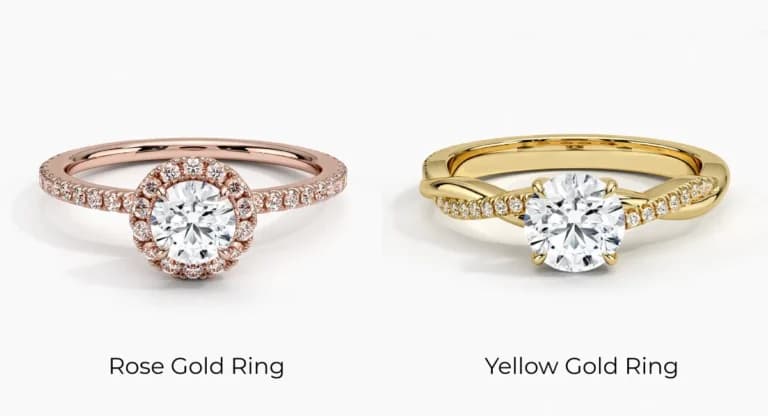
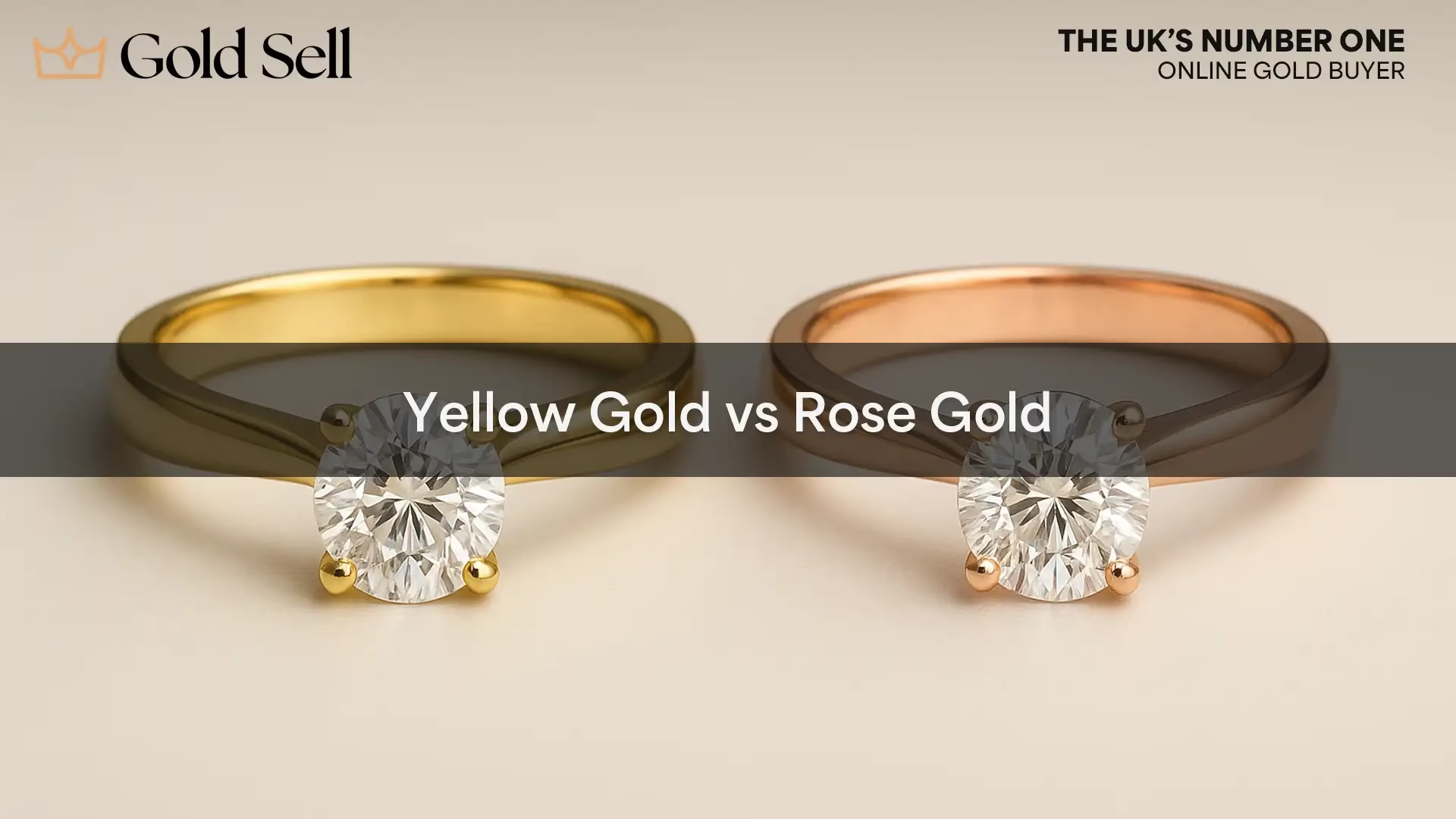
A rose gold ring (left) and a yellow gold ring (right) displayed together to clearly show how each metal’s colour and warmth differ at a glance.
Colour
Yellow gold is yellow in colour, this is the natural hue of pure gold, while rose gold has a distinctive pink or rosy tint due to the copper in its alloy. Pure 24K gold is a vibrant orangey-yellow, and higher-karat yellow gold alloys (with more gold content) appear more richly yellow. By contrast, rose gold’s blush tone becomes more pronounced with higher copper content: the more copper mixed with the gold, the deeper and redder the pink hue. For example, 18K rose gold (75% gold) has a soft pink tone, whereas 14K rose gold (58% gold, 42% other metals) looks a more saturated pink because of its greater copper proportion. Rose gold alloys may also include a bit of silver, which helps soften the red tone and produce a subtler pink shade. In summary, yellow gold displays the classic golden colour, and rose gold exhibits a warm pink sheen, both are alluring in their own way.
Alloys
Both yellow gold and rose gold are gold alloys, meaning pure gold mixed with other metals to enhance strength and modify colour. The difference lies in which metals are used. Yellow gold jewellery is typically an alloy of pure gold plus metals like silver and copper (and sometimes zinc) that preserve its yellow appearance. For instance, 18K yellow gold is about 75% gold alloyed with roughly 25% combination of silver and copper, which yields a warm yellow tone. Rose gold, on the other hand, is made by mixing pure gold with a substantial amount of copper (and often a small amount of silver). An 18K rose gold might be 75% gold, 22% copper and a touch of silver, whereas 14K rose gold uses a higher copper ratio for a redder colour. It’s important to note that at the same karat (say 14K or 18K), both yellow and rose gold contain the same proportion of pure gold, the only difference is the alloy recipe used to achieve the desired colour. In both cases, alloying gold improves its hardness for use in jewellery, since 24K pure gold is too soft on its own.
Durability
Rose gold is generally more durable and scratch-resistant than yellow gold of the same karat, thanks to its copper-rich composition. Copper is a sturdy metal, so alloying it with gold increases hardness and resistance to wear. For example, 18K rose gold (with more copper) will be a bit harder than 18K yellow gold. That said, all gold alloys used in jewellery are fairly durable when properly made. Pure 24K gold is very soft, but common purities like 14K (58% gold) or 18K (75% gold) are strengthened by their alloy metals. With yellow gold, adding metals like silver and zinc also increases hardness, and in fact a lower-karat yellow gold can be tougher than a higher-karat rose gold simply because it contains a larger percentage of other metals. (For instance, 10K yellow gold, which is only 42% gold, can be more durable than 18K rose gold which is 75% gold.) In everyday terms, both rose and yellow gold hold up well for jewellery, but rose gold has a slight edge in scratch resistance at equivalent purity. You should still treat both metals with care to avoid dents, but neither will bend or wear down excessively under normal use, especially in 14K or 18K form.
Maintenance
When it comes to maintenance, yellow gold and rose gold are quite similar and low-maintenance precious metals. Neither metal will rust or corrode, and both can keep a beautiful lustre for decades with basic care. The key is to occasionally clean and polish your gold jewellery to remove dirt and oils. Routine cleaning can be done by soaking the piece in warm water with a mild dish soap and gently brushing it with a soft cloth or soft-bristle brush. Avoid using any abrasive cleaners or rough materials, as these can scratch the gold. Also, be mindful to keep gold jewellery away from harsh chemicals. Substances like bleach, chlorine (found in swimming pools), or strong cleaning agents can react with alloy metals and may weaken or discolour the surface over time. It’s wise to remove your rose or yellow gold rings before using household cleaners or going into chlorinated water.
In terms of tarnish, pure gold does not tarnish, but the alloy metals in gold jewellery (like copper or silver) can very slowly oxidise. High-purity yellow gold (18K–22K) rarely shows tarnish, whereas lower-karat gold might get a slight dulling or darkening after long exposure to air and moisture. Rose gold is also quite resistant to tarnishing; it can develop a subtle patina over many years (a slight rosy coppery bloom), but it doesn’t tarnish in the way sterling silver does. Many wearers won’t notice any change in rose gold’s colour if they keep it clean. If your gold jewellery starts looking a bit lacklustre, a quick polish with a jewellery polishing cloth will usually restore its shine. It’s also recommended to store gold jewellery in a dry, soft container (like a fabric-lined box or pouch) separate from other pieces to prevent scratches. With proper care and storage, both yellow and rose gold require only minimal maintenance and will stay beautiful for generations.
Appearance
Beyond technical differences, yellow and rose gold each offer a distinct appearance and aesthetic. Yellow gold has a bright, rich yellow gleam that has long been associated with classic elegance and luxury. It’s the colour people traditionally think of for gold jewellery, conveying a timeless appeal. Yellow gold tends to complement warmer skin tones especially well, and it provides a striking contrast to white diamonds and deeply coloured gemstones. In fact, yellow gold’s warm hue beautifully enhances many gems, for example, blue sapphires or green emeralds set in yellow gold create a vivid, regal look. Culturally, yellow gold often symbolises wealth, tradition, and permanence (think of heirloom wedding bands or royal jewellery crafted in yellow gold).
Rose gold, in contrast, offers a softer, more romantic look. Its pinkish tone is often described as feminine, vintage-inspired, and unique. Rose gold flatters a wide range of skin tones with its warm blush colour, many find it has a neutralising, enhancing effect on the complexion. Visually, rose gold can give jewellery a subtly vintage or whimsical character; it was very popular in Victorian-era jewellery and has made a major comeback in modern designs. Jewellers today use rose gold to add warmth and uniqueness to pieces, for instance, a halo of rose gold around a diamond can impart a romantic rosy glow to the stone. Rose gold also pairs exceptionally well with certain gemstones like morganite (a peachy-pink stone), as the similar hues amplify each other’s beauty. Designers often choose rose gold to convey a modern, trendy vibe or to evoke a nostalgic, antique feel depending on the design.
In terms of perception, many consider yellow gold to be classic and timeless, whereas rose gold is seen as a chic, alternative choice that sets you apart. Neither is “better”, it truly comes down to personal taste. Some people prefer the traditional look of yellow gold that will always be in style, while others love the contemporary, “millennial” twist of rose gold. Notably, both metals can be worn together harmoniously. Fashion trends in recent years encourage mixing metal colours, and rose gold pieces complement white gold or silver and yellow gold nicely for a two-tone or even tri-tone jewellery look. There are no strict rules: you might stack a rose gold and a yellow gold ring together for contrast, or wear a rose gold pendant on a yellow gold chain, it can be quite stylish and personal.
Use
Uses in Jewellery: Both yellow gold and rose gold are widely used in all types of jewellery, but they have carved out different niches in terms of style. Yellow gold has been the standard for fine jewellery for millennia. It’s commonly used for wedding bands, class rings, religious jewellery, and heritage pieces. Because of its long history, yellow gold often carries a sense of tradition and formality, for example, many classic engagement ring designs and royal family jewels are in yellow gold. Rose gold, by comparison, was historically less common but has seen huge popularity in modern jewellery. It’s a favourite for trend-conscious designs like sleek stacking rings, fashion-forward necklaces, and vintage-inspired engagement rings. In the 21st century, rose gold became a major trend (even tech gadgets and accessories started appearing in “rose gold” hues), and it remains highly sought after. Designers use rose gold to give a fresh twist to styles, from minimalist modern pieces to ornate retro designs.
Historical Context: Yellow gold’s use in jewellery dates back to ancient civilisations. The Egyptians, Greeks, and Romans crafted jewellery from yellow gold thousands of years ago, and it has symbolised wealth and power across cultures. Nearly half of all gold mined even today is used for jewellery, underscoring how central yellow gold has been in adornment. Rose gold, on the other hand, emerged more recently in jewellery history. It became notably popular in Russia in the 19th century, so much so that rose gold was once nicknamed “Russian gold.” The famed jeweller Carl Fabergé used rose gold in his luxurious Fabergé eggs for the Russian Imperial family, sparking wider interest in the metal. Rose gold later gained popularity in the United States during the Victorian and Art Deco periods, and it has seen a strong revival in the 21st century as a fashionable choice.
Modern Popularity: In today’s market, both colours of gold are desired, but rose gold has experienced a particular surge among younger consumers. On social media and in bridal trends, rose gold has at times outpaced yellow gold, one 2025 analysis of Instagram hashtags even found rose gold to be the #1 most posted engagement ring metal, indicating its trendiness with brides-to-be. Celebrities have also embraced rose gold for engagement rings and red carpet jewellery, further fuelling its popularity. Yellow gold, while considered more traditional, has also made a strong comeback in recent years. Vintage-inspired and retro styles are in vogue, and with them yellow gold has reappeared as a stylish option for modern brides (it ranked as the second most popular engagement ring metal in that same 2025 social media study). Many iconic celebrity engagement rings are in yellow gold as well, for example, Princess Diana’s sapphire engagement ring (now worn by Kate Middleton) was set in 18K yellow gold, boosting interest in yellow gold rings after a period when white metals dominated.
Other Uses: Beyond rings and necklaces, both rose and yellow gold are used in watches, earrings, bracelets, and even fine decorative objects. Yellow gold remains a mainstay for coin jewellery and investment-grade jewellery due to its perceived value and purity (24K and 22K yellow gold pieces are popular in some cultures for this reason). Rose gold is commonly seen in fashion jewellery and has even been used as an accent metal in two-tone pieces (for example, a watch might combine stainless steel with rose gold accents). Both metals are malleable and work well for intricate designs or engravings. Because they share the same fundamental properties (being mostly gold), jewellers can set any kind of gemstone in either yellow or rose gold. Ultimately, the use of yellow vs. rose gold in a piece comes down to the aesthetic effect desired: if a designer or customer wants a classic, vibrant gold look, yellow gold is the go-to; if they want a romantic or distinctive flair, rose gold is an excellent choice.
What Is Rose Gold?
Rose gold is a gold alloy known for its delicate pinkish colour. It is made by blending pure gold with copper (and often a small amount of silver), creating a warm-toned metal used in jewellery. In other words, rose gold is real gold, it contains a significant percentage of pure gold, but the presence of copper gives it that rosy hue instead of the yellow of pure gold. Common varieties include 18K rose gold (which is 75% gold and 25% other metals) and 14K rose gold (58.5% gold and about 41.5% other metals, mostly copper). Because it contains the same proportion of gold as any other alloy of the same karat, rose gold has the same intrinsic value as yellow or white gold of equal purity. Its market value fluctuates with the price of gold, not with its colour, the copper and silver in the alloy are relatively inexpensive and do not add much cost.
The appeal of rose gold lies in its unique colour and surprisingly durable nature. Gold in its pure form (24K) is very soft, but the addition of copper makes rose gold harder and tougher than pure gold. In fact, rose gold is a bit more durable than yellow gold of the same karat, since copper is a sturdier metal than the silver or zinc often used in yellow gold. This durability and its romantic colour have cemented rose gold’s place in modern fine jewellery. Rose gold has become especially popular for engagement rings, wedding bands, and fashion jewellery in recent years. Many people choose it as a fresh alternative to more common white gold or yellow gold. Its rise in popularity has been significant, for example, trends reports in the mid-2020s noted that rose gold remains one of the trendiest metals for engagement rings and jewellery. Its vintage charm yet contemporary cool factor make it appealing to a broad range of ages.
In terms of composition, rose gold is typically an alloy of gold, copper and sometimes silver. A classic formula for 18K rose gold is about 75% gold, 22–23% copper, and perhaps 2–3% silver. The copper is the key ingredient that creates the rose colour, copper has a red-orange tone, so when mixed with yellow gold, the result is a pinkish gold. Small amounts of silver (or sometimes zinc) may be added to fine-tune the shade or the melting characteristics. Higher copper content yields a stronger red colouration (sometimes called “red gold”), while a bit more silver produces a lighter pink (“pink gold”). These terms (red, rose, pink gold) all refer to gold-copper alloys but with slightly different hues. It’s worth noting that rose gold is a man-made alloy, it doesn’t occur naturally in the earth. All rose gold jewellery is created by metallurgists and jewellers combining pure 24K gold with the other metals in the right proportions.
Uses of Rose Gold: Rose gold’s modern popularity means it’s used in virtually every kind of jewellery today. You’ll find rose gold engagement rings (a very popular choice for those who want a romantic or non-traditional ring), rose gold earrings, bracelets, pendants, and even watches with rose gold cases or accents. Its versatile colour complements both diamonds and coloured gemstones nicely. For example, a Morganite stone (which has a peachy-pink colour) is often paired with rose gold prongs or band to enhance the stone’s blush hue. Rose gold is also common in multi-tone jewellery designs, providing a beautiful contrast to white diamonds or to white/yellow gold elements.
Care and Maintenance: Caring for rose gold is straightforward, it doesn’t require any special plating or treatment to maintain its colour (unlike white gold, which is often rhodium-plated). The colour you have is throughout the metal, so it won’t fade or wear away with normal use. Rose gold jewellery should be cleaned periodically with mild soap and water and a soft cloth to keep it free of oils and dirt. Like all gold alloys, it’s wise to keep rose gold away from harsh chemicals or abrasive cleaners that could potentially affect the alloy metals. With proper care, rose gold jewellery will retain its warm glow for many years without much fuss, it’s generally as easy to maintain as yellow gold.
Allergies: One question often asked is whether rose gold is hypoallergenic. Rose gold typically does not contain nickel (a metal that often causes allergic reactions in jewellery), which is good news for those with nickel allergies. The primary non-gold metal in rose gold is copper, and sometimes silver. Most people do not have strong reactions to copper when it’s alloyed in gold, so rose gold is usually comfortable even for sensitive skin. In fact, rose gold (and yellow gold) are considered more skin-friendly than white gold alloys that contain nickel. However, a small percentage of people with metal sensitivities could react to copper or other trace metals in lower-karat rose gold. If you have known metal allergies, it’s advisable to opt for 18K rose gold (which has less copper proportionally than 14K) or ensure the alloy is nickel-free. In general, rose gold is less likely to trigger allergic reactions than many other metal options. Always communicate any metal allergies to your jeweller; they can confirm the alloy composition or suggest higher-purity gold or alternative metals (like platinum) if needed.
Why It’s Called “Rose” Gold: The term comes simply from its rosy pink colour. In some countries and eras it was also called “pink gold” or “red gold.” These all refer to similar gold-copper alloys with varying shades. Historically, as mentioned, “Russian gold” was an early name after it gained popularity in Russia. Today “rose gold” is the prevailing term, evoking the flower-like, romantic nature of its hue.
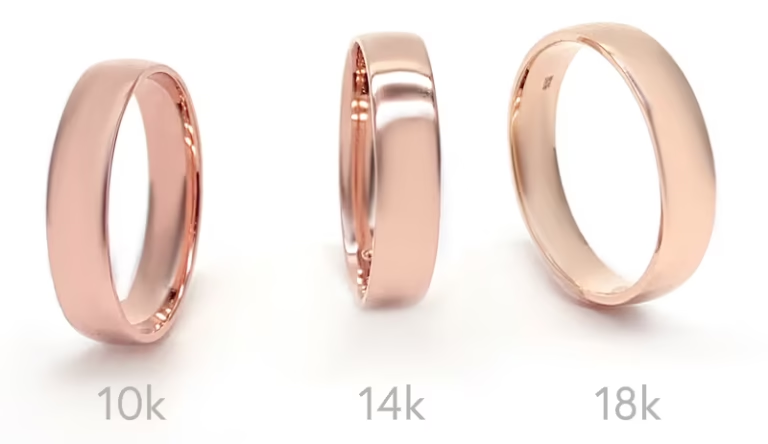
These 10k, 14k and 18k rose gold rings show how increasing gold purity lightens the metal’s colour. Lower-karat rose gold appears deeper and redder due to higher copper content, while higher-karat rose gold looks softer and more subtle, illustrating how alloy ratios shape the final rose gold shade.
What Is Yellow Gold?
Yellow gold refers to the traditional form of gold used in jewellery, gold that displays the metal’s natural yellow colour. In pure form, gold is a bright yellow element. Jewellery gold (being less than 24K) is not 100% pure; it’s an alloy of gold with other metals to improve its strength, but it is formulated to retain that classic yellow appearance. For example, 18K yellow gold is about 75% pure gold alloyed with 25% other metals (commonly copper and silver), which yields a warm yellow tone almost indistinguishable from pure gold. Even 14K yellow gold (58.5% gold, 41.5% other metals) still has a yellow look, though slightly lighter in shade than 18K due to the higher proportion of white alloy metals. Essentially, yellow gold is “real” gold, it contains real gold through and through, combined with small amounts of other metals to make it harder and to adjust the colour slightly. It’s the only colour of gold that exists naturally; other gold colours (white, rose, etc.) are achieved by specific alloy mixes.
Yellow gold has been prized for centuries for its beauty and malleability. Because pure gold (24K) is quite soft, it’s usually mixed with metals like silver, copper, and zinc to create jewellery-grade gold that can withstand wear. These additions also influence the exact shade of yellow: for instance, silver tends to lighten or tone down the yellow, while copper adds a warmer, richer cast. High-karat yellow gold (such as 22K, which is ~92% gold) has a very rich saturated yellow-orange colour, whereas 14K yellow gold (only 58% gold) appears a bit paler or more muted in comparison. But all are considered “yellow gold” as long as the intent is to keep that traditional golden look. Unlike white gold, which is deliberately made to appear white and often rhodium-plated, yellow gold’s alloys are chosen to support its natural colour rather than mask it.
Uses of Yellow Gold: Yellow gold is ubiquitous in jewellery. It has been the metal of choice for wedding bands and engagement rings in many cultures. Classic solitaires, three-stone rings, and church rings have traditionally been crafted in yellow gold. Many luxury timepieces (watches) are offered in yellow gold or gold-toned stainless steel to capitalise on gold’s prestige. In addition, yellow gold is common in necklaces, earrings, bangles, and virtually any form of adornment. Its neutral yet rich colour pairs elegantly with gemstones of all colours, for example, the famous engagement ring of Princess Diana (now Kate Middleton) features a deep blue sapphire in a yellow gold setting, a combination which makes the blue really “pop” against the warm gold. Yellow gold is also widely used in men’s jewellery (rings, cufflinks, etc.) where a classic and masculine look is desired, as well as in cultural jewellery (like Indian bridal jewellery or Middle Eastern gold pieces) where very high karats of yellow gold (22K or even 24K) are traditional.
Value and Purity: The value of yellow gold jewellery is primarily determined by its gold content (karat and weight) and craftsmanship, not by the presence of other alloys. This means a 18K yellow gold ring and an 18K rose gold ring of identical weight will have essentially the same gold value. Yellow gold is often sold in karats: 24K is pure gold, but too soft for most wear; 22K, 18K, 14K, and 9K (in some regions) are used for jewellery, with 18K and 14K being common for a balance of richness of colour and durability. In some cultures, high-karat yellow gold jewellery (21K, 22K, etc.) is favoured both for its deeper colour and as a store of value, for example, 22K gold bangles that can be worn but also represent investment in gold. Lower karat yellow gold, like 14K, is popular in the West for its strength and affordability (since it has less gold). Regardless of karat, reputable yellow gold jewellery will be hallmarked or stamped with its karatage (for instance “18K” or “750” for 18K). This tells you the piece is indeed made of genuine gold alloy of that purity.
Durability: In terms of hardness and scratch resistance, yellow gold varies with karat. 14K yellow gold, having a higher percentage of other metals, is relatively hard and excellent for everyday wear, resisting scratches better than 18K or 22K gold (which are softer due to higher gold content). 18K yellow gold is slightly softer but still durable enough for most jewellery; it might scratch a bit more easily than 14K, but many people prefer its richer colour and find the trade-off in hardness acceptable. It’s worth noting that pure gold (24K) does not tarnish or corrode, it’s a very inert metal. The alloys in yellow gold (like copper or silver) can tarnish, so a lower-karat yellow gold piece might eventually get a faint tarnish if heavily exposed to the elements. However, this is usually minimal; yellow gold is known for keeping its shine. With occasional polishing, even an old yellow gold ring can look as bright as new. Many antique yellow gold pieces survive beautifully due to gold’s stability.
Care: Caring for yellow gold is virtually the same as for rose gold as described above. Regular gentle cleaning, avoiding harsh chemicals, and proper storage will keep it gleaming. One advantage of yellow gold’s persistence in jewellery is that it typically doesn’t have surface coatings (unlike rhodium on white gold), so you don’t need to worry about any plating wearing off. What you see is the metal itself, all the way through. As with any pronged jewellery, you’ll want to have settings checked periodically (gold prongs can wear over many years), but the metal’s colour and integrity will remain. If a yellow gold piece develops tiny scratches from wear (normal “patina of wear”), a professional polishing at a jeweller can restore a mirror finish. Many people actually appreciate a bit of patina on older gold jewellery as it can give character, but if you prefer a like-new shine, yellow gold is easy to buff back to perfection.
Hypoallergenic Considerations: Is yellow gold hypoallergenic? Generally, high-karat yellow gold (18K and above) is very unlikely to cause allergic reactions since gold itself is biocompatible and the common alloy metals (silver, copper) are usually well-tolerated. Low-karat gold (9K, 10K) can sometimes contain trace amounts of nickel or other white metals, which in some cases cause allergies. However, most quality yellow gold alloys today avoid nickel (nickel is more often used in white gold). If someone has a copper allergy (quite rare), they could potentially react to the copper in yellow gold alloys, though it’s uncommon. Overall, allergies to yellow gold are infrequent. Those with extremely sensitive skin might opt for 18K or 22K gold or even platinum just to be safe. It’s always a good idea for anyone with metal allergies to discuss alloy ingredients with their jeweller.
In summary, yellow gold is the quintessential jewellery metal, timeless, richly coloured, and precious. It represents the metal in its most recognisable form. Whether in a simple gold chain or a diamond-studded ring, yellow gold brings a classic shine that has been cherished from ancient times to the present day.
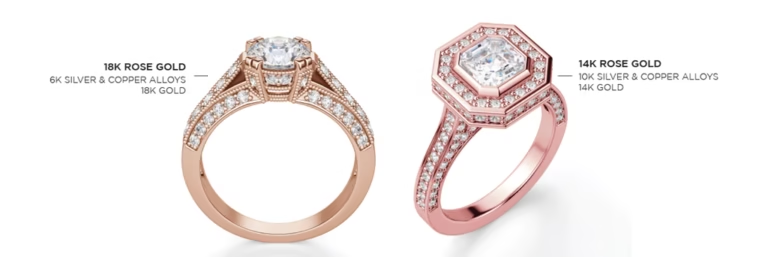
Rose gold is made by blending pure gold with copper-rich alloys, and the amount of copper determines how light, warm, or deeply pink the final metal appears. As shown here, 18K rose gold contains a lower proportion of copper than 14K, resulting in a softer blush tone, while 14K rose gold, made with more copper in the alloy, produces a richer, more vibrant pink shade.
How Is Rose Gold Made?
Rose gold is made by mixing pure gold with copper (and often a bit of silver) to create a gold alloy with a pink tint. The process starts with 24K pure gold, which is too soft and bright yellow on its own. Metallurgists or jewellers melt down the pure gold and then add in the precise amounts of copper and silver to form the rose gold alloy. The metals are blended together thoroughly (often in a crucible or furnace) until they fuse into a uniform mixture, and then the molten rose gold is cast into bars, sheets, or the desired jewellery components.
The key to rose gold’s creation is the ratio of copper to gold (and silver). Copper is what imparts the rosy-red colouration, it literally “roses” the gold. Silver, when used, tends to soften the pink and add a bit of lustre. A higher copper ratio will deepen the pinkish-red hue, while a higher gold or silver content will result in a lighter rose or pink shade. For example, 18K rose gold (75% gold, 25% alloy) typically contains around 22–23% copper and perhaps 2–3% silver. This yields a classic rose colour, noticeable pink but not extremely red. In 14K rose gold (58.3% gold, 41.7% alloy), the copper portion is higher (on the order of 33% copper, 8–9% silver), giving 14K rose gold a slightly redder, more pronounced pink hue than 18K. Some rose gold formulations, especially those called “red gold,” might omit silver entirely and use just gold and copper (for instance, 18K red gold can be 75% gold + 25% copper), resulting in a stronger red tone.
To manufacture rose gold, once the metals are combined and molten, they are poured into moulds or formed into an ingot which is then rolled or drawn into whatever form needed (sheet, wire, etc.) for making jewellery. The result is a solid alloy, meaning the pink colour is present throughout the metal, not just on the surface. It’s important to control the proportions carefully; even small differences in copper content can slightly change the colour. For consistency, jewellers use specific recipes (often noted in percentages or parts). Modern refining and casting techniques allow for very uniform rose gold alloys.
One notable point is that rose gold does not occur naturally in mines. Gold comes out of the earth as yellow (and occasionally with a natural mix of other metals giving a slight colour, but not the pink we see in jewellery). The rose gold we use is entirely a human-created alloy made by intentional combination of metals. This is similar to how white gold is made (mixing gold with white metals). In the past, especially in the 19th century, different jewellers experimented with these alloys, which is how rose gold became popular.
In summary, to make rose gold you start with pure gold, add copper to impart the rose colour, and sometimes add a touch of silver to fine-tune the shade. Melt them together under high heat, mix thoroughly, and solidify, you now have rose gold material. The exact recipe can vary: common blends include 18K rose (approx 75% Au, 22% Cu, 3% Ag) and 14K rose (approx 58% Au, 33% Cu, 9% Ag). These ratios not only affect colour but also hardness, 14K (with more copper) will be a bit harder than 18K. Once the rose gold alloy is made, it is worked just like any other gold alloy: craftsmen can roll it into sheets, draw it into wires, and fabricate rings, chains, or any jewellery. The beautiful pink colour is uniform and won’t wear off, since it’s not a coating but the actual metal’s colour through and through.
Can Rose Gold Tarnish?
Rose gold does not tarnish in the typical sense, but it can develop a slight patina over time due to the copper content in the alloy. In general, pure gold is immune to tarnish or rust, and since rose gold is majority gold, it remains very resistant to oxidation. You won’t see rose gold jewellery turning black or green like you might with brass or bronze. That said, the copper within rose gold can slowly oxidise with exposure to air and moisture, which may cause the jewellery’s surface to deepen in colour slightly or lose a bit of its initial sheen after many years. This subtle change is often called a patina, a thin layer of oxidation that can impart an antique character. Some rose gold pieces, especially vintage ones, gain a warmer, somewhat richer look because of this gentle patina developing (often described as making the piece look more “aged” or “romantic”). The patina process is quite slow and mild, it’s not like silver which can tarnish and darken within months if not cleaned. In fact, many wearers will not notice any tarnish on rose gold for a very long time, especially if the piece is worn regularly (the friction from wearing it can keep it polished) and cleaned occasionally.
Importantly, the kind of “tarnish” rose gold might get is not damaging and is easily addressed. If your rose gold ring or pendant looks a little less bright than when new, a quick polish with a soft cloth or a professional buff at a jeweller will remove any dull film and restore its rosy shine. Unlike some other metals, rose gold doesn’t need constant maintenance, it holds its colour and lustre quite well. There’s no rhodium plating to redo (as there is with white gold) and no risk of a pure copper layer rubbing off (rose gold is an alloy through-and-through, not a coating). So in practical terms, rose gold is often said to “not tarnish” or to be tarnish-resistant.
One thing to watch for: because of the copper, rose gold can react with skin chemistry in rare cases. If someone has very acidic perspiration or wears a rose gold ring while using certain chemicals, they might notice a faint green or dark stain on their skin where the ring sits. This greenish mark is not the gold itself corroding (gold doesn’t corrode) but the copper alloy reacting, it’s similar to how copper can leave a green on skin. It tends to happen more with lower karat rose gold (like 10K or 14K which have higher copper percentages) and with individuals whose skin chemistry triggers it. The green discolouration is harmless and washes off the skin, and the ring can be cleaned easily as well. Not everyone experiences this, it’s an edge case, but it’s worth mentioning. If you do find a rose gold ring leaving a slight mark, keeping the ring clean and dry (and even adding a clear coating inside the band) can mitigate it.
In summary, rose gold is highly tarnish-resistant. It won’t oxidise heavily or change colour drastically. Over many years, you might observe a bit of deepening or a less mirror-bright surface, which is the patina forming due to copper oxidation, often described as giving the piece “character”. This can actually look appealing to some, but if you prefer the original shiny pink, a simple repolishing will bring it back. Regular gentle cleaning (just with mild soap and water) will also prevent any noticeable tarnish from setting in. Unlike sterling silver that needs frequent polishing, rose gold is very easy to maintain. So the short answer is: No, rose gold does not tarnish in the way silver does. It remains beautiful with minimal upkeep, and any minor dulling that does occur over a long period can be reversed, keeping your rose gold jewellery glowing for decades.
Frequently Asked Questions
Is yellow gold real?
Yes, yellow gold is real gold. Pure gold is naturally a rich yellow metal and jewellery alloys are created by mixing it with metals such as silver, copper or zinc for strength and durability. These alloys are still genuine gold, simply less than 24 karats. So 9K, 14K or 18K yellow gold rings all contain real gold in different proportions, and their value rises and falls with the gold price.
How is rose gold made?
Rose gold is made by alloying pure gold with copper and usually a little silver. Copper provides the warm pink tone, while silver lightens and softens the colour. A typical 18K rose gold recipe is about 75 percent gold, roughly 22 percent copper and a few percent silver. By adjusting these ratios, jewellers control the exact shade and hardness, creating everything from soft blush to deeper red gold.
Can rose gold tarnish?
Solid rose gold is very resistant to tarnish because most of the alloy is pure gold, which does not corrode. The copper content can gently oxidise over many years and create a soft patina that makes the metal look a little deeper or redder rather than black. This patina is usually considered attractive and can be polished away if you prefer a brighter finish. Regular gentle cleaning keeps rose gold looking fresh.
Can yellow gold tarnish?
Pure 24K gold does not tarnish. Yellow gold jewellery is usually 9K, 14K or 18K, which means pure gold alloyed with other metals such as copper and silver. Those alloy metals can react with air, sweat, perfumes or chlorine and cause light darkening or loss of shine over time. Any tarnish is normally superficial and can be removed with mild soapy water or a professional polish.
Yellow gold versus gold?
Yellow gold and gold are usually the same thing in everyday use. Gold in its pure state is a yellow metal, so traditional alloys that preserve this colour are called yellow gold. The term simply distinguishes it from white or rose gold, which use different alloy mixtures to change the colour. Regardless of wording, purity is still measured in karats and determines how much real gold the piece contains.
Rose gold or yellow gold?
Choosing rose gold or yellow gold is mostly about colour and lifestyle. Rose gold gives a romantic pink tone and its higher copper content can make it slightly more scratch resistant at the same karat, which suits everyday wear. Yellow gold offers the classic rich gold look that many associate with heirloom jewellery. At the same karat they contain equal amounts of pure gold and are similarly valuable, so pick the shade you love most.
Is rose gold real?
Yes, rose gold is real gold. It is a genuine alloy created by combining pure gold with copper and sometimes silver to produce a pink colour. For example, 14K rose gold contains about 58 percent gold and 18K rose gold contains 75 percent gold, the same gold content as 14K or 18K yellow gold. Its intrinsic value therefore follows the gold market, not its colour.
Is rose gold more expensive than yellow gold?
Rose gold is usually not more expensive than yellow gold when comparing the same karat and weight. Both metals are priced primarily on the amount of pure gold they contain. An 18K rose gold band and an 18K yellow gold band of similar design normally cost very similar amounts. Any difference tends to reflect design, brand and workmanship rather than the relatively low cost of copper or silver in the alloy.
Does rose gold fade?
Solid rose gold does not fade to white or yellow because its colour comes from the metals within the alloy, not from surface plating. The gold, copper and silver mixture is pink all the way through, so scratches reveal the same colour. Over many years the copper can form a light patina that makes the shade look slightly deeper, but a gentle polish restores the brighter rosy appearance.
What makes rose gold rose?
Rose gold gets its rosy colour from copper in the alloy. Pure gold is naturally yellow. When jewellers mix in a significant proportion of copper, the resulting metal takes on a pink or red tone because copper is reddish brown. Small amounts of silver are often added to soften the red and create a softer pink. Different gold, copper and silver ratios produce pink, classic rose or deeper red gold shades.
Does rose gold and silver go together?
Yes, rose gold and silver jewellery pair beautifully. The warm pink tone of rose gold softens the cool white shine of silver or white gold, which makes layered necklaces, stacked rings or mixed bangles look deliberate and stylish. Current jewellery trends actively encourage mixing metals, and many UK jewellers recommend combining gold, silver and rose gold to create versatile, modern combinations that work with a wide range of outfits.
Will rose gold plated tarnish?
Rose gold plated pieces are more likely to tarnish than solid rose gold. Plating uses a very thin layer of rose gold over a base metal such as brass, copper or silver. With wear, friction and exposure to moisture or cosmetics gradually break down this thin coating and allow the base metal to oxidise, causing darkening or patchy colour. Careful cleaning, keeping jewellery dry and occasional re plating extend its life.
Is rose gold hypoallergenic?
Rose gold is often described as hypoallergenic because it usually contains gold, copper and silver rather than nickel, which causes most metal allergies. Many people with sensitive skin wear rose gold comfortably. However, a small number of people react to copper or to trace nickel in some alloys. If your skin is very reactive, choose 18K nickel free rose gold and confirm the alloy details with your jeweller before buying.
Interested in selling gold with the UK’s highest paying gold buyer? Visit our Sell Gold page to get a competitive valuation – we provide fully insured postage and fast payment.
For more insights and the latest gold price today, keep an eye on our live charts and blog updates.