
Gold Filled vs Gold Plated
Gold filled jewellery has a much thicker layer of gold than gold plated jewellery, making it more durable and valuable in the long run. Gold filled pieces are created by bonding a substantial layer of real gold to a base metal, whereas gold plated items only have a microscopic gold coating on the surface. This fundamental difference means gold filled jewellery better resists wear and tarnish over time, while gold plated pieces are more prone to fading or chipping due to their very thin gold layer.
Key Takeaways
- Gold Content: Gold filled jewellery must contain at least 5% real gold by weight, giving it around 100x more gold content than gold plated jewellery. Gold plated items usually have less than 0.05% gold (just a thin electroplated layer), which is why gold filled pieces carry greater intrinsic value.
- Durability & Tarnish Resistance: Gold filled jewellery is far more durable and tarnish-resistant. Its thick gold layer (bonded under heat and pressure) rarely wears off, so gold filled items can last for decades without tarnishing. Gold plated jewellery, with its flimsy gold coating, can show wear or discolouration within months of frequent use and will likely need re-plating over time.
- Hypoallergenic Qualities: Gold filled pieces are generally hypoallergenic, the substantial gold layer shields the skin from any irritants in the base metal. Gold plated pieces may cause allergic reactions once the ultra-thin gold layer rubs off, exposing base metals (often nickel, brass, or copper) that can irritate sensitive skin.
- Appearance & Maintenance: At first glance, gold filled and gold plated jewellery both look like gold, but gold filled maintains its rich gold lustre much longer. Gold plated finishes tend to dull or fade quicker as the base metal peeks through. Gold filled items can be cleaned normally with mild soap and water, whereas gold plated pieces require more gentle care, just a soft cloth and avoiding exposure to water, sweat, or chemicals to prevent premature tarnish.
What Is Gold Filled Jewellery?
Gold filled jewellery (sometimes called “rolled gold” or “gold bonded”) is a type of jewellery made by permanently bonding a thick layer of real gold to a base metal core like brass or copper. In essence, the gold is mechanically fused to the inner metal using heat and pressure, creating a durable, uniform coating of gold all around the piece. Unlike gold plating, this gold layer in gold filled items is legally required to be at least 5% of the item’s total weight. If a piece has less than 5% gold by weight, it cannot be marketed as “gold filled.” (For context, the gold plated definition entails a much thinner layer, usually well under 0.05% of the item’s weight, applied by electroplating rather than mechanical bonding.)
Because of this high gold content, gold filled jewellery has a significant amount of real gold in its construction. A common example is 1/20 14K gold filled, which means the item is 5% 14-karat gold by weight. The gold used is often 10K, 12K or 14K in purity, providing the classic look of solid gold at a fraction of the price. Visually, gold filled pieces have the same rich yellow tone as genuine gold jewellery and are often indistinguishable from solid gold to the untrained eye. In fact, most high-quality gold filled items have the appearance and lustre of high-carat gold, and they can last 10 to 30 years even with daily wear before the gold layer might eventually wear down.
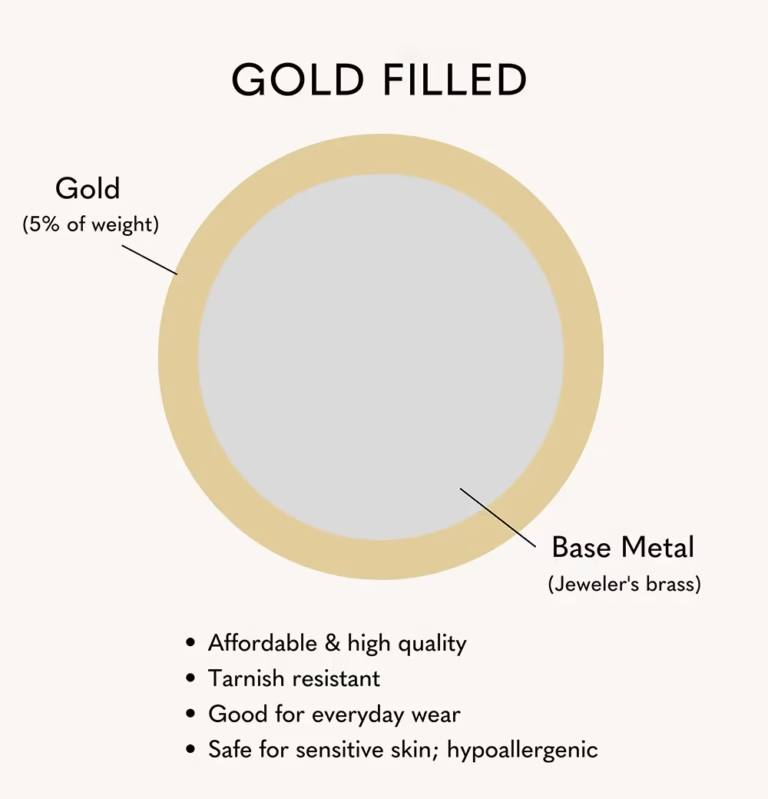
Gold filled jewellery is made by mechanically bonding a substantial layer of solid gold to a brass core. This process ensures the outer surface is real gold, providing the look and longevity of solid gold at a lower cost. Because the gold layer makes up at least 5% of the total weight, gold filled pieces are much more durable, tarnish-resistant, and skin-friendly than standard plated jewellery.
Importantly, the thick gold layer in gold filled jewellery is bonded so strongly that it won’t flake or peel off. This is a permanent metallurgical bond, not a fragile plating. As a result, gold filled jewellery is highly durable and resistant to tarnish. It’s a popular choice for quality-conscious buyers who want the look and feel of real gold without the cost of solid gold. Gold filled items can be worn daily without worry: their gold layer is 50 to 100 times thicker than the layer on a gold plated item, so it withstands wear and exposure far better. Many heirloom pieces like vintage lockets or watch cases were often gold filled, precisely because this technique produces a long-lasting gold finish.
In summary, gold filled means a thick layer of real gold (usually 5% of the piece) is mechanically bonded to a base metal interior, yielding a robust product that looks truly gold. It should not be confused with gold plating. In fact, to reiterate the gold plated definition for contrast: gold plated jewellery has only a microscopically thin film of gold electrically deposited onto the surface. Gold filled jewellery, by comparison, carries a much more substantial gold presence, making it a superior option in terms of durability and longevity.
What Is Gold Plated Jewellery?
Gold plated jewellery refers to items made of a non-gold base metal that have been covered with a very thin layer of real gold by electroplating. In gold plating, the base object (often brass, copper, nickel, or stainless steel) is dipped into a solution and an electric current deposits a thin layer of gold onto its surface. The resulting gold layer is typically extremely thin, often between about 0.5 to 2.5 microns in thickness, and sometimes even thinner for inexpensive fashion jewellery. In terms of gold content, gold plated jewellery usually contains well under 0.05% actual gold by total weight (in many cases, the gold is so minimal it’s negligible). This is the key aspect of the gold filled meaning versus gold plated: gold filled has a mandatory 5% weight in gold, whereas gold plated items do not have a regulated minimum gold content and generally use only a flash of gold for colour.
Because the gold layer in plating is so thin, gold plated jewellery is much less durable. The gold coating can wear away with time and exposure, revealing the base metal underneath. For instance, on a frequently worn ring or chain, the gold plating might start rubbing off within a matter of months to a couple of years, depending on the thickness of the plate and how often it’s worn. Higher-end gold plated pieces sometimes use a somewhat thicker layer (perhaps up to 5–10 microns on luxury costume jewellery), but even that is tiny compared to gold filled standards. Many standard plated pieces have only a flash plating (often 0.5 micron or less).
Gold plated jewellery is affordable and great for trendy, occasional-wear pieces. Because so little gold is used, these items are usually much cheaper than both solid gold and gold filled items. You can enjoy the look of gold without a big investment. However, the trade-off is that the gold finish is not permanent. Over time, the thin gold layer can fade, dull, or tarnish as it wears down. Notably, gold itself doesn’t tarnish, but once plating thins, the exposed base metal (like copper or brass) can oxidise, causing discolouration or darkening of the jewellery’s appearance.
Maintenance is particularly important for gold plated items because of their delicate finish. It’s recommended to keep gold plated jewellery away from water, sweat, perfume, and chemicals, as these can speed up the breakdown of the gold layer. Even oils from your skin can slowly wear away the plating. Cleaning should be done very gently, typically just wiping with a soft cloth. Aggressive polishing or abrasive cleaners will strip off the thin gold layer quickly. (By contrast, gold filled pieces can handle more regular use and gentle cleaning without issue.)
In summary, gold plated jewellery is a base metal piece with a thin wash of gold on top. It’s an excellent choice if you want the appearance of gold for a low cost or for pieces you don’t plan to wear daily. Just be aware that the gold is only on the surface and not in great quantity, so these pieces require careful handling to preserve their finish. The gold filled meaning in this context becomes clear: gold filled has a much thicker gold layer and is a longer-lasting, higher-quality product, whereas gold plated is a more temporary gold-coloured finish.
Gold Filled vs Gold Plated
When comparing gold filled vs gold plated jewellery, it’s important to understand the difference between gold filled and gold plated jewellery across several key factors. These two types of gold finishes may look similar initially, but they differ in their gold content, durability, appearance, hypoallergenic properties, cost, and maintenance needs. Below, we break down each of these aspects to highlight what sets gold filled and gold plated pieces apart.
Gold Content and Composition
The gold content is the most significant difference between gold filled and gold plated jewellery. Gold filled jewellery contains a substantial amount of real gold – by law it must be at least 5% of the item’s weight in gold. In practice, that means a gold filled piece has a thick gold sheet or layer bonded over the entire surface of the item. For example, a 10-gram gold filled bangle will have about 0.5 grams of actual gold in it. This is a much higher gold proportion than gold plated pieces. Gold filled items are often marked with designations like “1/20 14K GF,” indicating the fraction and karat of gold content (here 1/20th of the weight is 14K gold).
On the other hand, gold plated jewellery has only a minuscule amount of gold on its exterior. There is no specific minimum gold weight requirement for plating, it’s whatever the manufacturer decides to apply, which is usually just enough to give a gold-coloured look. Estimates for typical gold plated jewellery put the gold content at only up to 0.05% of the item’s weight or even less. In terms of thickness, gold plating might be on the order of fractions of a micron. This is why gold plated items are so inexpensive, the gold itself contributes virtually no weight or precious metal value. Some higher-quality gold plated jewellery (like vermeil, which is gold plated sterling silver) uses a thicker plating of around 2.5 microns, but even that remains far thinner than a gold filled layer.
To visualise the difference: the gold layer on a gold filled item can be dozens of times thicker than that on a gold plated item. This huge disparity in gold content not only affects the value but also the performance of the jewellery over time.
In composition, gold filled pieces are usually made with brass or a similar alloy core and then coated in a karat gold alloy (often 14K). Gold plated pieces can have a variety of cores, brass and copper are common, but sometimes zinc or nickel alloys, or even stainless steel. The gold used for plating can be any karat (sometimes 22K or 18K is used for a rich yellow appearance), but because it’s so thin, the karat doesn’t drastically change durability, it’s the thickness that matters more. No matter the karat, a thin gold plating means low gold content overall. Gold filled, conversely, guarantees a significant amount of gold is present in the item by weight.
Durability
In terms of durability, gold filled jewellery is vastly superior to gold plated jewellery. The thick gold layer on gold filled pieces means they can withstand regular wear and even contact with skin or the elements without immediately losing their gold appearance. Gold filled items do not chip or wear through easily, under normal use, you could enjoy a gold filled necklace or ring for many years before you might notice any of the base metal showing. In fact, gold filled jewellery is often said to last several decades. With proper care, a quality gold filled chain or pendant can last 20–30 years and still keep its gold shine. Many vintage gold filled pieces from the mid-20th century still look great today, which speaks to their durability.
By contrast, gold plated jewellery is much less durable because of the thinness of its gold layer. The plating on a frequently worn piece can start to rub off relatively quickly. For example, plated rings or bracelets (which get a lot of friction) might begin to reveal the base metal after only a few months of daily wear. Even on items like necklaces or earrings, which get slightly less abrasion, the gold plating can gradually dull or wear away within a year or two of regular use. Once the gold layer is breached or thins out, the piece may noticeably change colour (as the base metal oxidises) and lose its gold-like appearance. At that point, the only remedy is to re-plate the item with gold if you want to restore its original look.
Several factors influence how quickly gold plating wears down: the thickness of the plating, the amount of wear and friction (e.g., rings vs. pendants), and exposure to chemicals or sweat. But no matter what, because the gold layer is so small, gold plated jewellery simply cannot tolerate rough handling or long-term wear the way gold filled can. Gold plated pieces are best treated as delicate fashion accessories — put them on for the occasion, and take them off after use, storing them carefully. Gold filled pieces, on the other hand, are robust enough for everyday wear; they don’t chip or fade easily and are even used in things like watch cases or eyeglass frames precisely for their resilience.
In short, gold filled = very durable, gold plated = relatively fragile. If you want a piece that can accompany you daily (like a signature necklace or a pair of go-to hoops), gold filled is the better choice because it will maintain its gold layer for the long haul. Gold plated is best for occasional-wear items or trendy pieces you might only wear for a season.
Appearance
At a glance, both gold filled and gold plated jewellery offer the attractive look of gold, since both are initially coated in real gold. To the naked eye, a new gold plated piece can be virtually indistinguishable from a gold filled piece or even solid gold. Both will have that lustrous yellow shine of gold when new. Thus, in terms of immediate appearance, there may be no obvious difference when the pieces are brand new.
However, there are some subtle differences in appearance that can manifest, especially over time. Gold filled jewellery typically retains a richer, more consistent gold colour over its life. The layer of gold is thick enough that the colour stays true and doesn’t fade. Gold filled pieces often have a brilliant, shiny finish similar to solid 14K gold, and because the gold layer is substantial, the tone can appear deeper and more lustrous. Additionally, since the gold layer in gold filled items is less prone to wearing off, the piece’s appearance remains consistent year after year; it won’t suddenly turn brassy or dull unless the gold layer is actually compromised (which usually takes many years).
Gold plated jewellery, while shiny and golden at first, may not have as rich a colour in some cases. Because the gold layer is so thin, sometimes the underlying metal can subtly affect the hue (for instance, a very thin plating over a dark base might not look as vibrant as a thicker gold layer would). More importantly, as a gold plated piece ages, its appearance will change. The finish can become dull or patchy as the gold microscopically wears off. You might notice areas that look slightly less yellow or more pale once some of the base metal starts mixing in or showing through. Eventually, a heavily worn gold plated item can visibly lose its gold colour in spots, appearing silverish or coppery depending on the base metal.
Tarnishing and discolouration also relate to appearance. Gold itself doesn’t tarnish, but the base metals do. In gold filled jewellery, the base metal is kept away from air by the thick gold coat, so tarnishing is not an issue on the surface. Gold plated jewellery, on the other hand, might start to tarnish once the plating is thin enough that air reaches the base metal, causing that dull or dark tarnish film to appear. So a gold plated necklace might look shiny at first, but if left exposed to air and humidity for a long time, you might find it looks darker or greenish in areas (where copper in the alloy oxidised) once the scant gold layer permits oxidation.
From a normal viewing distance, gold filled and gold plated can look identical when new, so appearance isn’t a differentiator initially. But over time, gold filled will far outshine gold plated. Gold filled jewellery will maintain a bright, untarnished gold appearance for many years, whereas gold plated pieces will likely fade or discolour relatively soon if worn often. For someone concerned about their jewellery looking nice in the long term, this is a key point of distinction.
Hypoallergenic Properties
If you have sensitive skin or metal allergies, the difference between gold filled and gold plated can be significant. Gold itself is a hypoallergenic metal, and it rarely causes skin reactions. The issue with jewellery allergies usually comes from metals like nickel, copper, or brass, which can cause irritation when they contact the skin.
Gold filled jewellery is generally considered hypoallergenic because the outer surface that touches your skin is real gold (often 14K gold or similar), and that layer is thick enough to prevent reactions in most people with metal sensitivities. The gold layer in gold filled jewellery creates a protective barrier, preventing the base metal from causing contact allergies. Unless you are specifically allergic to gold (which is very rare), gold filled pieces, especially those made with nickel-free brass cores, are a safe option for sensitive skin. Many people who cannot wear base metals directly can comfortably wear gold filled earrings or necklaces without irritation, since only the inert gold is in contact with the skin.
Gold plated jewellery can be problematic for sensitive skin because the gold layer on plated items is so thin that it may not fully isolate the base metal. Microscopic pores in the plating or light wear can expose the skin to irritating metals. For example, many fashion earrings are gold plated over brass or mixed base metals that might contain nickel. When the thin gold layer begins to wear, or if any nickel is present near the surface, the skin may become inflamed or itchy. If the base metal contains nickel, a gold plated piece is very likely to cause a reaction in someone with a nickel allergy, particularly once the plating wears down. Even before that point, very thin plating does not guarantee safety.
Some gold plated jewellery is produced over hypoallergenic metals such as surgical stainless steel or sterling silver. A special case is gold vermeil, which is essentially gold plated over sterling silver. Vermeil, which uses a thick gold layer of at least 2.5 microns over silver, is typically suitable for people with nickel sensitivities because sterling silver is generally hypoallergenic. However, most standard gold plated costume jewellery uses inexpensive base metals that may cause irritation.
For hypoallergenic needs, gold filled is the better choice. It is widely recommended as a safer alternative for those who cannot wear ordinary plated jewellery. Gold plated jewellery may or may not be hypoallergenic, depending on the base metal and the individual’s skin sensitivity. If you have sensitive skin, it is best to choose gold plated items that are clearly marked as nickel-free. Even so, gold filled jewellery is often the more reliable option. For instance, gold filled earrings are commonly chosen by people who react to base metals, as the posts and ear wires are thickly coated in gold and much less likely to cause discomfort.
Cost
Cost is another major difference between gold filled and gold plated jewellery. Generally, gold plated jewellery is the most affordable of the two. Because gold plated items use only a tiny amount of gold, they can be produced at low cost. You’ll often find gold plated fashion jewellery at a fraction of the price of even gold filled pieces. For example, a gold plated pendant might cost £20, whereas a similar design in gold filled might be £50, and in solid gold could be hundreds of pounds. Gold plated is thus great for budget-conscious buyers or for trend pieces you only plan to wear short-term.
Gold filled jewellery is more expensive than gold plated, but still much cheaper than solid gold. The higher cost reflects the significantly higher gold content and the more labour-intensive bonding process. Gold filled items contain a layer of gold worth something substantial, so their price will factor in the current price of gold to an extent. On average, you can expect a gold filled piece to cost several times more than a superficially similar gold plated piece. For instance, a simple gold plated chain might be very cheap, while a gold filled chain of the same size will cost more because it actually has a measurable amount of gold in it (and is more durable).
To put it simply: Gold plated = lowest cost, Gold filled = mid-range cost. Solid gold would be the highest cost. This makes gold filled a sweet spot for many shoppers, you pay more upfront than plated, but you get a product that lasts much longer and holds up better, which can be more cost-effective over time.
Additionally, the cost can be influenced by the base metal. Gold plated jewellery might use a very cheap base (like brass) to keep costs down. Gold filled usually uses brass or copper as well (which are not expensive metals), so the base doesn’t drastically raise the price; it’s really the gold and craftsmanship you’re paying for. Gold filled items tend to be made with a bit more care (since they’re marketed as higher quality), whereas gold plated can be mass-produced cheaply.
Another perspective on cost: resale or scrap value. Gold filled jewellery does have some resale value because it contains a notable percentage of gold. It’s not high (since 5% is still low compared to solid gold), but if you had a large quantity of gold filled material, a refiner could reclaim the gold. Gold plated jewellery, by contrast, has essentially no scrap gold value, there’s so little gold that it’s not economical to recover it in small volumes. So gold filled pieces might be “worth” more in the long run not just for durability but even in melt value (though still much less than equivalent-weight solid gold).
In summary, if you see two similar looking pieces and one is gold filled and the other gold plated, the gold filled will usually carry a higher price tag, reflecting its higher gold content and quality. Consumers often decide based on budget: gold plated for the lowest cost option, gold filled for a balance of quality and price.
Maintenance
The maintenance and care required for gold filled vs gold plated jewellery also differs due to their differing durability.
Gold filled jewellery is relatively low-maintenance. Because the gold layer is thick and sturdy, you don’t have to be as fearful of it coming off with normal handling. You can clean gold filled jewellery occasionally to restore shine, simply using mild soapy water and a soft cloth or brush is effective. It’s recommended to avoid harsh chemicals (which you’d avoid with any jewellery, really) but gold filled pieces can handle standard jewellery cleaning methods well. After wearing, you can wipe them with a soft cloth to remove any oils or dirt, and store them in a dry place. If properly cared for, gold filled pieces will maintain their finish for years without special treatment. Basic precautions like not exposing them to pool chlorine or abrasive cleaners will keep them looking their best. But there’s no extraordinary care needed, they’re made for regular use. In fact, many people wear gold filled necklaces or rings daily, even in the shower or at the gym, with minimal dulling (though removing jewellery before very harsh conditions is always wise).
Gold plated jewellery requires more delicate care because the gold layer can be rubbed off with too much handling. When cleaning gold plated pieces, you should never use abrasive polishes or rough cloths, as these can strip the thin gold layer. The best practice is to gently wipe the piece with a soft, lint-free cloth after each wear. If deeper cleaning is needed (for example, if the piece has gotten sweaty or dirty), you can use lukewarm water with a tiny bit of mild soap, lightly clean, and immediately rinse and dry the piece. Do not soak gold plated jewellery for long, and avoid any jewellery cleaners that are meant for solid gold or silver, as those can be too harsh for plating. Exposure to liquids and chemicals is the enemy of gold plated finishes. It’s advisable to remove gold plated rings before washing hands, remove plated earrings or necklaces before showering or swimming, and avoid spraying perfumes or hairspray onto gold plated accessories. Even sweat can speed up tarnishing, so for gold plated items, it’s best to not wear them during workouts.
When not in use, store gold plated jewellery in an airtight container or pouch to minimise exposure to air and humidity, which can cause the base metal to tarnish once it’s slightly exposed. You might even put anti-tarnish strips in the storage container. Essentially, with gold plated pieces, you want to treat them gently and think of the plating like a thin coat of paint, you don’t want to scratch it or wash it away.
As a rule of thumb: clean gold filled jewellery occasionally with mild soap and water (pat dry thoroughly), and clean gold plated jewellery very gently with just a soft cloth, avoiding any chemicals. If a gold plated piece does lose its shine, you might consider re-plating it if it’s valuable enough to you. Jewellers can often reapply a gold plate, though the cost may or may not be worth it for inexpensive pieces.
To illustrate the difference, one guide suggests that gold filled jewellery can be treated similarly to solid gold when cleaning, it’s quite forgiving, whereas gold plated jewellery should be treated more like a delicate pearl or costume jewellery, very carefully and not too often. This reflects their inherent durability differences.
Is Gold Filled Real Gold?
Yes, gold filled jewellery does contain real gold, on its outer surface, but it is not solid gold all the way through. The gold layer on a gold filled piece is genuine karat gold (e.g., 12K or 14K gold alloy), which is why gold filled items look identical to real gold jewellery. In that sense, you are touching and seeing real gold when you wear gold filled. However, the piece’s core is made of a different metal (like brass), so it’s not 100% gold material throughout. Essentially, gold filled is a composite: a base metal item wrapped in a substantial layer of real gold.
By legal standards in the UK (and many other countries), to be considered “gold filled” the item must have a gold layer that is at least 5% of its total weight. This is a significant amount of gold. It means if you had 100 grams of gold filled material, 5 grams of that is pure gold (for 12K gold filled, 5% of the item is 12K gold; for 14K gold filled, 5% is 14K gold, etc.). Thanks to this thick layer, gold filled jewellery has a much higher gold content than gold plated jewellery, which often contains only trace amounts of gold by comparison. So, while a gold filled piece is mostly made of base metal by weight (approximately 95%), the part you see and that provides the jewellery’s character is real gold.
It might help to clarify the terminology: “real gold” typically means the item includes authentic gold, as opposed to a gold-coloured imitation. Gold filled definitely meets this criteria, the gold on the surface is authentic and usually of a known karat. For example, 14k gold filled jewellery uses 14-karat gold for the outer layer. The gold is “real” in every sense (it could be melted down and tested as real gold, for instance). This sets it apart from things like gold-tone or gold-plated items with negligible gold; gold filled has enough real gold to even have some scrap value (albeit small), whereas plated often does not.
However, gold filled is not the same as solid gold. Solid gold jewellery (like a 14K gold ring) is made entirely of a gold alloy through-and-through. Gold filled pieces only have the gold on the outside. Over a very long time (think many years or decades of wear), it is possible for the gold layer to wear thinner. If it ever wears completely off in spots (which is hard but can happen after a long time or rough use), the metal exposed would be the base metal and not gold, at that point one could say the item is no longer “real gold” on that worn spot. But under normal circumstances, a well-made gold filled piece will keep its gold exterior for a lifetime.
Legally and commercially, gold filled jewellery is often considered a “quality alternative” to solid gold, precisely because it gives you the real gold experience at a lower cost. In the UK, gold filled items aren’t hallmarked as gold since they aren’t solid precious metal, but they can be marketed as gold filled if they meet the required standard of gold content. Consumers can take confidence in the gold filled label knowing that there’s a thick layer of real gold on their jewellery.
In summary: Gold filled jewellery is real gold on the outside, not pure gold inside. It’s made with real karat gold significantly layered over another metal. If your question is whether it’s “fake” or just paint, no, it’s real gold, and that’s why it wears and looks just like solid gold. But because it’s not entirely gold all the way through, it isn’t as valuable as a solid gold piece of the same size, and it’s not what we’d call “solid gold jewellery.” It’s best described as a high-quality gold composite that gives you all the appearance and most of the benefits of real gold, at a fraction of the price of solid gold.
Can Gold Filled Jewellery Tarnish?
Gold filled jewellery is highly resistant to tarnishing under normal conditions. In most cases, you will not see a gold filled piece tarnish or discolour the way sterling silver or lower-quality metals do. This is because the outer surface of gold filled jewellery is real gold, and gold does not tarnish or oxidise. Pure gold is one of the least reactive metals and it maintains its shine without developing the dark tarnish that metals like copper or silver get. Therefore, as long as that gold layer remains intact (and it usually does for a very long time on gold filled items), the jewellery’s surface will not tarnish.
Users often find that gold filled pieces stay bright and shiny for years, only requiring the occasional gentle cleaning. You won’t find your gold filled necklace turning black or green, and it’s uncommon for it to leave any stains on your skin (gold, being inert, won’t stain). Even when exposed to air, humidity, or everyday wear, gold filled jewellery generally keeps its colour and lustre. This is a major advantage of gold filled over gold plated or even sterling silver items.
However, while the gold layer itself doesn’t tarnish, what about the base metal underneath? Could that cause tarnish on the piece? The answer is only if the gold layer gets worn away or compromised. In a well-constructed gold filled item, the base metal core is completely enveloped by gold, preventing oxygen or moisture from reaching it. Over a very long time (or if the item is subject to harsh wear or abrasion), some parts of the gold layer might thin out. If the base metal (often brass, which is a copper/zinc alloy) is then exposed to air, it could oxidise. Oxidation of brass can produce a tarnish or patina (which might be greenish or dark). But this scenario is unlikely to occur for many years with normal use, because the gold filled layer is thick and durable.
One might see tarnish on gold filled jewellery if, for example, the piece was heavily scratched or worn such that tiny bits of brass are touching the air, those brass bits could tarnish. But even then, any tarnish would usually be minor and can often be polished off, given that surrounding it is still gold. Many vintage gold filled items decades old still show no tarnish, testifying to the protection the gold layer provides.
Another consideration: sometimes what people interpret as “tarnish” on gold filled can just be surface dirt or a slight dullness from wear. This can be cleaned off with mild soap and water. Gold filled items can accumulate grime like any jewellery, but that’s not chemical tarnishing; once cleaned, they shine again.
So, in practical terms, gold filled jewellery does not tarnish and is advertised as such by retailers. It’s one of the selling points. Only under unusual circumstances would a gold filled piece tarnish, and it’s usually the base metal tarnishing after extreme wear of the gold layer. If you keep your gold filled jewellery dry and clean, it will remain tarnish-free and keep looking gold.
In summary, you can expect gold filled jewellery to stay tarnish-resistant for a very long time. The gold outer layer shields it from the typical corrosion that affects other metals. This makes gold filled items a great option if you’re worried about tarnish or if you live in a humid environment where even sterling silver darkens quickly, your gold filled pieces should remain gleaming.
Tip: If you ever do notice a slight darkening on a gold filled piece (which is rare), you can gently clean it. Often it’s just dirt or maybe tarnish from a tiny exposed bit of metal (like inside a clasp). A soft polishing cloth or mild cleaning should restore the shine. But by and large, tarnish is not a concern with gold filled jewellery, unlike many other jewellery metals.
Can Gold Plated Jewellery Tarnish?
Yes, gold plated jewellery can tarnish over time and it actually tends to tarnish more readily than gold filled jewellery. It might sound odd at first, because we know gold doesn’t tarnish. The catch is that with gold plated items, the gold layer is extremely thin, and the metal underneath (usually copper, brass, or nickel) does tarnish. As the thin gold plating wears away or develops microscopic pores, the underlying metal is exposed to air and moisture, which causes tarnish.
When we say “tarnish” for gold plated jewellery, we’re typically referring to the piece becoming dull, dark, or discoloured. Initially, a gold plated item is shiny gold, but give it some time and wear, and you might notice it starting to lose its lustre. Eventually, it can develop areas of discolouration, often a slightly brown, reddish, or greenish tint, depending on the base metal, as corrosion products from the base metal come to the surface. For example, if the base metal is brass (copper/zinc), you might see green or black tarnish because copper forms green verdigris and other oxides that are bluish-green or black. If the base is nickel, you might see a dull greyish or brownish tarnish.
The process of tarnishing in gold plated jewellery often begins once the gold layer begins to break down or get scratched, allowing the base metal to contact the air. Factors that accelerate this are exposure to sweat, water, perfumes, and just friction from wearing the piece. Sweat and moisture are particularly aggressive because they can seep through microscopic cracks in plating and reach the base metal, triggering oxidation. That’s why you might find a cheap gold plated ring leaves a greenish mark on your finger after a while, the copper in the ring’s alloy is reacting with your perspiration and creating copper salts that are green (and those get on your skin).
In essence, it’s not the thin layer of gold that tarnishes, but the base metal beneath it, once the gold can no longer fully protect it. Gold plated jewellery with a high-quality, thicker plate can hold off tarnish longer, because it takes more time for the base to get exposed. But most gold plated jewellery will eventually show tarnish or discolouration, especially if worn often. This is one of the main drawbacks of gold plated pieces, after a while, they don’t look so “golden” anymore.
Comparatively, gold plated jewellery tarnishes much more easily than gold filled. A gold plated chain might start to dull in a matter of months, whereas a gold filled chain would remain bright. It’s also worth noting that even before obvious tarnish sets in, gold plated items can simply lose their shine (which one might consider a form of “surface tarnish” or degradation). They might turn a darker yellow or an off-colour as the alloy underneath subtly affects the surface colour.
Preventing tarnish on gold plated items involves protecting that gold layer as much as possible: keeping pieces dry, removing them during activities, storing them properly, and occasionally wiping them clean. But no matter how careful you are, some tarnish is likely to appear eventually on frequently worn gold plated jewellery. When it does, you might attempt to clean it gently, but aggressive tarnish removers can’t really be used because they’ll remove the gold plate too. If tarnish becomes significant, re-plating the item with a fresh layer of gold is a solution to restore its look.
In summary, gold plated jewellery definitely can tarnish, and in fact it’s expected that it will over time. The thin gold layer only delays tarnish until it’s breached. Once that happens, the piece will exhibit the tarnishing of its base metal, whether that’s the green of copper or the dull brown of brass, etc. Compared to gold filled, gold plated is much more prone to tarnish, gold filled’s thick gold shield keeps tarnish at bay for many years, whereas gold plated’s thin covering often succumbs within a short period. This is a key reason why gold filled is preferred for quality and longevity; it’s simply far less maintenance when it comes to keeping that untarnished golden look.
To directly answer the question: Can gold plated jewellery tarnish? Absolutely yes. It may look great new, but give it time and without careful care, it will tarnish and change colour as the thin gold layer wears off. Always remember, the gold on plated items is very thin, once it’s gone, tarnish is free to occur on the metal beneath.
Frequently Asked Questions
How to clean gold plated jewellery?
Clean gold plated jewellery with a soft lint-free cloth, then, if needed, a little lukewarm water with mild soap, and dry immediately. Avoid abrasives, ultrasonic cleaners, silver dips, baking soda, vinegar, and hydrogen peroxide because they strip plating. Store pieces dry in separate pouches and remove before bathing, swimming, or workouts to slow wear. Gentle, regular wipe-downs help preserve shine and delay re-plating.
Is gold plated real gold?
Gold plated jewellery has a real gold layer on a non-gold core, so the surface is genuine gold but the item is not solid gold. The gold is deposited by electroplating and is very thin, which limits durability. When the thin coating wears, the base metal shows, so re-plating may be needed to restore colour.
Gold filled vs solid gold?
Gold filled looks and wears like gold because a thick layer of karat gold is bonded to a base metal core, but it is not gold all the way through. Solid gold is a gold alloy throughout, so it retains value and can be polished indefinitely. Gold filled is more affordable and durable for daily wear, though its gold layer can eventually thin.
What is the difference between gold filled and gold plated jewellery?
Gold filled has a mechanically bonded gold layer that must be substantial by trade guides, historically described as assuring reasonable durability, whereas gold plated uses a very thin electroplated coating with no fixed minimum by weight. The thicker layer on gold filled resists wear and tarnish far better, so it lasts longer and carries more intrinsic value.
Can you shower with gold filled jewellery?
You can occasionally shower with gold filled jewellery because the bonded gold layer is robust, but routine exposure to hot water, soaps, and pool chemicals may dull finishes over time. Dry pieces thoroughly after getting them wet, and remove them for chlorinated or sulphur-rich water to maximise longevity. Treat like fine jewellery for best results.
Can you shower with gold plated jewellery?
You should not shower with gold plated jewellery because water, heat, soaps, and shampoos accelerate breakdown of the thin plating, which exposes the base metal and leads to tarnish. Remove plated pieces before bathing, swimming, or workouts, and dry them promptly if they get wet. Good care slows wear but cannot stop eventual thinning.
Can gold filled jewellery tarnish?
Gold filled jewellery is highly tarnish resistant because the surface you see is real gold, which does not oxidise. Tarnish usually appears only if the gold layer is severely worn or damaged, allowing the brass core to oxidise. With normal wear and gentle cleaning, gold filled pieces remain bright for many years.
Is gold filled jewellery worth anything?
Yes, gold filled jewellery is worth something, but not as much as solid gold. It contains a bonded layer of karat gold, typically about 5% by weight, which gives it modest scrap value when processed in bulk by refiners. Its primary value is practical, it wears like gold for years at a lower price. Individual pieces usually resell for design and condition more than melt value.
Is gold plated jewellery worth anything?
Gold plated jewellery usually has little scrap value because the gold layer is extremely thin and not economical to recover in small quantities. Its value is mostly aesthetic and fashion driven. If you love a piece, you can re-plate it to refresh the look, but it is not a store of gold value.
How long does gold filled jewellery last?
Gold filled jewellery can last for many years of regular wear, often decades, because the bonded gold layer is thick and designed for reasonable durability. Longevity improves with basic care, such as avoiding harsh chemicals and cleaning gently. Many vintage gold filled pieces remain in excellent condition.
What is 14k gold filled?
14k gold filled means a layer of 14 karat gold is mechanically bonded to a base metal core, creating a durable surface of real 14k gold. The construction is regulated by trade guides to ensure reasonable durability of the coating, which is much thicker than ordinary plating, giving better wear and colour retention.
How long does gold plated last?
Gold plated jewellery can look good from a few months to a couple of years, depending on plating thickness and wear. Frequent friction, sweat, water, and cosmetics speed up fading. Gentle cleaning, dry storage, and removing pieces for bathing and exercise help, but all plating eventually thins, so re-plating restores colour when needed.
Does gold plated turn green?
Gold plated jewellery can cause green skin marks once the thin gold wears and the copper or brass beneath reacts with sweat and air, creating green copper salts. This is not the gold reacting. Choosing nickel-free, copper-free bases or vermeil, and keeping jewellery dry, reduces the chance.
Does gold plated sterling silver tarnish?
Gold plated sterling silver, often called vermeil when thickness and karat criteria are met, can tarnish once microscopic wear exposes the silver base, which oxidises to a grey or black film. Thicker vermeil lasts longer than standard plating, and careful storage slows silver tarnish. Re-plating restores the gold look when required.
Is plated gold fake?
Plated gold is not fake gold because the surface is genuine gold, but the item is not gold throughout. The thin gold layer provides the colour, while the base metal supplies most of the structure. Accurate descriptions and clear labelling are required to avoid misleading buyers.
Are gold plated earrings hypoallergenic?
Gold plated earrings are not automatically hypoallergenic because the base metal can contain nickel or copper, and the thin gold layer may not fully isolate skin from those metals. Hypoallergenic performance improves when plating is over sterling silver or surgical steel, and when nickel is excluded. Sensitive ears usually do better with gold filled or solid gold.
Does gold plated rust?
Gold itself does not rust because rust is iron oxide. Most jewellery bases for plating are brass, copper, or silver, which corrode by tarnishing rather than rusting. If an iron or steel component exists and becomes exposed as plating wears, reddish rust can appear on that component. Keep plated items dry to minimise corrosion.
Does gold plated fade?
Gold plated jewellery fades as the thin gold layer wears from friction and chemical exposure, revealing a paler tone or the base metal beneath. Avoid abrasion, keep pieces dry, and clean gently to delay fading. When colour loss is visible, professional re-plating returns the original gold appearance.
Are gold plated earrings good?
Gold plated earrings are good for affordability and trend-led looks, although longevity is limited because plating wears at high-friction spots like posts. Choose nickel-free bases or vermeil for sensitive skin, and remove before bathing, swimming, or workouts to extend life. For daily wear and better skin comfort, consider gold filled or solid gold.
Can gold plated jewellery get wet?
Gold plated jewellery should be kept dry because frequent water exposure accelerates wear of the thin gold layer and promotes tarnish from the base metal. Brief splashes are usually fine if you dry pieces immediately. Remove plated items for showers, swimming, and exercise to maximise lifespan and preserve colour.
Interested in selling gold with the UK’s highest paying gold buyer? Visit our Sell Gold page to get a competitive valuation – we provide fully insured postage and fast payment.
For more insights and the latest gold price today, keep an eye on our live charts and blog updates.





