
How To Test Gold At Home
Testing gold at home involves several simple checks—hallmarks, magnets, water float, scratch tests, acids, and sound—that together can indicate if a piece is real gold. Each method has pros and cons: hallmarks checks are of course quick and non-destructive, while acids give more definitive results but can harm the metal. Using a mix of methods provides more confidence, though professional assays (like XRF) are needed for absolute certainty.
Key Takeaways
- Hallmark Check: Look for purity stamps (e.g. 18K, 14K, 750, 585) on the jewellery. These marks indicate gold content (e.g. 18K = 75% gold).
- Magnet Test: Gold is non-magnetic. Use a strong magnet – if the item is pulled by it, the metal is not pure gold.
- Float/Density Test: Gold is very dense (~19.3 g/cc). In water, real gold sinks completely. If it floats or is much lighter than expected, it’s not real gold.
- Scratch (Ceramic) Test: Rub the item on an unglazed ceramic plate. Real gold leaves a gold-coloured streak; a black mark means fake. (A touchstone works similarly: rub on a black stone and compare streaks.)
- Vinegar (Mild Acid) Test: Gold resists mild acids. Drop white vinegar on the piece – real gold will not react or change colour. Any bubbling or discolouration indicates base metals.
- Nitric Acid Test Kit: More definitive: apply a small drop of acid (from a gold testing kit) on a scratch mark. Pure high-karat gold will not dissolve, while lower karat gold or fakes will react. This requires care (acids are corrosive) but reveals approximate karat.
- Sound (“Ping”) Test: Gold coins or pure gold rings produce a clear, high-pitched ring when tapped. Non-precious metals sound duller. Balancing a coin on your finger and tapping it with another coin lets you listen for that characteristic “ping.”
- Weight & Dimensions: Compare the item’s weight and size to known specifications. Because gold is so heavy, any fake (even with tungsten core) usually ends up the wrong weight or thickness. Genuine gold pieces match official weight/diameter charts.
How To Test Gold At Home
At-home testing for gold authenticity is about combining clues. No single test is foolproof, so experts recommend using several methods. For example, a quick visual check for hallmarks or a magnet test might immediately flag obvious fakes, while a weight/dimension or float check will reveal major density discrepancies. More rigorous tests like using an acid kit or a touchstone give stronger evidence but can damage the piece if done incorrectly. In practice, begin with non-destructive tests (identify gold hallmarks, magnet, float) and use acid or scratching only if needed. Remember that only a professional assay (XRF or fire assay) can confirm purity with certainty.
Identify Gold Hallmarks
Checking hallmarks is the fastest non-destructive test. Many real gold items are stamped with purity marks. Look inside rings or on clasps for numbers like “10K,” “14K,” “18K” or millesimal marks like “417,” “585,” “750,” “999”. These indicate the gold content: for example, “750” or “18K” means 75% gold, while “585” or “14K” is about 58.5% gold. A letter “P” after a karat (e.g. “10KP”) denotes “plumb,” meaning exact purity. Hallmarks can sometimes be faked or worn off, but a clear stamp is strong evidence of real gold. Keep in mind that very old or cheap pieces might have no markings; lack of a mark doesn’t guarantee a fake, but when present, hallmarks give a useful quick check.
How To Identify Gold Hallmarks
Hallmarks are official stamps indicating the purity and origin of gold items.
Common Gold Hallmarks To Look For:
-
Purity Marks: Indicate gold content.
- 24K (999), 22K (916), 18K (750), 14K (585), 10K (417)
-
Assay Office Marks: Identify the testing office (e.g., London, Birmingham).
-
Maker’s Mark: Identifies the manufacturer.
-
Date Letter: Indicates the year of hallmarking.
Where To Find Gold Hallmarks:
- Rings: Inside the band.
- Necklaces/Bracelets: Near the clasp.
- Earrings: On the post or back.
- Watches: On the back case or clasp.
Tip: Use a magnifying glass or jeweller’s loupe to examine small markings.
Read Our In-Depth Guide On How To Identify Gold Hallmarks
Gold Hallmarks Chart
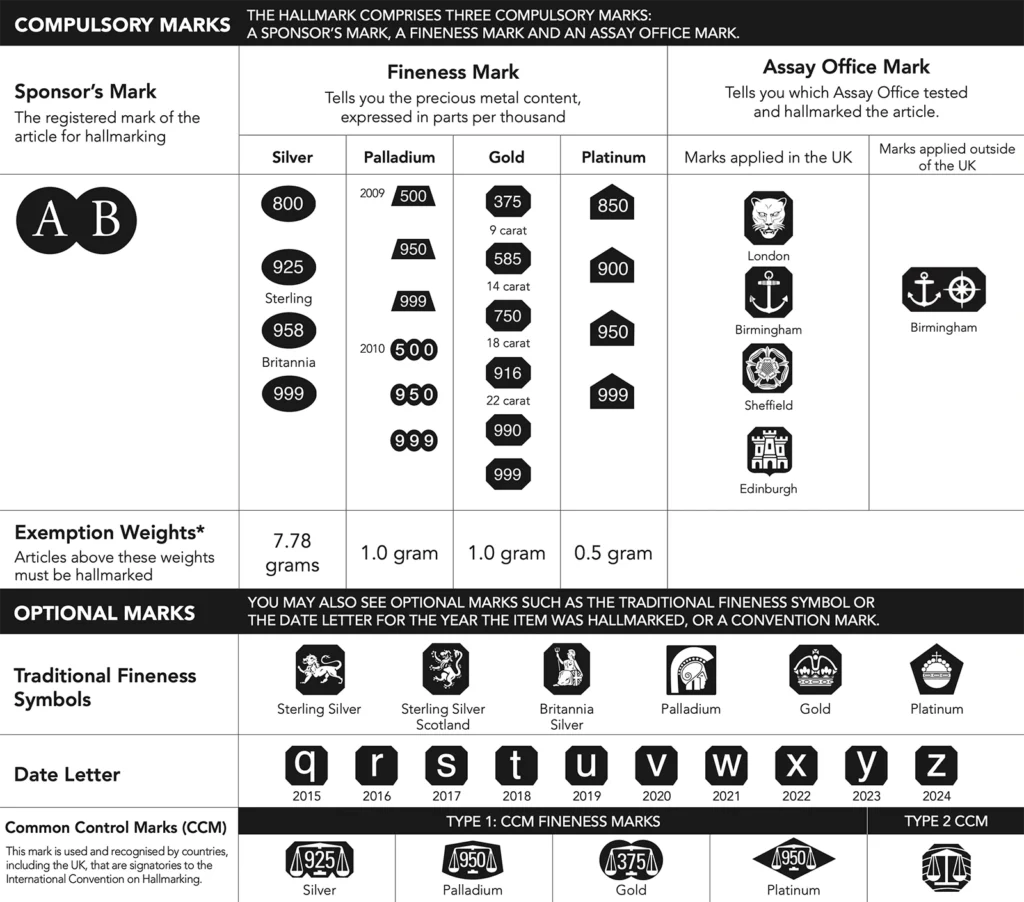
(Gold hallmark chart showing compulsory and optional marks to help identify gold hallmarks, including sponsor’s marks, fineness marks, and assay office marks)
Gold Magnet Test
A magnet test is simple but limited. Pure gold is not magnetic, so it will not stick to a magnet. To perform this test, use a strong neodymium magnet (household fridge magnets are usually too weak). Hold the magnet close to the gold item – if the item is pulled toward the magnet, it contains ferrous metals (iron, nickel, etc.) and is not pure gold. This easily catches many counterfeits. However, if nothing happens, it only shows the item isn’t strongly magnetic; many fake metals, like gold-plated brass, also won’t stick to a magnet. A negative result is a good sign, but it doesn’t confirm the item is real gold — it simply means it’s not made of magnetic metals.
How To Perform A Gold Magnet Test
Gold is non-magnetic; if your item is attracted to a magnet, it may not be real gold.
Steps:
-
Obtain a Strong Magnet: Use a neodymium magnet for best results.
-
Test the Gold Item:
- Hold the magnet close to the item.
- Observe if there’s any attraction.
-
Interpret Results:
- No Attraction: Possible real gold.
- Attraction: Likely not pure gold.
Note: Some gold alloys may contain magnetic metals; this test isn’t foolproof.
Gold Float / Density Test
Gold’s high density makes float tests useful. In a float test, you simply place the item in a cup of water: real gold (19.3 g/cm³) will always sink quickly and lie on the bottom. If the piece floats or hangs at the surface, it cannot be solid gold (it’s likely very light alloys or hollow). For more precision, measure mass and volume: weigh the item (in grams) then submerge it in water to get the displaced volume (in cm³). Divide mass by volume to compute density. Pure gold should be very close to 19.3 g/cm³. Any significant difference means the metal isn’t pure gold. This density calculation requires a sensitive scale and careful measurement, but it’s one of the most reliable home tests. (Note: clever counterfeits with a tungsten core can mimic gold’s weight, which is why professionals sometimes use ultrasound or XRF to catch them.)
How To Perform The Gold Float/Density Test
Gold is dense and will sink in water.
Steps:
-
Fill a Container with Water:
- Use a clear glass for visibility.
-
Place the Gold Item in Water:
- Gently drop the item into the water.
-
Observe the Behavior:
- Sinks Immediately: Likely real gold.
- Floats or Hovers: Possibly fake.
Advanced: Calculate density by dividing the item’s weight by the volume of water displaced. Pure gold has a density of ~19.3 g/cm³.
Ceramic Scratch Test
A ceramic scratch test (or touchstone test) visually reveals gold content. Use an unglazed ceramic plate or a specialised black stone. Drag your gold item firmly across the rough surface to leave a streak. If the streak is gold-coloured, that’s a sign the metal is real gold. A dark or black streak means the item is likely a base metal. The reason: gold leaves a shiny yellow mark, whereas most fake alloys (copper, steel, etc.) leave a grey or black line. The downside is it slightly abrades the item (though only a tiny area).
As an alternative, a touchstone kit uses a black testing stone: you rub the metal on the stone and then apply acid drops to the streak. The colour and reaction of the streak can be compared against reference samples (10K, 14K, 18K). These scratch methods are easy and fast, but they do require judgment of colour and pressure.
How To Perform The Ceramic Scratch Test
Caution: This test can scratch or damage the item.
Steps:
-
Obtain an Unglazed Ceramic Plate: Ensure it’s uncoated.
-
Clean the Gold Item: Remove any dirt or oils.
-
Scratch the Item on the Plate:
- Apply firm pressure to create a streak.
-
Observe the Streak:
- Gold Streak: Likely real gold.
- Black Streak: Possibly fake.
Warning: Avoid using this test on valuable or sentimental items.
Gold Vinegar Test / Mild Acid Spot Test
Acidity can reveal non-gold metals. Gold is chemically inert to mild acids.
Steps:
-
Apply White Vinegar:
- Put a drop of white vinegar (acetic acid) on the metal or soak the item briefly.
-
Observe the Reaction:
- No Reaction: Likely real gold (no bubbles, colour change, or tarnish).
- Fizzing or Discolouration: Possibly fake (alloyed with reactive metals).
Note: Vinegar testing is non-toxic and safe for home use but only detects major impurities (it won’t specify exact karat purity).
How To Perform The Gold Vinegar Test
Caution: Vinegar is acidic and may damage certain items.
Steps:
-
Clean the Gold Item: Ensure it’s free from dirt.
-
Apply White Vinegar:
- Place the item in a bowl.
- Pour enough vinegar to cover it.
- Let it sit for 15 minutes.
-
Rinse and Dry:
- Remove the item and rinse with water.
- Dry thoroughly.
-
Inspect the Item:
- No Change: Likely real gold.
- Colour Change: Possibly fake.
Warning: This test may not be suitable for all gold items, especially those with gemstones.
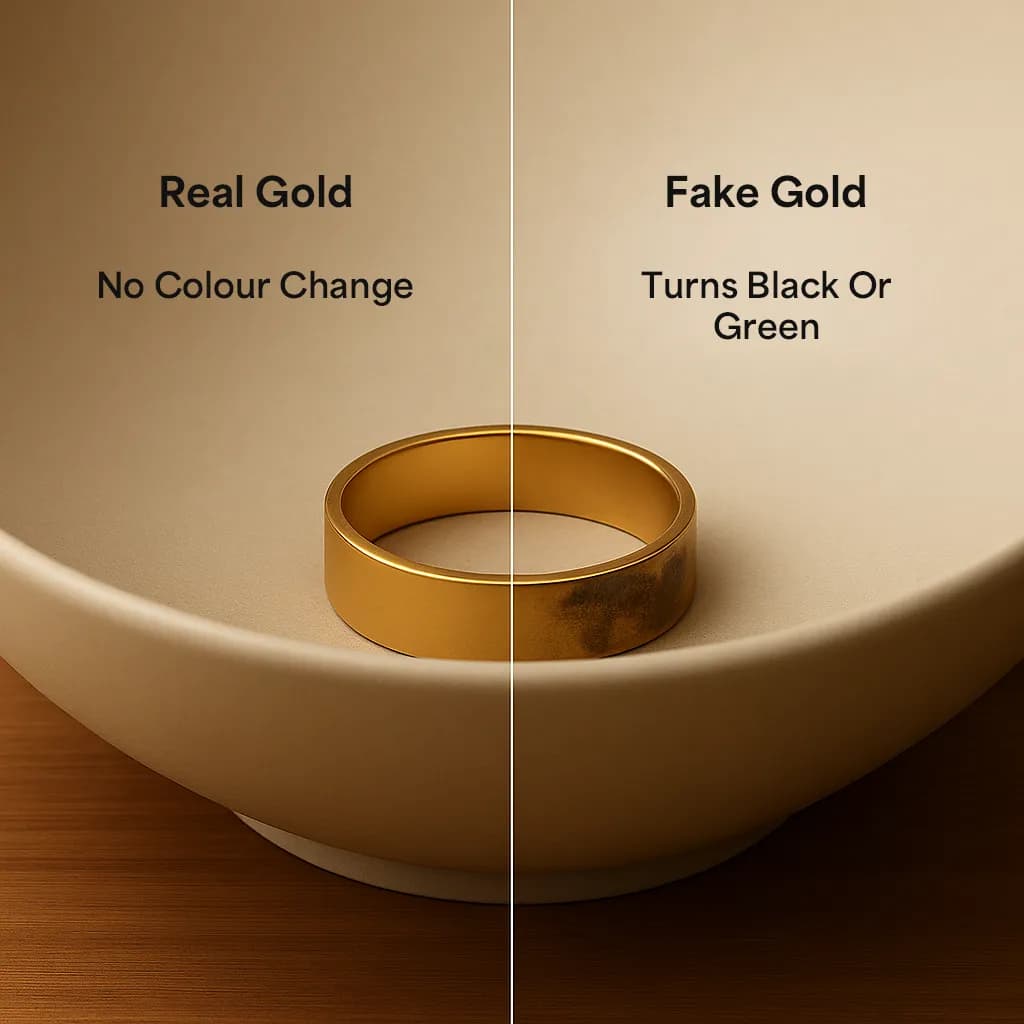
(This image shows the results of a gold vinegar test, where real gold remains unchanged while fake gold develops black or green discolouration)
Nitric-Acid / Touchstone Kit
For more decisive results, use a nitric acid test kit (often called a touchstone kit). This involves scratching the item on the black stone and applying tiny drops of nitric acid (and sometimes hydrochloric or other acids) labeled for different karats. Pure gold (especially 18K or 24K) will not react to nitric acid, while lower-karat gold or fake metals will dissolve or change colour. For example, applying “18K acid” to a 10K streak will cause bubbling if it’s truly only 10K gold. These gold test kits yield more definitive karat estimates than vinegar, but they must be used carefully. Nitric acid is highly corrosive and poisonous, so wear gloves and eye protection. Also note this test only checks the surface layer – it can be fooled by a thin plating over a different core. Still, acid-testing on a touchstone is one of the most common home methods to pin down gold’s purity.
How To Use A Gold Test Kit
Danger: Nitric acid is highly corrosive. Use protective gear and work in a well-ventilated area.
Steps:
-
Prepare the Workspace:
- Wear gloves and eye protection.
- Work on a stable surface.
-
Rub the Gold Item on the Touchstone:
- Create a visible streak.
-
Apply Nitric Acid:
- Place a drop of acid on the streak.
-
Observe the Reaction:
- No Reaction: Likely real gold.
- Green or Milky Reaction: Possibly fake.
-
Clean the Touchstone:
- Rinse with water and dry.
Warning: Do not apply acid directly to the gold item; it can cause damage.
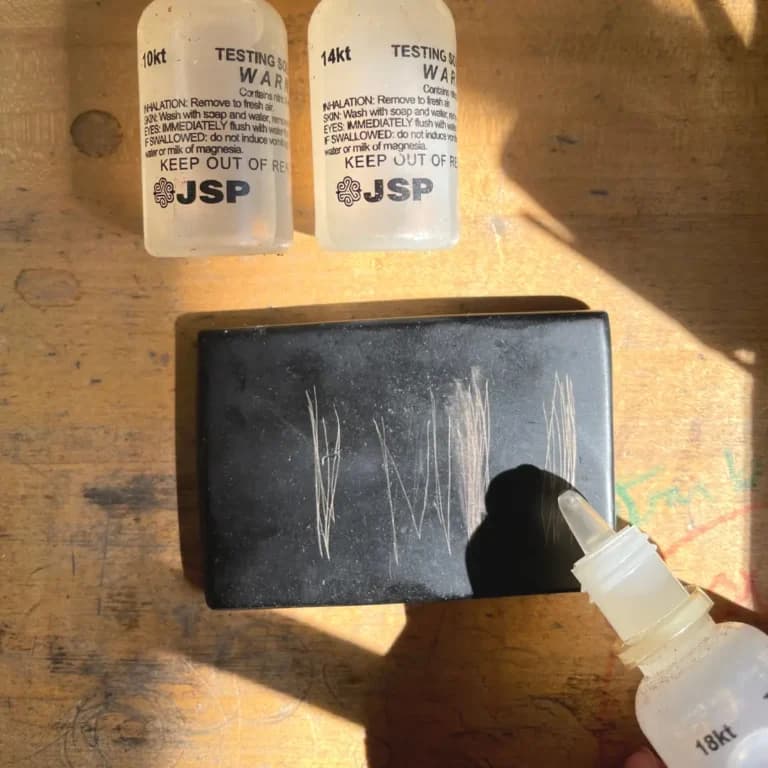
(A gold test kit uses acid solutions and a touchstone to help determine if gold is real by observing how the metal reacts to different purity tests)
Sound (“Ping”) Test
Ping Test: Gold has a characteristic resonance. In this test, you gently balance a gold coin or ring on your fingertip and tap it with another metal object.
Steps:
-
Balance the Gold Item:
- Hold the coin or ring lightly on your fingertip.
-
Tap the Item:
- Gently tap it with another metal object (like another coin).
-
Listen to the Sound:
- Real gold produces a long, high-pitched ring. Fake metals give a short, dull thud.
Tip: Some people use a “coin pinger” device for more consistent results. This test works best with coins and pure gold pieces, and benefits from having a known real gold item for sound comparison.
How To Perform The Sound (“Ping”) Test
Gold produces a distinct, long-lasting ringing sound when struck.
Steps:
-
Hold the Gold Item:
- Balance it on your fingertip.
-
Tap the Item:
- Use another metal object to gently tap.
-
Listen to the Sound:
- Long, High-Pitched Ring: Likely real gold.
- Dull Sound: Possibly fake.
Tip: Compare the sound to a known real gold item for reference.
Weight & Dimension Check
Because gold is so dense, its weight for a given size is very specific. If you know the type of item (say, a one-ounce gold coin or a 10-gram bracelet), you can measure its dimensions and mass to check against standards. Bullion coins and bars have official weight, diameter, and thickness specifications. A fake of the correct weight must be slightly larger, or one of correct size will be lighter. For jewellery, use a precise digital scale and calipers: calculate the item’s density (mass/volume) and compare it to pure gold (≈19.3 g/cm³). Any large discrepancy suggests a non-gold core. This method is very accurate for solid bars and coins, though less straightforward for complex-shaped jewellery.
How To Perform The Weight & Dimension Check
Gold’s density means it has a specific weight and size.
Steps:
-
Weigh the Gold Item:
- Use a precise scale.
-
Measure Dimensions:
- Use calipers to measure thickness and diameter.
-
Compare to Standards:
- Refer to official specifications for gold items.
- Discrepancies may indicate a fake.
Note: This method is most effective for coins and bars with known dimensions.
Gold Test Myths & Tests To Avoid
Some “tests” are unreliable or dangerous. Biting gold (feeling if it’s soft) is an old myth – it could mark soft pure gold but may not affect harder alloys, and it can damage your teeth or item. Weak fridge magnets won’t help (you need a strong neodymium magnet as noted above). Chlorine or bleach tests are not useful for home testing; gold does not dissolve in a swimming pool, and such chemicals only corrode the jewellery’s alloys or plating. In general, avoid any test that risks hurting you or permanently altering the piece unless absolutely necessary.
Gold-Plated vs. Gold-Filled vs. Solid Gold
Many jewellery pieces are not solid gold but “filled” or “plated.” Hallmarks tell these apart too. A stamp like GF (Gold Filled) or RGP means a thick layer of gold is bonded to a base metal. Gold filled items contain a substantial fraction of real gold (often ≥5% by weight), while gold plated (stamps GP or GEP) have a very thin gold layer. For example, “18K GF” means the item is gold-filled with 18-karat gold; “18K GP” means only electroplated with 18K. These markings mean you’re not getting solid gold, so you should expect a much lower gold value. Another mark: 10KP means 10 karat plumb (exactly 41.7% gold). In short, any letters like GF, GP, GEP, RGP, HGE indicate plating, whereas solid gold pieces will just say something like “14K” or “750” with no extra codes.
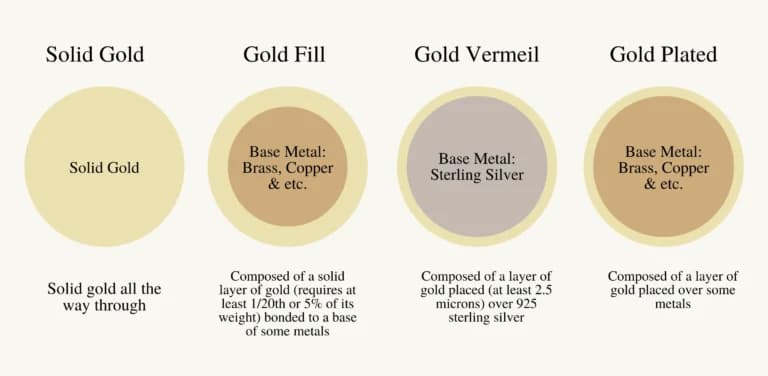
(This diagram shows the key differences between solid gold, gold filled, gold vermeil, and gold plated items, helping you understand how much real gold each type contains)
When To Seek A Professional Gold Test/Assay
DIY gold tests at home are great for quick checks, but leave high-stakes cases to experts. If you have a very valuable item (rare coins, heirloom jewellery, etc.) or your home tests give mixed results, a professional assay is wise. Jewellers and refineries use X-ray fluorescence (XRF) machines or fire assays to measure gold content precisely. For example, major dealers routinely use XRF for a quick, non-destructive purity readout. Professionals can also detect tricks like a tungsten core (a counterfeit that mimics gold’s weight) that a float or scale test might miss. In summary: for anything important or uncertain, pay for a professional gold test to be absolutely sure.
Frequently Asked Questions
How to test gold at home?
You can test gold at home by looking for purity stamps (hallmarks), trying a magnet test, a sink/flotation test, a ceramic or touchstone test, and by using mild acids. For example, gold sinks in water (float test) and does not stick to a magnet. No single DIY test is foolproof, so using several together gives the best indication.
How to tell if gold is real?
Real gold is heavy and non-reactive. Check for official marks (like 10K/14K/18K). Try the magnet test (genuine gold won’t stick) and a ceramic scratch test (real gold leaves a gold streak). You can also use an acid test kit: real gold will resist nitric acid while fakes react. Using multiple checks is key.
How to test gold at home with toothpaste?
Toothpaste does not reliably test gold. Although it’s abrasive, it won’t remove a thin gold layer or tell you purity. Rub toothpaste on the item and rinse – gold will generally remain shiny, but so will many fakes. This method is not scientifically valid for gold authenticity.
How to test carat of gold?
Carat (purity) is best checked by professional or acid test. At home, you can use a touchstone kit: scratch the gold on the stone and apply different acids (10K, 14K, 18K). The acid that doesn’t dissolve the streak indicates the carat. For example, if only 14K acid leaves it intact, the gold is ~14K. Hallmarks also tell carat (e.g. 18K = 75% gold).
Does gold tarnish?
Pure gold (24K) does not tarnish or corrode. It resists oxygen and humidity. Lower-karat gold (alloys with other metals) can tarnish over time because those other metals (like copper or silver) can oxidise. In general, anything above about 14K gold will stay shiny, while very low-karat or plated gold may darken a bit over years.
How does a gold acid test kit work?
A gold acid test kit uses nitric (and often hydrochloric) acids marked for specific karats. You rub the item’s surface on a touchstone, then drop acid on the streak. Each acid strength should corrode metals below its karat. If the streak persists under, say, 18K acid, the metal is at least 18K. If it dissolves in 10K acid, the gold is less than 10K. Real high-karat gold won’t react to the weaker acids. Always wear safety gear – the acids are strong.
Should white gold tarnish?
White gold is usually gold alloyed with nickel or palladium and plated with rhodium. The pure metal alloy itself doesn’t tarnish much, but the thin rhodium coating can wear off, revealing a yellowish tint underneath. So white gold can look discoloured over time, but it’s not actually “tarnishing” – you’re just seeing the gold alloy below the worn plating. Polishing or replating restores its shiny white look.
How to test if a gold ring is real?
How to test if a gold ring is real? Inspect the ring for stamps (e.g. “10K” or “750”). Do a magnet test: real gold won’t stick. Try a ceramic scratch: a golden streak means it’s likely real. If still unsure, use a touchstone with acid. You can also have it weighed and measured: real gold rings have a predictable density. If any test fails (e.g. magnet attracts, streak is black), the ring isn’t real gold.
Can you test gold with a lighter?
Gold has a high melting point, so holding it in a flame (like a lighter) is not reliable. It will get hot but won’t melt or burn easily. People sometimes say pure gold resists flame, but this won’t distinguish real gold from many fakes, and the heat can damage the item or stones. In short, lighter or flame tests are unsafe and not accurate.
Should white gold turn yellow?
If a white gold piece starts looking yellow, it usually means the rhodium plating is wearing off, exposing the yellow gold beneath. White gold itself (under the plating) is a pale gold alloy, not bright white. As the plating fades, your jewellery will look more yellow. You can avoid this by getting the piece re-plated, or accept the natural yellow tint of white gold alloy.
How do you test gold with vinegar?
Place a drop of vinegar (or soak a small item in vinegar) for a few minutes. Real gold will show no reaction at all. If the metal changes colour, bubbles, or tarnishes in the vinegar, it is not pure gold. This quick test relies on gold’s chemical inertness.
What is a magnet test for gold?
A magnet test uses a strong magnet to check if a metal is attracted. Real gold is not magnetic, so it should not be drawn to the magnet. If your gold-coloured item clings to the magnet, it contains magnetic metals (like iron or nickel) and is therefore not real gold. It’s a fast way to rule out many counterfeits.
Interested in selling gold with the UK’s highest paying gold buyer? Visit our Sell Gold page to get a competitive valuation – we provide fully insured postage and fast payment.
For more insights and the latest gold price today, keep an eye on our live charts and blog updates.





