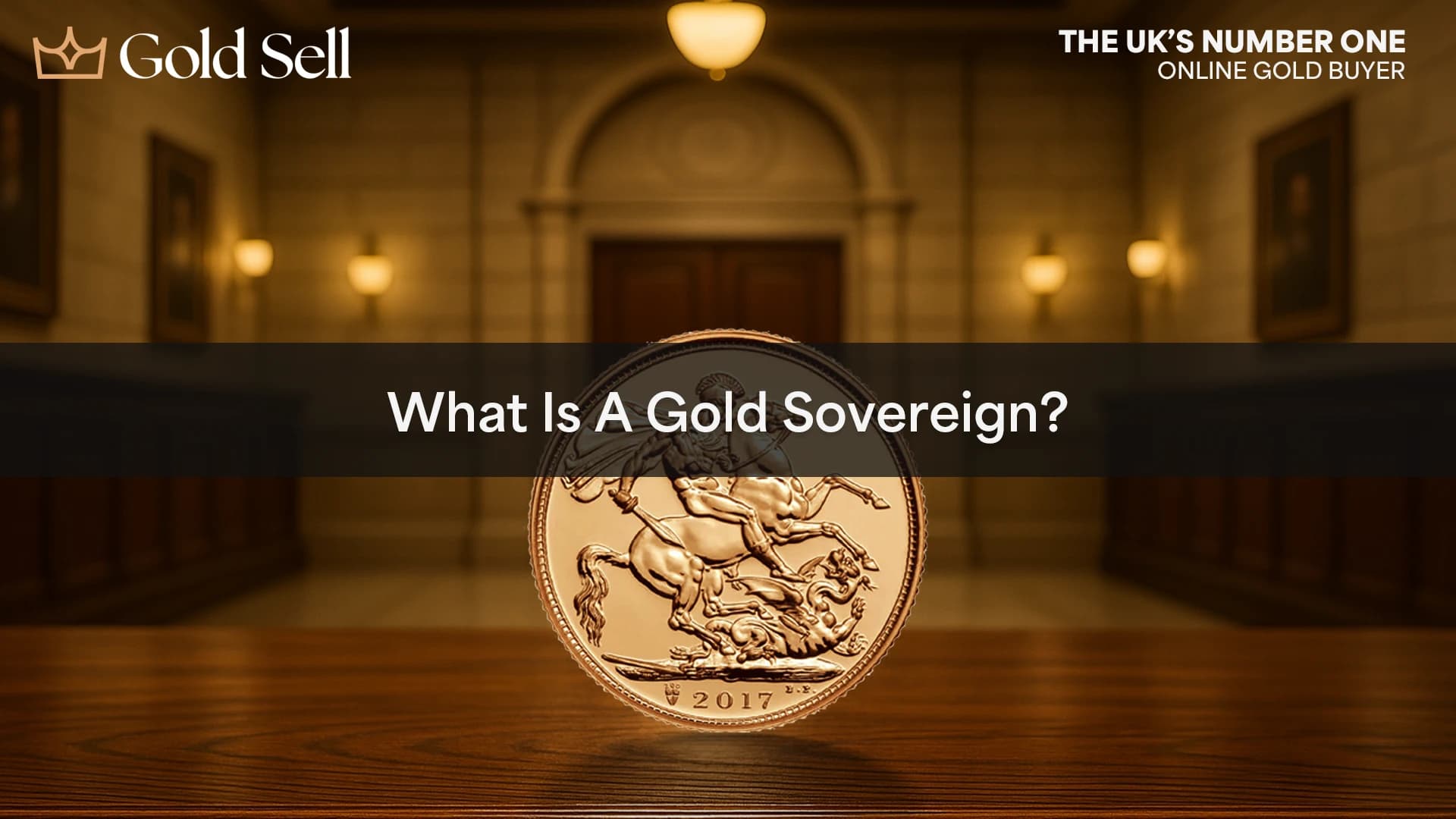
What Is A Gold Sovereign?
A gold Sovereign is a British gold coin with a face value of one pound, containing about 7.32 grams of pure gold (22-carat). First issued in 1817, the Gold Sovereign served as legal tender in the UK and across the British Empire. While no longer circulating as everyday currency, it remains a popular bullion coin and collector’s item due to its gold content, historical significance, and tax-free status in the UK.
Key Takeaways
- Gold Sovereign Definition: A Gold Sovereign is a 22-carat gold coin (91.7% pure gold) originally worth £1, minted since 1817. It features St. George slaying the dragon on the reverse and the monarch’s portrait on the obverse.
- Legal Tender & Tax Free: Sovereigns (and fractional versions like Half, Double, and Quarter Sovereigns) are official UK legal tender, so any gains are exempt from Capital Gains Tax (CGT) for UK residents. They are not generally spent at face value today, but this status provides tax advantages.
- Gold Sovereign Value: Most Sovereigns are worth their weight in gold (≈0.2354 troy oz of gold) – £726.57 at current prices – with the gold spot price being the main driver of a gold Sovereign coin’s value. Common modern Sovereigns trade close to their gold melt value, while rare or historic Sovereigns (e.g. certain Victorian issues or the 1937 Edward VIII) carry significant collector premiums.
- Investment Appeal: Gold Sovereigns are considered a solid investment and store of value. Over the past decade, their value roughly doubled in line with rising gold prices. They offer portfolio diversification, hedge against uncertainty, and tax-free gains, making them attractive for UK investors.
- Buying & Selling: You can buy Sovereigns from the Royal Mint, bullion dealers, some banks/post offices, or online marketplaces. Dedicated bullion dealers often offer the best value and authenticity checks. When selling, reputable gold dealers or auction houses will pay for the gold content (and any numismatic value), whereas private sales might fetch more for rare coins but come with greater risk.
What Is A Gold Sovereign?
A Gold Sovereign is a 22-carat gold coin of the United Kingdom with a nominal value of £1. Each full Sovereign contains 0.2354 troy ounces (approximately 7.32 g) of pure gold, alloyed with copper for durability. This coin was introduced in 1817 as part of the Great Recoinage, replacing the older guinea denomination. It features the reigning monarch’s portrait on the obverse and Benedetto Pistrucci’s iconic Saint George and the Dragon design on most modern reverses.
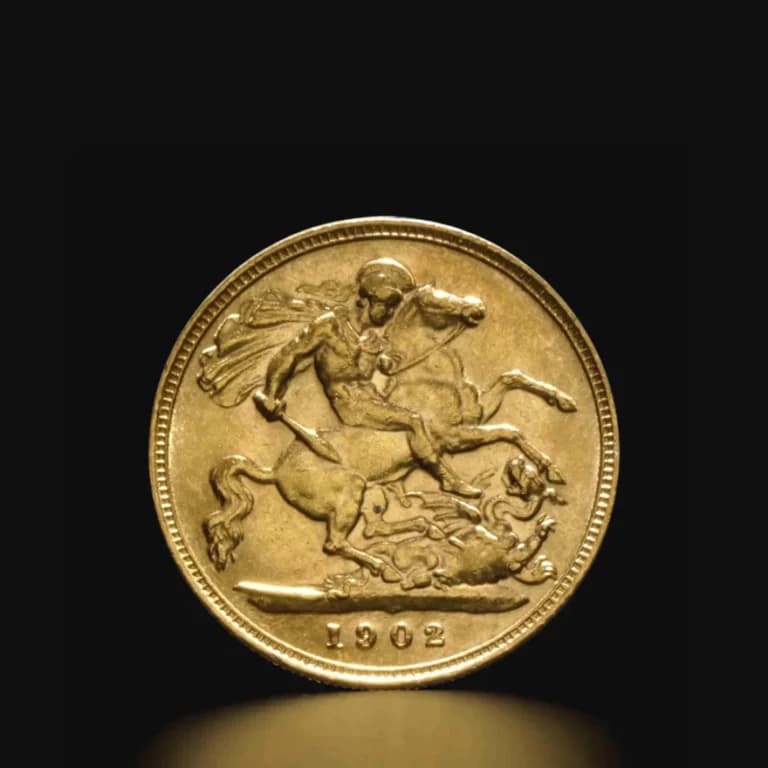
This 1902 gold sovereign shows Benedetto Pistrucci’s iconic design of St George slaying the dragon—a motif that has featured on most sovereigns since 1817. Coins like this one are struck in 22-carat gold and contain approximately 7.32 grams of pure gold. While its face value is £1, its actual worth depends on gold sovereign prices and potential collector demand based on year, condition, and mint mark.
Importantly, Gold Sovereigns (along with fractional Half, Double, Quarter and even Quintuple Sovereigns) are still legal tender in the UK. The standard Sovereign’s face value is £1 (one pound sterling), but there are also Half Sovereigns (£0.50 face value), Double Sovereigns (£2) and Quarter Sovereigns (25 pence) officially issued. In practice, they are not used in circulation today – their gold content value far exceeds the face value – yet this legal tender status provides a key benefit: capital gains tax exemption. UK-invested Sovereigns can be sold tax-free on any profits because HMRC treats them as currency. This makes them especially appealing to investors compared to gold bars or foreign coins, which could incur capital gains tax. Want to understand why certain gold coins like Sovereigns are exempt from tax? Read our full guide: What is Capital Gains Tax? to learn how CGT works in the UK, how it’s calculated, and when it applies to gold investments.
Historically, Gold Sovereigns were circulating coins of the 19th and early 20th centuries. They were widely accepted in Britain and internationally as a trusted amount of gold. However, with the outbreak of World War I in 1914, gold Sovereigns vanished from circulation – the UK government replaced them with paper £1 and £10 notes, and Sovereigns were hoarded or used for war payments. After the war, Sovereigns never returned to daily commerce in Britain (by the 1920s their gold value exceeded £1), though mintage continued at overseas mints until 1932 for use in trade. Production resumed in 1957 for bullion and collectors, and modern Sovereigns are struck annually by the Royal Mint to this day.
In summary, a Gold Sovereign is a small, durable gold coin rich in heritage – containing roughly 7.98 g total weight (of which ~7.32 g is gold) in a 22.05 mm diameter coin. It carries the prestige of British history, the artistic majesty of Pistrucci’s design, and the financial allure of a tax-free gold investment. Sovereigns are highly recognisable worldwide, making them easy to buy, sell, or trade as a form of portable wealth. Curious how gold Sovereign prices have changed over time? Explore our in-depth breakdown of gold Sovereign prices, including current values, historic price trends, and how collector demand influences the value of different years.
Check the latest gold sovereign price and discover how to buy gold sovereign coins smartly—or sell gold sovereign for the highest payout in the UK today.
How Much Is A Gold Sovereign Worth?
Most Gold Sovereigns are worth roughly their weight in gold, which forms the baseline of their value. Each full Sovereign contains about 0.2354 troy ounces of gold, so its intrinsic value rises and falls with the live gold price. For example, Gold is currently trading at £3,086.25 per troy ounce, so a Sovereign’s melt value (gold content value) is £726.57 (0.2354g of pure gold x £3,086.25). In practice, common Sovereigns trade at a small premium above melt – the market price might be a bit higher to account for minting and demand. At recent rates, a brand new bullion Sovereign coin sells close to the £803.15 mark in the UK.
However, certain Sovereigns carry additional numismatic value beyond just gold content. The gold Sovereign value can increase if a coin is rare, historically significant, struck at a less common mint, or in exceptionally fine condition. For instance, ordinary George V or Elizabeth II Sovereigns from the mid-20th century are plentiful, so they tend to be valued only slightly above their gold content (these are often sold as “bullion grade” coins). In contrast, scarcer Sovereigns such as the 1819 George III, which had an extremely low mintage of fewer than 4,000 coins, or the 1879 London Mint Sovereign, which is highly sought-after in high grades, can fetch significantly higher premiums. Similarly, branch mint issues like the 1917 London Sovereign (most were melted down, making surviving examples rare), or the 1916-C (struck in Ottawa), are also valued well above melt due to limited availability. Collectors also prize coins such as the 1908 Melbourne Mint Sovereign with the ‘M’ mint mark, especially in better grades. These examples demonstrate how rarity, mint origin, and condition can substantially affect a Sovereign’s market value.
One extreme example is the 1937 Edward VIII Sovereign, which was never issued for circulation due to Edward’s abdication. Only a few pattern coins exist, making it one of the rarest Sovereigns – one sold at auction in 2020 for £1,000,000, a record-breaking price for any British coin. Similarly, an 1819 Sovereign (a year with an exceptionally low mintage) or certain branch mint issues (like the 1859 Sydney Mint Sovereign or the 1917 London Sovereign, of which few survive) can command hefty premiums in the tens of thousands of pounds.
For most owners and investors, though, the value of a gold Sovereign will be closely tied to gold’s market price. Dealers typically buy Sovereigns at or just below the gold spot value and sell them slightly above it. This means the coin’s value in sterling will fluctuate day to day. Over the past couple of years, as gold prices have surged, the value of a Sovereign coin has climbed accordingly – e.g. rising from around £250–£300 a decade ago to well around £726.57 today for a common issue. When checking “How much is my gold Sovereign worth?”, it’s wise to look at the current gold price per gram or per ounce, then multiply by ~7.32 grams (the pure gold content). Any additional value would depend on the coin’s rarity or condition (for instance, proofs and rare dates can sell for more to collectors).
In summary: the gold Sovereign’s value is primarily its gold content (0.2354 oz of gold), which at current prices is a few hundred pounds. The value of common Sovereigns is typically based on their gold content, with a small premium added by the bullion dealer, whereas rare Sovereigns’ worth is based on their gold value + collector and rarity premium. Even at the low end, a Sovereign will always be “worth” something significant because of its gold. It’s reassuring for owners that the coin’s intrinsic value can never fall below the gold melt value, and historically that floor has been rising over time with the price of gold.
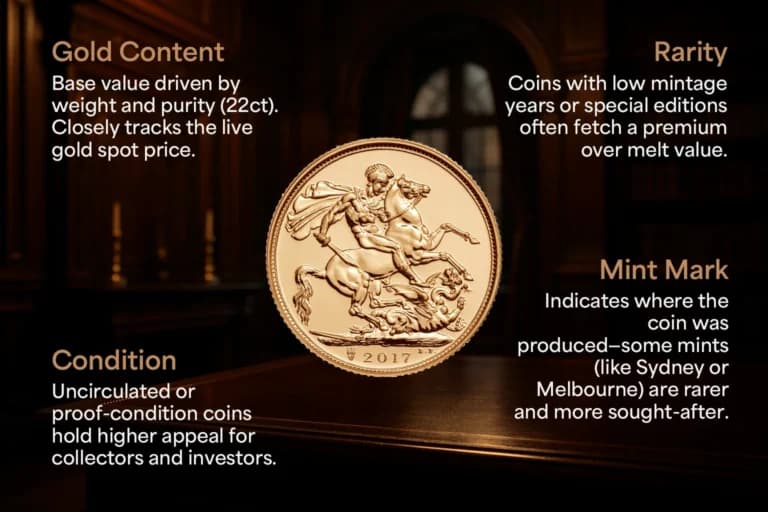
The gold Sovereign value is influenced by more than just the live gold price. As shown above, a coin’s gold content provides its melt value baseline, but rarity, condition, and mint mark can all significantly increase what a buyer is willing to pay. Understanding these factors helps investors and collectors alike determine how much a gold Sovereign is truly worth in today’s market.
Gold Sovereign Prices
Gold Sovereign prices are directly influenced by the live gold spot price, which determines the coin’s melt value—the intrinsic worth based on its pure gold content. A full Sovereign contains 7.322 grams of pure gold, and a Half Sovereign contains 3.661 grams. As of today, the melt value of a full Sovereign is approximately £726.57, and a Half Sovereign is worth around £363.28 in gold content alone.
However, the price you’ll actually pay for a modern Sovereign coin on the open market is usually higher. Our research, which analysed pricing across a wide range of UK bullion dealers, found that even “best value” Sovereigns—modern bullion coins sold solely based on their gold content and in fair-to-good condition—typically sell for around 5% more than their melt value. This small margin helps cover dealer overheads such as refining, distribution, insurance, and logistics.
Looking across the broader market, the average retail price of a modern bullion Sovereign currently sits at around £803.15, which represents approximately 10.54% above the live gold spot price. Importantly, this higher price point is still for coins with no added collector value—just standard bullion-grade Sovereigns that are widely available. This demonstrates that Sovereign pricing is driven not just by gold weight, but also by availability, demand, and dealer cost structures.
The same dynamic applies to Half Sovereigns. While their gold melt value is £363.28, they are commonly sold at around £401.57, again reflecting an average 10.54% premium over their intrinsic value. Because Half Sovereigns are smaller, they carry relatively higher production and handling costs per gram, which contributes to this pricing structure.
It’s worth noting that these pricing trends are based on extensive analysis of UK dealer listings and reflect current market behaviour. This gives buyers a realistic expectation of what to pay and ensures transparency in valuing gold Sovereigns.
While this section focuses on modern bullion Sovereigns, certain rare coins—such as those with limited mintages or historic mint marks—can trade for far more, sometimes significantly above gold value due to their scarcity and collectability. However, for typical investors purchasing for gold content, understanding melt value and dealer premiums is key to recognising fair market value.
To help you understand today’s Sovereign coin pricing more clearly, we’ve summarised the latest live market rates below. These figures reflect both the intrinsic melt value based on the gold spot price and the actual retail prices dealers are currently charging for modern bullion-grade Sovereigns and Half Sovereigns. This will give you a real-world view of what these coins are worth, and what you should expect to pay or receive when buying or selling.
- Full Sovereign (Spot Value): £726.57 – This is the current melt value based purely on the Sovereign’s gold content and weight. A full Sovereign contains 7.322 grams of 22-carat gold (equating to 91.67% purity), or 0.2354 troy ounces of pure gold. This intrinsic value underpins the base worth of all Sovereign coins. When coins are common, heavily circulated, or lack collectible rarity, their market value typically tracks closely to this melt price.
- Half Sovereign (Spot Value): £363.28 – The melt value of a Half Sovereign, which contains 3.661 grams of gold and 0.1177 troy ounces of pure gold. Like full Sovereigns, Half Sovereigns are 22-carat and their base value is directly tied to the live gold spot price. Circulated Half Sovereigns with no collectible appeal often sell near this ‘scrap gold value’.
- Full Sovereign (Dealer Premium Factored In): £803.15 – This is the average retail price currently charged by UK bullion dealers for modern, common-issue Sovereigns with no numismatic value. Based on our market research, this represents a typical 10.54% premium over the gold spot price. This premium covers a dealer’s operational costs such as storage, insurance, testing, secure shipping, and in some cases, minting and VAT (on new coins). While Sovereigns are exempt from VAT in most cases, the cost of sourcing, verifying, and handling gold coins justifies the added margin.
- Half Sovereign (Dealer Premium Factored In): £401.57 – This figure reflects the average market price for a bullion-grade Half Sovereign from UK dealers. Despite containing only half the gold of a full Sovereign, Half Sovereigns tend to attract higher proportional premiums—in part because minting and handling costs don’t scale down by weight. The coins are also popular in the retail market, driving stronger demand.
- Gold Price Per Troy Ounce: £3,086.25 – The live spot price for one troy ounce (31.1035g) of 24-carat (pure) gold. This benchmark price, set by the London Bullion Market Association (LBMA), is the basis for all gold valuations—including the melt value of Sovereign coins. As spot prices fluctuate constantly with global markets, they directly affect what your Sovereign is worth.
These live prices are automatically updated every 60 seconds based on the latest LBMA gold spot price and reflect real-time UK market trends. Understanding this breakdown helps you make smarter decisions whether you’re investing, buying, or selling Sovereign coins.
Live Gold Sovereign Prices
Gold price last updated:
Wednesday, 21 October 2026, 13:15.
The LBMA (London Bullion Market Association) spot price changes daily.
The prices displayed are based on the global market rate for pure 24ct gold, known as the spot price. Like all gold dealers, GoldSell pays a percentage of this rate to account for assaying, refining, secure logistics, market volatility, and handling costs. We consistently offer among the highest payout rates in the UK, with the exact percentage increasing based on the weight and purity of the gold you sell.
Gold Half Sovereign Value
A Half Sovereign is, as the name suggests, half the weight and gold content of a full Sovereign – so its value is approximately half that of a full Sovereign, moving in lockstep with the gold spot price. If a standard Sovereign contains ~7.32 g of pure gold, a Half Sovereign contains ~3.66 g of gold (0.1177 troy oz). That means the intrinsic gold half Sovereign value will be about 50% of the full coin. For example, with gold at £3,086.25 (making a full Sovereign worth £726.57 in gold), a Half Sovereign’s gold content would be worth £363.28.
It’s important to note that Half Sovereigns often carry a slightly higher premium (in percentage terms) than full Sovereigns. The fixed costs of minting, handling, and distribution are similar for both coins, but the Half Sovereign delivers less gold, so those costs represent a larger fraction of its price. For instance, one UK dealer’s pricing in May 2025 showed they would sell a new Full Sovereign at about 104% of spot price, whereas a Half Sovereign was ~106% of spot, reflecting a 2% higher premium. On the buy-back side, the same dealer might pay ~96% of spot for either coin, meaning the bid-ask spread is a bit wider on Half Sovereigns (around 10% vs 8% on the full coin in that example).
In practical terms, this means if you are selling, a Half Sovereign might fetch proportionally a little less than half the price of a full one, and if you are buying, it might cost slightly more than half the price of a full (due to those premiums). For long-term investors, the difference is relatively small – both sizes are very liquid in the market. Half Sovereigns remain tax-free (CGT exempt) UK coins like their bigger siblings and are equally recognised by dealers and collectors. They can be a good entry point for those who want smaller units of gold.
Do keep in mind that Half Sovereigns were also issued in various historic periods, and some older or rare Half Sovereign coins can carry collector premiums just as full ones do. But generally, the Half Sovereign’s value tracks the gold market identically to the full Sovereign – just on a smaller (half) scale. If gold goes up 10%, both a full and a half Sovereign will increase ~10% in melt value. The main difference is the slightly higher percentage cost to acquire or dispose of the smaller coin. Some investors accept that premium as the price of flexibility (since halves allow selling smaller portions of gold). In summary, a Half Sovereign will always be worth roughly half a full Sovereign’s value by weight, with minor adjustments for market premiums. This has held true historically and continues in today’s bullion trade.
Gold Sovereign Weight
A full Gold Sovereign weighs 7.98805 grams in total, of which 7.32240 grams is pure gold. The remainder (~0.67 g) is copper (and a tiny bit of silver in older issues), since Sovereigns are minted in 22-carat gold (91.67% purity). This alloy, known as “crown gold”, was chosen to make the coins harder and more wear-resistant than 24-carat gold.
In troy weight measurements, a Sovereign contains 0.2354 troy ounces of gold (since 1 troy ounce is 31.1035 g). It’s useful to remember this figure if you’re valuing Sovereigns by the ounce – about 4.25 Sovereigns equal one troy ounce of gold. The coin’s dimensions are also standardised: the diameter of a modern Sovereign is approximately 22.05 mm and the thickness about 1.52 mm. Despite their small size, they pack a significant amount of gold into a handy coin.
For comparison, a Half Sovereign weighs 3.99 g in total (with ~3.66 g of gold) – literally half the weight of the full coin. A Double Sovereign (the £2 coin) weighs about 15.98 g (with ~14.65 g of gold), and the largest, the Quintuple Sovereign or £5 piece, weighs ~39.94 g (with ~36.6 g of gold). All of these coins are 22-carat purity, so they maintain the same gold-to-alloy ratio.
It’s interesting to note that the weight of the Sovereign was originally set by law and has stayed consistent for over 200 years. Under the Coinage Act of 1816, each Sovereign was defined such that 46⅔ Sovereigns weighed one troy pound of standard gold. This works out to the 7.988 g figure we use today. The Royal Mint tightly controls the weight and purity; historically, circulating Sovereigns had allowed tolerances of only a few thousandths of an ounce. Worn coins were removed from circulation to maintain the gold standard integrity.
In summary, the Gold Sovereign’s weight is ~7.99 grams (gross), with ~7.32 grams of pure gold. This is a handy fact for investors (to calculate melt value) and is a testament to the coin’s consistency. If you hold a stack of Sovereigns, you can be confident each one contains the same amount of gold, whether it’s a Victoria, Edward, or Elizabeth issue, as long as it’s the standard 22mm Sovereign. The precise weight is one reason Sovereigns became trusted worldwide in the 19th century – they were literally as good as gold in terms of known content.
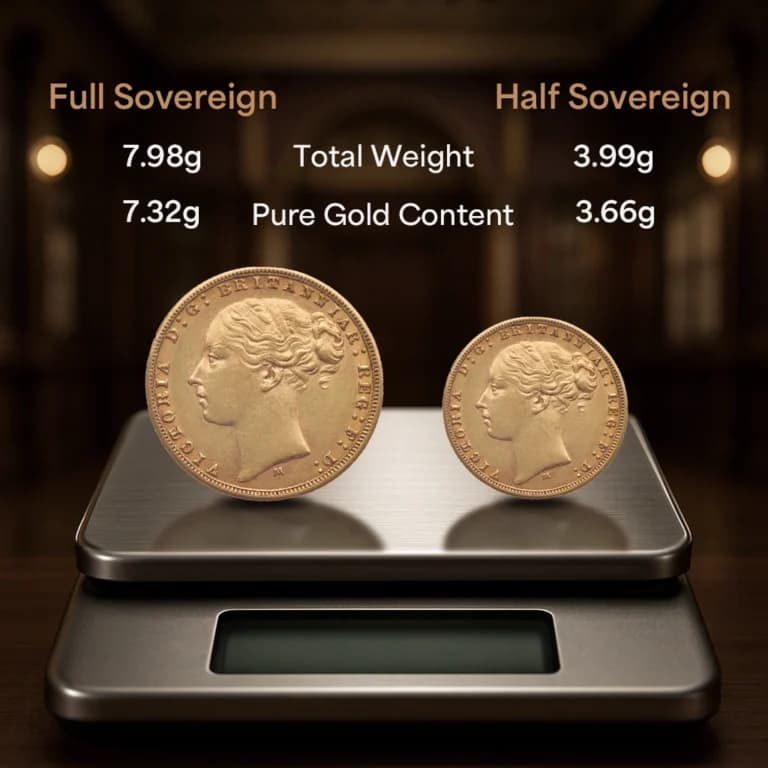
Full Sovereign vs Half Sovereign: While the Full Sovereign weighs 7.98g with 7.32g of pure gold, the Half Sovereign weighs 3.99g and contains 3.66g of gold. This weight breakdown is essential for understanding intrinsic value based on gold content and highlights why Full Sovereigns often offer better value per gram for investors.
Are Gold Sovereigns A Good Investment?
Gold Sovereigns are often considered a good investment for those seeking a stable, long-term store of value and a hedge against economic uncertainty. They combine the intrinsic benefits of gold with additional advantages like tax exemptions and collectible upside. Over the past decades, investors who held Sovereigns have seen their wealth grow in line with the price of gold – and importantly, any gains realised are free from capital gains tax in the UK (since Sovereigns are legal tender).
To illustrate, if you had bought a Sovereign ~10 years ago, you would likely have paid on the order of £275. Today, that same coin might be worth around £726.57+ based purely on the gold content, reflecting the roughly 80–100% increase in gold price over the last decade. Even accounting for slight dealer premiums, the trend has been rewarding. During periods of financial stress or inflation, gold (and thus Sovereigns) tends to appreciate. For example, in the aftermath of the 2008–2009 recession, gold prices climbed significantly while stocks and property faltered, demonstrating gold’s role as a safe-haven asset. Sovereigns held through that period would have gained value as the gold price rose.
Looking ahead, many analysts predict that gold will continue to rise in the long term. Some bullish forecasts even suggest gold could approach $5,000–$7,000 per ounce in the next 5–10 years under favourable conditions. If that happened, a full gold Sovereign could be worth between approximately £940 and £1,300 based on its gold content alone, depending on exchange rates and market premiums. Of course, such predictions are speculative – not all experts agree on the magnitude or timing of gold’s increase. But the general rationale is that ongoing currency inflation, geopolitical risks, and central bank demand for gold may drive prices higher over time. Gold has a track record of preserving purchasing power; an ounce of gold (or four Sovereigns) today buys roughly the same basket of goods it did decades ago, whereas paper currencies have depreciated.
Another advantage of Sovereigns as an investment is liquidity and recognisability. Gold Sovereigns are among the easiest coins to sell globally – every major bullion dealer, pawn shop, or coin broker will recognise them and pay based on the gold content (often slightly above melt for Sovereigns, due to their desirability). This instant liquidity gives investors flexibility; you can sell part of your holdings (say, a few coins) when needed, unlike a large gold bar that might be less divisible.
Tax efficiency is a huge plus: As mentioned, UK Sovereigns are exempt from Capital Gains Tax. This means if you make a profit on Sovereigns – no matter how large – you keep 100% of the gains. Compare this to stocks or property, where a significant chunk of your profit can go to the taxman. Even many other gold coins (like Krugerrands or US Eagles) are not CGT-free in the UK because they aren’t legal tender in Britain. So British coins (Sovereigns and Britannias) offer a unique tax shelter. Additionally, investment gold (coins and bars of high purity) is VAT-free in the UK, so when you buy Sovereigns you don’t pay Value Added Tax either. This means you’re buying “pure” investment value, not losing 20% upfront to tax.
Beyond financial metrics, some investors find Sovereigns “good” because they are tangible assets with historical significance. There’s a certain comfort in holding a physical gold coin that has been a symbol of value for centuries. Unlike owning gold via ETFs or certificates, holding Sovereigns means you have no counterparty risk – the value isn’t dependent on any institution’s solvency. You can literally take your wealth with you (a few tubes of Sovereigns can be worth many thousands of pounds yet are compact and portable).
Of course, no investment is perfect. Gold Sovereigns do not pay interest or dividends; their returns come purely from capital appreciation. In very short-term scenarios, gold’s price can be volatile (though typically less so than stocks). If the price of gold stagnates or falls, Sovereigns will similarly stagnate/fall in value. However, many people view them as a long-term hold, not a speculative trade. They tend to hold their value over the long run and often increase during times when other investments struggle, which provides balance in a portfolio. Want to explore the broader picture of investing in gold? Read our guide Is Gold A Good Investment? for expert insights on timing the market, comparing different gold investment options, and using our gold return calculator to estimate future gains.
In summary, Gold Sovereigns can be an excellent investment for a portion of one’s portfolio – especially for those in the UK, thanks to the CGT exemption. They offer the durability and universal acceptability of gold, the added perk of tax-free profits, and even a bit of historical/collectible interest. If one had steadily invested in Sovereigns over the years, they would have seen stable growth; and if one believes gold will climb further in the future, Sovereigns are a convenient vehicle to capture that growth. As always, it’s wise to diversify – but as far as gold investments go, Sovereigns are a time-tested choice that have protected wealth for generations. They often serve as a “rainy day fund” or insurance policy in one’s portfolio – not necessarily to get rich quick, but to preserve wealth and provide peace of mind that no matter what happens in the markets, these little gold coins will maintain value.

Investing In Gold: Is Gold A Good Investment?
Investing in gold: Discover how to invest in gold and use our gold investment calculator for smart, profitable wealth strategies.
Gold Coin vs Bar
When considering gold for investment, a common question is gold coins vs gold bars – which is better? The answer depends on your priorities (tax efficiency, flexibility, budget, etc.). Gold Sovereign coins offer some distinct advantages over gold bars, but bars have their merits too. Let’s compare:
- Tax Benefits: In the UK, gold coins like Sovereigns (and Britannias) are free from Capital Gains Tax, whereas gold bars are not CGT exempt. This means if your gold appreciates and you sell at a profit, coins allow you to keep all of it, but bars could incur CGT (above the annual allowance). For investors who anticipate significant gains or large holdings, this tax edge strongly favours coins. Both coins and bars are VAT-free when purchased as investment gold, so there’s no VAT difference – but CGT can be a big factor.
- Premiums and Pricing: Generally, larger gold bars have lower premiums over the spot price compared to smaller coins. You’ll typically pay a bit less per ounce for a 1kg gold bar than for an equivalent weight in Sovereigns. This is because manufacturing one big bar is cheaper than minting many individual coins, and dealers operate on thinner margins for big transactions. However, for smaller denominations, the gap narrows. If you buy multiple small bars (like a stack of 10g or 1oz bars), the combined premiums can approach what you’d pay for coins. In other words, the more pieces you buy, the more the premium differences diminish. Sovereigns themselves often carry modest premiums (for common-date bullion ones, usually 5–8% over spot in normal market conditions). Bars can be as low as 1–2% for large bars, but 5–8% for very small bars. So for major long-term investors dealing in high volumes, bars might offer cost savings. But for most retail investors, the difference in unit price between popular coins and small bars isn’t huge.
- Liquidity and Flexibility: Gold coins tend to be easier to resell in small quantities and have a very broad market. Every coin dealer is used to trading Sovereigns and other bullion coins. Coins are also in convenient denominations – you can sell just one or two coins if you need a small amount of cash. If you only had a large bar (say 1kg ~ £70–80k worth), you can’t easily sell a fraction of it – you’d have to liquidate the whole bar, which might overshoot what you need. Many investors therefore like the divisibility of coins: it gives flexibility to “trim” holdings piecemeal. Bars come in smaller sizes too (down to 1g or 1oz), but the smaller the bar, the higher the relative premium. With coins, each piece is already small (£726.57 value for a Sovereign), yet still very tradable. Also, certain coins (like Sovereigns) might be easier to sell quickly to the public or collectors via online marketplaces, whereas generic bars appeal mainly to bullion dealers.
- Security and Recognition: Both forms are real gold, but recognisability can be higher with famous coins. A Sovereign is globally known; a random gold bar from a lesser-known refiner might require assay or authentication when selling. That said, any reputable bar (from recognised refiners like PAMP, Perth Mint, Royal Mint bars, etc.) will be accepted by dealers after verification. Coins have anti-counterfeiting advantages – milled edges, detailed designs, and centuries of history that make fakes easier to spot. Bars can also have serial numbers and certificates. It’s wise to purchase bars with a hallmark from LBMA-approved refineries. In terms of physical storage, bars might be slightly more space-efficient (especially large bars), but the difference is negligible for typical amounts – a tube of coins vs a small bar won’t change your home safe requirements by much.
- Collectible Upside: Gold coins can have a collector (numismatic) premium, whereas bars are purely tied to metal content. For example, certain year Sovereigns or limited mintages could appreciate in value beyond just gold price (if demand from collectors rises). Bars almost never have this aspect – you wouldn’t pay extra for a “2005 PAMP bar” vs any other bar, it’s just gold. Some investors see this as an advantage of bars (no fuss over rarity; you get more gold for your money), while others see coins as having a potential bonus – you might get lucky if a coin becomes sought-after. However, note that paying a big numismatic premium upfront is an entirely different strategy (coin collecting vs bullion investing). Bullion Sovereigns are usually priced close to gold content, so you’re not heavily speculating on collectibility, but you still have that slight edge that, say, a 1917 Sovereign might one day fetch more as an antique.
- Fractions and Scaling: If you’re investing a very large sum (tens of thousands of pounds or more), bars can be more convenient simply because you could buy one or two large bars rather than hundreds of coins. It can simplify storage and paperwork. Also, large investors (institutions, etc.) often prefer bars to minimise transaction costs. Conversely, if you’re investing a smaller amount or plan to accumulate gradually, coins are very convenient – you can buy a few at a time, and cost-average. With bars, you might not want to buy tiny bars regularly due to premiums, and saving up for a big bar introduces timing risk. Many gold buyers actually go for a mix of coins and bars, e.g. some large bars for core holding plus a batch of coins for flexibility.
- Resale Process: Selling coins and selling bars are quite similar – contact a bullion dealer for a quote, etc. One difference: Sovereigns (being legal tender coins) don’t require a separate assay or authentication when selling to UK dealers if they are common post-1800 issues, whereas an obscure bar might be tested. But reputable bars (especially if kept in sealed condition) pose no problem either. Some dealers even pay slightly more (relative to spot) for Sovereigns than for random 22k scrap gold, because they know they can resell Sovereigns easily. For example, a dealer might pay 97% of spot for Sovereigns but only 95% for a gold bar of similar weight – this can vary, but it’s seen in practice due to market liquidity differences.
In summary: If you’re in the UK, gold coins like Sovereigns often come out on top for tax efficiency and flexibility. Gold bars excel if your goal is to obtain the maximum gold for the lowest premium, particularly in larger quantities, and you don’t mind the CGT considerations or lack of diversity in piece size. Many private investors appreciate that with coins, especially Sovereigns, they get tax-free growth, easy divisibility, universal recognition, and a beautiful asset to hold. Bars are a bit more utilitarian – a chunk of gold that’s valued only by weight, possibly better for high-volume transactions. For most, the decision isn’t either/or: you might buy some of each. But given that a Sovereign’s premium is fairly modest and could save you 20% tax on gains, the coin vs bar decision often tilts in favour of Sovereigns for UK investors. They strike a balance between investment and collectibility, and that adds to their enduring appeal.
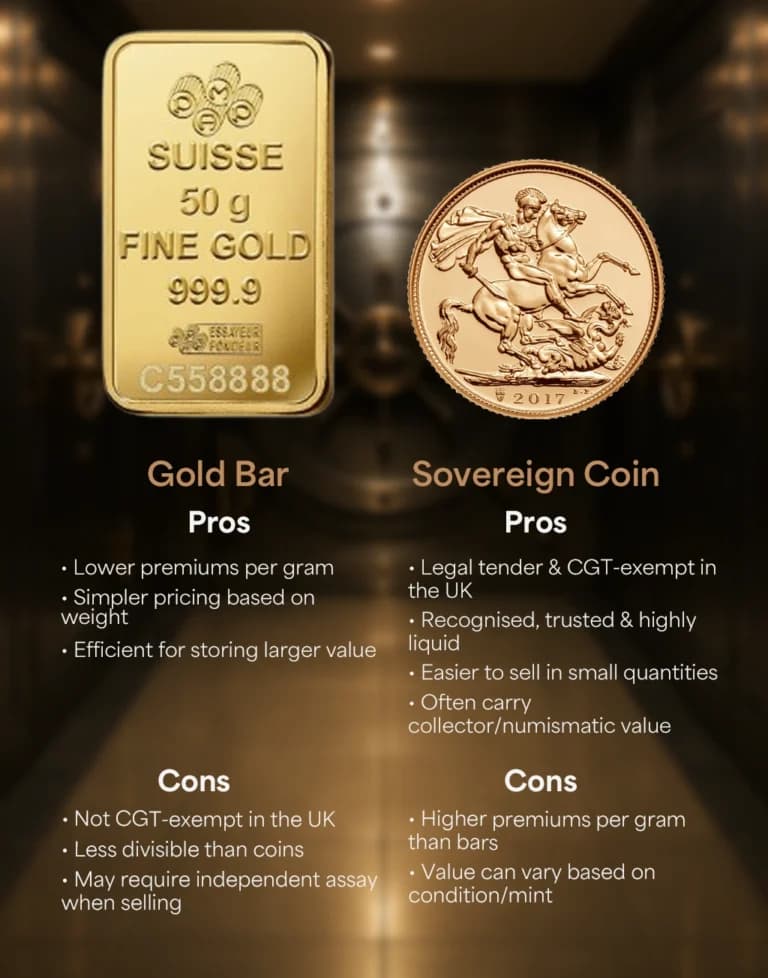
A side-by-side visual comparing the pros and cons of gold bars and Sovereign coins. While bars offer lower premiums and efficient storage, coins like the Gold Sovereign provide tax advantages and greater flexibility when selling. This infographic helps investors understand which option best aligns with their goals.
How To Sell Gold Sovereigns?
You can sell gold Sovereigns through several channels – notably via specialist gold buyers or bullion dealers, through auctions, or by private sale – and each route has its pros and cons. The key is to choose a safe, reputable option that gives you a fair price for your coins.
-
Selling to a Reputable Gold Dealer: This is the most straightforward and popular method. Virtually all bullion dealers and coin shops buy Sovereigns because of their consistent gold content and market demand. You can walk into a high-street bullion dealer or use online gold-buying services. A credible dealer (preferably one who is BNTA accredited, i.e. a member of the British Numismatic Trade Association) will typically offer you close to the current intrinsic gold value of the coin. For common Sovereigns, dealers usually pay slightly below spot gold price (to cover their margin) – often ~96–98% of the gold value for bullion-grade coins. The process is usually quick: the dealer will test/verify the coins (Sovereigns are easy to authenticate by weight and appearance), then pay you by bank transfer or cash. The advantage here is speed, convenience, and certainty – you get paid immediately at a known rate. Reputable gold buyers will also be aware of any numismatic premium; if you happen to have a rarer date or proof Sovereign, good dealers will often pay extra for that collector value (or at least not melt it blindly). It’s wise to shop around a little or check the day’s gold price so you have an idea of what your coins are worth. But going to a known bullion dealer is generally safe and efficient.
-
Auctions and Coin Specialists: If you suspect your Sovereigns have significant collector value (e.g. uncommon Victorian mint marks, proofs, error coins, or a large collection of historical pieces), you might consider selling through a numismatic auction house or a coin dealer specialising in rare coins. Auction houses (or online auction platforms like eBay, discussed below) can expose your coin to many potential buyers, possibly driving the price above the gold melt value if it’s sought-after. For example, an auction is a good route for something like a 1838 Sovereign in high grade, which collectors might fight over. The downside is auctions involve fees/commissions (often around 5–15% for the seller, depending on venue) and time – you have to consign the coin and wait for the auction date and settlement. There’s also no guarantee a bidding war will occur; sometimes items sell at the reserve (minimum) price. However, for extremely rare Sovereigns (worth thousands), auctions or private sales via specialist dealers are often the only way to realise their full value. A specialised coin dealer might even broker a direct sale to one of their collector clients for a finder’s fee. In summary, choose auctions for rare/valuable Sovereigns, and ensure you deal with reputable auctioneers or coin brokers with experience in gold coins.
-
Private Sale (Peer-to-Peer): Selling directly to another individual – for instance, via an online marketplace (like eBay, Facebook groups) or to a friend/collector – is another option. In some cases, private buyers, especially collectors, may pay a bit more than dealers because they value the specific coin (e.g. they need a 1908 Sydney mint Sovereign for their collection). On platforms like eBay, gold Sovereigns often sell at prices above spot, effectively splitting the premium between seller and buyer. However, there are risks: you must be vigilant about fraud (ensure payment is secure), and factor in platform fees (~10%+ on eBay) and postage/insurance costs. Also, selling privately can be time-consuming – you might have to answer buyer questions, create listings, etc. If you only have a few common Sovereigns, doing individual sales might not be worth the hassle compared to a one-and-done dealer sale. But if you have a larger batch or special coins, you could net a bit more by cutting out the middleman. Safety tip: if meeting someone in person via classifieds, do so in a secure public place or a bullion dealer’s office and verify banknotes or bank transfers on the spot. Gold coins unfortunately attract scammers, so caution is warranted.
-
Postal Gold Services: There are many postal gold buying services available today, and due to increased competition, we often match the prices offered by traditional bullion dealers. In fact, most bullion dealers have now transitioned into postal gold buying themselves, so there’s a lot of crossover in what we all offer—including very similar rates.
That said, we always advise customers to check reviews and do their research. Some heavily advertised “cash for gold” companies operate purely as middlemen—they don’t refine gold themselves and instead pass it on to refiners, meaning they have to pay you less to make a profit.
At GoldSell, we’re different. We honour our quoted rates, so you’ll know exactly what you’re getting once we’ve assessed your item. In fact, we’ve had many customers come to us after being let down by well-known bullion dealers who advertise ‘up to’ buy-back rates on their websites, only to back out or find a clause when it comes time to actually buy the coin at that price. With us, there are no gimmicks, no vague promises—just a fair, honest offer and fast payment.
Regardless of method, keep an eye on the gold price trend – if it’s a particularly low week, you might wait if possible, or if gold just spiked, that could be a good time to sell. Remember that Sovereigns have the CGT-free advantage even at selling time; unlike selling gold bars, you don’t need to worry about tax paperwork on any profit for UK residents.
In conclusion, selling Gold Sovereigns is quite easy due to their popularity. For most, a trusted gold buyer or bullion exchange is the best choice for a fair, immediate sale. They handle all verification and will pay the true market value for the gold (and even appreciate the numismatic angle). If you suspect your coin is special, consult a coin expert or auction house to explore competitive bidding. If you’re savvy and patient, private sales can yield the best prices (just be careful). The good news is that there’s always a strong market for Sovereigns – you’re never far from a buyer for these coins.
Where To Buy Gold Sovereigns
Gold Sovereigns can be purchased from a variety of sources, including the Royal Mint, authorised bullion dealers (online or in-store), certain banks or Post Office branches, and even from peer-to-peer marketplaces. Each option has its considerations:
- The Royal Mint: Buying directly from the Royal Mint (the official mint of the UK) is perhaps the most secure and “official” way. The Royal Mint sells new gold Sovereigns (as well as historic editions) on its website and sometimes via phone. When you buy from them, you are guaranteed authenticity and quality – each coin comes freshly minted and sealed. However, there are drawbacks: the Royal Mint tends to charge high premiums for individual coins. You’re partly paying for the elegant packaging and the brand. For example, a brand-new Sovereign might cost significantly more on the Royal Mint site than through a bullion dealer. The Mint often positions these coins as collectibles or gifts, so the pricing isn’t geared for bargain-seeking investors. Additionally, the Royal Mint’s bullion offerings are limited to the coins they produce; you won’t find non-UK coins or older circulated Sovereigns on sale. Notably, the Royal Mint does not buy back coins at the consumer level – if you later want to sell, you’d still need to go to a dealer. In summary, buying from the Mint is ultra-safe and ideal for special occasions, but not the cheapest route for stacking gold.
- Authorised Bullion Dealers (Online or Physical): This is the method most gold investors use. There are many reputable bullion dealers in the UK who offer Sovereign coins at competitive prices. These dealers get stock either directly from the Mint or from the secondary market and operate on thinner margins than the Mint’s retail arm. Buying gold Sovereigns online from such dealers is straightforward: you place an order on their website, pay via bank transfer or card, and they ship the coins fully insured to your address. Prices are usually quoted live and track the gold spot price closely, with a transparent premium. Dedicated gold dealers also offer a wide range – you can choose specific years, graded coins, or simply go for “best value” random year Sovereigns at low premiums. Many dealers will also store the coins for you or offer vaulting services if you prefer not to take delivery. The key benefit of using a specialist dealer is the combination of competitive pricing and trust. They authenticate coins, often have buy-back guarantees, and you can typically get Sovereigns for just a few percent over the market gold price. For example, you might pay 5–8% above spot for a bullion Sovereign from a dealer, compared to 10–20% markup at the Mint. Additionally, dealers provide selection – you can buy older circulated Sovereigns (sometimes at a slight discount relative to brand new ones) or specific monarchs if you have a preference. It’s wise to use established dealers with good reviews. Check if they are members of trade bodies (BNTA, LBMA, etc.), which is a sign of credibility. In-person: Some dealers have physical shops (in London’s bullion markets or elsewhere) where you can buy coins over the counter, often for cash or cleared funds – this can suit those who prefer personal service or privacy.
- Banks/Post Offices: In some countries, banks sell gold coins, but in the UK it’s not common for high-street banks to sell Sovereigns these days. However, certain Post Office branches do offer gold bullion in partnership with the Royal Mint. The Post Office’s website even lists which branches stock bullion. Typically, they sell Royal Mint Sovereigns and Britannias. The advantage might be convenience (you can potentially buy locally) and trust (the Post Office acting as intermediary). But, like buying from the Mint, the selection is limited to UK coins and the prices are generally on the higher end. Post Offices treat these coins as a kind of gift or small investment item, so they might not be ideal if you’re looking to buy in bulk or at the lowest premium. There may also be ordering delays if the branch doesn’t hold stock and needs to order from the Mint. In short, it’s an option if you want to “see before you buy” and don’t mind paying a bit extra for the convenience of picking up at your local branch.
- Online Marketplaces and Private Sellers: You can also buy Sovereigns from platforms like eBay, Facebook groups, or coin forums, or even from other individuals via classifieds. This route can sometimes yield good deals – for instance, buying a lot of Sovereigns at near spot price from a private seller looking to liquidate quickly. On eBay, you might find competitive auctions or estate sales. However, proceed with caution: the gold market unfortunately has fakes and scammers. Ensure the seller is reputable, check feedback if on eBay, and be wary of prices that seem too good to be true. Only buy raw (ungraded) Sovereigns from trusted sources, because counterfeit Sovereigns do exist (though many are quite obvious in weight/size when measured). If buying in person from an individual, you need to know how to authenticate the coin (weight, diameter, thickness, and appearance – genuine Sovereigns of modern era will weigh ~7.98g and have specific dimensions). Some people use online communities or dealers’ buy/sell boards to find trusted private transactions. Online marketplaces offer variety – you might snag a rare year or a nicer condition coin a dealer would charge more for – but always factor in the risk and any platform fees/shipping. In general, we don’t recommend online marketplaces for novice buyers looking for bullion because of the potential pitfalls. Stick to them only if you’re comfortable identifying authenticity or if the seller has a solid return policy.
- Coin Shows and Auctions: Coin fairs or auctions (including well-known ones like Dix Noonan Webb, Spink, or online bullion auctions) are another avenue. At auctions, you might find lots of Sovereigns selling at market rates. Keep in mind auction fees (buyer’s premium) which can add ~15–20% to the hammer price – that can negate any bargain, so bid accordingly.
Given all these options, for most buyers the sweet spot is an established bullion dealer or coin retailer. They combine assurance of authenticity with decent pricing. Many dealers also offer price alerts or the ability to lock in a price when you place an order, which helps when markets are moving fast. Delivery is typically by insured courier, and discreet.
A quick note on payment and identification: UK dealers often require ID for larger purchases (due to anti-money laundering regulations) especially if paying cash over a certain amount. Online, you’ll pay by bank transfer (most cost-effective) or card. Buying from a dealer also ensures the coin’s condition is as advertised (BU or circulated etc.), whereas private sales are as-is.
In summary, where to buy gold Sovereigns boils down to buying from the Royal Mint or authorised dealers for peace of mind, versus private/secondary marketplaces for potentially lower cost but higher risk. The Royal Mint offers provenance but at a premium; bullion dealers offer the best blend of price, selection, and reliability; and marketplaces offer opportunity if you’re experienced. Most investors will find a good dealer (or two) and build a relationship. Thanks to the internet, you can compare prices in real time and ensure you’re getting a competitive deal. The market for Sovereigns is very active, so with a bit of research, purchasing these coins is safe and simple. Always remember to buy from trusted sources, and you’ll be stacking Sovereign gold with confidence.
Mint Mark On Gold Sovereign Coins
Many gold Sovereign coins bear a mint mark – a small letter(s) on the coin that indicates which mint produced it. These mint marks are a fascinating aspect for collectors and can often be found by looking closely at the coin’s design near the date. On modern Saint George and the Dragon Sovereigns (the common reverse design), the mint mark is typically located on the reverse, in the area called the exergue, just above the year. On the older Victorian “shield back” Sovereigns (which have a crowned shield design on the reverse, 1838–1887), the mint mark, if present, is below the wreath or shield.
What do the letters mean? Throughout history, Sovereigns were not only minted in London but also at several branch mints across the former British Empire. Each mint had its identifying letter(s):
- No Mint Mark: If there’s no letter, the Sovereign was struck in London (the Royal Mint in Tower Hill, until 1970s, and now in Wales). London was the primary mint and did not use a mint mark.
- “M” – Melbourne, Australia.
- “S” – Sydney, Australia.
- “P” – Perth, Australia.
- “C” – Ottawa, Canada. (The Royal Canadian Mint in Ottawa struck Sovereigns from 1908 to 1919; those carry a small “C”.)
- “I” – Bombay (Mumbai), India. (The Bombay Mint produced Sovereigns only in the year 1918, making “I” mint Sovereigns quite notable and relatively scarce for that single year.)
- “SA” – Pretoria, South Africa. (Struck at the South African Mint in Pretoria, often denoted “SA” or sometimes just “SA” combined, on coins from 1923–1932).
These letters are usually tiny but visible with magnification. For example, on a George V Sovereign 1918 “I”, you’ll see a small letter I above the date. On a 1917 “C” (Canada), a tiny C above the year. The Australian mints (S, M, P) were active in the late 19th and early 20th centuries – by one estimate, about 40% of all Sovereigns in Britain by 1900 had actually been minted in Australia. The branch mint issues initially had some different designs (Sydney’s early Sovereigns in the 1850s had “Sydney Mint” on them), but later on they all converged to the St. George design with just the mint letter to distinguish.
Mint marks matter mostly to collectors. They can signify rarity: For instance, some branch mints had low mintage years – the 1879 Sovereign from the London mint (no mark) is rare because most production that year was in Australia; the 1916-C (Ottawa) is a key date for Canadian Sovereigns; the 1918-I (India), as mentioned, is special because it’s the only year of Indian issue (just ~1.3 million coins, many of which were later melted) so surviving examples in nice condition are valued. Another famous one: 1923-SA was the first South African Sovereign year and relatively limited.
From a practical bullion standpoint, mint marks don’t affect the gold content – all Sovereigns, regardless of origin, have the same specs. But if you come across an uncommon mint mark, you might have a coin worth slightly more than melt value. Collectors often seek to assemble sets of Sovereigns from each mint. For example, a full set of Queen Victoria Young Head Sovereigns might include those from London, Sydney (S), Melbourne (M), etc., each year.
Locating the Mint Mark: On most St. George reverse coins (Victoria Jubilee head 1887 onward, Edward VII, George V, Elizabeth II bullion Sovereigns, etc.), look at the ground under St. George or above the date. It’s usually a single letter like S or M. On shield back (Victoria Young Head 1838–1874 and shield reverses up to 1887 for some mints), the mark is often below the wreath near the rim. On some earlier Australian Sovereigns (1850s), the marks were on the obverse below the monarch’s bust (for example, some Sydney issues have a tiny “S” under Queen Victoria’s portrait).
To give a concrete example: A 1914 Sovereign with mint mark “P” above the date was struck in Perth. A 1917 Sovereign with no mark was struck in London. A 1917 with “C” was struck in Canada. These little letters can mean a difference of value; e.g., the 1917-C is scarcer than the 1917 London.
It’s also worth mentioning the modern era: The Royal Mint in recent years sometimes adds tiny privy marks or details on special edition Sovereigns (like a privy mark for anniversary editions), but those aren’t mint marks in the traditional sense – since modern Sovereigns are generally only minted in the UK, there’s no need for a mint location mark (aside from special issues like some Sovereigns minted in India in 2013 for the local market, which had an “I” again). Most bullion Sovereigns today have no mint letter (just a date), indicating Royal Mint UK origin.
For a collector or enthusiast, identifying the mint mark can be quite rewarding – it connects the coin to a specific place and time in the Empire’s history. A small letter can tell you your Sovereign was, say, struck in Sydney during Australia’s gold rush era, or in Ottawa during World War I. If you have a pile of older Sovereigns, it’s fun to sort them by mint marks – you might find a mix of British and colonial mints.
In summary, the mint mark on a gold Sovereign is a tiny letter telling you where it was struck. Common marks include S, M, P, C, I, SA, each corresponding to a different mint city. They’re usually found near the date or shield. For investors, they don’t change the gold value, but for collectors, they can make certain coins more desirable. So be sure to check your Sovereign – that little letter could be a pleasant surprise!
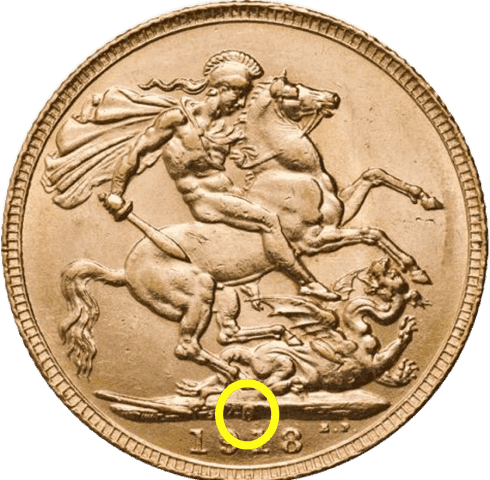
Gold Sovereigns often include a small mint mark—such as ‘S’ for Sydney or ‘M’ for Melbourne—indicating where the coin was struck. If no mint mark is present, the coin was most likely produced at the London Mint. These London-minted Sovereigns are typically bullion-grade coins and tend to trade closer to their intrinsic gold spot value, unless in exceptional condition or of historic interest. Mint marks can play a key role in identifying rarity and collector appeal.
Gold Sovereign Sizes
Gold Sovereigns actually come in multiple sizes (denominations), all sharing the same 22-carat gold composition. The classic “full” Sovereign is the one-pound coin we’ve been discussing, but the Royal Mint has produced fractional and multiple versions over time. Here are the main gold Sovereign sizes:
- Quarter Sovereign: The smallest of the family, introduced in 2009 for collectors and investors. It contains one-quarter of a Sovereign’s gold. A quarter Sovereign has a nominal face value of 25 pence, weighs about 1.997 g total (with ~1.83 g pure gold), and is ~13.5 mm in diameter. It’s tiny – roughly the size of a 5p coin – and usually minted in limited quantities. These are more of a novelty or for completing sets, as the high production cost relative to gold content makes premiums significant on such a small coin.
- Half Sovereign: Valued at half a pound (10 shillings in pre-decimal currency), the Half Sovereign is a very common and popular coin. It’s exactly half the weight of a full Sovereign, so 3.994 g total with 0.1177 troy oz of gold (approx 3.66 g gold). Diameter is about 19.3 mm. Half Sovereigns were issued from 1817 alongside full Sovereigns and were regular circulation coins in the 19th century (and, like full Sovereigns, were removed from circulation in the 20th century). Today they’re struck mostly as bullion and commemoratives. Half Sovereigns look just like mini Sovereigns – same designs, just smaller. They offer a lower entry price point and more flexibility (as discussed, albeit with slightly higher premium). Half Sovereigns remain legal tender with a face value of 50 pence.
- Full Sovereign: The standard unit, face value £1, weighs 7.988 g (0.2354 oz gold), diameter ~22.05 mm. Historically also called a “Double Half-Sovereign” in the early days, but nobody uses that term now. This is the benchmark coin.
- Double Sovereign: This is worth £2 and is basically two Sovereigns in gold content. Weight ~15.976 g total (0.4708 oz of gold, i.e. ~14.65 g gold). Diameter is around 28.4 mm. Double Sovereigns have been issued occasionally for commemorative purposes (for example, 1989, 2005, etc., and now sometimes as bullion too). In circulation back in the 19th century, the equivalent was the £2 gold coin (which existed but was not as common as the Sovereign). The Double Sovereign is sometimes just called a £2 Sovereign or two-pound coin (not to be confused with the modern base-metal £2 coin). It’s a nice large coin – about the size of a £2 coin in diameter, but all gold.
- Quintuple Sovereign (Five-Sovereign Piece): Face value £5, this is a hefty gold coin containing five times the gold of a Sovereign. It weighs about 39.94 g (of which ~36.6 g is gold, equating to 1.177 troy ounces of gold). Diameter is ~36.0 mm – roughly the size of a modern crown coin or the silver £5 commemoratives. Quintuple Sovereigns were often produced for special events (like coronations, jubilees) in proof sets. In recent decades, the Mint has also issued them in bullion form (for example, 2022 saw a bullion £5 coin). They’re quite valuable given they contain over an ounce of gold. Interestingly, the £5 gold piece traces its lineage to the early 19th century as well (some were struck in 1820 for George III, etc.), but they were never common circulation coins due to their high value.
All these coins together are sometimes referred to as the Sovereign family. The Royal Mint often releases proof sets that include the half, full, double, and quintuple (and now quarter) in one set for collectors.
It’s worth noting that the design on all these denominations is usually the same in a given year – for example, in 2022, all will have the same monarch’s portrait on the front and Pistrucci’s St. George on the back (unless it’s a year with a special design). So the main difference is the size and the denomination. The quarter sovereign being a modern introduction, sometimes has odd availability and slightly different designs (e.g., first issued in 2009).
Historic sizes vs Modern: The term “Sovereign” originally (in Tudor times) referred to a much larger gold coin (1489 Henry VII sovereign was 240 shillings, larger than a modern £5 coin, about 42 mm diameter). But that early sovereign was discontinued and unrelated to the modern sovereign beyond the name. The modern Sovereign of 1817 onward is the size we know. Over the years, the weights haven’t changed except within tolerance – so an 1840 sovereign and a 2020 sovereign are the same specs. This consistency is partly why Sovereigns became a globally accepted trade coin.
Dimensional summary:
- Quarter Sovereign: 13.5 mm diameter, ~1.99 g.
- Half Sovereign: 19.3 mm diameter, 3.99 g (gold content ~3.66 g).
- Full Sovereign: 22.0 mm diameter, 7.98 g (gold ~7.32 g).
- Double Sovereign: 28.4 mm diameter, 15.98 g (gold ~14.64 g).
- Quintuple Sovereign (£5): 36.0 mm diameter, 39.94 g (gold ~36.6 g).
All are 22 carat (91.67% purity). The thickness varies slightly but generally around 1.0–1.5 mm for the smaller ones up to ~2 mm for the largest.
From an investment perspective, the full Sovereign is by far the most prevalent and liquid. The half is next. Double and quintuple Sovereigns are a bit more niche – often bought by collectors or those wanting larger display pieces. Quarter Sovereigns are mainly for collectors given their size. If you’re aiming for pure investment, typically you’d stick to halves and fulls (or an occasional quintuple if you want a big coin, as it has similar per-ounce premium to a 1 oz coin).
In conclusion, the Gold Sovereign comes in multiple sizes to suit different needs, but they all share the same gold purity and classic design. Whether you hold a tiny quarter Sovereign or a giant quintuple Sovereign, you’re participating in that long Sovereign tradition – just in different scales. It’s quite neat that one can own a matching set from 1/4 to 5 Sovereigns; it’s both an investor’s sampler and a collector’s delight.
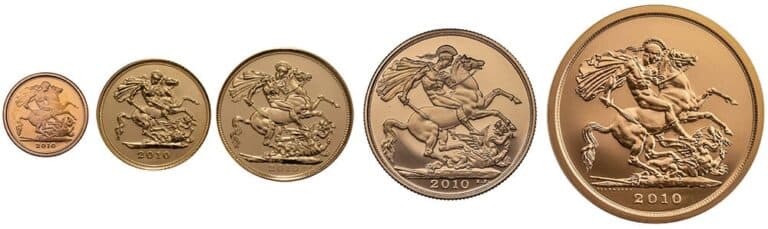
A visual comparison of the five main types of gold Sovereign coins. From left to right—quarter, half, full, double, and quintuple. Each coin contains the same 22-carat purity but varies in diameter and gold weight. This size range makes Sovereigns accessible to both collectors and investors, whether you’re after compact coins for entry-level investing or larger pieces for display or portfolio diversification.
Frequently Asked Questions
What is a gold Sovereign?
A gold Sovereign is a 22-carat British coin first issued in 1817, containing 0.2354 troy ounces (7.32g) of pure gold. It is legal tender in the UK with a face value of £1, but its real value comes from its gold content and historic appeal. Sovereigns are widely recognised for investment and collecting and are exempt from UK Capital Gains Tax (CGT), making them a tax-efficient way to own physical gold.
How much gold Sovereign worth?
The value of a gold Sovereign is primarily based on its gold content, which is worth £726.57 at the current gold spot price. However, certain Sovereigns with rare dates, mint marks, or collector appeal can be worth significantly more. For example, low-mintage issues like the 1819 Sovereign or 1917 London Mint Sovereign fetch thousands. Common modern Sovereigns usually trade just above melt value, influenced by market premiums and dealer demand.
How much is a half gold Sovereign worth?
A Half Sovereign is worth approximately half the value of a full Sovereign, based on its gold content of 0.1177 troy ounces (around 3.66g of pure gold). At current gold prices, this equates to £363.28. Due to minting costs, Half Sovereigns often carry a slightly higher premium relative to their size. Like full Sovereigns, their value can rise if the coin has collectible or historic appeal beyond its melt value.
How much does a gold Sovereign weigh?
A gold Sovereign weighs 7.988 grams in total, of which 7.322 grams is pure gold. It is struck in 22-carat gold, meaning the rest is made up of alloy (usually copper), which strengthens the coin for durability. This standard weight has remained consistent since 1817, making the Sovereign one of the most reliable and widely recognised gold coins worldwide, especially for investment and trade purposes.
How much does a gold Sovereign cost?
The cost of a gold Sovereign depends on the current gold price, market demand, and dealer premiums. As of now, a standard bullion Sovereign typically costs around £803.15. Collectible Sovereigns, proofs, or rare dates may cost considerably more. While buying from the Royal Mint ensures authenticity, it often comes with higher premiums than trusted bullion dealers, who generally offer better value for standard investment-grade coins.
What is the gold Sovereign scrap price?
The gold Sovereign scrap price refers to the value of its pure gold content, based on the current gold spot price. A full Sovereign contains 7.322 grams of pure gold, giving it a melt value of £726.57 based on today's gold spot price. However, Sovereign coins usually sell at a baseline above their scrap price due to factors like minting costs, historical appeal, recognisability, and dealer handling fees—especially for coins in good condition or with collectible demand.
How many grams in a gold Sovereign?
A gold Sovereign contains 7.988 grams in total, of which approximately 7.322 grams is pure gold. The remaining weight is made up of alloy (copper and a small amount of silver), as it’s minted in 22-carat gold (91.67% purity). This composition gives the coin durability while retaining its intrinsic value and investment appeal. The consistent weight and purity have helped establish Sovereigns as one of the most trusted bullion coins globally.
How much is a Queen Victoria gold Sovereign worth?
A Queen Victoria gold Sovereign is worth at least its melt value (around £726.57), but when sold through a dealer, it typically commands a slightly higher price (around £803.15) to cover minting costs, handling, and resale margins. Certain rare issues—like the 1879 London Mint or early Sydney Mint Sovereigns—can fetch over £1,000. However, more common dates from her reign may sell just above bullion value unless in exceptional condition.
Mint mark on gold Sovereign?
The mint mark on a gold Sovereign indicates where it was struck and is usually found on the reverse, just above the date. Common mint marks include 'S' for Sydney, 'M' for Melbourne, 'P' for Perth, 'C' for Canada, 'I' for India, and 'SA' for South Africa. Coins with rare mint marks or low mintage years can command higher values from collectors, especially those with scarce combinations of year and mint.
What size is a gold Sovereign coin?
A full gold Sovereign has a diameter of 22.05 mm and a thickness of approximately 1.52 mm. Despite its compact size, it contains 7.988 grams of 22-carat gold. The Sovereign’s size has remained consistent since 1817, making it easily recognised and tradable worldwide. Other denominations, like the Half or Double Sovereign, are proportionately smaller or larger but maintain the same gold purity and general design features.
Are gold Sovereigns exempt from inheritance tax?
No, gold Sovereigns are not exempt from inheritance tax (IHT) in the UK. While they are exempt from Capital Gains Tax due to their legal tender status, their full market value is still included in your estate calculation. If your total estate exceeds the IHT threshold, Sovereigns will be subject to inheritance tax like any other valuable asset. Proper estate planning can help manage potential IHT liabilities on gold holdings.
Are gold Sovereigns legal tender?
Yes, gold Sovereigns are official legal tender in the UK, with a face value of £1. However, because their intrinsic gold value far exceeds this nominal value, they are not used in everyday transactions. Their legal tender status makes them exempt from Capital Gains Tax for UK residents, which is a key reason they are popular among investors. Sovereigns are one of the few forms of tax-efficient gold in the UK.
Are gold Sovereigns pure gold?
Gold Sovereigns are not pure gold—they are minted in 22-carat gold, meaning they are 91.67% gold and 8.33% alloy (usually copper). This alloy makes the coin more durable for handling and circulation. Each full Sovereign still contains exactly 7.322 grams of pure gold, which is why it holds high value for both investors and collectors, despite not being 24-carat (pure) gold like some bullion bars or coins.
Are gold Sovereigns worth anything?
Yes, gold Sovereigns are worth significantly more than their £1 face value. At minimum, they are worth the value of their gold content—currently £726.57—but some can be worth far more if they are rare, proof-struck, or in exceptional condition. Their value is driven by gold prices, collector interest, and market demand, making them highly sought after for both investment and heritage purposes.
Do gold Sovereigns go up in value?
Yes, gold Sovereigns typically increase in value over time, driven by rising gold prices and investor demand. Over the past decade, for example, their melt value has nearly doubled. Additionally, rare Sovereigns may appreciate further due to their numismatic appeal. Their legal tender status means UK investors don’t pay Capital Gains Tax on any profits, making them a highly efficient long-term asset that often performs well during economic uncertainty.
Can gold coins be used to make jewellery?
Yes, gold coins like Sovereigns are often used in jewellery, particularly in rings, pendants, or bracelets. However, once mounted, the coin typically loses its numismatic (collector) value due to damage or alteration. While the gold content remains valuable, collectors usually prefer unaltered coins. If you want to preserve both the gold and collector value, consider bezel settings that allow the coin to be removed without soldering or damage.
Do gold Sovereigns hold their value?
Gold Sovereigns are known for holding their value well over time. Their worth is anchored to the global gold price, and they are recognised worldwide, ensuring strong liquidity. In addition, UK investors benefit from Capital Gains Tax exemption, enhancing their long-term appeal. During times of inflation or market volatility, Sovereigns often perform well, making them a popular hedge and a historically proven store of wealth across generations.
Can gold coins be used as currency?
Technically, yes—gold coins like Sovereigns are legal tender and can be used as currency at their face value (£1). However, in practice, their intrinsic gold value far exceeds their face value, making them unsuitable for everyday spending. Instead, Sovereigns are traded as investment assets or collector items. Their legal tender status is valuable mainly for tax purposes, such as Capital Gains Tax exemption in the UK, rather than for spending.
When did Sovereigns go out of circulation?
Gold Sovereigns were withdrawn from regular circulation in 1914, at the start of World War I, when the UK government replaced gold coins with paper banknotes. Although production continued at overseas mints for trade, Sovereigns never returned to everyday use in Britain. By the 1930s, they were minted solely for bullion and collector demand. Today, they remain legal tender but are no longer used in circulation due to their high gold value.
Interested in selling gold with the UK’s highest paying gold buyer? Visit our Sell Gold page to get a competitive valuation – we provide fully insured postage and fast payment.
For more insights and the latest gold price today, keep an eye on our live charts and blog updates.