Where Does Gold Come From?
Gold originates in deep space and arrived on Earth via meteorites. It’s forged in stellar explosions (supernovae) and especially neutron star collisions, which produce heavy elements like gold. When the young Earth formed, most gold sank into its core. Later, about 3.9 billion years ago, meteorite bombardments delivered gold to Earth’s crust. In short, gold is cosmic – it was produced by nuclear processes in stars and “rained” down on our planet.
Key Takeaways
- Cosmic origin: Gold was produced in supernovae and neutron-star mergers (r-process nucleosynthesis), then delivered to Earth by meteorite impacts.
- Quantity on Earth: About 216,000 tonnes of gold have been mined in human history, which would fit in a cube roughly 22 meters on a side.
- Deposits: On Earth, gold occurs as quartz-vein (lode) deposits and eroded placer (alluvial) deposits. Rivers wash gold particles downstream, creating nuggets and flakes.
- Major sources: The lion’s share of world gold has historically come from China, Australia and South Africa. Today China is the top producer (~10% of global output), with Russia, Australia, the U.S., and Canada also mining large amounts.
- Rarity: Gold is extremely rare in Earth’s crust (about 0.004 parts per million) and virtually all gold ever mined still exists (mostly in jewellery, investments, and reserves).
- Unreactive metal: Gold never tarnishes or rusts and is highly durable, which is why ancient artifacts still look new.
Where Does Gold Come From?
The short answer is: the stars. Gold atoms are created in extreme cosmic events where intense neutron bombardment occurs. When massive stars explode (supernovae) or especially when neutron stars smash into each other, conditions allow heavy nuclei like gold to form. These events scatter gold (and other precious metals) into space. Over time, this stellar debris became part of the gas and dust that formed our solar system.
On early Earth, most of that primordial gold sank into the core along with iron. The gold we mine today was actually delivered after Earth cooled. Geological studies show a late veneer of meteorites (around 3.9 billion years ago) coated Earth’s crust with gold. In other words, our jewellery literally came from the sky. So where did gold come from? From the explosive deaths and collisions of stars, followed by delivery to Earth by meteorites.
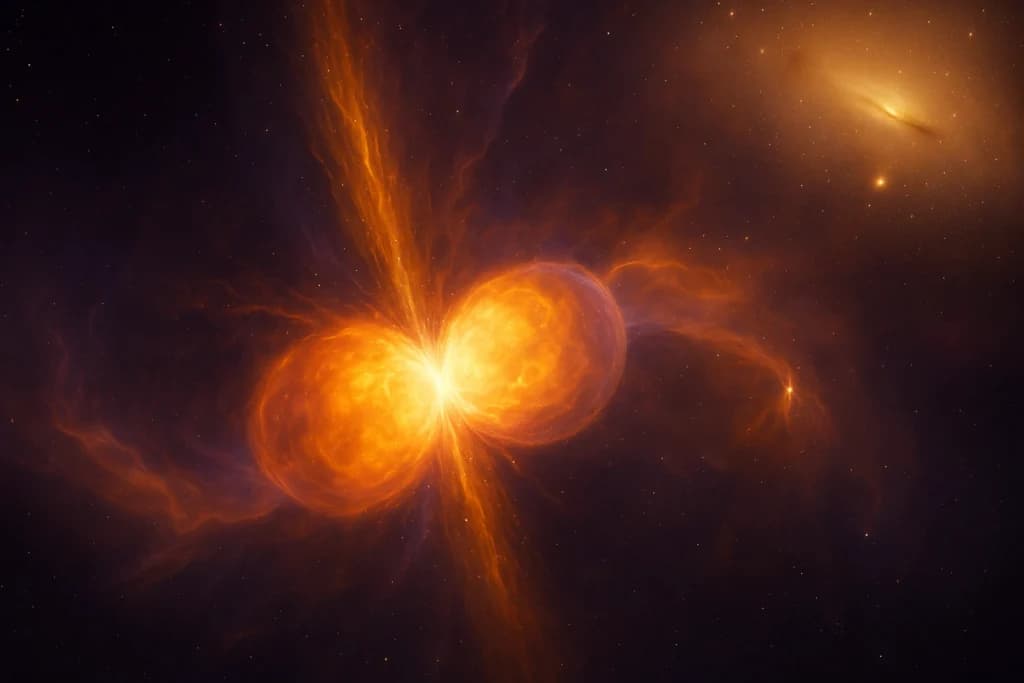
(Artistic depiction of neutron stars merging, illustrating how gold is formed through cosmic gold formation events)
How Is Gold Formed?
Cosmically, gold is formed by rapid neutron capture (the r-process) in cataclysmic events. In plain terms, once fusion in a star builds elements up to iron, creating anything heavier (like gold) requires a neutron-rich, high-energy environment. When two neutron stars collide, they eject neutron-packed material that decays into new elements – a confirmed gold-making forge. In fact, the first observed neutron-star merger (2017) produced over 100 Earth-masses worth of gold and other heavy metals, proving these explosions are “fantastic at creating heavy elements.”
Geologically, once gold is on Earth, it collects in certain deposits. Most gold is found in lode deposits: quartz veins in rocks, often deep underground. Over eons, weathering erodes those rocks and carries gold flakes into streams, creating placer deposits (alluvial gold in riverbeds). Prospectors search lode (hard-rock) gold and pan placer gold. For more on this, see our posts How Is Gold Made? and How Is Gold Formed?. They cover cosmic synthesis and terrestrial formation in detail. Gold’s dual origin (cosmic and geological) explains both “how is gold produced” and “where did gold come from.”
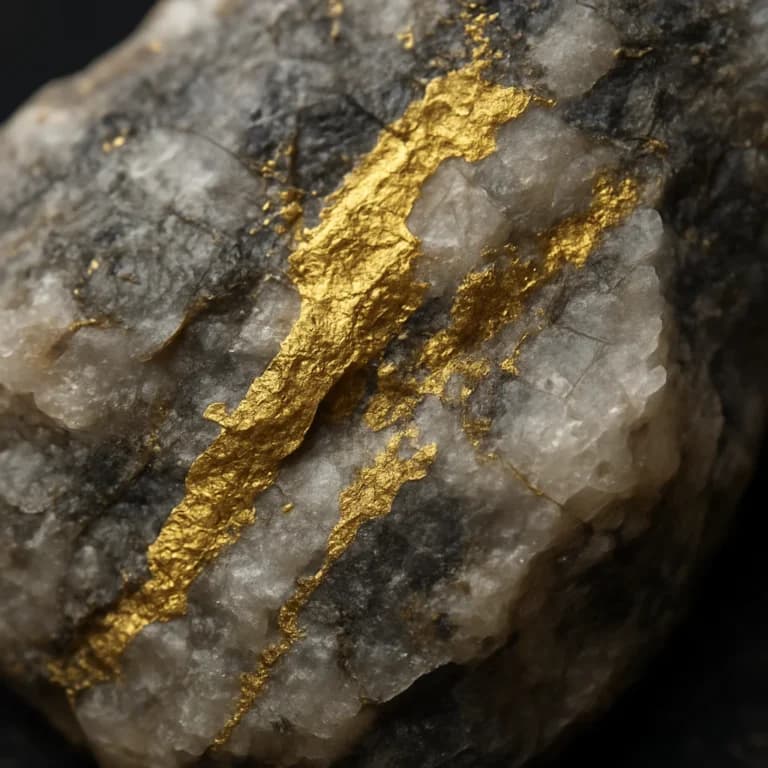
(Close-up of a gold lode deposit in quartz rock, illustrating where gold is found in natural underground formations)
Where Is Gold Found?
Gold is found throughout the world in the Earth’s crust. It often occurs in quartz veins (hard-rock mines) and in river gravels (placer deposits). Some of the richest gold fields on Earth are in South Africa (Witwatersrand Basin), Australia (Kalgoorlie, Olympic Dam), China (various provinces), Russia (Kolyma, Ural), USA (Nevada, Alaska), and Canada (Yukon, Ontario). About 244,000 tonnes of gold have been discovered so far, and roughly two-thirds of that came from China, Australia and South Africa.
China alone produced about 10% of world gold in 2023, making it the current leader. Other top producers include Russia, Australia, the US and Canada. Gold is often found with quartz or sulfide minerals in hard rock, but placer gold can be found in streams and old river gravels (e.g., California’s rivers, Alaska’s creeks). For a deep dive on global deposits, see our post Where Is Gold Found?.
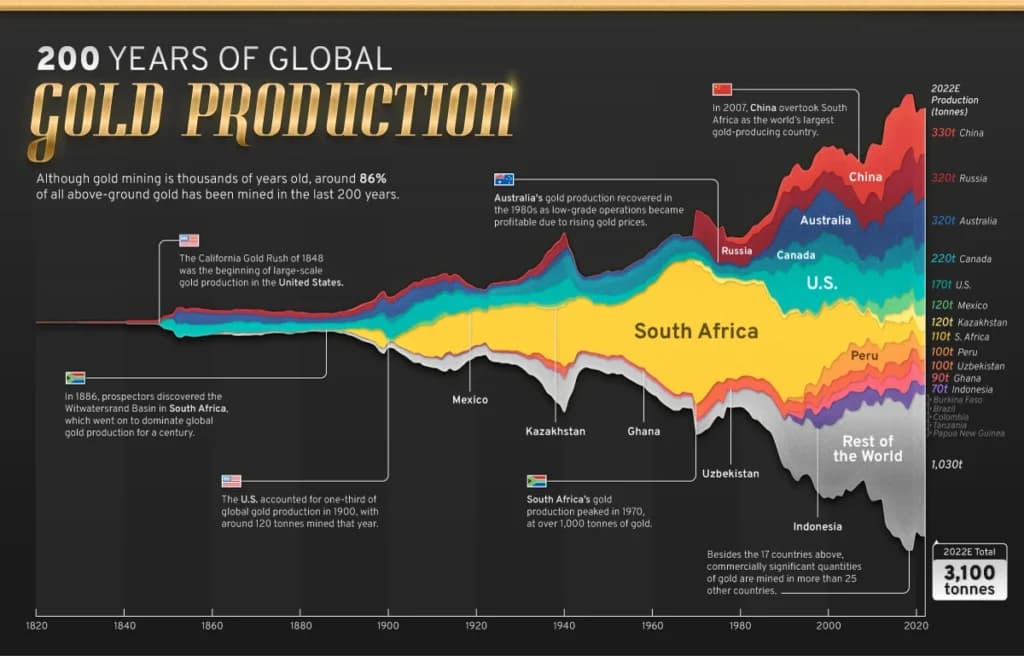
(Timeline showing where gold is found and gold production by country over 200 years, highlighting major producers like South Africa, China, and Australia)
How Much Gold Is On Earth?
Only a few hundred thousand tonnes of gold exist in usable form on Earth’s surface and near-surface. To date about 216,000 tonnes of gold have been mined (all above ground). If collected into one giant cube, that gold would only be about 22 meters on each side – surprisingly small! Known underground reserves (gold we know is still in the ground) are on the order of 50,000–60,000 tonnes. By contrast, Earth’s core likely contains vastly more, but it’s inaccessible. Because gold doesn’t rust away, nearly all the mined gold still exists today – either in jewellery, coins, electronics, or stored by central banks.
For perspective, see the visualisation below of all mined gold in history.
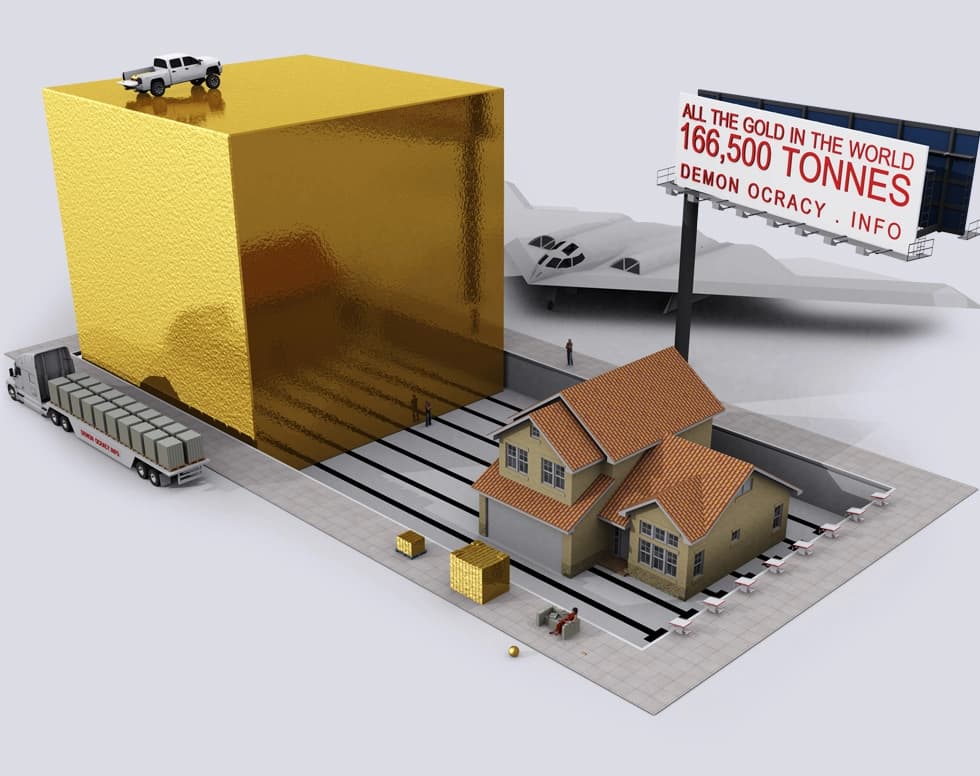
(This image shows how much gold has been mined throughout history. If all the world’s mined gold were gathered, it would form a cube measuring 22 meters on each side—roughly the height of a seven-story building. Remarkably, this entire cube could easily fit under the Eiffel Tower!)
20 Interesting Facts About Gold
- Gold is the element with atomic number 79 (symbol Au, from Latin aurum, “shining dawn”). It has 79 protons and (usually) 118 neutrons per atom.
- It’s extremely dense and heavy: 1 cm³ of gold weighs 19.3 grams, compared to iron’s 7.9 g/cm³.
- Gold is amazingly malleable. One gram of gold can be beaten into a sheet of 1 square meter; one ounce (28 g) can be drawn into a wire ~50 miles long.
- Gold is chemically inert – it never tarnishes, rusts or oxidises. (It resists nearly all acids. Only aqua regia can dissolve it.) Ancient gold artifacts look as shiny today as when they were made.
- Gold conducts electricity exceptionally well. It’s used in electronics (motherboards, connectors, spacecraft) because it won’t corrode.
- Pure gold (24K) is very soft: it can be scratched with a fingernail and bent by hand. That’s why “karat” markings (18K, 14K, etc.) indicate alloys with harder metals.
- Nearly all gold ever mined still exists today in some form. About 45% of it is in jewellery, 22% in coins/bars, and 17% held by central banks. The rest is in industry, electronics, etc.
- Gold is one of the few metals that occur in nature in pure form. It often appears as nuggets or flakes embedded in quartz or placer deposits.
- It’s even edible and non-toxic. Gold leaf is used to decorate high-end foods and drinks. Some precious desserts are gilded with 24K gold (body-safe).
- Dentists have used gold for crowns and fillings because it’s biocompatible and long-lasting.
- The largest gold nugget ever found was the “Welcome Stranger” in Australia (1869) at ~72 kg (~156 pounds). It had about 85% gold.
- Gold can be created artificially via nuclear reactions (e.g., neutron bombardment in reactors), but it’s extremely expensive and only done for research.
- Gold is tasteless, odourless, and completely immune to biological decay – it could lie on the ground forever and stay pure.
- In terms of rarity, gold is about the 64th most abundant element in Earth’s crust Wikipedia (around 0.004 parts per million by weight). That’s roughly 3 micrograms per kilogram of rock.
- Gold has been treasured throughout history: the oldest gold jewellery dates back over 5,000 years (in what is now Bulgaria), and gold coins were first minted around 600 BC in Lydia (Turkey).
- Gold was the backbone of money: most national currencies used to be tied to gold (the “gold standard”). The U.S. dollar was backed by gold until 1971.
- The United States holds the largest official gold reserves (~8,100 tonnes in Fort Knox and elsewhere), followed by Germany (~3,300 t), Italy, France, Russia, and China. These are stored as bullion.
- By definition, gold is a precious, yellow transition metal (it’s one of Group 11 in the periodic table). Its unique colour comes from relativistic effects on its electrons.
- Gold rushes have shaped history (California 1849, Yukon 1896, etc.). Each was triggered by finding placer gold in streams, which led prospectors upstream to the lode source.
- A curious use: gold nanoparticles are now used in medicine and technology (e.g., targeted drug delivery, sensors) because of gold’s stability and conductivity.
Frequently Asked Questions
Where does gold come from?
It’s made in stars. Heavy elements like gold form in supernovae or neutron-star mergers. Meteorites carrying this gold then bombarded early Earth, adding precious metals to the crust.
How is gold formed?
Cosmically, gold forms by rapid neutron capture (the r-process) during stellar explosions. On Earth, the gold that was delivered is concentrated into lode (rock) and placer (river) deposits by geological processes.
Where is gold found?
In the Earth’s crust – often in quartz veins (mined as lode gold) or in river gravels (placer gold). Major deposits are in South Africa, Australia, Russia, the U.S., China and Canada. Historically, China, Australia and South Africa produced most of the world’s gold.
How much gold is on Earth?
Not much. All the gold ever mined is only ~216,000 tonnes (fits in a ~22 m cube). Known undeveloped reserves add another ~50–60k tonnes. By contrast, most of Earth’s gold is locked in the inaccessible core.
How is gold made?
Gold is naturally created during cosmic events, primarily from neutron star collisions and supernova explosions. These powerful events produce heavy elements, scattering gold across space. Humans can also produce tiny amounts artificially through nuclear reactions, but it's extremely costly and impractical. Nearly all gold we use today is mined from deposits formed by geological processes.
How much gold is left on Earth?
About 50–60 thousand tonnes remain in known mines/reserves. Global mine production is a few thousand tonnes per year, so there’s still many years of supply, but new discoveries become rarer.
What is gold made of?
Gold metal is made of gold atoms (element 79), each with 79 protons. Pure gold consists of the element with one stable isotope (Au-197, which has 118 neutrons).
What is the biggest nugget of gold ever found?
The “Welcome Stranger,” found in Victoria, Australia in 1869, is the largest natural nugget recorded. It weighed about 72 kg (156 lb) before being hammered thin.
What is the chemical symbol for gold?
Au. The symbol comes from aurum, Latin for “shining dawn.”
How much gold has been mined?
Roughly 216,000 metric tons have been mined throughout history. About two-thirds of this was extracted since 1950 thanks to modern mining.
Can gold be made artificially?
Yes, by nuclear reactions, but only in minute amounts. Converting other elements into gold (alchemy) is possible in physics but wildly expensive, so commercial gold is always mined.
Why is gold found in rivers?
Because erosion breaks gold-bearing rock veins apart. Gold flakes and nuggets are carried downstream by rivers, concentrating in streambeds (placer deposits). Panning and sluicing take advantage of this.
What countries have the largest gold reserves?
The countries with the largest gold reserves stored as bullion are the United States (approximately 8,100 tonnes), Germany (around 3,300 tonnes), Italy (about 2,400 tonnes), France (around 2,400 tonnes), and Russia (roughly 2,200 tonnes). In terms of mineral reserves still underground, the leading countries include Australia, Russia, South Africa, Canada, and the United States.
What type of metal is gold?
Gold is a precious transition metal. It’s one of the group 11 metals (with silver and copper), characterised by high density, a bright yellow colour, and excellent conductivity. Gold is chemically inert (a “noble” metal).
Interested in selling gold with the UK’s highest paying gold buyer? Visit our Sell Gold page to get a competitive valuation – we provide fully insured postage and fast payment.
For more insights and the latest gold price today, keep an eye on our live charts and blog updates.