Where Is The Best Place To Buy Gold?

The best place to buy gold in the UK is through reputable dealers offering competitive prices, secure delivery or storage, and options for tax-efficient investments. Whether purchasing online or in person, choosing a trusted source ensures the authenticity and value of your gold investment.
Key Takeaways
- Top UK Gold Dealers: Reputable dealers include The Royal Mint, BullionByPost, GOLD.co.uk, Hatton Garden Metals, Chards, and Sharps Pixley. These dealers offer a range of gold products and services to suit various investment needs.
- Online vs. In-Person Purchases: Online platforms provide convenience, more competitive pricing, and secure delivery options. In-person purchases allow for immediate inspection gold buying.
- Tax Considerations: Investing in certain UK legal tender gold coins, such as Britannias and Sovereigns, can offer exemptions from Capital Gains Tax (CGT) and Value Added Tax (VAT), enhancing the tax efficiency of your investment.
- Storage Options: Many dealers offer secure storage solutions, including insured vaulting services, for added security and peace of mind.
- Customer Support and Services: Leading dealers provide comprehensive customer support, including investment advice, buyback guarantees, and educational resources to assist both novice and experienced investors.
Buying gold in the UK can be done through several channels, each with its pros and cons.
Where is the best place to buy gold? The answer depends on what you value – price, convenience, or assurance of authenticity. The main options include buying from The Royal Mint, purchasing through online bullion dealers (like BullionByPost, Atkinsons, Chards, or Baird & Co), or going to local gold sellers such as coin shops or jewellers. All of these can provide investment-grade gold bars and coins, but the “best” place will vary for each investor. Below we overview these options:
The Royal Mint:
The UK’s official mint offers gold Britannia coins, Sovereigns, and bars directly to the public. You’re buying straight from the source, which guarantees authenticity and quality. All gold coins from The Royal Mint (being UK legal tender) are Capital Gains Tax (CGT) free for UK investors, meaning any profits on sale are tax-exempt. The Mint also provides insured delivery and even secure storage (the “Royal Mint Vault”). However, Royal Mint prices tend to be a bit higher – you pay a premium for the brand and packaging goldsell.co.uk.
The selection is also limited to Royal Mint’s own products (you won’t find foreign coins like Krugerrands there). If absolute lowest price is your priority, the Royal Mint may not be the cheapest place to buy gold, but it excels in trust and heritage.
Online Bullion Dealers:
Private online retailers (e.g. BullionByPost, Atkinsons, Chards, Baird & Co., Hatton Garden Metals, etc.) specialise in gold bullion. These dealers usually offer very competitive pricing and a wide range of products from mints worldwide. For example, on one site you could buy UK Britannias or Sovereigns, South African Krugerrands, American Eagles, Canadian Maple Leafs, or gold bars from popular refineries (PAMP, Heraeus, Metalor, etc.) all in one place.
Online dealers often run special offers and volume discounts – so this can be the best place to buy gold if you’re seeking value and variety. They also typically offer buy-back programs; for instance, BullionByPost sources new coins directly from mints and will buy back your gold at competitive rates.
The downside is that you’re not transacting face-to-face, so you must choose a reputable dealer. Stick to dealers with strong customer feedback and proper accreditation. Check if the dealer is listed by organisations like the British Numismatic Trade Association (BNTA) or is a member of the London Bullion Market Association (LBMA) – these are good indicators of trustworthiness.
Reputable online dealers will ship via insured delivery, and you’ll need to arrange safe storage (either at home in a secure safe or via a third-party vault service). Overall, buying gold online from a well-known dealer combines good pricing with convenience, and for many investors this is the best way to buy gold securely in the UK.
Local Gold Buyers & Jewellers:
Searching for “buy gold near me” might lead you to high-street jewellers, pawn shops, or coin dealers that sell gold. The big advantage here is the face-to-face service – you can see and hold the item before paying, ask questions in person, and take the gold home immediately. A knowledgeable local dealer can provide personal advice, which is reassuring if you’re new to gold. There’s also no waiting or shipping involved.
However, local shops often have higher premiums to cover their overhead costs (rent, staff, insurance, etc.) goldsell.co.uk.
The selection might be limited – a small shop might only have a few common coins or small bars in stock. Also, not all high-street jewellers are experienced in investment bullion; some primarily sell jewellery and may not offer certified gold coins or bars.
If you do find a good local coin shop with fair prices, that’s wonderful – just double-check that their prices aren’t significantly above what you’d pay online for the same item. Many investors find that local shops are more about convenience and immediacy rather than price competitiveness. In fact, traditional brick-and-mortar gold dealers tend to charge higher premiums due to their higher operating costs, so you might pay a bit extra for the same gold compared to an online source.
So, where is the best place to buy gold?
It truly depends on your priorities. If trust and a prestigious source matter most, The Royal Mint offers unparalleled assurance (and tax-free coins). If low price and variety are key, online bullion dealers usually win – you might save a few percentage points on premiums and have a broader selection of products.
If you value personal service or want to make a small purchase locally, a local jeweller or coin shop can suffice (just ensure they are reputable and price-competitive).
Seasoned gold investors often use a combination of sources: for example, buying special edition coins or gifts from the Royal Mint, but purchasing bulk bullion from online dealers to get the best price goldsell.co.uk.
Whichever route you choose, do your homework on the seller. Make sure they offer genuine, hallmarked gold, and check if they have clear buyback policies in case you want to sell later. The good news is that the UK has a well-developed gold market with many reputable places to buy gold, so if you stick to established names you can invest with confidence.
Local Jewellers vs Online Gold Dealers
Many people initially search for “buy gold near me”, hoping to find a convenient local source. Let’s compare buying gold locally versus online, since each approach has its pros and cons for UK investors:
- Local Gold Buyers / Jewellers: Buying from a nearby gold dealer (such as a jeweller, pawn shop, or coin dealer) allows you to inspect the gold in person and walk out with it immediately. This face-to-face interaction can feel safer and more personal. Local experts might also share useful advice about coins or bars. However, local gold buyers often have higher prices (premiums) because they must cover overhead expenses like rent and security. Their inventory can be limited; you might only find a few popular items. Also, in a small town with only one or two gold shops, there’s little competition – they may not offer the best price since buyers have few alternatives. It’s not uncommon for high-street shops to charge significantly above the market spot price for coins or bars. In short, buying gold “near me” is convenient and immediate, but you typically pay for that convenience.
- Online Bullion Dealers: If you expand your search beyond your immediate vicinity, you’ll discover many online options. Buying gold online from a U.K. bullion dealer can often save you money. With online competition, dealers keep premiums low to attract customers. You can shop around easily and compare prices on the same coin across multiple websites. The selection is also much broader – you’re not limited to what one shop has in the window. An online dealer might stock everything from 1g miniature bars up to 1kg bars, as well as dozens of coin types. The process is simple: order online and have the gold delivered to your door, fully insured. The downside is waiting for delivery (usually only 1-3 days) and not physically seeing the item first – which is why sticking to established dealers with good reviews is important. Reputable online sellers provide authenticity guarantees (many send assay certificates with bars, etc.) and offer return policies. For most investors in the UK, using a well-known online dealer is the most cost-effective route to buy investment gold. In fact, online prices for popular gold coins are often just a few percent above the spot gold price, whereas a local shop might charge more.
- Major Institutions (The Royal Mint & Others): Another “buy gold near me” option – at least in the sense of being domestic – is buying directly from major institutions like The Royal Mint (or even certain banks, though banks in the UK rarely sell physical gold nowadays). As discussed, The Royal Mint gives total peace of mind on authenticity and offers the convenience of online ordering with optional storage. They are a great choice for first-time buyers seeking safety and for those buying Britannia or Sovereign coins to benefit from tax exemptions. The trade-off is a somewhat higher premium. There are also private mints or large refiners (like Baird & Co., based in London) that sell gold to the public – these aren’t “near you” in the sense of a high-street shop, but you could visit their showroom or simply purchase online for delivery. Baird & Co., for example, is a London gold refinery and dealer that sells bars and coins (and even offers vault storage in UK and internationally). Such institutions combine the reliability of a long-established business with prices closer to the market rate, so they are worth considering.
In summary, “buy gold near me” vs online comes down to a trade-off between immediacy vs. price. If you have a trusted local bullion shop that only charges a small premium, it can be a convenient way to start. But in most cases, online gold dealers offer better prices and more choice, even after including insured delivery costs. Many investors use local shops for small impulse buys or gifts, but turn to online dealers for larger investments. No matter which you prefer, always compare the total price (including any commissions, shipping, or insurance fees) and ensure you’re dealing with a reputable seller. It’s wise to get a quote from a few sources – for example, check a local dealer’s price on a 1 oz Britannia, then see what established online dealers are charging for the same coin. This way, you’ll know if the convenience of “near me” is worth the extra cost or if you’d rather save money by ordering online.
How To Buy Gold?
When it comes to how to buy gold, you have several different avenues. The main ways to invest in gold are: buying physical gold (coins or bars that you take possession of), paper or electronic gold (such as gold ETFs or gold-backed funds through a stockbroker), or using a gold account/platform that holds gold on your behalf.
Here’s a breakdown:
Buying Physical Gold (Coins/Bars)
This is the straightforward method – purchasing actual gold bullion and owning it directly. You can buy gold coins or small bars from dealers (online or in person), or even from The Royal Mint. In the UK, common choices for investors are Britannia and Sovereign coins (for reasons discussed in the next section), or gold bars ranging from 1g up to 1 kilogram.
Pros: It’s a tangible asset with no counterparty risk – you’re not relying on any institution once you have the gold in hand. It’s ideal for long-term wealth preservation and as a hedge against economic troubles. Plus, certain UK coins have tax perks (no Capital Gains Tax).
Cons: You need to think about secure storage – whether that’s a home safe, a rented safety deposit box, or a specialist vault service. Insurance is also wise if you store at home. Physical gold can be slightly less liquid than “paper” gold; selling may take effort, although popular coins and bars are usually easy to sell quickly in the UK.
Many investors choose to start with physical gold as it’s straightforward and has the psychological benefit of actually owning and seeing your investment.
(UK tip: when buying physical gold for investment, favour bullion coins that are VAT-free and CGT-free, like Britannias or Sovereigns, to maximise your tax advantages.)
For a deeper dive into investing in gold, check out our simple guide on investing in gold.
Gold ETFs (Exchange-Traded Funds) and ETCs:
These are often cited as the easiest way to invest in gold without handling the metal. A gold ETF/ETC is a fund traded on the stock market that aims to track the price of gold. For example, UK ETFs include iShares Physical Gold (SGLN) and WisdomTree Physical Gold (PHGP).
You can buy or sell ETF shares through any stockbroker platform (e.g. Hargreaves Lansdown, Trading 212), just like stocks. goldsell.co.uk
Pros: Extremely convenient – you can purchase gold exposure in seconds online, even invest within an ISA or pension. No storage or security concerns. Very liquid – you can sell shares whenever the market is open.
Cons: You don’t have physical possession of the gold, which for some defeats the purpose of a “safe haven.” There are small annual management fees (~0.2–0.4%). ETFs are not CGT-free – profits are subject to Capital Gains Tax.
Nonetheless, for many people, gold ETFs are the best way to invest in gold for the medium term or to include in a broader investment portfolio. Some ETFs can be held in a Stocks & Shares ISA, making gains tax-free.
Digital Gold Accounts / Online Platforms:
These let you buy a portion of physical gold stored on your behalf. Services like BullionVault, GoldMoney, and fintech apps like Revolut let you purchase and hold gold digitally.
You can buy, say, 100 grams of gold; the company stores that amount in a vault, often in Zurich, London, New York, etc. Delivery may be possible, but most users trade within the platform.
Pros: Easy and quick to trade 24/7, low transaction fees, no personal storage burden. Backed by physical metal (if reputable), and usually low storage fees.
Cons: You must trust the platform’s management and security. There are storage fees (e.g. 0.12%/year). You don’t physically hold the gold, which may matter to some.
This is a middle ground – it gives the security of physical backing with the convenience of online access.
Gold Mining Stocks / Funds:
Another option is indirect exposure via mining companies. You can buy individual mining stocks (e.g., Barrick Gold, Newmont) or ETFs tracking gold miners.
The idea is that mining companies may rise more than the gold price during bull markets.
Pros: Potential for greater gains and sometimes dividends. Miners may outperform gold in strong markets.
Cons: Much riskier. Exposed to company-specific risks, political issues, and market volatility. Not a direct gold investment, more suitable for experienced stock investors.
For most casual investors, a small allocation to a mining fund suffices, with the bulk of their gold exposure in physical or ETF form.
To actually buy gold in practice:
If buying physical gold, choose a dealer (online or local), select your coin/bar, and pay. You’ll receive it by insured delivery or in person. Ensure it comes with proper documentation (receipt and often an assay certificate).
If buying via ETF or digital platforms, open an account, fund it, and place your order. The exposure shows up in your account after execution.
Each method has its nuances, and one isn’t universally “better.” Many UK investors use a mix – physical coins for long-term holding, ETFs for liquidity, and maybe mining stocks for upside potential.
UK taxation on gold can vary:
Investment-grade gold (high purity coins and bars) is VAT-free. Royal Mint bullion coins (e.g., Britannias and Sovereigns) are VAT and CGT exempt. ETFs may incur CGT unless held in an ISA. Profits from physical gold bars may be taxed if above the CGT exemption and not legal tender.
It’s worth reviewing our articles on gold investment and capital gains tax on gold.
In summary, how to buy gold depends on your preference: physical for hands-on, long-term holding; ETFs or digital gold for convenience and liquidity. Many start with coins and add ETFs later. Just ensure you buy investment-grade gold from a reputable source, and you’re well on your way.
Gold ETFs (Exchange Traded Funds) and ETCs (Exchange Traded Commodities)
These are often cited as the easiest way to invest in gold without handling the metal. A gold ETF/ETC is a fund traded on the stock market that aims to track the price of gold. For example, UK ETFs include iShares Physical Gold (SGLN) and WisdomTree Physical Gold (PHGP).
You can buy or sell ETF shares through any stockbroker platform (e.g. Hargreaves Lansdown, Trading 212), just like stocks. goldsell.co.uk
Pros: Extremely convenient – you can purchase gold exposure in seconds online, even invest within an ISA or pension. No storage or security concerns. Very liquid – you can sell shares whenever the market is open.
Cons: You don’t have physical possession of the gold, which for some defeats the purpose of a “safe haven.” There are small annual management fees (~0.2–0.4%). ETFs are not CGT-free – profits are subject to Capital Gains Tax.
Nonetheless, for many people, gold ETFs are the best way to invest in gold for the medium term or to include in a broader investment portfolio. Some ETFs can be held in a Stocks & Shares ISA, making gains tax-free.
Digital Gold Accounts / Online Platforms
These let you buy a portion of physical gold stored on your behalf. Services like BullionVault, GoldMoney, and fintech apps like Revolut let you purchase and hold gold digitally.
You can buy, say, 100 grams of gold; the company stores that amount in a vault, often in Zurich, London, New York, etc. Delivery may be possible, but most users trade within the platform.
Pros: Easy and quick to trade 24/7, low transaction fees, no personal storage burden. Backed by physical metal (if reputable), and usually low storage fees.
Cons: You must trust the platform’s management and security. There are storage fees (e.g. 0.12%/year). You don’t physically hold the gold, which may matter to some.
This is a middle ground – it gives the security of physical backing with the convenience of online access.
Gold Mining Stocks / Funds
Another option is indirect exposure via mining companies. You can buy individual mining stocks (e.g., Barrick Gold, Newmont) or ETFs tracking gold miners.
The idea is that mining companies may rise more than the gold price during bull markets.
Pros: Potential for greater gains and sometimes dividends. Miners may outperform gold in strong markets.
Cons: Much riskier. Exposed to company-specific risks, political issues, and market volatility. Not a direct gold investment, more suitable for experienced stock investors.
For most casual investors, a small allocation to a mining fund suffices, with the bulk of their gold exposure in physical or ETF form.
To actually buy gold in practice:
If buying physical gold, choose a dealer (online or local), select your coin/bar, and pay. You’ll receive it by insured delivery or in person. Ensure it comes with proper documentation (receipt and often an assay certificate).
If buying via ETF or digital platforms, open an account, fund it, and place your order. The exposure shows up in your account after execution.
Each method has its nuances, and one isn’t universally “better.” Many UK investors use a mix – physical coins for long-term holding, ETFs for liquidity, and maybe mining stocks for upside potential.
UK taxation on gold can vary:
Investment-grade gold (high purity coins and bars) is VAT-free. Royal Mint bullion coins (e.g., Britannias and Sovereigns) are VAT and CGT exempt. ETFs may incur CGT unless held in an ISA. Profits from physical gold bars may be taxed if above the CGT exemption and not legal tender.
It’s worth reviewing our articles on gold investment and capital gains tax on gold.
In summary, how to buy gold depends on your preference: physical for hands-on, long-term holding; ETFs or digital gold for convenience and liquidity. Many start with coins and add ETFs later. Just ensure you buy investment-grade gold from a reputable source, and you’re well on your way.
How Much Is 1g of Gold Worth?
This is a common question, especially from new investors or those looking to understand the value of small amounts of gold. How much is 1 gram of gold worth? The answer fluctuates daily, because the gold price continuously changes based on market trading. The value of 1g of gold is determined by the current spot price of gold.
As of today, the price of gold per gram is £99.28 based on the live gold price for 24ct gold. This means a standard 1g gold bar (999.9 fine gold) would have £99.28 worth of gold content by melt value. If you’re buying retail, you’ll pay a bit more (a premium for manufacturing and dealer margin), so a 1g bar might cost you say 8-10% more to purchase. Likewise, if you sell, a dealer might pay slightly under spot for small quantities.
In summary, you can sell gold jewellery, sell gold coins, sell gold bullion bars, or sell any scrap gold through GoldSell. They make it simple by purchasing a wide range of gold items. For each category, the process is the same: send it in, get a valuation, and get paid fast. Having covered what you can sell, let’s look at the exciting part – how much your gold is worth today.
What Is A Troy Ounce?
It’s important to note that the market price of gold is usually quoted per troy ounce (31.1035 grams). Prices update constantly due to supply/demand, currency rates, and economic factors. Gold is traded globally in USD, so GBP prices also move with the GBP/USD exchange rate.
Gold Price by Carat (Purity): If you’re asking about the price of 1g gold, its value depends on purity (carat). Pure gold is 24 carat (24k or .999 fine). But most jewellery is 9k, 14k, 18k, etc., meaning it contains less gold per gram. For instance, 9k gold is only 37.5% gold by weight. So 1 gram of 9k gold contains 0.375 grams of pure gold. If 24k gold is £99.28/g, then 9k gold’s intrinsic gold value is £37.23 per gram goldsell.co.uk. Similarly, 18k gold (75% purity) has £74.46 worth of gold per gram at today’s live gold price. Jewellers and gold buyers will often quote prices for these different carats when buying scrap gold.
To help you stay informed and make smarter decisions, we’ve included live data below showing the current gold price per gram across various carats. Whether you’re selling scrap gold or buying investment-grade bullion, understanding today’s gold price is essential for getting the best value.
Today's Gold Price Per Gram
Gold price last updated:
Wednesday, 21 October 2026, 12:32.
The LBMA (London Bullion Market Association) spot price changes daily.
The prices displayed are based on the global market rate for pure 24ct gold, known as the spot price. Like all gold dealers, GoldSell pays a percentage of this rate to account for assaying, refining, secure logistics, market volatility, and handling costs. We consistently offer among the highest payout rates in the UK, with the exact percentage increasing based on the weight and purity of the gold you sell.
For investment-grade gold, you are dealing with 24k (999.9) for bars and usually either 22k or 24k for coins. A 1g bar is 24k pure and so its value is straightforward (£99.28/g as mentioned).
Historical Price Perspective: Gold’s price per gram has generally been rising over the long term. A decade ago, 1g of gold was much cheaper. For example, 10 years back (2015), gold was around £25–£30 per gram. Today it’s £99.28/g – a substantial increase, reflecting gold’s performance and pound sterling inflation. In 2024 alone, gold prices in GBP jumped about 27% in one year, the biggest annual gain since 2010. This illustrates that the value of that 1g can change significantly over time. Gold often spikes during economic uncertainty or high inflation. Conversely, there are periods where gold’s price stalls or pulls back a bit. It’s not a steady upward line, but the long-term trend has been positive, preserving and growing value.
To get the exact current value of 1g of gold, you can use a live gold price tracker or view our gold price chart per gram above which updates in real-time.
Also keep in mind the difference between spot price and retail price. The gold spot price is what raw gold trades for on markets. If you buy a 1g physical piece, it will include a premium. The smaller the item, the higher the premium percentage – thus 1g bars have quite high premiums. If instead you bought a 100g bar, the per-gram cost would be much closer to the gold spot price. Dealers may charge, say, 5-8% premium on a 1g bar (due to manufacturing cost being the same proportionally), but only 1-2% premium on a 1oz or 100g bar. So the worth of 1g gold is £99.28 in raw value, but expect to pay a bit more to actually buy that gram in coin/bar form.
In summary, 1 gram of 24k gold is worth £99.28 based on the live gold price as of today in the UK, and this value changes with the market. Always check a live gold price source for the latest figure. And remember that if you’re dealing with less-than-pure gold (14k, 18k jewellery, etc.), the gold content value will be proportionally less (e.g. 18k is 75% of the 24k price per gram). Gold is typically quoted in troy ounces, but breaking it down: a troy ounce of gold is currently £3,088.06, which makes a gram £99.28. So that’s the ballpark for the price of 1g of gold today.
Should I Buy Gold Coins?
If you are investing in gold, you may wonder whether gold coins are a good choice (as opposed to gold bars or other forms). Should you buy gold coins? For many UK investors, the answer is yes – gold coins often offer unique advantages that make them an excellent way to hold physical gold.
Benefits of Gold Coins:
- Tax Advantages: UK bullion coins like the Britannia (1 oz gold coin) and Sovereign (approx 0.235 oz gold) are legal tender in the UK, which means they are exempt from Capital Gains Tax. If the value of your coins increases over time (which, if gold’s price rises, it will) and you later sell at a profit, you won’t owe any CGT on British coins such as Britannias or Sovereigns. This is a major benefit over gold bars; although gold bars are VAT-free to buy, they are not CGT exempt – so if you had substantial gains on bars, you could face tax on profits above the annual allowance. With coins like Britannias, you can realise unlimited gains tax-free. This makes gold coins particularly attractive for long-term investment.
- No VAT and Wide Recognisability: All investment-grade gold (coins or bars of purity ≥ 22k for coins, ≥ 99.5% for bars) is VAT-free in the UK. So, like bars, coins also enjoy no VAT on purchase. Additionally, popular gold coins are recognised worldwide. Coins such as Britannias, Sovereigns, Krugerrands, Maple Leafs, etc., are minted by reputable authorities and trusted for gold content. This makes them easy to resell – any dealer will readily buy well-known bullion coins. The Royal Mint’s Britannia and Sovereign are especially liquid in the UK (and even abroad) because they have been produced in huge numbers and have consistent gold content (Britannias are 1 troy ounce of 24k gold; Sovereigns are 7.322g of 22k gold containing 0.2354 troy oz of gold).
- Smaller Denominations & Flexibility: Coins often come in smaller units than large bars. This gives you flexibility. For example, say you accumulate 10 one-ounce coins over time (roughly 311 grams total). If you ever need to sell some gold, you can sell just 1 or 2 coins. If instead you only had a single 10-ounce bar, you’d have to sell the whole thing or have it cut (which is impractical). Coins like Sovereigns are even more granular, making it easy to liquidate little by little if needed. Many investors like to hold a mix of coins, as it gives options to sell in portions.
- Easy Storage and Transport: Coins are compact and hardy. A tube of Britannia coins (usually 10 or 20 coins) can be tucked away securely, and each coin is stamped with its weight and purity, which is reassuring. You don’t necessarily need assay certificates for coins because the design and details (and sometimes advanced anti-counterfeit features, like the Britannia has) serve as assurance. Coins can also be more easily hidden or transported discreetly if ever necessary (whereas bars, especially large ones, are bulky).
- Aesthetic and Collectible Upside: While as an investor you’re buying for gold content (not collectibility), it doesn’t hurt that coins have intricate designs and some semi-numismatic appeal. For instance, each year’s Britannia has a year stamp and occasionally design changes or special editions (like the 2023 Britannia featuring Queen Elizabeth II’s last effigy and King Charles III’s first effigy). Sometimes certain mintages become sought after. Sovereigns have a long history and some older ones can carry a small premium for collectors. All this means coins hold their value and sometimes appreciate beyond gold content – though the baseline assumption should be they trade at gold content value plus a small premium.

(Gold Sovereign coins, popular UK investment coins that are capital gains tax free for investors)
Given these advantages, gold coins are often recommended as the first choice for gold investors in the UK. In particular, Britannia (1 oz, 24k) and Sovereign (roughly 1/4 oz, 22k) coins are highlighted as they are both VAT-free, CGT-free, and produced by The Royal Mint with high purity and quality. These coins are effectively the “bread and butter” of UK gold investing – you really can’t go wrong with them as a foundation. They’re so popular that most dealers have very low premiums on Britannias and Sovereigns due to competition. In fact, Britannias often come at some of the lowest per-ounce prices among all forms of gold in the UK because of their mass production.
Any downsides of coins? The premiums on coins can be slightly higher (in percentage) than buying a large gold bar. For example, buying ten 1-ounce coins might cost a bit more than buying one 10-ounce bar. However, the difference is usually small, and often offset by the tax advantages if you stick to UK coins. For very large investors, high-value bars (like 1kg bars) can offer even lower premiums per gram – but those bars would then potentially incur CGT on gains. Also, storing many small coins can become a hassle if you accumulate a lot (though a safe deposit box can neatly handle hundreds of coins). In general though, for most individual investors, the pros of coins far outweigh these minor issues.
Gold Bars vs Coins: It often comes down to personal preference and scale of investment. If you’re investing, say, £10,000 or less at a time, coins are usually ideal. If you’re putting in six-figure sums, you might incorporate large bars for efficiency. Some people do both: e.g., buy a stack of Britannia coins and maybe a 100g or 1kg bar. There’s no rule that you must choose one exclusively. Coins give you those tax perks and flexibility, bars give you ultra-low premium for bulk. We cover more on this in our article on capital gains tax on gold – it explains why UK coins have the edge for tax planning.
Summary – Should you buy gold coins? If you’re a UK investor, yes, gold coins (especially Britannias and Sovereigns) are highly recommended for at least part of your gold portfolio. They are easy to buy, easy to sell, tax-efficient, and come from trusted mints. They provide the full intrinsic value of gold with added conveniences. Just be sure you are buying bullion versions of coins (not collectible proof versions unless you specifically want them). Bullion coins are the ones priced mainly for gold content and sold by weight (e.g. “1 oz Britannia coin”). Start with those. Over time, you can expand to other coins too – maybe some Krugerrands (the classic 1 oz South African coin), or Maple Leafs (Canadian), etc., for diversification. While those are not CGT-free in the UK, they sometimes have slightly lower premiums; however, many UK investors stick with UK coins to keep things simple and tax-free.
Finally, ensure you buy your coins from a reputable source (as discussed in previous sections). The Royal Mint itself is one route (guaranteed genuine, slightly higher price). Authorised dealers or members of the BNTA will also reliably provide genuine coins, often at better prices. Each coin should typically come in a mint-sealed packaging or at least be in brilliant uncirculated condition if it’s bullion. Once you have them, store them safely (they don’t take much space – a small home safe or a safe deposit box at the bank will do). With gold coins in hand, you have a piece of real wealth that’s globally recognised and timeless.
[Useful Note: We cover more on the investment merits of gold, including coins vs. other forms, in our guide on investing in gold which might help if you’re still on the fence about allocating to gold.]
Where Is The Best Place To Buy Gold Bars UK?
Perhaps you’ve decided that you want some larger quantities of gold – say in bar form. Where is the best place to buy gold bars in the UK? The options here are largely the same cast of characters we discussed earlier for coins, with a bit more emphasis on specialised bullion dealers.
In the UK, gold bars (sometimes called ingots) can be purchased from: online bullion dealers, certain high-street bullion shops, the Royal Mint, and directly from some refineries or mints (like Baird & Co., or international mints through their UK distributors). The key considerations when buying bars are authenticity, size options, and price (premium).
Trusted Bullion Dealers for Bars: Most of the reputable online dealers (BullionByPost, Atkinsons, Chards, Hatton Garden Metals, GoldCore, The Gold Bullion Company, etc.) offer a range of gold bars. These bars often come from well-known refiners such as PAMP Suisse, Credit Suisse, Metalor, Heraeus, Argor-Heraeus, Valcambi, or from the Royal Mint and Baird & Co (the only gold refinery in the UK). It’s generally best to buy bars that are hallmarked/assayed by recognised institutions. Fortunately, any established dealer will only sell hallmarked bars – typically LBMA-approved bars. The London Bullion Market Association (LBMA) maintains a “good delivery” list of refiners; bars from those refiners (which include all names mentioned above) are trusted worldwide. So, when shopping, you might see options like a “100g Heraeus gold bar” or “1 oz Royal Mint gold bar”. These are all good – the difference is mostly branding and slight design differences, but gold content is the same. Stick to 24k (999.9 fine) bars from a known brand.
When deciding where to buy, look for a dealer with competitive premiums on the size of bar you want. It’s wise to compare a few sites. For example, if you want a 100 gram bar, check at least two or three dealers to see who offers the best price per gram after including any delivery fees. Prices can vary, but competition has made spreads fairly tight. Many dealers even let you sort products by “price per gram” on their websites, making it easy to identify the cheapest options.
Royal Mint for Bars: The Royal Mint sells gold bars ranging from small 1g and 5g bars up to hefty 1kg bars. The Royal Mint’s bars are branded with their logo and are 24k purity. They come with an assay certificate (or the smaller ones are sealed in a certicard). Buying from the Royal Mint assures authenticity, but again, the Mint’s prices might be a touch higher than elsewhere. For small bars, this premium is relatively minor (a few pounds difference). For large bars, even a 1% difference can be significant. Some investors like having a Royal Mint bar as it’s an iconic and trusted source. If you value that and perhaps plan to use the Mint’s storage service, it could be the best place for you. But if you’re purely after the lowest price, dealers might edge out the Mint on pricing for bars.
Size Options and Best Practices: Gold bars come in many sizes: common weights are 1g, 5g, 10g, 1oz (~31.1g), 50g, 100g, 250g, 500g, and 1000g (1kg). In the UK you might also find the traditional “Ten Tola” bar (~116g) and others.
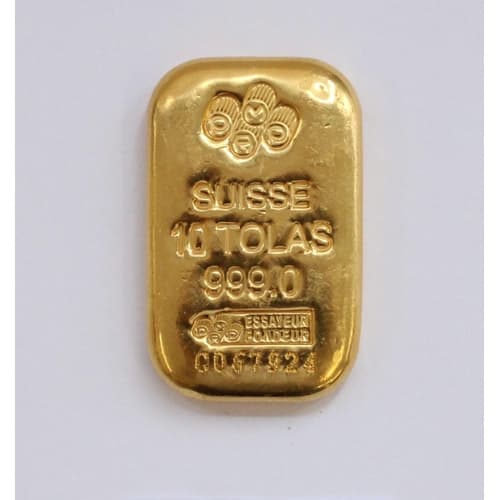
(A Ten Tola gold bar, which is around 116g of pure gold)
Which size is best? It depends on your budget and plans. Smaller bars (like 1g, 5g, 10g) are small and gift-able, but they carry very high premiums per gram – often 5-15% above spot price, because production cost per unit is high relative to gold content. They’re not the most efficient for pure investment (unless you specifically want small divisible portions). 1 oz (31.1g) and 100g bars are popular sweet spots for serious investors – they balance a relatively low premium with not being too pricey each. For example, a 1 oz bar might be only ~3-4% over spot at a dealer. Larger bars (250g, 1kg) usually have the lowest premium per gram (maybe 1-2% over spot or even less). The trade-off is less flexibility when selling (you have a lot of value in one piece) and losing the Capital Gains Tax-free benefit (since bars are not legal tender). If you think you may need to sell in smaller chunks, you might not want only 1kg bars. Many investors do a mix, e.g., a couple of 100g bars and the rest in coins, etc.
In terms of the best place, online dealers are generally the go-to for bars. Dealers like Atkinsons, Chards, or BullionByPost often source bars directly from mints in bulk and can offer them at very small margins. Sometimes, certain dealers have exclusive partnerships (e.g., one dealer might always stock Scottsdale Mint bars, another focuses on Perth Mint bars, etc.), but all are comparable in quality. Baird & Co. (a London-based refinery) not only produces its own bars (you can buy “Baird & Co 1oz gold bar” etc.), but they also have a shop where you can buy in person or online. They are a reputable source – being a refiner, their prices are often competitive too. In short, stick to buying from known bullion dealers or mints, and you really can’t go wrong with bar quality.
Watch Out For: When buying bars, ensure they come with a serial number and/or certificate for larger sizes. Most 1oz and above will have this. Smaller bars (like 1g, 5g) often are sealed in a credit-card sized package that serves as a certificate. Always keep these intact; it helps when selling to prove authenticity. Also, beware of any deals that look too good to be true from unknown websites (unfortunately, counterfeit bars do exist, but if you buy from the sources we’re talking about, you won’t encounter them).
One more consideration is storage: if you buy a very large bar (like a 1kg gold bar), you might prefer not to store it at home. Some dealers offer to store the bar for you in their vault (sometimes the first year is free, then you pay a fee). The Royal Mint Vault or third-party vaulting services can store bars as well. This can be worth it for peace of mind on sizeable holdings.
So, where to buy gold? To recap, the best place to buy gold bars in the UK is either a reputable bullion dealer or directly from the Royal Mint or Baird & Co. All of these will provide genuine bars. You might choose based on who has the lowest premium for your desired bar on the day. It wouldn’t hurt to check multiple sources. For example, if you want a 100g bar, check prices on Gold.co.uk (Chards’ retail site), Atkinsons Bullion, BullionByPost, and The Royal Mint – and see which is best. Also factor any shipping cost (most dealers ship free over a certain amount). The differences might be small, but for larger buys it adds up.
In conclusion, gold bars are a great way to invest larger amounts into gold efficiently. The UK has many trustworthy places to get them. Focus on dealers with a long track record. A few names repeatedly highly regarded by UK investors include Atkinsons, Chards, Bullion By Post, Baird & Co, Hatton Garden Metals, among others. If you buy from any of these or The Royal Mint, you’ll be getting legitimate gold bars with no trouble. The rest is just shopping for the best price and deciding what size bars suit your needs.
Where Is The Cheapest Place To Buy Gold UK?
Everyone likes a good deal, and with gold being a significant investment, it’s wise to seek the cheapest place to buy gold in the UK so you get more metal for your money. Here are some tips on finding low premiums and the best deals:
1. Shop Around Online: The cheapest place to buy gold is usually online, where competition forces margins down. UK online dealers often operate on thin margins (especially for popular products like Britannia coins or 100g bars). Compare prices on a few websites before you purchase. You’ll notice pricing can differ by day or stock levels. One dealer might have a special sale on 1oz Krugerrands this week, another might have a bulk discount on sovereigns. Take advantage of these when you see them.
2. Buy in Bulk or Larger Units: As a rule, buying gold in larger quantities results in a lower premium per unit. For example, a single 1/10 oz coin will have a much higher premium (maybe 10-15%) than a 1 oz coin (3-5% premium). Likewise, a 1kg bar might be just 1% over spot, whereas a 1g bar could be 20% over spot. If your goal is to accumulate gold at the lowest cost, go for larger coins or bars rather than many tiny pieces. That said, don’t stretch to a size you’re uncomfortable with just to marginally save on premium. It’s about balance. But if you know you plan to buy 10 ounces eventually, you might save by buying a 10 oz bar (or ten 1-oz coins in one go from a dealer who offers volume discounts) rather than one coin at a time.
3. Look for Low-Premium Gold categories: Many dealers have a section for “Best Value” or “Low Premium” gold coins/bars. These might be coins of mixed years or secondary market bars that they acquired from sellers. For example, a “best value sovereign” might be any year Sovereign in decent condition sold at a lower premium than brand-new Sovereigns. The gold content is the same. If you’re not concerned about getting a specific design or year, these options can be cheaper. Pre-owned bullion (sold by investors back to dealers) often is put back on sale at a slight discount versus new. It’s a great way to get gold closer to spot price. Always ensure, though, that “pre-owned” still comes with authenticity guarantees (reputable dealers will have checked the items).
4. Consider Comparison Tools: There are websites and forums where people discuss current best deals. While there isn’t a single dedicated gold price aggregator in the UK (like a comparison site), checking communities like the Silver Forum or subreddits like r/Gold can give insight into which dealers are offering the best rates at the moment. For instance, users often mention that Atkinsons Bullion frequently has coins at just ~2-4% over spot, or that Hatton Garden Metals has tight spreads. Staying plugged into these discussions can point you to the cheapest source at a given time.
5. Keep an Eye on Promotions and Discounts: Dealers occasionally run promotions – especially around Black Friday, Christmas, or when they have excess inventory. This could be free shipping, or a slightly reduced premium on certain items. Signing up for newsletters from a couple of big dealers can alert you to these deals. Also, watch for bulk pricing tiers – e.g. a dealer might list a 1oz coin at £1600 each, but if you buy 10 or more, it drops to £1590 each. If you’re buying quantity, those tiered discounts help.
6. The Royal Mint vs Dealers – Who’s cheaper? Generally, private dealers are cheaper than the Royal Mint for the same product. The Royal Mint often charges a premium for its official product (you pay partly for the brand and packaging). For example, a 1oz Britannia might be a bit more expensive on the Mint’s site compared to a dealer selling Britannias. If “cheapest” is the goal, you’d likely favour the dealer. However, on very large purchases, sometimes the Mint’s prices are more in line and they might throw in free insured storage for a year or something – but those cases are rare. Usually, to get the lowest premium, you’ll be buying from a competitive dealer rather than the Mint. The Mint is fantastic for trust and if you want the latest designs immediately upon release, but you pay a little extra for those perks.
7. Timing the Market vs. Premium: There’s an element of “price of gold” vs “premium on gold” to consider. If you’re purely asking about cheapest premiums, the above points cover that. If you’re asking when gold itself is cheapest to buy – that’s a market timing question. It’s notoriously hard to time the gold market short-term. A sensible approach is to average in: buy some gold at regular intervals or when you have the funds, rather than obsessing over small price dips. If gold dips significantly (say 5%+), that could be a good window to buy a chunk – but no one can predict it perfectly. Historically, people who hold off waiting for a drop sometimes miss out if gold instead rises further. So, if you believe in owning gold, the best time to buy is whenever you’re ready and at as low a premium source as possible. Over the long run, a few percent difference in entry price won’t matter hugely if gold continues to appreciate.
Summary: The cheapest place to buy gold in the UK is typically through a well-established online bullion dealer offering competitive premiums, especially when you buy in a decent quantity. Dealers like Atkinsons, Chards, Bullion By Post, Hatton Garden Metals, and others often compete to offer the lowest prices – Britannia and Sovereign coins in particular tend to have small premiums due to their popularity and tax advantages. In recent times, increased competition has actually driven premiums down – after spiking during the 2020 pandemic, gold coin premiums have normalised and even big players price-match each other closely. This is good news for buyers.
No single dealer is always the absolute cheapest; it can vary by product and week. So do compare. Avoid buying from sources like eBay or private sellers unless you’re very confident in authentication, because while you might think you’re getting a bargain, the risks of counterfeit or misrepresented items are higher there – and ironically you may end up paying more if you’re unlucky. Stick to authorised dealers where the price difference is only marginal and you have certainty of what you’re getting.
In conclusion, to buy gold at the cheapest price: do your research on dealer prices, aim for standard bullion products (coins/bars) with low premiums, and consider slightly larger purchases to take advantage of volume discounts. By doing so, you ensure that more of your money goes into the gold itself rather than fees and premiums – positioning you for better gains if gold’s value rises.
Frequently Asked Questions
How much is 1g of gold worth?
As of 21 Oct 2026, the 24ct gold price per gram is £99.28 based on the live gold price as of today in the UK.
Where is the best place to buy gold sovereigns?
The best place to buy Sovereign gold coins is through reputable bullion dealers or the Royal Mint. Sovereigns are widely available, so compare prices at dealers like BullionByPost, Atkinsons, or Chards – they often have Sovereigns at low premiums. The Royal Mint also sells new Sovereigns (with the latest year’s design) if you prefer to buy direct, though you might pay a bit more there. In short, buy from a trusted source that offers authentication and a competitive price.
Where is the best place to buy gold bullion?
For gold bullion, reputable online bullion dealers are ideal. Established dealers such as Atkinsons, BullionByPost, or Chards offer a range of coins and bars with competitive premiums and secure, insured delivery. The Royal Mint also sells bullion, though at slightly higher prices. Whether you prefer online or in-person purchases, always verify authenticity and hallmarks to ensure you’re getting genuine investment-grade gold.
Is buying gold a good investment?
Gold is a solid long-term investment, serving as a store of value and a hedge against inflation and economic uncertainty. It can stabilise a portfolio during market downturns and typically retains value over time. However, it doesn’t yield income like dividends. For many investors, gold is best used as a diversification tool, usually representing 5–10% of the overall portfolio to provide balance.
How to buy gold for investment?
To buy gold for investment, choose between physical gold (bullion coins or bars) and “paper” gold (ETFs or digital platforms). Purchase physical gold from reputable dealers or the Royal Mint for direct ownership and tax benefits, especially with CGT-free coins. For ETFs, use a trusted broker like Trading 212. Always confirm authenticity and secure storage options for physical purchases.
Is buying gold worth it?
Buying gold is worth it as a hedge against inflation and currency fluctuations, and it can preserve wealth during economic uncertainty. It doesn’t provide dividends but adds diversification and stability to a portfolio. Long-term trends show gold retaining its value, though short-term gains may be modest. It’s best used as a defensive asset rather than for explosive growth, complementing other investments for a balanced portfolio.
Why buy gold?
Gold is bought for its long-standing role as a store of value, a hedge against inflation, and a safe haven during economic uncertainty. It offers diversification as it often moves differently than stocks or bonds, and it carries no counterparty risk. Its universal recognition makes it a reliable asset in times of crisis, ensuring that your wealth retains its purchasing power over the long term.
Is buying gold jewellery a good investment?
Gold jewellery is generally not the best investment due to high retail markups for design and craftsmanship. When sold, buyers usually pay for the gold’s intrinsic value only, often resulting in a loss. Investment-grade gold is best bought as bullion coins or bars, which have lower premiums and clearer pricing. Jewellery is ideal for personal use or adornment rather than as a pure investment asset.
Can I buy gold on Trading 212?
Yes, you can invest in gold on Trading 212 by buying gold ETFs or trading CFDs that track gold’s price. However, you cannot purchase physical gold directly on the platform. Gold ETFs allow you to gain exposure to gold prices through a stock market product. Choose ETFs like iShares Physical Gold ETC for a straightforward investment, but note that these do not provide physical ownership of gold.
Can you buy gold from the Royal Mint?
Absolutely – the Royal Mint sells a range of investment-grade gold products, including bullion coins like Britannias and Sovereigns and various sizes of gold bars. Purchasing directly from the Royal Mint ensures authenticity and quality. Their coins also benefit from CGT exemptions as they are legal tender. While prices may be slightly higher than other dealers, the trust and heritage behind the Royal Mint make it a solid choice.
Where can you buy gold bars?
You can buy gold bars from reputable online bullion dealers, the Royal Mint, or specialised refiners like Baird & Co. These sources offer a variety of bar sizes—from small gram bars to large kilo bars. Ensure that any gold bar comes with proper hallmarking or assay certificates. Reputable dealers provide insured delivery and verified authenticity, making them the best option for purchasing gold bars safely and competitively.
What is a troy ounce?
A troy ounce is a weight measurement specifically used for precious metals. It is equal to approximately 31.1035 grams, which is heavier than the standard avoirdupois ounce (28.35 grams). This unit has been used for centuries in the gold and silver markets, ensuring consistency in pricing and trading globally. Its long-standing history makes it the preferred measurement for evaluating and pricing gold investments.
What is a tola of gold?
A tola is a traditional unit of mass used primarily in South Asia for measuring gold, equating to roughly 11.66 grams. It has been widely used historically and remains popular in countries like India and Pakistan. In modern international trade, a tola is often converted into grams to compare with global gold prices, providing a familiar reference for both local buyers and global investors.
Interested in selling gold with the UK’s highest paying gold buyer? Visit our Sell Gold page to get a competitive valuation – we provide fully insured postage and fast payment.
For more insights and the latest gold price today, keep an eye on our live charts and blog updates.