What Is The Price Of Gold Today?
As of 21 Oct 2026, the price of gold is £99.28 per gram for 24 carat gold and the troy ounce price is £3,088.06. This is the current live gold price in the UK and updates every 60 seconds.
Live Gold Price Per Gram
Gold price last updated:
The LBMA (London Bullion Market Association) spot price changes daily.
The prices displayed are based on the global market rate for gold, known as the gold spot price. Like all gold buyers, GoldSell pays a percentage of this rate to account for assaying, refining, secure logistics, market volatility, and handling costs. We consistently offer among the highest payout rates in the UK, with the exact percentage increasing based on the weight and purity of the gold you sell.
GoldSell displays live gold prices per gram by karat because most of our customers are selling gold jewellery rather than pure bullion. Knowing your gold’s purity is key – check the tiny hallmark on your item to verify if it’s 9ct, 18ct, 22ct, etc. (see our guide on how to identify gold hallmarks for help). This ensures you understand the true value of your gold when selling.
Key Takeaways
- Today’s Gold Price (24k): The price of gold today is £99.28 per gram, and £3,088.06 per troy ounce (31.1g).
- Gold Priced per Ounce: The live gold price is typically quoted per troy ounce on global markets. (One troy ounce is ~31.1035 grams). We convert it to per gram for easy comparison when valuing jewellery.
- Record Highs & Why: Gold’s price is near record highs. Factors like high inflation, economic uncertainty, and strong demand from investors and central banks have driven the gold price today UK upward. In times of market turmoil, gold shines as a safe-haven asset.
- Outlook is Positive: Many experts expect gold to remain strong or even rise further. Major banks have raised their forecasts – some predict gold could hit $3,100–$3,300/oz by end of 2025 (around £2,600+ per ounce). While short-term dips can happen, the long-term trend has been upward.
- Selling Your Gold: If you plan to sell, choose a reputable gold buyer. GoldSell is the UK’s highest-paying gold buyer, offering fast payments and a Price Match Guarantee. We buy all gold items (jewellery, coins, bullion, etc.) and ensure you get the best price for your gold.
What Is The Price Of Gold Today?
As of today, the gold price per ounce is £3,088.06 per troy ounce in the UK (which equates to £99.28 per gram for 24ct gold). Gold is typically priced in troy ounces on global markets – a troy ounce is a special weight unit (about 31.1 grams) used for precious metals. When you hear gold quoted at, say, $3,000/oz, it refers to a troy ounce. We choose to display live gold prices per gram to make it easier for jewellery sellers to determine the value of their items.
So, what is a troy ounce? It’s simply a unit of weight for gold. 1 troy ounce = 31.1035 grams. This is about 10% heavier than the everyday “ounce” (which is 28.35g) used for food, etc.. Gold prices are quoted per troy ounce to keep measurements standard worldwide. For example, if the market says gold is £3,088.06 per ounce, that means £3,088.06 per 31.1g of pure gold. We then derive the per-gram price (£99.28/g in this case) by dividing by 31.1.
Gold price today (per oz) changes constantly during market hours. It’s influenced by supply-demand dynamics in the global bullion market. In practice, multiple trading hubs (London, New York, Shanghai, etc.) contribute to the live price. In the UK, the LBMA (London Bullion Market Association) publishes a benchmark daily, but prices fluctuate minute by minute based on trading activity. This live gold price is sometimes called the “spot price.” It represents the current value for immediate delivery of gold.
What drives the gold price as of today? Primarily, it’s the international spot market. Gold is traded 24/7 during weekdays, and the price you see today reflects a host of economic factors: currency values (a weaker pound can make gold more expensive in GBP terms), interest rates, inflation, and investor sentiment. When investors anticipate inflation or economic trouble, they often buy gold, pushing the price up. Conversely, if the economy is strong and interest rates are high, gold can soften as investors seek higher yields elsewhere.
How Much Is Gold Per Gram?
The live price of gold is currently£99.28/gram today. If you’re selling or valuing gold jewellery, which is often 9ct, 14ct, 18ct, or 22ct, the price per gram will be proportional to its purity. For example:
- 24ct (99.9% pure): £99.28 per gram (this is the benchmark for pure gold).
- 22ct (91.6% pure): £91.01 per gram (around 91.6% of the 24ct price, since 22k gold is 91.6% gold content).
- 21ct (87.5% pure): £86.87 per gram (roughly 87.5% of pure gold value).
- 18ct (75% pure): £74.46 per gram (about 3/4 of the 24ct price, as 18k gold contains 75% gold).
- 14ct (58.5% pure): £57.92 per gram (roughly 58.5% of pure gold value).
- 9ct (37.5% pure): £37.23 per gram (about 37.5% of the 24ct price).
In the UK, most jewellery is 9ct, 18ct, or 22ct, so it’s handy to know those values. GoldSell’s live price chart lists the current price per gram for each purity (it updates every 60 seconds so you know the live gold price per gram for 9k, 14k, 18k, etc.). That way, if you have a 9ct gold ring, you can instantly see its base metal value by multiplying the gram weight by the 9ct rate. (Pro tip: You can find your jewellery’s carat by its hallmark stamp – e.g. “375” means 9ct, “750” means 18ct, “916” means 22ct.)
Keep in mind that these prices are for the pure gold content in your item. If you sell gold jewellery, a top buyer (like GoldSell) will pay based on the gold weight and purity, usually close to the live scrap gold price. Gold price per gram today is at historically high levels, which is why many people are cashing in old jewellery. Even a few grams can be worth a tidy sum when gold is £99.28 per gram.
Gold Price Forecast
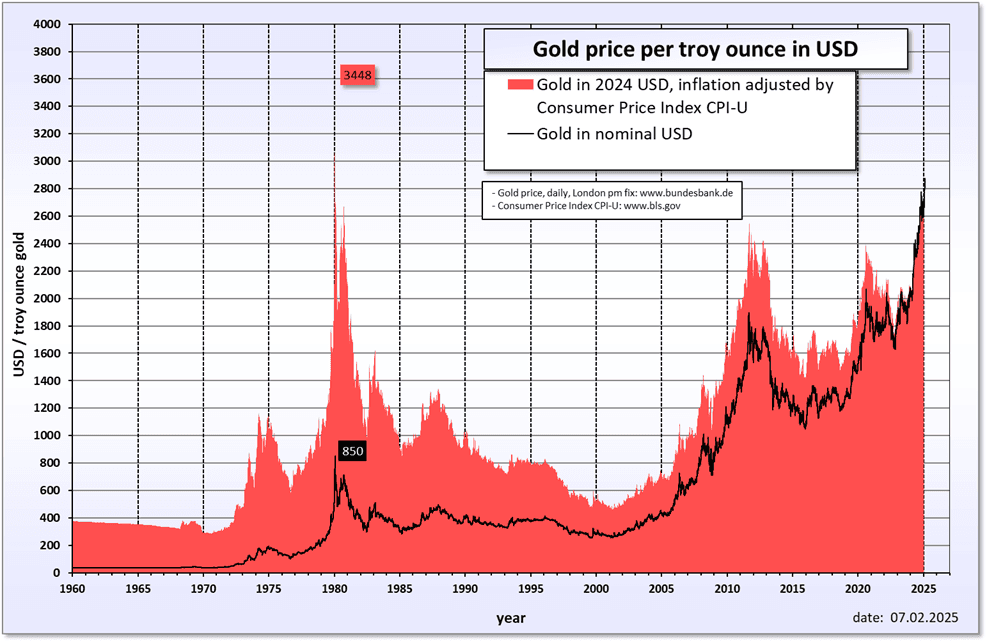
(Gold price chart (USD per troy ounce) from 1960–2025, showing nominal prices (black line) and inflation-adjusted prices (red area). Notable spikes in ~1980 and 2011, with a sharp rise into the 2020s)
Gold has a track record of long-term growth. Over the past 10 years, the gold price in the UK has roughly tripled – rising from around £700 per ounce in 2015 to £3,088.06+ per ounce today. The red and black chart above shows gold’s history since 1960: you can see big jumps around 1980 (when inflation was rampant) and 2011 (post-financial crisis), and now another surge in the early 2020s. The key takeaway is that gold tends to hold its value over time, often hitting new highs after periods of economic uncertainty.
What’s the outlook for gold in the coming years? Many analysts remain bullish (optimistic) about gold’s prospects. The consensus is that the forces driving gold up – inflation, economic risks, geopolitical tensions – aren’t going away soon. In fact, investment banks have been upgrading their gold price predictions for the next few years:
- Goldman Sachs: now forecasts gold could reach around $3,300/oz by end of 2025 (they earlier predicted $3,100, but raised it due to strong demand). $3,300/oz is roughly £2,700 per ounce at current exchange rates.
- Bank of America (BofA): recently raised its 2025 gold forecast to $3,063/oz, up from a previous $2,750. They also see gold at $3,350 in 2026, citing persistent uncertainty (they specifically pointed to trade tensions and economic worries).
- UBS: and other banks have likewise boosted their targets, generally expecting gold to stay above $3,000/oz through 2025. Some even suggest $3,500+ in the next couple of years under bullish scenarios.
These forecasts underline a positive sentiment: gold is seen as likely to remain at high prices or climb further. Low interest rates (in real terms), ongoing inflation, and central bank buying are supportive factors. Goldman’s analysts, for example, attribute their higher target to massive gold purchases by central banks and investors seeking alternatives as interest rates are expected to eventually ease.
Of course, predictions aren’t guarantees. Gold prices can be volatile in the short term. A swift resolution to major risks or tighter monetary policy (higher interest rates) could cool off the rally. But at least for now, the gold price forecast tilts upward. As of early 2025, gold hit all-time highs above $3,100/oz (about £2,520/oz), and those highs have attracted more investors, creating momentum.
If you’re curious about the potential future value of gold or considering an investment, try our gold price calculator on our investing guide page. It lets you input a custom amount (say £1,000) and a time horizon to project what that investment might be worth based on historical trends. Our gold price calculator factors in past gold performance and inflation to give a rough estimate of future value. (For example, £1,000 in gold 10 years ago would be worth well over £3,000 today – a testament to gold’s growth.) This tool is great for experimenting with scenarios, but remember, it’s using historical averages – real future prices will depend on those economic factors we discussed.
And if you’re looking for deeper insight into gold as an investment, check out our comprehensive guide on investing in gold. It covers whether gold is a good investment now, how it has performed historically, and different ways to invest (coins, bars, ETFs, etc.). In that guide, we discuss the pros and cons in detail – useful reading if you’re thinking about buying gold as a part of your portfolio.
Why Is Gold Price Rising?
Gold’s current surge to record highs has been driven by a perfect storm of supportive factors. Here are the key reasons why the gold price is rising:
- High Inflation: Across the globe (including the UK), inflation has been elevated. When the cost of living rises, investors flock to gold as an inflation hedge. Gold is seen as a store of value that won’t erode like cash does when prices surge. The late 2020–2023 period saw inflation spike to multi-decade highs, boosting gold demand.
- Economic Uncertainty & Recession Fears: Economic warning signs (such as slowing growth or even the risk of recession) make investors nervous. In these times, gold’s appeal grows as a safe haven. For example, concerns about global growth, debt levels, and even recent bank instability issues have sent people into gold for safety.
- Geopolitical Tensions: Gold often jumps when there’s geopolitical turmoil. The war in Ukraine, trade disputes (like the U.S.–China trade war), and other global conflicts or uncertainties drive investors toward gold. In early 2025, for instance, fears over new tariffs and international frictions fuelled a rush into gold.
- Central Bank Buying: Central banks worldwide have been buying gold at record rates in recent years. In 2022 and 2023, central banks (like those of China, India, Turkey, etc.) added tons of gold to their reserves. This official sector demand provides a strong underfloor for prices – when central banks buy, it soaks up supply and signals confidence in gold’s long-term value.
- Low Real Interest Rates: While central banks did raise nominal interest rates to fight inflation, “real” interest rates (after inflation) are still low or even negative. Gold pays no interest, so it tends to perform best when real interest rates are low – meaning the opportunity cost of holding gold is small. Investors prefer gold over low-yield bonds when inflation is eroding bond returns.
- Investor & ETF Demand: Exchange-traded funds (ETFs) and other investors have been piling into gold. For example, gold-backed ETFs saw significant inflows as gold broke $2,000/oz and then $3,000/oz. This investment demand amplifies price rises. Safe-haven seekers, from small retail buyers to large hedge funds, all contribute to upward pressure.
In short, gold is rising because it’s the go-to asset in uncertain times. As one analysis noted, rising recession risks, geopolitical flare-ups, supply chain disruptions, and inflation fears have put gold on “strong footing” in the foreseeable future. All these factors combined have made gold glitter brightly in the eyes of investors, driving its price to all-time highs.
Can Gold Prices Go Down?
Yes – despite the current strength, gold prices can go down, and they periodically do. Like any market, gold isn’t one-way; it has pullbacks and even prolonged downtrends under certain conditions. Here are scenarios that can push gold prices down:
- Rising Interest Rates: When central banks hike interest rates aggressively (and real interest rates turn positive and high), gold often faces downward pressure. This is because investors can get attractive yields elsewhere (like bonds), making non-yielding gold less appealing. For instance, if the Bank of England and U.S. Federal Reserve keep raising rates beyond expectations, gold might dip as a result.
- Economic Stability & Growth: If the economy is doing very well – strong growth, low unemployment, low inflation – the appetite for safe havens like gold decreases. Investors may rotate out of gold and into riskier assets like stocks. A booming economy with no crises in sight can lead to gold sell-offs (as was seen in the late 1990s, for example, when gold languished during a high-growth period).
- Lower Inflation or Deflation: Gold thrives on inflation fears. If inflation quickly falls back to normal levels (or if there’s deflation), the urgency to hold gold diminishes. Price pressures easing could remove a big support for gold’s price.
- Stronger Currency (Strong USD): A lot of gold trading is in USD. If the U.S. dollar becomes significantly stronger, gold prices in USD often fall (since gold becomes more expensive for non-USD buyers). In the UK context, a sharply stronger pound could make gold cheaper in GBP terms too. Essentially, if currencies stabilise or strengthen, gold’s relative appeal can drop.
- Investor Profit-Taking: After a big rally, investors may simply take profits. We could see short-term corrections where traders sell gold to lock in gains, causing a dip. These pullbacks can sometimes snowball if stop-loss orders trigger more selling, pushing gold down faster than fundamentals alone would suggest.
- Increase in Gold Supply: Gold mining and recycling can affect prices over the longer term. If high prices encourage a lot of new gold mining projects (and hence more gold supply hitting the market), it can weigh on the price. One analyst pointed out that many producers ramp up output when gold is high, which could add downward pressure in coming years. More scrap gold being sold by consumers (people cashing in jewellery, etc.) also boosts supply.
It’s important to note that any single factor rarely acts in isolation. For gold to have a sustained downturn, usually a combination of these positive developments (stable geopolitics, strong growth, higher rates, etc.) would need to occur. Can it happen? Certainly – gold saw a multi-year decline after 2011 when crises abated and the economy recovered.
However, even when gold prices go down, it’s often a gradual process. And historically, such dips have eventually been followed by recoveries in line with economic cycles. Gold’s long-term trajectory has been up, but not without interim valleys. The current question is whether the pillars holding gold up now will weaken soon or not.
Will Gold Price Go Down?
Given gold’s record highs, many people are asking, will the gold price go down in the near future? The honest answer: minor corrections – likely yes, major crash – unlikely barring a big shift in conditions. Most analysts do not foresee a dramatic plunge in gold in the immediate term, though they acknowledge the possibility of modest declines.
At the moment, the consensus on Wall Street and among commodity experts is that gold will stay elevated or even climb further through 2025. The bullish factors (inflation, uncertainty, central bank buying) still dominate. For instance, Goldman Sachs and JP Morgan have bullish outlooks into 2025 (targeting around $3,000/oz or higher). As long as global economies remain in a fragile, inflation-prone state, there’s strong support under gold.
That said, could gold go down from its peak of ~£2,520/oz? Yes, it’s plausible we’ll see pullbacks. A scenario where gold retreats somewhat: if peace treaties or improved trade relations ease geopolitical tensions, or if central banks indicate much higher interest rates for longer, gold could slide. Even without fundamental changes, after such a steep run-up, a technical correction of say 5-10% wouldn’t be surprising – prices might consolidate or dip as the market takes a breather.
Some contrarian analysts even predict a sizeable long-term drop. For example, an analyst at Morningstar, Jon Mills, argued that over the next 5 years, gold might gradually fall to around $1,820/oz (a 38% plunge from current levels) as increased mining supply and reduced demand take hold. This is a minority view, but it underscores that not everyone expects gold’s rise to continue unabated.
The more prevalent view is that any declines will be limited. Gold’s role as a hedge means that if it falls too much, bargain hunters and central banks could step in to buy, cushioning the drop. In practical terms, we might see gold oscillate, with occasional dips, but a severe collapse would likely require a big shift (for instance, a robust global economic boom with high real interest rates – something that doesn’t seem on the immediate horizon).
In summary, will gold go down? Possibly in the short term, yes – it can dip from its peak. But a significant sustained downturn appears unlikely in the current climate. It’s wise for investors to be prepared for volatility, but also to remember that gold’s fundamentals remain fairly strong. As always, monitor the economic signals: if we start seeing tame inflation, surging growth, and hawkish monetary policy, those would be the warning signs of a gold cooldown. Barring that, gold is expected to hold its value well.
Where Is The Best Place To Sell Gold?
If you’re looking to sell gold, you’ll naturally want the best price and a trustworthy transaction. The best place to sell gold in the UK is typically a reputable online gold buyer with high payouts – and this is where GoldSell stands out. GoldSell is proud to be the UK’s number one highest-paying gold buyer, and we back that up with a Price Match Guarantee (if you somehow get a higher quote elsewhere, we’ll match or beat it). We also offer fast payment (often within 20 minutes of accepting our offer), so you get your money in a flash.
Why choose an online specialist like GoldSell over, say, a high street pawn shop or local jeweller? Two big reasons: price and convenience. Online gold buyers have lower overhead and typically operate at smaller margins, meaning we can pay you closer to the actual market gold price today. For example, GoldSell constantly monitors live prices and what competitors are paying, to ensure we’re top of the market. A local shop might offer you considerably less (they bank on people not knowing the live price). By selling via an established online buyer, you’re more likely to get the full value of your gold based on the live market.
In terms of process, GoldSell makes it easy: you can request a from our website, which includes a discreet, prepaid insured Royal Mail envelope. You send in your gold (fully insured up to a high value), our experts appraise it using expert testing equipment, and we then make you a valuation. Because we use the latest live gold price data, our offers reflect the real-time value of your gold’s weight and purity. Once you accept, we pay instantly, you’ll have the funds the same day, often within minutes goldsell.co.uk.
Types of gold: You might be wondering if we buy your kind of gold item. The answer is likely yes – GoldSell buys all kinds of gold, in any condition. You can sell gold jewellery (rings, necklaces, bracelets, etc.), sell scrap gold (broken bits, odd earrings, gold dental crowns – anything that’s gold by weight), sell gold coins (Krugerrands, Sovereigns, Britannias, etc.), sell gold bullion (bars and ingots), and even sell Sovereign coins specifically. Essentially, if it’s gold, we will buy it – from 9ct up to 24ct, and we’ll pay you according to the purity and weight.
Many customers ask, “Where can I sell gold for the highest price?” The answer is: with a competitive buyer who bases their rates on the live market – which is exactly what GoldSell does. We update our buying prices as the market moves, so you always get a fair rate. Additionally, our best price guarantee means you won’t miss out on a better deal elsewhere. This is why GoldSell is often recommended as the best place to sell gold in the UK.
For more details, you can read our full guide on the best place to sell gold (which covers tips on selling safely, how to avoid common pitfalls, and why GoldSell leads the pack). But in short, if you want a top price, secure and insured transit, and quick payment, an established online gold buyer like GoldSell is hard to beat.
Where Is The Best Place To Buy Gold?
When it comes to buying gold, you have a few avenues, and the “best” place depends on your priorities (price, trust, convenience, etc.). Generally, the best place to buy gold for investment is through trusted bullion dealers, either online or through well-known institutions. Here’s a quick rundown:
- Online Bullion Dealers: These include specialised websites where you can purchase gold coins or bars at relatively small premiums over the live price. Online dealers (like BullionByPost, Atkinsons, Royal Mint’s online store, etc.) often offer a wide selection – from small coins like Sovereigns to 1kg bars. They tend to have competitive pricing because they deal in volume and have transparent quotes updated with the live market. Make sure to choose a dealer with good reviews and clear pricing (watch out for any hidden fees).
- High Street Gold Shops/Pawn Brokers: You might have local gold merchants or pawn shops that sell gold coins and bars. While the advantage is you get the gold immediately in hand, the downside is often higher premiums. Brick-and-mortar shops have more overhead. They might be convenient for buying a small piece on the spot, but typically you’ll pay a bit more than online dealers. Always compare their price to the online price for the same item.
- Major Institutions (e.g., The Royal Mint): In the UK, the Royal Mint is a popular and very trusted source for buying gold coins (like Britannias and Sovereigns) and bullion. They guarantee authenticity and quality. Premiums can be slightly higher than the cheapest online dealers, but you get peace of mind and sometimes tax advantages (UK Britannia and Sovereign coins are CGT-free for UK residents). Other mints or banks in some countries sell gold directly too (though most UK banks do not sell gold these days). The Royal Mint’s online platform is quite user-friendly for buyers.
- Peer-to-Peer or Auctions: Some people buy gold from online marketplaces (like eBay) or auctions. While you might find a deal, this route is only for the experienced – you risk counterfeit products or overpaying if you’re not careful. If you do go this way, ensure items come with authentication or purchase from established auction houses.
For most new buyers, online gold dealers or the Royal Mint are the best places to start. They combine convenience with reliability. You can compare prices easily – for example, check the price of a 1 oz Britannia coin on a couple of leading websites to see the going rate.
One important tip: always factor in all costs – including shipping, insurance, and any payment fees – when choosing where to buy. A dealer might have a slightly higher listed price but offer free insured delivery, whereas another has a low price but high shipping; the end cost could be similar.
To delve deeper into this, read our guide on where is the best place to buy gold. In that article, we break down the pros and cons of local vs online, how to spot reasonable premiums, and ways to ensure you’re dealing with a reputable seller. In summary, the best place to buy gold is one that offers genuine products, at a fair price close to the live gold price, and provides you with security (you get what you paid for) – our guide will help you pinpoint such sources so you can purchase with confidence.
Frequently Asked Questions
What is the price of gold today?
As of 21 Oct 2026, the price of gold is £99.28 per gram for 24-carat based on the live gold price in the UK.
How much is the price of an ounce of gold?
As of 21 Oct 2026, the gold price per ounce is £3,088.06 based on the live gold price in the UK.
How much is gold per gram?
As of 21 Oct 2026, the price of gold per gram is £99.28 for pure 24kt gold based on the live gold price in the UK.
What is the live 9ct gold price per gram?
As of 21 Oct 2026, the 9ct gold price per gram is £37.23 based on the live gold price as of today in the UK.
What is the live 14ct gold price per gram?
As of 21 Oct 2026, the 14ct gold price per gram is £57.92 based on the live gold price as of today in the UK.
What is the live 18ct gold price per gram?
As of 21 Oct 2026, the 18ct gold price per gram is £74.46 based on the live gold price as of today in the UK.
What is the live 21ct gold price per gram?
As of 21 Oct 2026, the 21ct gold price per gram is £86.87 based on the live gold price as of today in the UK.
What is the live 22ct gold price per gram?
As of 21 Oct 2026, the 22ct gold price per gram is £91.01 based on the live gold price as of today in the UK.
What is the live 24ct gold price per gram?
As of 21 Oct 2026, the 24ct gold price per gram is £99.28 based on the live gold price as of today in the UK.
How is the gold price determined?
The gold price is determined by global supply and demand, investor sentiment, currency values, inflation, interest rates, and trading on international bullion markets.
Why is gold price rising?
The gold price is rising due to high inflation, global economic uncertainty, geopolitical tensions, central bank buying, and strong investor demand.
Can gold price go down?
Yes, the gold price can go down due to factors like rising interest rates, strong economic growth, lower inflation, or increased gold supply.
Will gold price go down?
The gold price could go down in the short term if interest rates rise significantly or economic conditions improve markedly, but major drops seem unlikely right now.
Should I buy gold?
You should buy gold if you want a stable store of value, hedge against inflation, or diversify your investments. It’s ideal for long-term stability rather than quick profits.
Why is the gold price so high?
The gold price is so high because of high global inflation, ongoing economic uncertainty, geopolitical tensions, and record-high demand from investors and central banks.
Interested in selling gold with the UK’s highest paying gold buyer? Visit our Sell Gold page to get a competitive valuation – we provide fully insured postage and fast payment.
For more insights and the latest gold price today, keep an eye on our live charts and blog updates.