
What Is Gold Used For?
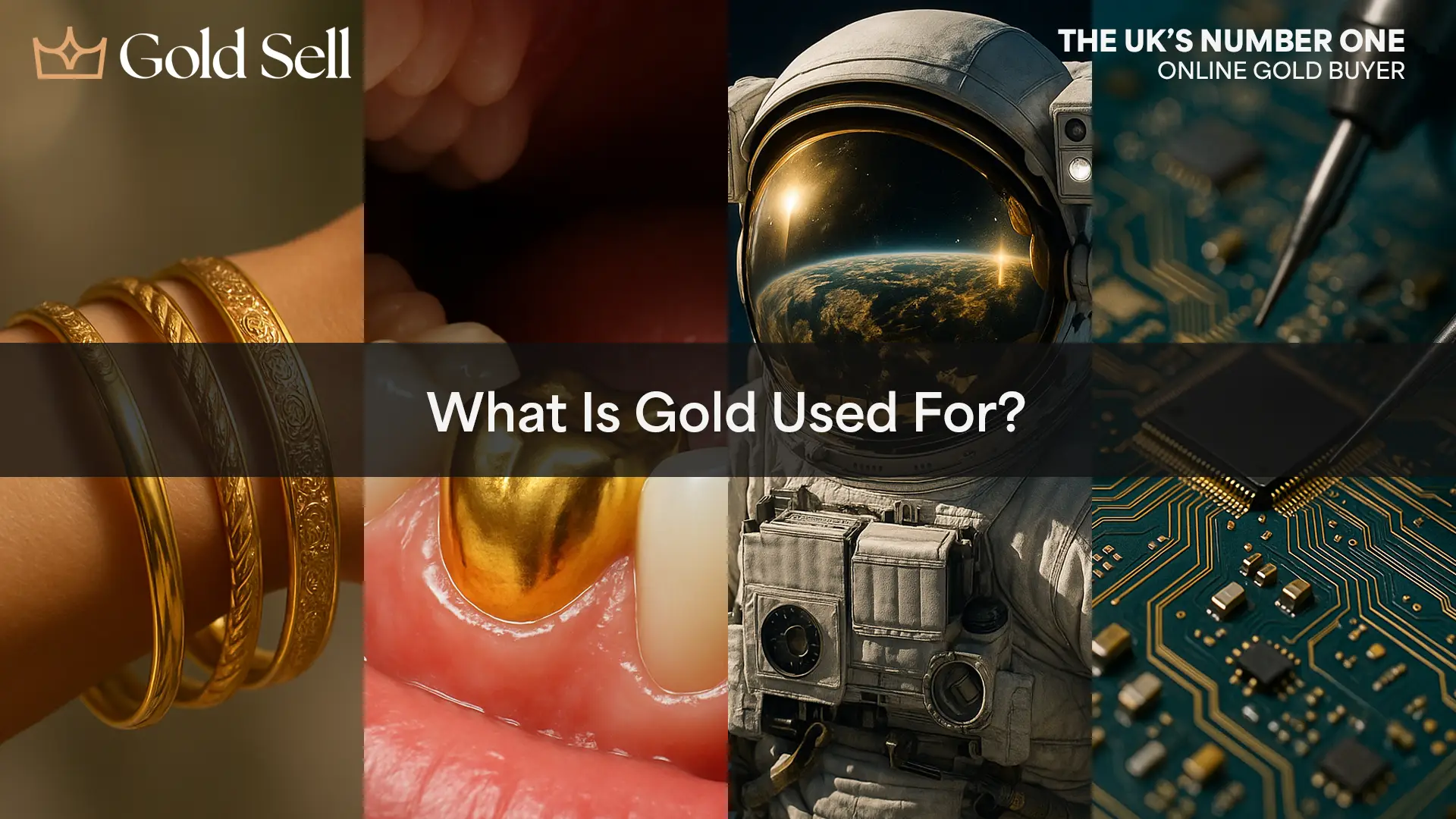
Gold is used for a surprising array of purposes, from jewellery and secure investments to crucial roles in electronics, medicine, and even spaceflight. Throughout history and into the modern day, this precious yellow metal’s unique properties have made it invaluable in many aspects of life.
Key Takeaways
- Gold’s Main Uses: Gold is widely used in jewellery, as a store of wealth and investment (coins, bars, and reserves), in technology (electronics, aerospace), and even in medicine and dentistry.
- Why Gold Is Valuable: Its scarcity, resistance to corrosion, beautiful lustre, and historical trust as money make gold extremely valuable. Gold doesn’t tarnish and is nearly indestructible, so all the gold ever mined still exists today in one form or another.
- Jewellery Dominates Demand: Approximately half of all gold demand is for jewellery. Gold’s beauty and workability have made it the metal of choice for wedding rings, luxury watches, and adornments across cultures.
- Investment & Finance: People and central banks hold gold bars, coins, and reserves as a safe-haven asset. It hedges against inflation and economic uncertainty, since gold tends to keep its value when paper currencies falter.
- Industrial Uses: Gold’s excellent conductivity and stability mean it’s used in electronics (from smartphones to satellites) and specialised applications like medical devices and aerospace components. It’s even used in small quantities in medicine and skincare products.
What Is Gold Used For?
Gold is used in many sectors of modern life. Its most well-known use is in jewellery, but gold is equally important in finance (as bars, coins, and reserves), in technology (like electronics and aerospace), and in medical fields. In fact, roughly half of the world’s gold consumption is for jewellery, and most of the rest is split between investment bullion, central bank reserves, and industrial uses. This enduring demand across different industries keeps gold constantly in use and highly valued.
To understand gold’s diverse uses, it helps to know why this metal is so special. Gold’s physical properties are highly unusual. It is extremely rare, yet malleable enough to be worked into tiny wires or thin leaf, and it does not rust or tarnish. It’s also an excellent conductor of electricity and heat. These traits explain why gold finds uses in so many places: its beauty and rarity drive demand in jewellery and wealth storage, while its non-reactive nature and conductivity make it vital in electronics, aerospace and other industries.
In summary, gold is used for:
- Jewellery and decoration: Ornamentation, luxury goods, awards, and art.
- Investment and wealth storage: Coins, bars, and national reserves to store value.
- Technology and industry: Electronic connectors, components in devices, aerospace hardware.
- Medicine and dentistry: Dental alloys for teeth, medical implants, diagnostics, and treatments.
Each of these uses is explored in detail below, along with why gold is so valuable in the first place.
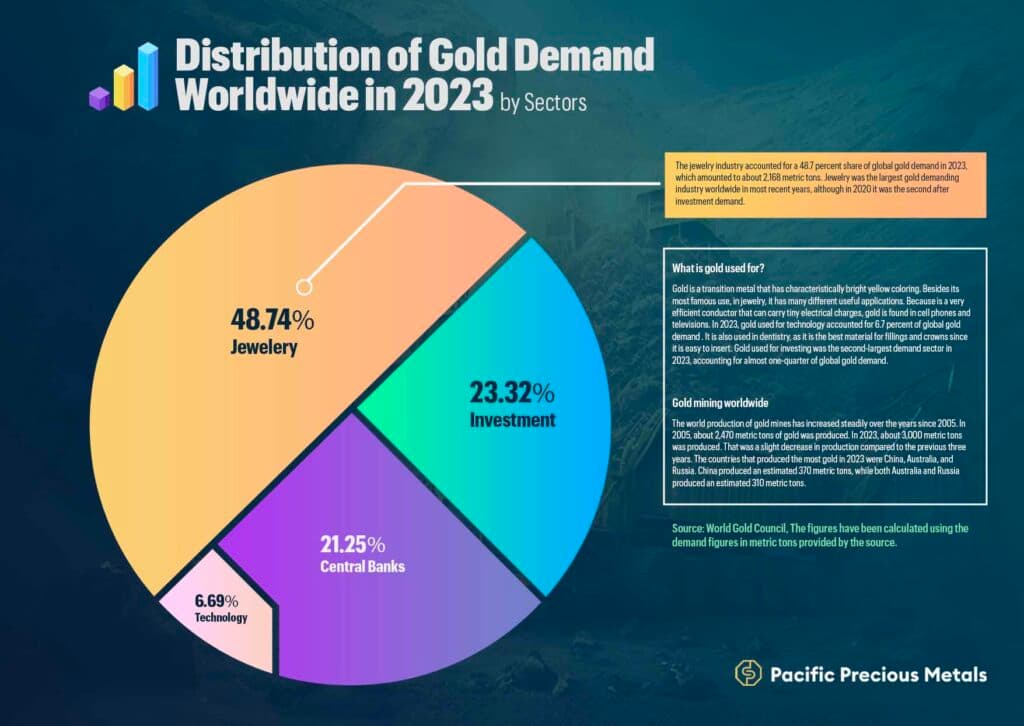
Distribution of global gold demand by sector in 2023. Jewellery accounted for 48.74% of gold usage worldwide, making it the leading category. Investment followed at 23.32%, with central bank reserves at 21.25%, and technology uses of gold making up 6.69%. This visual illustrates how gold’s main uses are split across consumer, financial, and industrial sectors.
To find out more about how gold is used for investment, and expert advice on gold investment, check out our gold investment blog posts.

How To Invest In Gold In The UK
Learn how to invest in gold UK, discover why investing in gold protects your wealth, and find out if gold is a good investment for UK investors right now.

Investing In Gold: Is Gold A Good Investment?
Investing in gold: Discover how to invest in gold and use our gold investment calculator for smart, profitable wealth strategies.
Why Is Gold So Valuable?
Gold is so valuable primarily because it is rare, durable, and trusted. In the Earth’s crust, gold is extremely scarce – all the gold ever mined would only fill a few Olympic-sized swimming pools – which naturally limits supply. This scarcity, combined with gold’s shining beauty and resistance to corrosion, has made people prize it for thousands of years. Unlike iron or copper, gold does not rust or tarnish; a gold artefact can gleam as brightly today as it did centuries ago. Culturally and historically, gold became a universal symbol of wealth and power, so much so that for millennia economies were built on the gold standard (paper money once could be exchanged for gold). This long association means people trust gold to hold value.
Beyond its physical traits, the value of gold is also psychological and economic. Because everyone believes gold is valuable, it indeed maintains high value – a self-fulfilling reputation reinforced over time. Gold has consistently remained prized, making it an excellent form of “investment insurance” in times of uncertainty. For example, when stock markets fall or inflation erodes currency value, investors often buy gold, driving its price up as other assets struggle. Part of gold’s value is thus as a safe-haven asset: it’s tangible, cannot be printed or devalued at a whim, and carries no counterparty risk (unlike a bond or stock, gold is not someone else’s liability).
Another reason gold is so valuable is that nearly all of the gold ever mined still exists and is recyclable. Gold can be melted and re-used without losing quality, so virtually none is wasted. However, even with continuous recycling, there is a finite amount of gold above ground (about 208,000 tonnes in total) and only a limited amount left to mine. Extracting gold is difficult and costly, often involving huge mines to gather just a few grams per ton of ore. This inherent scarcity and hard production helps gold retain its worth – there is a natural limit to how much can flood the market.
In summary, gold’s value comes from a perfect storm of factors: intrinsic qualities (it’s gorgeous, doesn’t corrode, is easy to shape but hard to find), combined with historical importance (the basis of currencies and treasures) and economic function (a hedge and investment). All these make gold universally regarded as one of the most valuable substances on Earth. As one chemistry professor noted, out of all elements, gold hits the “sweet spot” – it’s stable and rare enough to be precious, but not so rare or impractical as to be unusable. In short, we value gold because it has proven to be uniquely reliable and desirable throughout human history.
How Is Gold Used In Jewellery?
Gold is used in jewellery more than in any other way, thanks to its stunning appearance and workability. About 44–50% of global gold demand each year is for making jewellery. For thousands of years, gold has been the metal of choice for rings, necklaces, bracelets, earrings, and ceremonial objects. It’s easy to see why: gold’s natural luster and warm yellow color are immediately associated with beauty and luxury. Unlike silver, gold does not tarnish over time, so heirloom jewelry can be passed down generations looking just as radiant. Gold is also soft and malleable in pure form, which means jewelers can craft intricate designs – it can be hammered into ultra-thin leaf or drawn into fine wires for filigree work.
However, pure 24-karat gold is usually too soft for everyday wear, so most gold jewellery is made from gold alloys. By mixing gold with other metals like copper, silver, nickel, or palladium, manufacturers increase its hardness and alter its colour. For example, common alloys are 18k gold (75% gold) or 14k gold (58.3% gold) which are much more durable for rings and chains. These alloys still have the look of gold but are less prone to scratching or bending. They also allow for varieties like white gold (gold alloyed with white metals like nickel or palladium) and rose gold (gold alloyed with copper for a pinkish hue). This versatility means gold can suit many styles – from a traditional yellow wedding band to a modern white gold engagement ring.
Another reason gold is ideal for jewellery is its symbolism and cultural value. Gold has long been associated with wealth, success, and divinity. In many cultures, gold jewellery is a form of wearable savings and a status symbol. For instance, India and China are consistently the largest consumers of gold jewellery, together accounting for over half of the world’s annual gold jewellery demand. In 2018, China alone used over 1,200 tonnes of gold for jewellery, and India over 500 tonnes. Gifting and wearing gold is an integral part of festivals, weddings (Indian bridal jewellery can be extremely elaborate), and celebrations in these countries. Not only do people admire the beauty of gold ornaments, they also view them as a secure investment that can be sold or traded in times of need.
Gold’s prestige is further seen in how we reserve it for our highest honours: Olympic gold medals, trophies like Oscars and Nobel prizes, and royal regalia are gilded or made of gold. A crown for a king or queen is traditionally gold, not steel or copper – underscoring that gold is the metal of highest esteem. Even in fashion, a touch of gold immediately adds perceived value – consider gold-plated watches, handbags with gold-tone hardware, or clothing embroidered with gold thread (which has been done since ancient times).
In everyday terms, gold jewellery remains popular because it is both beautiful and meaningful. Many prefer gold for sentimental pieces like wedding rings due to its permanence (it won’t degrade or discolor). There’s also the practical side: gold is generally hypoallergenic – pure gold rarely causes skin irritation, unlike some base metals. This makes high-karat gold earrings or jewelry a good choice for those sensitive to other metals.
In summary, gold’s role in jewellery is irreplaceable. Its physical properties allow craftspeople to create stunning designs, and its intrinsic value gives the wearer confidence and prestige. Whether it’s a simple gold band or an ornate necklace studded with gems, gold jewellery combines beauty with lasting value, which is why it has adorned humanity from ancient times right up to the latest fashion collections.
How Is Gold Used For Investment?
Gold has a unique place in investment and finance as a tangible asset and safe-haven store of value. When we talk about investing in gold, it usually means buying physical gold (such as gold bars, coins, and bullion) or financial products backed by gold (like gold ETFs or mining stocks). Gold is used for investment as a way to preserve wealth and diversify a portfolio. Investors large and small turn to gold in order to protect against economic uncertainties – gold often maintains or increases its value when paper currencies inflate or when stock markets decline.
One of the oldest investment uses of gold is in the form of gold coins. Historically, many currencies were gold or silver coins, and gold coins like the British Sovereign or the American Eagle are still minted today for investors and collectors. These coins have legal tender face values, but their real worth is based on gold content. People buy them as a convenient way to hold pure gold in a recognisable, tradable form. Similarly, gold bars (ranging from small gram bars to the large 400-ounce Good Delivery bars held by banks) are purchased by investors who want to own bullion. Gold bars and coins are often kept in bank vaults or secure storage, though some investors literally keep gold “under the floorboards” at home as an emergency reserve.
Wealth protection: Gold’s investment appeal is that it is nobody’s liability and carries no default risk. For example, a government bond depends on the government’s solvency, a stock on a company’s performance – but a gold bar’s value is inherent. In times of crisis, gold tends to shine. During the 2008–2009 financial crisis, and again during recent volatile times, gold prices surged as investors sought safety. It’s considered a hedge against inflation and currency devaluation: if a currency weakens, gold (priced internationally in USD) often rises in local currency terms. This is why in some countries with volatile currencies, people prefer to keep savings in gold jewellery or coins. A dramatic example: at one point Vietnam even required large transactions like house sales to be done in gold rather than the unstable local currency.
Modern investment forms: In addition to physical bullion, many use financial instruments. Gold Exchange-Traded Funds (ETFs) allow people to invest in gold without handling the metal, as each share represents a certain amount of gold stored in a vault. Gold futures and options are traded for more speculative purposes. Central banks themselves are major “investors” in gold (though they consider it part of reserves rather than an investment per se – we’ll cover that next). In recent years, central banks have been net buyers of gold, adding to demand.
Pros and cons of investing in gold: Investing in gold is seen as a way to diversify. It often moves differently from stocks and bonds, so adding some gold can reduce overall portfolio risk. Over very long periods, gold maintains purchasing power – for example, an ounce of gold has roughly bought a fine suit of clothing for centuries. On the downside, gold doesn’t pay interest or dividends. Its price can also stagnate for long periods. Therefore, financial advisors typically suggest gold as a minority portion of an investment portfolio (commonly 5-10%) for stability, rather than a way to earn high returns.
In practical use, gold investment is visible in everyday life through things like gold ATMs (in some cities you can buy small gold bars from vending machines), gold dealers in high streets, and online platforms for trading vaulted gold. Gold is also deeply tied to cultural investment habits: in places like India, buying gold jewellery is both adornment and family investment; during festivals or weddings, gold gifts are a form of financial security for the recipient.
Overall, gold’s use in investment comes down to trust and tradition. When everything else feels risky, gold offers a sense of solidity. As the saying goes, “Gold is the only financial asset that isn’t someone else’s promise.” People invest in gold to own a piece of universal value that has stood the test of time.
How Is Gold Used In Technology & Electronics?
Gold plays a critical role inside our gadgets and technology, even if we don’t see it. In fact, gold’s third-largest use (after jewellery and investment) is in the electronics industry, despite accounting for under 10% of annual gold demand by weight. The average person might be carrying gold in their pocket without realising it – most smartphones, tablets, and computers contain small quantities of gold in their circuitry. Why? Because gold is one of the best electrical conductors and does not corrode. This makes it perfect for high-performance electronic connections that need to remain reliable over time.
Electronics: Gold is used in the connectors, ports, and circuit boards of many devices. For example, the tiny SIM card in a phone has gold-plated contacts, as do the connecting pins in your computer’s processor and the USB cables or HDMI cables that might link your electronics. Those little gold-coloured tips aren’t just for show – a thin layer of gold ensures a solid, corrosion-free connection. Even though alternatives like copper are cheaper and also conductive, gold outperforms them in critical ways: it doesn’t form oxide layers or tarnish, which can cause a bad connection. An oxidised copper contact might fail, but a gold-plated contact will keep conducting smoothly for years. That reliability is worth the cost in many cases, especially for high-end or critical equipment.

Gold-plated connectors on a SIM card ensure stable and corrosion-resistant electrical contact. Gold is used in SIM cards, smartphones, and other electronic devices because of its excellent conductivity and resistance to tarnish. These properties help maintain reliable communication between the card and the device, making gold essential in compact, high-performance tech components.
To appreciate scale: a typical smartphone contains only about 25-50 milligrams of gold – roughly worth £1-£2 in metal value – mainly in its circuit boards and connectors. That’s a tiny amount, but when you multiply by over a billion smartphones produced each year, it adds up. One estimate noted that around 1 billion phones contain about £2.3 billion worth of gold collectively! Gold is also in computer CPUs, memory chips, and virtually any electronic device’s high-quality connectors. If you have a gaming console, a flat-screen TV, or even modern appliances like a washing machine or microwave, they can have small gold-plated contacts ensuring the electronics work reliably.
Why not use something else? For many mass-produced items, manufacturers try to minimise gold use (to cut costs) by using just micro-thin electroplating of gold or by using copper wherever possible. But for certain applications, nothing beats gold. In extremely sensitive electronics or places where repair is impossible, gold’s dependability is vital. For instance, servers that run the internet use gold-plated connectors; high-end audio equipment might use gold jacks; and aerospace electronics (covered in the next section) rely on gold because a failure in space could be catastrophic.
Emerging tech: Gold is finding new tech uses as well. In recent years, researchers have explored gold nanoparticles in advanced electronics and nanotechnology. Gold nanoparticles are used in specialized sensors and in techniques like plasmonics for optical electronics due to their unique properties at tiny scales. While these uses consume minuscule amounts of gold, they highlight how even at the cutting edge of tech, gold remains relevant.
It’s worth noting that a lot of the gold used in electronics is eventually recycled. When devices are thrown away or recycled, the gold can be recovered from circuit boards (this is sometimes called “urban mining”). The recycling of electronics has become an important source of gold supply, since it’s often cheaper and greener to recover gold from e-waste than to mine it from the ground at very low ore concentrations.
In summary, gold is used in technology and electronics wherever a stable, long-lasting electrical connection or conductor is needed. It quietly enables the digital world – from the phone in your hand to the satellites in orbit. Next time you plug in a cable or use a gadget, a little bit of gold is likely working behind the scenes to keep the electrons flowing smoothly!
Central Bank Reserves
Central banks around the globe hold vast quantities of gold as part of their national reserves. This is often termed official gold reserves, and it’s essentially the state’s “savings account” in gold. But why do central banks stockpile gold bars in heavily guarded vaults? The answer lies in history and in gold’s role as a stabilising asset.
Historical background: Up until the 20th century, paper money was usually backed by gold (the Gold Standard). For example, the UK pound or US dollar once represented a claim to a fixed amount of gold in the treasury. While countries abandoned the strict gold standard (the US ended convertibility in 1971), central banks kept much of their gold. Even today, they hold gold to project financial strength and as a guarantee of value. It’s a legacy of the time when gold was literally the base of the monetary system.
Why do central banks hold gold now? Modern central banks use gold as a key diversification and safety asset in their foreign exchange reserves. Reserves are typically held in major currencies (like U.S. dollars, euros) and government bonds, but those can fluctuate or carry credit risk. Gold, on the other hand, is a real asset that isn’t tied to any single country’s economy. It acts as a hedge against currency risk and inflation. For instance, if the U.S. dollar (the primary global reserve currency) weakens, the price of gold (often inversely related to the dollar) tends to rise, offsetting losses. This inverse correlation is useful for central bankers to protect the overall value of reserves.
Gold also carries no counterparty risk – it doesn’t depend on someone’s promise to pay. In times of extreme crisis or war, gold is an internationally recognised asset that can be moved or traded if needed for critical supplies. It provides trust and confidence; holding gold can reassure citizens and investors that a country has a strong financial buffer. For example, during economic turmoil, people take comfort knowing their central bank has large gold reserves to backstop the currency.
How much gold do central banks hold? Collectively, central banks (and international organisations like the IMF) hold over 35,000 tonnes of gold – roughly one fifth of all the gold ever mined. The United States is the largest holder, with about 8,133 tonnes in reserves (stored in places like Fort Knox and the New York Fed vault). That’s almost as much as the next three countries combined. Germany is second with around 3,355 tonnes, much of which is kept in vaults in Frankfurt, London, and New York. Countries like Italy and France each have around 2,400+ tonnes. These Western nations have not been adding much in recent years, but crucially, they also haven’t sold their gold – they simply hold onto it as a large portion of their reserves (for the U.S. and Germany, gold makes up over 70% of their reserve asset value).
Meanwhile, emerging economies have been actively buying gold in the 21st century. Russia quadrupled its gold hoard in the 2010s to ~2,300 tonnes, and China reported holdings of over 2,000 tonnes (though many believe China has additional undisclosed reserves). Countries like India, Turkey, Brazil, Poland and others have also increased gold reserves in recent years. In 2022, central banks globally purchased a record 1,136 tonnes of gold in a single year – signalling a strategic shift towards gold amid geopolitical tensions and inflation. These purchases are partly to diversify away from reliance on any single foreign currency and to bolster financial stability.
Usage of reserves: Unlike private investors, central banks don’t “spend” gold day-to-day; they mostly hold it long-term. However, gold reserves can be deployed indirectly – for example, in a severe crisis, a country might borrow against its gold or use it to settle international debts if other forms of payment are distrusted. In the past, nations have occasionally sold some gold to raise funds (the UK famously sold a portion of its gold in 1999–2002, which is often criticised in hindsight as gold prices later rose substantially). But generally, central banks treat gold as a strategic asset rather than a trading instrument.
In sum, central banks store gold to ensure they have an ultimate fallback asset – a universal “financial anchor” that maintains value through all storms. Gold in central bank vaults underpins confidence in national currencies without directly backing them as it once did. It’s like a giant insurance policy: seldom used, but crucial to have. And just as important, gold reserves tie countries into the legacy of monetary history – a reminder that in a world of fiat money, a bar of gold still represents indisputable value recognised across borders.
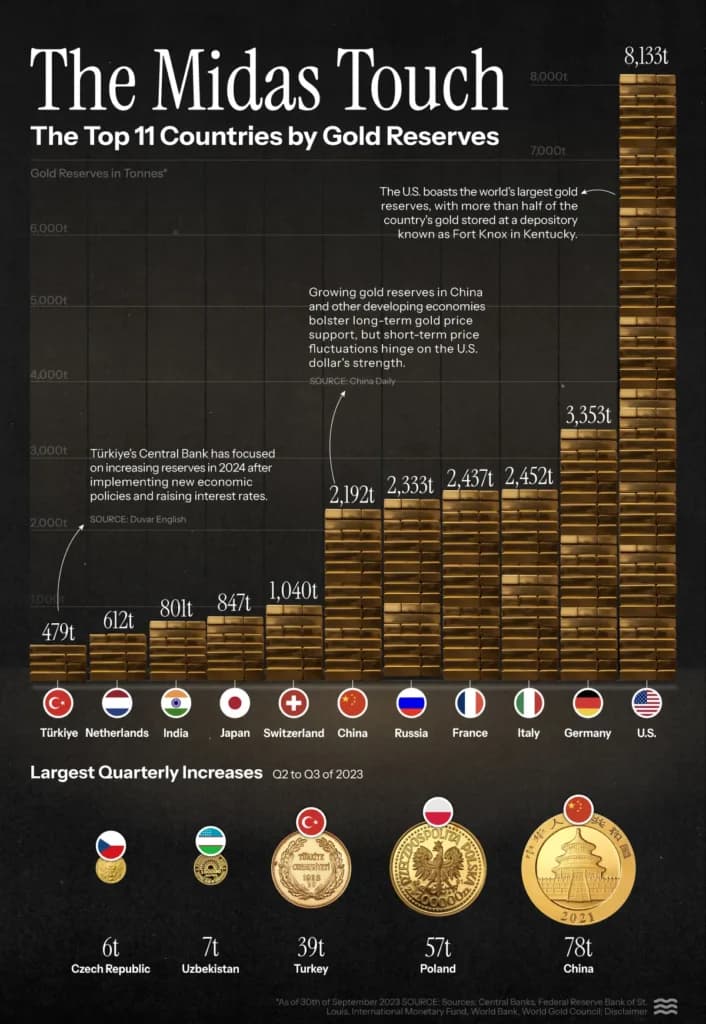
Gold reserves by country – top 11 nations as of 2023. The United States holds the largest gold reserves globally at 8,133 tonnes, followed by Germany (3,353t), Italy (2,452t), and France (2,437t). China and Russia also rank in the top 6. The chart also shows recent quarterly increases, with China, Poland, and Turkey significantly expanding their gold holdings. This visual illustrates how central banks use gold reserves to support economic security and monetary policy.
How Is Gold Used In Medicine?
Gold might not be the first thing that comes to mind for medicine, but it has some remarkable medical and dental uses thanks to its biocompatibility and stability. Gold is used in medicine both in its elemental metal form (for devices and dental work) and in chemical forms (for certain treatments). Being non-toxic and non-reactive, gold can safely exist in the human body without corroding or causing adverse reactions – a property few metals have.
Dentistry: One of the oldest medical uses of gold is in dentistry. Gold alloys are commonly used for dental crowns, bridges, fillings, and orthodontic appliances. If you’ve heard of someone having a “gold tooth” or gold filling, it’s usually a high-karat gold alloy. Why gold in teeth? Gold withstands corrosion from saliva and food acids indefinitely, unlike some other metals, and it’s soft enough to file and fit precisely to a tooth. A gold crown on a molar, for instance, offers an excellent fit and can last 20 years or more without cracking. Dentists often say gold crowns have the best longevity and cause the least wear on opposing teeth (gold’s slight malleability means it won’t wear down the tooth it bites against as aggressively as porcelain might). Some cultures even consider a gold tooth a status symbol or fashion statement, but clinically it’s about durability and biocompatibility. The only downside is the colour – in front teeth, most patients prefer porcelain for aesthetics, but in back teeth gold is still a “gold standard” for performance.
Medicine and treatments: Gold compounds have been used to treat certain medical conditions. This field, using gold-based drugs, is known as chrysotherapy. For decades, doctors prescribed injections of mild gold salts (like sodium aurothiomalate) to treat rheumatoid arthritis. Gold injections can reduce inflammation and joint damage in some arthritis patients (though newer treatments have largely overtaken this, some patients still receive gold therapy for arthritis that doesn’t respond to other drugs).
Gold is also used in radiation therapy for certain cancers. Tiny radioactive gold isotopes (such as Gold-198) can be implanted in or near a tumour to emit radiation in a very localised way. For example, in prostate cancer or some liver cancers, doctors have placed grains of radioactive gold to destroy malignant cells with minimal surgery. Since gold is a metal, these seeds can be precisely placed and will stay put, delivering therapeutic radiation as they decay.
A fascinating niche use is gold implants for a condition called lagophthalmos, where a person can’t fully close their eyelids (often due to facial paralysis). Surgeons implant a small gold weight in the upper eyelid, and gravity helps the eyelid shut properly. The gold weight is inert and doesn’t react, and it’s dense enough to do the job discreetly – an elegant solution enabled by gold’s physical properties.
Medical devices: Gold’s biocompatibility and conductivity also find uses in devices like pacemakers and stents. Some pacemakers have gold-plated contacts or components to ensure reliable electrical signals and to avoid corrosion inside the body. Gold is used in certain high-end surgical instruments and electronics for life-support machines for the same reason: you don’t want a critical instrument failing due to rust or poor conductivity, so gold ensures reliability.
Diagnostics: Perhaps the most widespread medical use of gold (in terms of number of people affected) is in diagnostics – specifically, rapid tests like some pregnancy tests and COVID-19 lateral flow tests. These often use colloidal gold nanoparticles as a visible marker. If you’ve seen a red or pink line appear on a quick test strip, there’s a good chance gold nanoparticles are what’s making that line red. The tiny gold particles are attached to antibodies and, when the test is positive, they accumulate and form a coloured line. Gold’s nanoparticles are red (at a certain size) and very stable, making them perfect for this job. In fact, gold was used in millions of COVID-19 antigen test kits as the indicator – a truly modern medical deployment of the metal.
Skincare and health fads: Beyond established medicine, gold has found its way into luxury skincare and alternative health treatments. Spas offer 24k gold facials, and some high-end creams include gold flakes or colloidal gold, claiming benefits like reduced inflammation or youthful glow. While the scientific evidence for skincare benefits is limited, gold in these products is generally safe and simply adds a marketing allure (and a literal sparkle). Gold does have mild antibacterial and anti-inflammatory properties, but whether a gold-infused serum can penetrate skin to any meaningful effect is debatable. Nonetheless, the idea of gold as a skin rejuvenator persists since ancient times (Cleopatra was rumoured to sleep in a gold face mask). At the very least, gold in skincare can make the skin appear more radiant by the subtle glitter it imparts – a cosmetic benefit if not a physiological one.
In conclusion, gold’s uses in medicine are a blend of the practical and the innovative. It repairs our teeth, helps diagnose disease, and has treated severe arthritis. It’s valued not for any mystic “healing energy” (despite what some alternative beliefs suggest), but because it’s chemically inert, safe in the body, and reliable. From a gold filling in a tooth to a tiny gold nanoparticle revealing a test result, these medical and dental applications illustrate gold’s versatility beyond wealth and ornamentation.
How Is Gold Used In Aerospace?
When it comes to the extreme environment of space, gold is literally rocket science. Gold is used in aerospace applications ranging from satellites and spacecraft components to the visors on astronaut helmets. The reason is simple: space is unforgiving, and you need materials that are extraordinarily reliable and resilient. Gold fits the bill in several ways.
Electronics in space: Just like in consumer electronics – but even more critically – spacecraft electronics use gold for connections and circuitry. A satellite or a Mars rover cannot have a corroded circuit after a year in space; repair is impossible out there. Thus, NASA uses gold in hundreds of ways in every space vehicle it launches. Gold-plated connectors, gold wires, and gold bonding help ensure that onboard computers, communication systems, and scientific instruments all function flawlessly for years. For instance, the James Webb Space Telescope (JWST) famously has 18 large mirror segments coated with an ultra-thin layer of gold. This isn’t for looks – the gold coating optimises reflection of infrared light, which JWST is designed to observe. Gold’s reflectivity across infrared and visible wavelengths is exceptional, improving the telescope’s ability to collect faint heat signals from distant galaxies.

The James Webb Space Telescope (JWST) uses gold-coated mirror segments to optimise infrared light reflection. Gold was chosen for its superior reflectivity and durability in the vacuum of space, helping the telescope capture distant heat signatures from ancient galaxies. This is a prime example of how gold is used in aerospace to ensure performance in extreme environments.
Thermal protection: Gold is an excellent reflector of infrared radiation (heat). In the vacuum of space, managing temperature is vital – one side of a spacecraft might bake in sunlight while the other freezes. To regulate this, engineers often use gold-coated foils or films on spacecraft surfaces. If you’ve seen photos of lunar landers or satellites, the gold or shiny foil wrapping isn’t just fancy gift-wrap; it’s multi-layer insulation, and often the outer layer has gold. The gold-coated polyester film helps reflect intense solar heat and stabilise the spacecraft’s temperature. Similarly, the sun visors on astronauts’ helmets are coated with a thin layer of gold. This golden visor reflects harmful solar rays and reduces glare, protecting astronauts’ eyes and skin while they work in space. It’s essentially a space-worthy sunglasses visor, using gold as the protective filter.
Lubrication: One of the most intriguing uses of gold in space is as a lubricant. In the vacuum of space, conventional lubricants (like oils or greases) can boil off or degrade quickly due to extreme temperatures and radiation. Imagine if a mechanical gear or hinge in a satellite seizes up because the lubricant evaporated – mission failure. Gold comes to the rescue because if you sandwich two moving metal surfaces with a thin layer of gold, the gold’s atoms can slide over each other, reducing friction. Gold has a very low shear strength, meaning it shears (slips) easily, acting like a lubricant between moving parts. It doesn’t volatilise in vacuum or get destroyed by radiation like organic lubricants would. For example, some space probe deployable arms or joint mechanisms use gold coatings to ensure they don’t stick. Think of gold as a dry lubricant coating for critical parts – it’s a brilliant solution where regular oil can’t be used.
Coatings and optics: Gold’s use in aerospace extends to coating glass and other materials. Besides JWST’s mirrors, gold-coated lenses or detectors are used in certain sensors. Gold is also applied to some airplane windows (the thin heat-reflective coatings in cockpit windows to reduce radar signature or heat) and high-end aircraft engines components for protective reasons.
All told, gold is not used in huge bulk for aerospace (a spacecraft might use a few kilograms of gold at most, often much less), but every milligram is put to work in a high-leverage application where failure is not an option. These uses illustrate a pattern: whenever reliability and performance trump cost, gold becomes viable. In a $200 million satellite, using $50,000 worth of gold in critical places is a no-brainer if it prevents a mission-critical failure.
In summary, gold is used in aerospace as the silent guardian of spacecraft: conducting electricity flawlessly, reflecting perilous radiation, and even greasing the wheels (figuratively and literally) of space machinery. Next time you see the gleam of a golden foil on a spacecraft image or an astronaut’s visor, you’ll know it’s not for glamour – it’s gold performing life-saving duties in the harshness of space.
Frequently Asked Questions
What is gold used for?
Gold is used for jewellery, investment, central bank reserves, and various industrial purposes. The majority of gold goes into jewellery and decorative objects. A significant portion is held as physical bullion (bars and coins) or vault reserves by investors and governments as a store of value. A smaller but important share is used in electronics (circuits, connectors), dentistry (crowns, fillings), medicine (treatments, diagnostics), and even specialised areas like aerospace (satellites, astronaut visors).
Why is gold so valuable?
Gold’s value comes from its scarcity and unique properties. It’s rare in the Earth’s crust and costly to mine, which limits supply. It’s also durable (doesn’t rust or tarnish) and easily malleable into coins or jewellery. Culturally, gold has been a symbol of wealth for millennia, used as money and treasure, so people trust it to hold value. In modern times, it’s valuable as a hedge against inflation and uncertainty – investors consider it a safe asset when other investments falter.
How is gold formed?
Almost all gold on Earth was formed in cosmic explosions. Scientists believe heavy elements like gold were forged when neutron stars collided or during supernova explosions billions of years ago. These violent events created gold atoms, which eventually became part of the dust and gas that formed our solar system. Within Earth, geological processes (volcanism, hydrothermal activity) concentrated gold into deposits that miners extract. In short, gold is star-stuff, scattered in Earth’s crust by cosmic events and then gathered by geological forces.
What karat gold is best for everyday use?
14K or 18K gold is best for everyday jewellery. 14K gold balances durability and gold content, resisting scratches and wear. 18K gold is more luxurious, with higher purity and deeper colour, though slightly softer. Pure 24K gold is too soft for daily wear. Lower karats like 9K are more durable but contain less gold. Choosing the right karat depends on your lifestyle, aesthetic preference, and how often the piece will be worn.
Is there any benefit of wearing gold?
Yes, gold is hypoallergenic, non-tarnishing, and ideal for sensitive skin. It’s also symbolic of wealth, love, and cultural heritage. Gold jewellery offers both emotional and practical value—it’s beautiful, long-lasting, and can be sold in emergencies. While some claim health benefits, most benefits are aesthetic or cultural. Gold’s main uses in jewellery and adornment continue due to its comfort, style, and significance. Wearing gold blends tradition, beauty, and a subtle form of portable wealth.
How is gold used for investment?
Gold is used for investment through bullion bars, coins, ETFs, and gold-backed financial products. It protects wealth by hedging against inflation, currency risk, and market downturns. Though it doesn’t yield interest, gold retains long-term value and diversifies portfolios. Investors value gold for its stability and liquidity. Central banks also hold gold for national reserves. These investment uses demonstrate why gold remains one of the top 5 uses and a trusted store of value.
How is gold used in technology?
Gold is used in technology for its excellent conductivity and resistance to corrosion. It’s found in smartphones, computers, and high-end electronics—coating connectors, circuit boards, and contacts. Gold ensures reliable performance in critical systems like aerospace, servers, and medical devices. Its use in nanotechnology and sensors is growing. Though used in tiny amounts, gold is essential in electronics and one of gold's main uses, enabling the technology we rely on daily.
How is gold used in aerospace?
Gold is used in aerospace for thermal insulation, electronics, and protection against radiation. It coats satellite components, spacecraft insulation, and astronaut visors. Gold-plated connectors ensure reliable function in critical systems. It also acts as a dry lubricant in space where oils can’t be used. Gold’s stability in extreme environments makes it vital for missions where failure is not an option. These uses highlight why aerospace is one of gold's most advanced sectors.
How is gold used in medicine?
Gold is used in medicine and dentistry due to its safety in the body. It appears in dental crowns, fillings, and orthodontics for durability and biocompatibility. Gold compounds treat rheumatoid arthritis, and radioactive gold isotopes are used in cancer therapies. It’s also used in diagnostics, like pregnancy and COVID tests, using gold nanoparticles. These applications show gold’s versatility and importance beyond jewellery—making medicine one of gold's main uses.
Why is gold used in skincare?
Gold is used in skincare for its anti-inflammatory and antioxidant claims. It’s found in luxury creams, masks, and facials, adding a glow and soothing properties. Though clinical benefits are debated, gold nanoparticles may enhance product delivery. Its hypoallergenic nature makes it safe for skin. These cosmetic uses are small compared to jewellery and technology but still form part of what gold is used for in the modern beauty industry.
How is gold used in jewellery?
Gold is used in jewellery because it’s beautiful, durable, and doesn’t tarnish. It’s crafted into rings, necklaces, and heirlooms using alloys like 14K and 18K for strength. Gold suits daily wear and carries deep symbolic meaning in weddings, celebrations, and culture. It’s hypoallergenic and long-lasting, making it perfect for sentimental items. Jewellery is one of the top 5 uses of gold and remains its most visible and emotionally significant role.
Where is gold used in everyday life?
Gold is used daily in jewellery, electronics, banking, and decor. It’s in smartphones, TVs, and computers for reliable electrical connections. In homes, gold decorates frames or is kept in jewellery boxes and safes. Banks and governments store gold as financial reserves. It’s also found in luxury foods and skincare. These varied uses reflect gold’s enduring role in both essential systems and cultural traditions—key reasons why gold is so useful today.
Where is gold kept?
Gold is kept in central bank vaults, home safes, jewellery boxes, and secure facilities. Countries like the USA and UK store gold as national reserves. Investors use professional vault services or personal storage for bullion. Jewellery is often kept at home or in bank safety deposit boxes. The location depends on whether the gold is for investment, decoration, or strategic reserve. These storage methods reflect gold’s dual value: aesthetic and financial.
Where is gold used in computers?
Gold is used in computers for reliable electrical connections. It appears in CPUs, memory modules, and circuit boards—especially in gold-plated connectors and contact pins. Gold ensures signal stability in vital components and resists corrosion over time. Even small devices contain traces of gold. These high-performance roles in computing make technology one of gold’s main uses and show how this precious metal powers the digital world behind the scenes.
Why is gold used for jewellery?
Gold is used for jewellery due to its lustre, workability, and non-tarnishing surface. It’s easy to shape into beautiful designs and doesn’t irritate the skin. It’s also symbolic—representing love, wealth, and status across cultures. Gold jewellery holds both emotional and resale value. These attributes make jewellery one of the top 5 uses of gold, blending practicality with elegance and meaning.
Why is gold so useful?
Gold is useful due to its conductivity, corrosion resistance, and chemical stability. It’s malleable, hypoallergenic, and durable, making it ideal for jewellery, investment, technology, and medicine. Its rarity and universal acceptance make it a reliable store of value. These qualities explain gold's main uses across many industries and why it’s been treasured for centuries. Whether in electronics or heirlooms, gold’s usefulness is unmatched.
Which is more useful gold or silver?
Silver is more conductive and used widely in solar panels, electronics, and healthcare. Gold is more corrosion-resistant, stable, and preferred in luxury items, investments, and critical technology. While silver sees broader industrial use, gold is more versatile in high-reliability and financial applications. Gold’s dual role as both a practical material and store of value makes it more universally useful in the long term.
Top 5 uses of gold
The top 5 uses of gold are: jewellery, investment, central bank reserves, electronics, and medicine/dentistry. Jewellery dominates global demand. Investment includes bars, coins, and ETFs. Reserves are held by governments for stability. Electronics use gold for corrosion-free conductivity. Medicine and dentistry rely on gold’s safety and durability. These are gold’s main uses, highlighting its economic, cultural, and industrial importance worldwide.
Interested in selling gold with the UK’s highest paying gold buyer? Visit our Sell Gold page to get a competitive valuation – we provide fully insured postage and fast payment.
For more insights and the latest gold price today, keep an eye on our live charts and blog updates.





